Cheese in different languages is a useful phrase to learn if you’re traveling, exploring international cuisines, studying foreign languages, or shopping in another country.
Since cheese is one of the world’s most popular dairy products, knowing its translation can make ordering food and communicating much easier.
In this complete guide, you’ll discover 70 different languages with accurate translations, easy English pronunciations, real-life example sentences, and English meanings.
If you’re searching for cheese in all languages, how to say cheese in different languages, or cheese translations around the world, this article has everything you need.
Learning everyday food vocabulary is one of the easiest ways to improve your language skills while discovering new cultures.
Cheese in Different Languages (70 Languages)
| # | Language | Native Phrase | Easy Pronunciation | Example Sentence | English Meaning |
|---|---|---|---|---|---|
| 1 | English | Cheese | Cheez | I like cheese on pizza. | I like cheese on pizza. |
| 2 | Spanish | Queso | KAY-so | Me gusta el queso. | I like cheese. |
| 3 | French | Fromage | Froh-MAHZH | J’aime le fromage. | I like cheese. |
| 4 | German | Käse | KAY-zuh | Ich esse gern Käse. | I like eating cheese. |
| 5 | Italian | Formaggio | For-MAJ-jo | Mi piace il formaggio. | I like cheese. |
| 6 | Portuguese | Queijo | KAY-zhoo | Eu gosto de queijo. | I like cheese. |
| 7 | Dutch | Kaas | Kahs | Ik hou van kaas. | I like cheese. |
| 8 | Russian | Сыр | Seer | Я люблю сыр. | I like cheese. |
| 9 | Ukrainian | Сир | Seer | Я люблю сир. | I like cheese. |
| 10 | Polish | Ser | Ser | Lubię ser. | I like cheese. |
| 11 | Czech | Sýr | Seer | Mám rád sýr. | I like cheese. |
| 12 | Slovak | Syr | Seer | Mám rád syr. | I like cheese. |
| 13 | Hungarian | Sajt | Shite | Szeretem a sajtot. | I like cheese. |
| 14 | Romanian | Brânză | BRUN-zuh | Îmi place brânza. | I like cheese. |
| 15 | Bulgarian | Сирене | See-REH-neh | Обичам сирене. | I like cheese. |
| 16 | Serbian | Сир | Seer | Волим сир. | I like cheese. |
| 17 | Croatian | Sir | Seer | Volim sir. | I like cheese. |
| 18 | Bosnian | Sir | Seer | Volim sir. | I like cheese. |
| 19 | Slovenian | Sir | Seer | Rad imam sir. | I like cheese. |
| 20 | Greek | Τυρί | Ti-REE | Μου αρέσει το τυρί. | I like cheese. |
| 21 | Turkish | Peynir | Pay-NEER | Peyniri seviyorum. | I like cheese. |
| 22 | Albanian | Djathë | JAH-thuh | Më pëlqen djathi. | I like cheese. |
| 23 | Lithuanian | Sūris | SOO-ris | Mėgstu sūrį. | I like cheese. |
| 24 | Latvian | Siers | See-ers | Man garšo siers. | I like cheese. |
| 25 | Estonian | Juust | Yoost | Mulle meeldib juust. | I like cheese. |
| 26 | Finnish | Juusto | YOOS-to | Pidän juustosta. | I like cheese. |
| 27 | Swedish | Ost | Oost | Jag gillar ost. | I like cheese. |
| 28 | Norwegian | Ost | Oost | Jeg liker ost. | I like cheese. |
| 29 | Danish | Ost | Oost | Jeg kan lide ost. | I like cheese. |
| 30 | Icelandic | Ostur | OS-tur | Mér finnst ostur góður. | I like cheese. |
| 31 | Irish | Cáis | Kawsh | Is maith liom cáis. | I like cheese. |
| 32 | Welsh | Caws | Kows | Rwy’n hoffi caws. | I like cheese. |
| 33 | Scottish Gaelic | Càise | KAA-shuh | Is toil leam càise. | I like cheese. |
| 34 | Maltese | Ġobon | JO-bon | Inħobb il-ġobon. | I like cheese. |
| 35 | Arabic | جبن | Ju-bin | أحب الجبن. | I like cheese. |
| 36 | Hebrew | גבינה | Gev-ee-NAH | אני אוהב גבינה. | I like cheese. |
| 37 | Persian | پنیر | Pa-neer | من پنیر دوست دارم. | I like cheese. |
| 38 | Urdu | پنیر | Pa-neer | مجھے پنیر پسند ہے۔ | I like cheese. |
| 39 | Hindi | पनीर | Pa-neer | मुझे पनीर पसंद है। | I like paneer/cheese. |
| 40 | Punjabi | ਪਨੀਰ | Pa-neer | ਮੈਨੂੰ ਪਨੀਰ ਪਸੰਦ ਹੈ। | I like paneer/cheese. |
| 41 | Bengali | পনির | Po-neer | আমি পনির পছন্দ করি। | I like cheese. |
| 42 | Gujarati | પનીર | Pa-neer | મને પનીર ગમે છે. | I like paneer/cheese. |
| 43 | Marathi | पनीर | Pa-neer | मला पनीर आवडते. | I like paneer/cheese. |
| 44 | Nepali | पनीर | Pa-neer | मलाई पनीर मन पर्छ। | I like cheese. |
| 45 | Sinhala | චීස් | Chees | මම චීස් කැමතියි. | I like cheese. |
| 46 | Tamil | சீஸ் | Chees | எனக்கு சீஸ் பிடிக்கும். | I like cheese. |
| 47 | Telugu | చీజ్ | Cheez | నాకు చీజ్ ఇష్టం. | I like cheese. |
| 48 | Kannada | ಚೀಸ್ | Cheez | ನನಗೆ ಚೀಸ್ ಇಷ್ಟ. | I like cheese. |
| 49 | Malayalam | ചീസ് | Chees | എനിക്ക് ചീസ് ഇഷ്ടമാണ്. | I like cheese. |
| 50 | Odia | ଚିଜ୍ | Cheez | ମୋତେ ଚିଜ୍ ଭଲ ଲାଗେ। | I like cheese. |
| 51 | Assamese | চীজ | Cheez | মই চীজ ভাল পাওঁ। | I like cheese. |
| 52 | Chinese (Simplified) | 奶酪 | Nai-Lao | 我喜欢奶酪。 | I like cheese. |
| 53 | Japanese | チーズ | Chee-zu | チーズが好きです。 | I like cheese. |
| 54 | Korean | 치즈 | Chi-jeu | 치즈를 좋아해요. | I like cheese. |
| 55 | Vietnamese | Phô mai | Fo Mai | Tôi thích phô mai. | I like cheese. |
| 56 | Thai | ชีส | Chees | ฉันชอบชีส | I like cheese. |
| 57 | Indonesian | Keju | Kay-joo | Saya suka keju. | I like cheese. |
| 58 | Malay | Keju | Kay-joo | Saya suka keju. | I like cheese. |
| 59 | Filipino | Keso | KEH-so | Mahilig ako sa keso. | I like cheese. |
| 60 | Khmer | ឈីស | Chees | ខ្ញុំចូលចិត្តឈីស។ | I like cheese. |
| 61 | Lao | ເນີຍແຂງ | Ner Khaeng | ຂ້ອຍມັກເນີຍແຂງ. | I like cheese. |
| 62 | Burmese | ချိစ် | Chees | ချိစ်ကြိုက်တယ်။ | I like cheese. |
| 63 | Mongolian | Бяслаг | Byas-lag | Би бяслагт дуртай. | I like cheese. |
| 64 | Swahili | Jibini | Ji-BEE-nee | Napenda jibini. | I like cheese. |
| 65 | Zulu | Ushizi | Oo-SHEE-zee | Ngithanda ushizi. | I like cheese. |
| 66 | Afrikaans | Kaas | Kahs | Ek hou van kaas. | I like cheese. |
| 67 | Yoruba | Warankasi | Wa-ran-KA-see | Mo fẹ́ warankasi. | I like cheese. |
| 68 | Hausa | Cuku | CHOO-koo | Ina son cuku. | I like cheese. |
| 69 | Amharic | አይብ | Ayib | አይብ እወዳለሁ። | I like cheese. |
| 70 | Somali | Jiis | Jees | Waxaan jeclahay jiis. | I like cheese. |
How to Say Cheese in Different Languages
The word cheese has different translations around the world, but it refers to the same delicious dairy product enjoyed in countless cuisines.
Learning these cheese translations is helpful when ordering food, shopping, reading recipes, or practicing a new language.
Why Learn Cheese Translations?
Learning cheese in different languages can help you:
- Order meals with confidence while traveling.
- Read international recipes.
- Understand restaurant menus.
- Expand your food-related vocabulary.
- Connect with people from different cultures.
Cheese Around the World
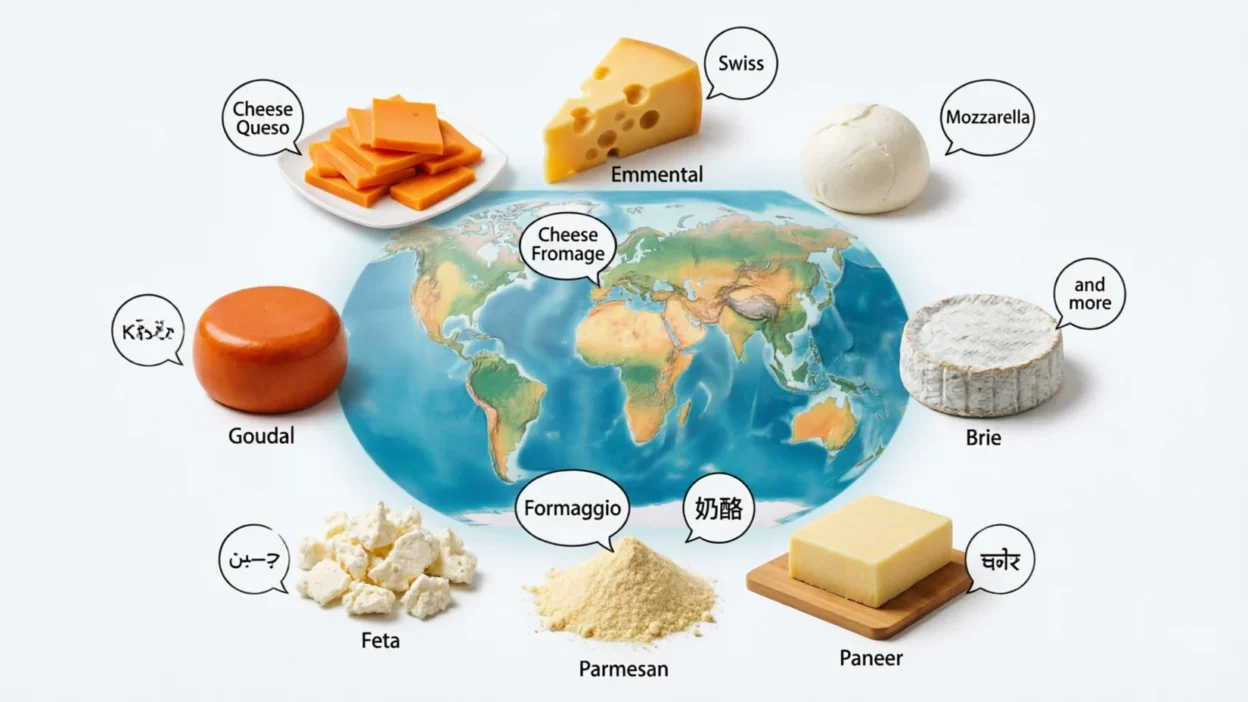
Cheese is an essential ingredient in many global cuisines. From French cheeses and Italian mozzarella to Dutch Gouda and Indian paneer, every culture has its own unique varieties and traditions. Knowing the local word for cheese makes exploring these foods even more enjoyable.
Tips for Remembering Cheese in Different Languages
- Practice a few new translations each day.
- Say each pronunciation aloud.
- Use the words in simple sentences.
- Watch cooking videos in different languages.
- Review with flashcards regularly.
Common Situations Where You’ll Use the Word “Cheese”
- Ordering pizza or burgers.
- Shopping in supermarkets.
- Reading recipes.
- Dining at international restaurants.
- Learning everyday food vocabulary.
Conclusion
Learning cheese in different languages is an easy way to expand your vocabulary while exploring cultures from around the world.
If you’re traveling, studying languages, or enjoying international cuisine, these cheese translations will help you communicate more confidently and understand food-related conversations.
FAQs:
1. How do you say cheese in different languages?
Cheese is called queso in Spanish, fromage in French, Käse in German, 奶酪 in Chinese, and チーズ in Japanese.
2. Why should I learn cheese translations?
Learning cheese translations helps when traveling, ordering food, shopping, reading recipes, and improving your language skills.
3. Is paneer the same as cheese?
Paneer is a fresh cheese commonly used in South Asian cuisine. While it is a type of cheese, not all cheeses are paneer.
4. Can I use these cheese translations while traveling?
Yes. These translations are useful in restaurants, grocery stores, food markets, and conversations with native speakers.
5. Where can I learn more food words in different languages?
You can continue learning words like bread, milk, butter, chicken, rice, vegetables, fruits, and drinks in different languages.

Anthony Dylan is a language enthusiast and content writer at LingoMean, where he helps readers understand what to say in different situations. He creates clear, practical, and engaging guides that improve communication, confidence, and everyday conversations.