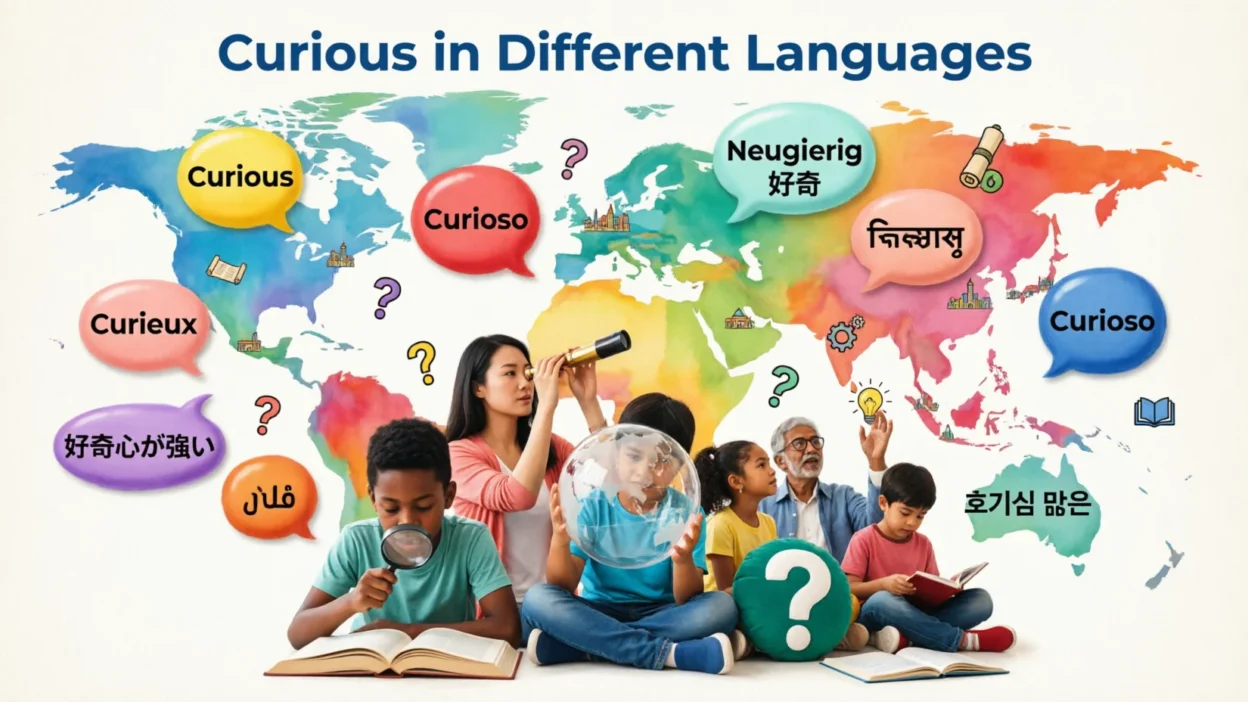
Curious in different languages is a useful phrase to learn if you’re studying foreign languages, traveling, or expanding your vocabulary.
The word “curious” is commonly used to describe someone who is eager to learn, interested in discovering new things, or asking questions about the world around them.
In this comprehensive guide, you’ll discover 70 different languages with accurate translations, easy English pronunciations, real-life example sentences, and English meanings.
Whether you’re searching for curious in all languages, how to say curious in different languages, or curious translations around the world, this guide has everything you need.
Learning descriptive words like curious helps improve your communication skills and makes conversations more natural in many languages.
Curious in Different Languages (70 Languages)
| # | Language | Native Phrase | Easy Pronunciation | Example Sentence | English Meaning |
|---|---|---|---|---|---|
| 1 | English | Curious | KYUR-ee-us | She is curious about science. | She is curious about science. |
| 2 | Spanish | Curioso / Curiosa | Koo-ree-O-so | Ella es muy curiosa. | She is very curious. |
| 3 | French | Curieux / Curieuse | Kyur-YUH | Elle est très curieuse. | She is very curious. |
| 4 | German | Neugierig | NOY-gier-ig | Sie ist sehr neugierig. | She is very curious. |
| 5 | Italian | Curioso / Curiosa | Koo-ree-O-so | Lei è molto curiosa. | She is very curious. |
| 6 | Portuguese | Curioso / Curiosa | Koo-ree-O-zoo | Ela é muito curiosa. | She is very curious. |
| 7 | Dutch | Nieuwsgierig | NEEWS-kheer-ig | Zij is erg nieuwsgierig. | She is very curious. |
| 8 | Russian | Любопытный | Lyu-bo-PIT-nee | Она очень любопытная. | She is very curious. |
| 9 | Ukrainian | Допитливий | Do-pyt-LY-vyi | Вона дуже допитлива. | She is very curious. |
| 10 | Polish | Ciekawy | Che-KA-vih | Ona jest bardzo ciekawa. | She is very curious. |
| 11 | Czech | Zvědavý | ZVYE-da-vee | Je velmi zvědavá. | She is very curious. |
| 12 | Slovak | Zvedavý | ZVE-da-vee | Je veľmi zvedavá. | She is very curious. |
| 13 | Hungarian | Kíváncsi | KEE-vaan-chee | Nagyon kíváncsi. | She is very curious. |
| 14 | Romanian | Curios | Koo-ree-OS | Ea este foarte curioasă. | She is very curious. |
| 15 | Bulgarian | Любопитен | Lyu-bo-PI-ten | Тя е много любопитна. | She is very curious. |
| 16 | Serbian | Радознао | Ra-do-ZNA-o | Она је веома радознала. | She is very curious. |
| 17 | Croatian | Znatiželjan | Zna-ti-ZHEL-yan | Ona je vrlo znatiželjna. | She is very curious. |
| 18 | Bosnian | Radoznao | Ra-do-ZNA-o | Ona je veoma radoznala. | She is very curious. |
| 19 | Slovenian | Radoveden | Ra-do-VE-den | Je zelo radovedna. | She is very curious. |
| 20 | Greek | Περίεργος | Pe-REE-er-gos | Είναι πολύ περίεργη. | She is very curious. |
| 21 | Turkish | Meraklı | Me-rak-LUH | O çok meraklı. | She is very curious. |
| 22 | Albanian | Kureshtar | Koo-resh-TAR | Ajo është shumë kureshtare. | She is very curious. |
| 23 | Lithuanian | Smalsus | SMAL-soos | Ji labai smalsi. | She is very curious. |
| 24 | Latvian | Ziņkārīgs | ZIN-ka-reegs | Viņa ir ļoti ziņkārīga. | She is very curious. |
| 25 | Estonian | Uudishimulik | OO-di-shi-mu-lik | Ta on väga uudishimulik. | She is very curious. |
| 26 | Finnish | Utelias | OO-te-lee-as | Hän on hyvin utelias. | She is very curious. |
| 27 | Swedish | Nyfiken | NEE-fee-ken | Hon är mycket nyfiken. | She is very curious. |
| 28 | Norwegian | Nysgjerrig | NIS-yer-rig | Hun er veldig nysgjerrig. | She is very curious. |
| 29 | Danish | Nysgerrig | NIS-ge-rig | Hun er meget nysgerrig. | She is very curious. |
| 30 | Icelandic | Forvitinn | FOR-vi-tin | Hún er mjög forvitin. | She is very curious. |
| 31 | Irish | Fiosrach | FEE-os-rakh | Tá sí an-fhiosrach. | She is very curious. |
| 32 | Welsh | Chwilfrydig | Khoo-il-VRUH-dig | Mae hi’n chwilfrydig iawn. | She is very curious. |
| 33 | Scottish Gaelic | Fiosrach | FEE-os-rakh | Tha i glè fhiosrach. | She is very curious. |
| 34 | Maltese | Kurjuż | Kur-YOOZ | Hi kurjuża ħafna. | She is very curious. |
| 35 | Arabic | فضولي | Fu-DOO-lee | هي فضولية جدًا. | She is very curious. |
| 36 | Hebrew | סקרן | Sak-RAN | היא מאוד סקרנית. | She is very curious. |
| 37 | Persian | کنجکاو | Kon-je-KAV | او بسیار کنجکاو است. | She is very curious. |
| 38 | Urdu | متجسس | Mu-ta-JAS-sis | وہ بہت متجسس ہے۔ | She is very curious. |
| 39 | Hindi | जिज्ञासु | Jig-YAA-su | वह बहुत जिज्ञासु है। | She is very curious. |
| 40 | Punjabi | ਜਿਗਿਆਸੂ | Jig-YAA-su | ਉਹ ਬਹੁਤ ਜਿਗਿਆਸੂ ਹੈ। | She is very curious. |
| 41 | Bengali | কৌতূহলী | Kou-tu-HO-lee | সে খুব কৌতূহলী। | She is very curious. |
| 42 | Gujarati | જિજ્ઞાસુ | Jig-NYA-su | તે ખૂબ જિજ્ઞાસુ છે. | She is very curious. |
| 43 | Marathi | जिज्ञासू | Jig-YAA-su | ती खूप जिज्ञासू आहे. | She is very curious. |
| 44 | Nepali | जिज्ञासु | Jig-YAA-su | उनी धेरै जिज्ञासु छिन्। | She is very curious. |
| 45 | Sinhala | කුතුහලය ඇති | Ku-tu-ha-la Ya-ti | ඇය ඉතා කුතුහලය ඇති. | She is very curious. |
| 46 | Tamil | ஆர்வமுள்ள | AAR-va-mul-la | அவர் மிகவும் ஆர்வமுள்ளவர். | She is very curious. |
| 47 | Telugu | ఆసక్తిగల | Aa-sak-ti-ga-la | ఆమె చాలా ఆసక్తిగలది. | She is very curious. |
| 48 | Kannada | ಕುತೂಹಲಕಾರಿ | Ku-too-ha-la-ka-ri | ಅವಳು ತುಂಬಾ ಕುತೂಹಲಕಾರಿ. | She is very curious. |
| 49 | Malayalam | ജിജ്ഞാസയുള്ള | Ji-jnaa-sa-yul-la | അവൾ വളരെ ജിജ്ഞാസയുള്ളവളാണ്. | She is very curious. |
| 50 | Odia | ଜିଜ୍ଞାସୁ | Ji-jnya-su | ସେ ବହୁତ ଜିଜ୍ଞାସୁ। | She is very curious. |
| 51 | Assamese | জিজ্ঞাসু | Jig-NYA-su | তাই খুব জিজ্ঞাসু। | She is very curious. |
| 52 | Chinese (Simplified) | 好奇 | Hao-Chee | 她很好奇。 | She is very curious. |
| 53 | Japanese | 好奇心が強い | Ko-ki-shin Ga Tsu-yoi | 彼女はとても好奇心が強いです。 | She is very curious. |
| 54 | Korean | 호기심 많은 | Ho-gi-sim Ma-neun | 그녀는 매우 호기심이 많아요. | She is very curious. |
| 55 | Vietnamese | Tò mò | Tor Mor | Cô ấy rất tò mò. | She is very curious. |
| 56 | Thai | อยากรู้อยากเห็น | Yak Roo Yak Hen | เธออยากรู้อยากเห็นมาก | She is very curious. |
| 57 | Indonesian | Penasaran | Pe-na-SA-ran | Dia sangat penasaran. | She is very curious. |
| 58 | Malay | Ingin tahu | Ing-in Ta-hu | Dia sangat ingin tahu. | She is very curious. |
| 59 | Filipino | Mausisa | Ma-u-SEE-sa | Napakamausisa niya. | She is very curious. |
| 60 | Khmer | ចង់ដឹងចង់ឃើញ | Chong Deng Chong Khernh | នាងចង់ដឹងចង់ឃើញណាស់។ | She is very curious. |
| 61 | Lao | ຢາກຮູ້ | Yak Hoo | ນາງຢາກຮູ້ຫຼາຍ. | She is very curious. |
| 62 | Burmese | စူးစမ်းလိုသော | Soo-Sam Lo-thaw | သူမ အရမ်းစူးစမ်းလိုတယ်။ | She is very curious. |
| 63 | Mongolian | Сониуч | So-nee-uch | Тэр маш сониуч. | She is very curious. |
| 64 | Swahili | Mdadisi | Mda-DA-see | Yeye ni mdadisi sana. | She is very curious. |
| 65 | Zulu | Onelukuluku | O-ne-loo-ku-LOO-ku | Unelukuluku kakhulu. | She is very curious. |
| 66 | Afrikaans | Nuuskierig | NEWS-keer-ig | Sy is baie nuuskierig. | She is very curious. |
| 67 | Yoruba | Onífẹ̀ẹ́ mọ̀ | O-ni-feh Mo | Ó nífẹ̀ẹ́ mọ̀ gan. | She is very curious. |
| 68 | Hausa | Mai son sani | Mai Son Sa-ni | Ita tana da son sani. | She is very curious. |
| 69 | Amharic | ጉጉት ያለው | Gu-goot Ya-lew | እሷ በጣም ጉጉት አላት። | She is very curious. |
| 70 | Somali | Xiise badan | Hee-se Ba-dan | Aad bay u xiise badan tahay. | She is very curious. |
How to Say Curious in Different Languages
The word curious describes someone who enjoys learning, asking questions, and exploring new ideas. Learning curious in different languages can improve your communication skills and help you describe personalities accurately in conversations around the world.
Why Learn Curious Translations?
Learning curious translations offers several benefits:
- Build your descriptive vocabulary.
- Express personality traits accurately.
- Improve your foreign language skills.
- Communicate confidently while traveling.
- Better understand books, movies, and conversations.
Curious Around the World
Curiosity is a valued quality in every culture. It encourages learning, creativity, problem-solving, and innovation. Although the word changes from language to language, the meaning remains largely the same around the world.
Tips for Remembering Curious in Different Languages
- Practice a few translations every day.
- Repeat each pronunciation aloud.
- Use the word in simple conversations.
- Watch videos in your target language.
- Create vocabulary flashcards for review.
Common Uses of the Word “Curious”
- Describing someone’s personality.
- Talking about children who love to learn.
- Discussing education and science.
- Writing stories or essays.
- Giving compliments about a love of learning.
Conclusion
Learning curious in different languages is an excellent way to expand your vocabulary and communicate more naturally with people worldwide.
If you’re a student, traveler, teacher, or language enthusiast, these curious translations will help you express interest, learning, and discovery across cultures.
FAQs:
1. How do you say curious in different languages?
Curious is translated differently across languages, such as Curioso in Spanish, Curieux in French, Neugierig in German, 好奇 in Chinese, and 好奇心が強い in Japanese.
2. Why should I learn curious translations?
Learning curious translations helps improve your language skills and makes it easier to describe personality traits and interests.
3. Is the meaning of curious the same in every language?
Generally, yes. It usually refers to someone who is eager to learn, explore, or discover new information.
4. Can I use these translations while traveling?
Yes. These words are useful in everyday conversations, classrooms, workplaces, and cultural exchanges.
5. Where can I learn more personality words in different languages?
You can continue learning words like creative, kind, intelligent, brave, happy, friendly, and curious in different languages.

Carter Connor is a language enthusiast and content writer at LingoMean, helping readers discover what to say in everyday conversations with clear explanations, practical examples, and easy-to-understand communication tips.