
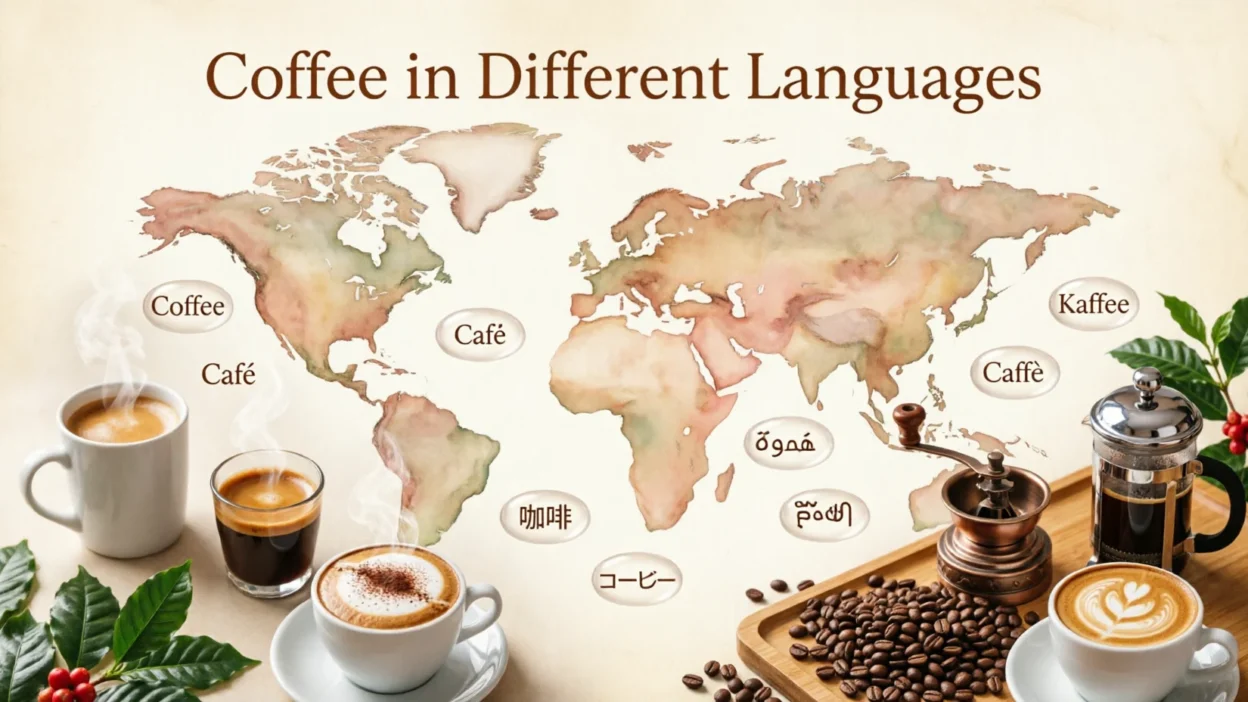
Coffee in different languages is one of the most useful phrases to learn if you love traveling, exploring new cultures, or simply enjoy ordering your favorite drink abroad.
Coffee is one of the world’s most popular beverages, making its translation valuable for everyday conversations, restaurants, cafés, and language learning.
In this complete guide, you’ll discover 70 different languages with accurate translations, easy English pronunciations, real-life example sentences, and English meanings.
If you’re searching for coffee in all languages, how to say coffee in different languages, or coffee translations around the world, you’ll find everything you need here.
Learning food and drink vocabulary like coffee is an excellent way to improve your language skills while connecting with people worldwide.
Coffee in Different Languages (70 Languages)
| # | Language | Native Phrase | Easy Pronunciation | Example Sentence | English Meaning |
|---|---|---|---|---|---|
| 1 | English | Coffee | KAW-fee | I drink coffee every morning. | I drink coffee every morning. |
| 2 | Spanish | Café | Ka-FEH | Me gusta el café. | I like coffee. |
| 3 | French | Café | Ka-FAY | J’aime le café. | I like coffee. |
| 4 | German | Kaffee | Ka-FAY | Ich trinke Kaffee. | I drink coffee. |
| 5 | Italian | Caffè | Kaf-FEH | Mi piace il caffè. | I like coffee. |
| 6 | Portuguese | Café | Ka-FEH | Eu gosto de café. | I like coffee. |
| 7 | Dutch | Koffie | KOF-fee | Ik drink koffie. | I drink coffee. |
| 8 | Russian | Кофе | KO-fe | Я люблю кофе. | I love coffee. |
| 9 | Ukrainian | Кава | KA-va | Я люблю каву. | I love coffee. |
| 10 | Polish | Kawa | KA-va | Lubię kawę. | I like coffee. |
| 11 | Czech | Káva | KAA-va | Mám rád kávu. | I like coffee. |
| 12 | Slovak | Káva | KAA-va | Mám rád kávu. | I like coffee. |
| 13 | Hungarian | Kávé | KAA-vay | Szeretem a kávét. | I like coffee. |
| 14 | Romanian | Cafea | Ka-FEH-ah | Îmi place cafeaua. | I like coffee. |
| 15 | Bulgarian | Кафе | Ka-FEH | Обичам кафе. | I love coffee. |
| 16 | Serbian | Кафа | KA-fa | Волим кафу. | I love coffee. |
| 17 | Croatian | Kava | KA-va | Volim kavu. | I love coffee. |
| 18 | Bosnian | Kafa | KA-fa | Volim kafu. | I love coffee. |
| 19 | Slovenian | Kava | KA-va | Rad imam kavo. | I like coffee. |
| 20 | Greek | Καφές | Ka-FES | Μου αρέσει ο καφές. | I like coffee. |
| 21 | Turkish | Kahve | KAH-veh | Kahveyi seviyorum. | I like coffee. |
| 22 | Albanian | Kafe | Ka-FEH | Më pëlqen kafeja. | I like coffee. |
| 23 | Lithuanian | Kava | KA-va | Mėgstu kavą. | I like coffee. |
| 24 | Latvian | Kafija | Ka-FEE-ya | Man garšo kafija. | I like coffee. |
| 25 | Estonian | Kohv | KOHV | Mulle meeldib kohv. | I like coffee. |
| 26 | Finnish | Kahvi | KAH-vee | Pidän kahvista. | I like coffee. |
| 27 | Swedish | Kaffe | KAF-feh | Jag gillar kaffe. | I like coffee. |
| 28 | Norwegian | Kaffe | KAF-feh | Jeg liker kaffe. | I like coffee. |
| 29 | Danish | Kaffe | KAF-feh | Jeg kan lide kaffe. | I like coffee. |
| 30 | Icelandic | Kaffi | KAF-fee | Ég elska kaffi. | I love coffee. |
| 31 | Irish | Caife | KAF-eh | Is maith liom caife. | I like coffee. |
| 32 | Welsh | Coffi | KOF-fee | Dw i’n hoffi coffi. | I like coffee. |
| 33 | Scottish Gaelic | Cofaidh | KOF-ee | Is toil leam cofaidh. | I like coffee. |
| 34 | Maltese | Kafè | Ka-FEH | Inħobb il-kafè. | I love coffee. |
| 35 | Arabic | قهوة | Kah-wa | أحب القهوة. | I love coffee. |
| 36 | Hebrew | קפה | Ka-FEH | אני אוהב קפה. | I love coffee. |
| 37 | Persian | قهوه | Ghah-VEH | من قهوه دوست دارم. | I love coffee. |
| 38 | Urdu | کافی | KAA-fee | مجھے کافی پسند ہے۔ | I like coffee. |
| 39 | Hindi | कॉफी | KAW-fee | मुझे कॉफी पसंद है। | I like coffee. |
| 40 | Punjabi | ਕੌਫੀ | KAW-fee | ਮੈਨੂੰ ਕੌਫੀ ਪਸੰਦ ਹੈ। | I like coffee. |
| 41 | Bengali | কফি | KO-fi | আমি কফি পছন্দ করি। | I like coffee. |
| 42 | Gujarati | કોફી | KOH-fee | મને કોફી ગમે છે. | I like coffee. |
| 43 | Marathi | कॉफी | KAW-fee | मला कॉफी आवडते. | I like coffee. |
| 44 | Nepali | कफी | KA-fee | मलाई कफी मन पर्छ। | I like coffee. |
| 45 | Sinhala | කෝපි | KO-pee | මම කෝපි කැමතියි. | I like coffee. |
| 46 | Tamil | காபி | KAA-pee | எனக்கு காபி பிடிக்கும். | I like coffee. |
| 47 | Telugu | కాఫీ | KAA-fee | నాకు కాఫీ ఇష్టం. | I like coffee. |
| 48 | Kannada | ಕಾಫಿ | KAA-fee | ನನಗೆ ಕಾಫಿ ಇಷ್ಟ. | I like coffee. |
| 49 | Malayalam | കാപ്പി | KAA-pee | എനിക്ക് കാപ്പി ഇഷ്ടമാണ്. | I like coffee. |
| 50 | Odia | କଫି | KO-fi | ମୋତେ କଫି ଭଲ ଲାଗେ। | I like coffee. |
| 51 | Assamese | কফি | KO-fi | মই কফি ভাল পাওঁ। | I like coffee. |
| 52 | Chinese (Simplified) | 咖啡 | Ka-Fei | 我喜欢咖啡。 | I like coffee. |
| 53 | Japanese | コーヒー | KOH-hee | コーヒーが好きです。 | I like coffee. |
| 54 | Korean | 커피 | Kuh-pee | 커피를 좋아해요. | I like coffee. |
| 55 | Vietnamese | Cà phê | Ka Fay | Tôi thích cà phê. | I like coffee. |
| 56 | Thai | กาแฟ | Ga-Fae | ฉันชอบกาแฟ | I like coffee. |
| 57 | Indonesian | Kopi | KO-pee | Saya suka kopi. | I like coffee. |
| 58 | Malay | Kopi | KO-pee | Saya suka kopi. | I like coffee. |
| 59 | Filipino | Kape | Ka-PEH | Mahilig ako sa kape. | I like coffee. |
| 60 | Khmer | កាហ្វេ | Ka-FEH | ខ្ញុំចូលចិត្តកាហ្វេ។ | I like coffee. |
| 61 | Lao | ກາເຟ | Ga-Fae | ຂ້ອຍມັກກາເຟ. | I like coffee. |
| 62 | Burmese | ကော်ဖီ | KAW-fee | ကော်ဖီကြိုက်တယ်။ | I like coffee. |
| 63 | Mongolian | Кофе | KO-fe | Би кофенд дуртай. | I like coffee. |
| 64 | Swahili | Kahawa | Ka-HA-wa | Napenda kahawa. | I like coffee. |
| 65 | Zulu | Ikhofi | Ee-KHO-fee | Ngithanda ikhofi. | I like coffee. |
| 66 | Afrikaans | Koffie | KOF-fee | Ek hou van koffie. | I like coffee. |
| 67 | Yoruba | Kọfi | KOH-fee | Mo fẹ́ kọfi. | I like coffee. |
| 68 | Hausa | Kofi | KO-fee | Ina son kofi. | I like coffee. |
| 69 | Amharic | ቡና | Boo-NA | ቡና እወዳለሁ። | I love coffee. |
| 70 | Somali | Qaxwo | QAH-hwo | Waxaan jeclahay qaxwo. | I love coffee. |
How to Say Coffee in Different Languages
The word coffee has similar spellings in many languages because of its global popularity. Learning coffee in different languages can help you order drinks, read café menus, and communicate confidently while traveling.
Why Learn Coffee Translations?
Learning coffee translations has many benefits:
- Order coffee easily while traveling.
- Read café menus in different countries.
- Improve your food and drink vocabulary.
- Connect with coffee lovers worldwide.
- Practice everyday language skills.
Coffee Around the World
Coffee is enjoyed in almost every country, from Italian espresso and Turkish coffee to Vietnamese iced coffee and Ethiopian coffee ceremonies. Although the pronunciation varies, coffee remains a favorite drink across cultures.
Tips for Remembering Coffee in Different Languages
- Learn five new translations each day.
- Practice each pronunciation aloud.
- Use the word in everyday conversations.
- Watch café or travel videos in your target language.
- Review with flashcards regularly.
Common Uses of the Word “Coffee”
- Ordering drinks at cafés.
- Shopping for coffee beans.
- Reading restaurant menus.
- Talking about your favorite beverages.
- Learning everyday travel vocabulary.
Conclusion
Learning coffee in different languages is a practical way to improve your vocabulary while preparing for travel and international conversations.
If you’re visiting a local café abroad or studying a new language, these coffee translations will help you communicate with confidence around the world.
FAQs:
1. How do you say coffee in different languages?
Coffee is translated differently around the world, including Café in Spanish and French, Kaffee in German, 咖啡 in Chinese, and コーヒー in Japanese.
2. Why should I learn coffee translations?
Learning coffee translations helps you order drinks, read menus, travel with confidence, and improve your language skills.
3. Is the word coffee similar in many languages?
Yes. Many languages use similar versions of the word because coffee spread globally through trade and culture.
4. Can I use these translations while traveling?
Absolutely. These translations are useful in cafés, restaurants, hotels, supermarkets, and everyday conversations.
5. Where can I learn more food and drink words in different languages?
You can continue learning words like tea, chocolate, cheese, bread, milk, water, fruit, and vegetables in different languages.

Carter Connor is a language enthusiast and content writer at LingoMean, helping readers discover what to say in everyday conversations with clear explanations, practical examples, and easy-to-understand communication tips.