
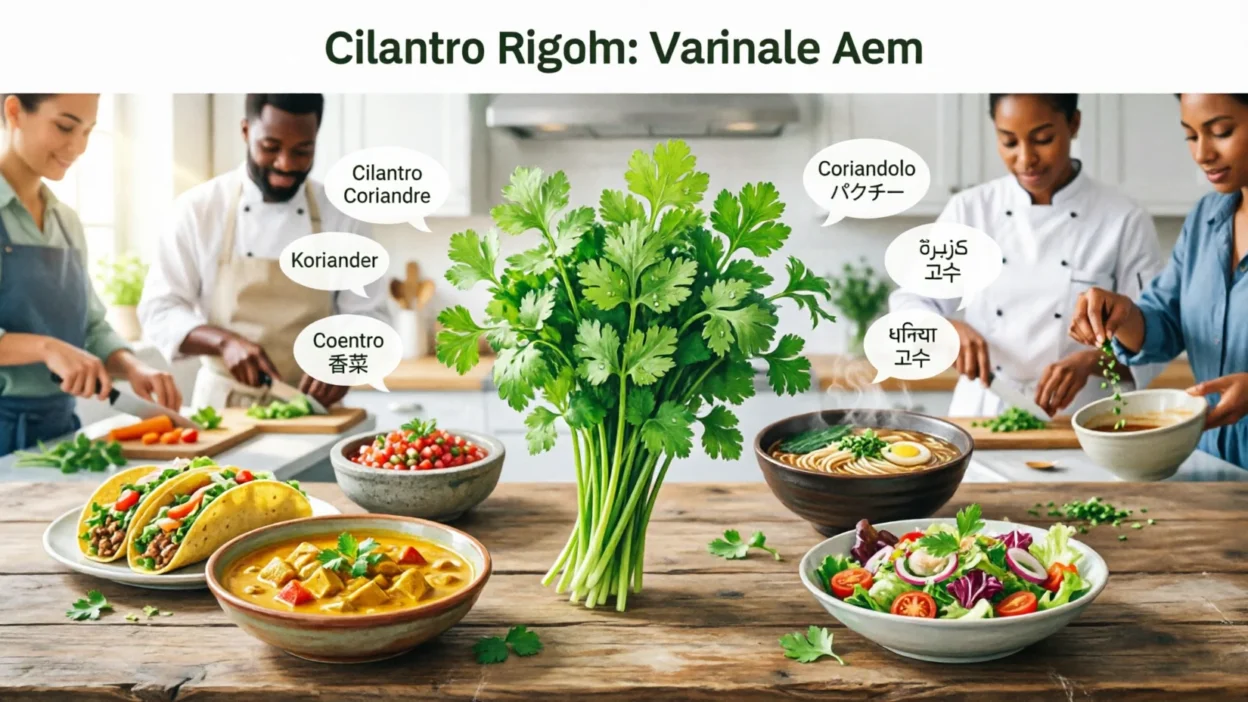
Learning cilantro in different languages is a great way to expand your food and cooking vocabulary while exploring cuisines from around the world.
Cilantro, also known as coriander leaves in many countries, is a popular herb used in Mexican, Indian, Middle Eastern, Asian, and Mediterranean dishes. It is valued for its fresh aroma, vibrant green color, and distinctive flavor.
Many people search for cilantro in all languages to compare translations and improve their language skills. Learning how to say cilantro in different languages is useful for travelers, chefs, food bloggers, students, translators, and anyone interested in international cuisine.
These cilantro translations can help you read recipes, shop at local markets, and communicate confidently when dining abroad.
It’s worth noting that in some countries, cilantro refers specifically to the fresh leaves, while coriander refers to the seeds of the same plant.
The table below lists the most common word for the fresh herb in 45 popular languages, along with the native spelling and an easy English pronunciation.
| Language | Native Phrase | English Pronunciation |
|---|---|---|
| English | Cilantro | See-LAN-troh |
| Spanish | Cilantro | See-LAN-troh |
| French | Coriandre | Ko-ree-ON-druh |
| German | Koriander | Ko-ree-AN-der |
| Italian | Coriandolo | Ko-ree-AN-do-lo |
| Portuguese | Coentro | Koo-EN-troo |
| Dutch | Koriander | Ko-ree-AN-der |
| Swedish | Koriander | Ko-ree-AN-der |
| Norwegian | Koriander | Ko-ree-AN-der |
| Danish | Koriander | Ko-ree-AN-der |
| Finnish | Korianteri | Ko-ree-AN-te-ree |
| Polish | Kolendra | Ko-LEN-dra |
| Czech | Koriandr | Ko-ree-AN-dr |
| Slovak | Koriander | Ko-ree-AN-der |
| Hungarian | Koriander | Ko-ree-AN-der |
| Romanian | Coriandru | Ko-ree-AN-droo |
| Greek | Κόλιανδρος | Ko-lee-AN-dros |
| Russian | Кинза | Keen-ZA |
| Ukrainian | Кінза | Keen-ZA |
| Turkish | Kişniş | Kish-NISH |
| Arabic | كزبرة | Kuz-BA-ra |
| Hebrew | כוסברה | Kus-BA-ra |
| Persian | گشنیز | Gash-NEEZ |
| Hindi | धनिया | Dha-nee-ya |
| Urdu | دھنیا | Dha-nee-ya |
| Bengali | ধনিয়া পাতা | Dho-nee-ya Pa-ta |
| Punjabi | ਧਨੀਆ | Dha-nee-aa |
| Gujarati | ધાણા | Dha-naa |
| Marathi | कोथिंबीर | Ko-thim-BEER |
| Tamil | கொத்தமல்லி | Kot-tha-mal-li |
| Telugu | కొత్తిమీర | Kot-thi-mee-ra |
| Kannada | ಕೊತ್ತಂಬರಿ | Kot-tham-ba-ree |
| Malayalam | മല്ലിയില | Mal-li-yi-la |
| Chinese (Mandarin) | 香菜 | Shyang Tsai |
| Japanese | パクチー | Pa-ku-chee |
| Korean | 고수 | Go-soo |
| Thai | ผักชี | Phak Chee |
| Vietnamese | Rau mùi | Rao Moo-ee |
| Indonesian | Ketumbar | Keh-toom-bar |
| Malay | Daun Ketumbar | Da-un Keh-toom-bar |
| Filipino | Kulantro | Koo-LAN-tro |
| Swahili | Giligilani | Gee-lee-gee-LAH-nee |
| Zulu | Ikoriyanda | Ee-ko-ree-YAN-da |
| Afrikaans | Koljander | Kol-YAN-der |
| Icelandic | Kóríander | Ko-ree-AN-der |
What is cilantro?
Cilantro is the fresh leafy part of the coriander plant (Coriandrum sativum). It is widely used as a herb in salads, soups, curries, tacos, salsas, and many other dishes.
Is cilantro the same as coriander?
It depends on the country. In the United States, cilantro usually refers to the fresh leaves, while coriander refers to the dried seeds. In many other English-speaking countries, coriander refers to both the leaves and the seeds.
Why should I learn “cilantro” in different languages?
Knowing this word helps you read recipes, shop for fresh herbs, order food at restaurants, and communicate with cooks and vendors in different countries.
Can I use these translations while traveling?
Yes. These translations are useful when visiting local markets, grocery stores, restaurants, and cooking classes around the world.
What is the easiest way to remember “cilantro” in different languages?
Group similar words together, such as Coriandre, Koriander, Koriandr, and Coriandru, then practice the unique translations like Kinza, Dhaniya, Pakuchi, and Xiang Cai.
Conclusion
Learning cilantro in different languages is an excellent way to improve your food vocabulary while exploring international cuisines.
If you’re traveling, cooking, studying a foreign language, or reading recipes from around the world, these translations will help you communicate with confidence.
Bookmark this guide whenever you want to learn cilantro in all languages, discover cilantro translations, or explore how to say cilantro in different languages.

Evelyn Grace is a language enthusiast and content writer at LingoMean, where she explains the meaning of words, phrases, and expressions. She creates clear, practical, and engaging content that helps readers confidently understand what to say in everyday conversations.