
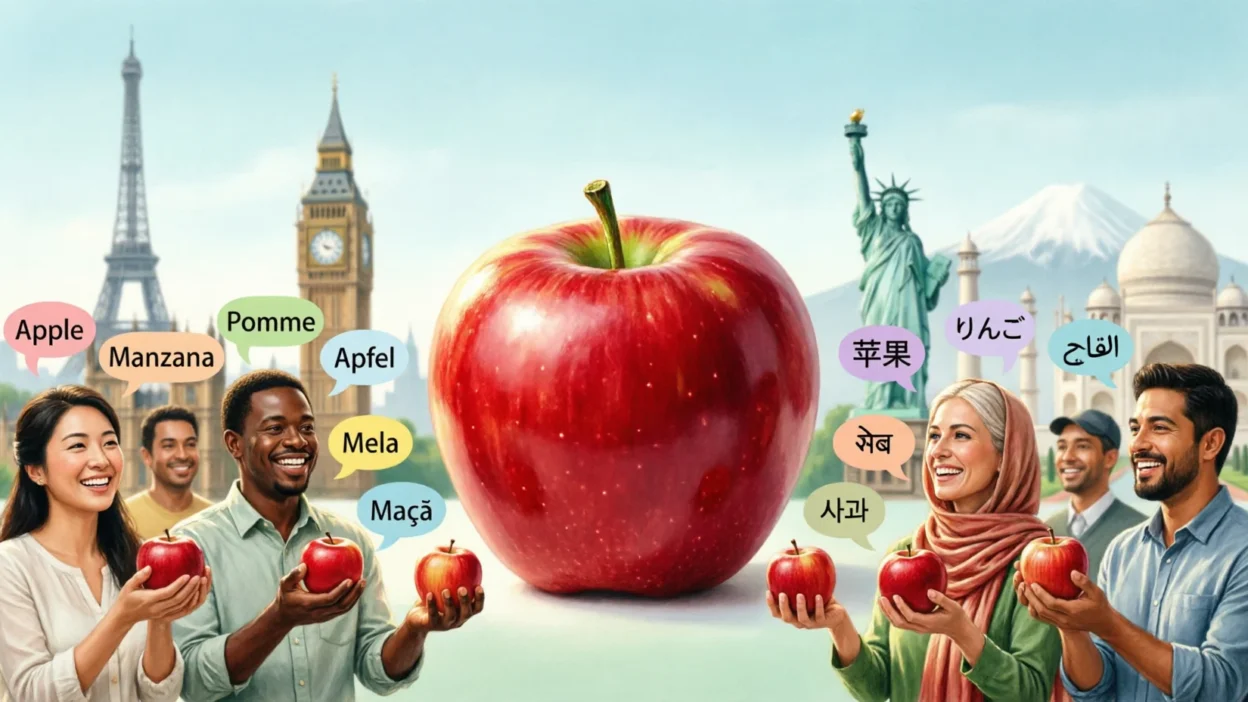
Learning apple in different languages is a simple and enjoyable way to build your vocabulary while exploring languages from around the world.
If you’re a student, traveler, language learner, or teacher, knowing how to say apple in multiple languages can improve your communication skills and help you recognize one of the most common everyday words.
Many people search for apple in all languages to compare translations and discover how this popular fruit is named across different cultures.
Understanding how to say apple in different languages is useful for reading menus, shopping at local markets, learning basic vocabulary, and practicing pronunciation.
These apple translations are also valuable for classrooms, multilingual projects, and cultural studies.
Although the fruit is the same everywhere, the word for apple varies from one language to another.
Some languages have similar spellings, while others use completely different words. The table below features apple around the world in 45 popular languages, including the native word and an easy English pronunciation.
| Language | Native Word | English Pronunciation |
|---|---|---|
| English | Apple | AP-uhl |
| Spanish | Manzana | Man-THA-na |
| French | Pomme | Pom |
| German | Apfel | AP-fel |
| Italian | Mela | MAY-la |
| Portuguese | Maçã | Ma-SANG |
| Dutch | Appel | AP-ul |
| Swedish | Äpple | EP-pleh |
| Norwegian | Eple | EP-leh |
| Danish | Æble | EH-bleh |
| Finnish | Omena | OH-me-na |
| Polish | Jabłko | YAB-ko |
| Czech | Jablko | YABL-ko |
| Slovak | Jablko | YABL-ko |
| Hungarian | Alma | AL-ma |
| Romanian | Măr | Mur |
| Greek | Μήλο | MEE-lo |
| Russian | Яблоко | YAB-la-ka |
| Ukrainian | Яблуко | YAB-loo-ko |
| Turkish | Elma | EL-ma |
| Arabic | تفاح | Tuf-fah |
| Hebrew | תפוח | Ta-poo-ach |
| Persian | سیب | Seeb |
| Hindi | सेब | Seb |
| Urdu | سیب | Seb |
| Bengali | আপেল | A-pel |
| Punjabi | ਸੇਬ | Seb |
| Gujarati | સફરજન | Sa-far-jan |
| Marathi | सफरचंद | Sa-far-chand |
| Tamil | ஆப்பிள் | Aa-pil |
| Telugu | ఆపిల్ | Aa-pil |
| Kannada | ಸೇಬು | Say-boo |
| Malayalam | ആപ്പിൾ | Aa-pil |
| Chinese (Mandarin) | 苹果 | Ping Gwo |
| Japanese | りんご | Rin-go |
| Korean | 사과 | Sa-gwa |
| Thai | แอปเปิล | Ap-pun |
| Vietnamese | Táo | Tao |
| Indonesian | Apel | A-pel |
| Malay | Epal | Eh-pal |
| Filipino | Mansanas | Man-sa-naas |
| Swahili | Tufaha | Too-fa-ha |
| Zulu | I-apula | Ee-a-poo-la |
| Afrikaans | Appel | AP-ul |
| Icelandic | Epli | EP-li |
Why should I learn “apple” in different languages?
Learning common food words like apple helps you communicate while traveling, shopping, ordering food, and building your basic vocabulary in a new language.
Is the word “apple” similar in every language?
No. Some languages have similar words because they share linguistic roots, while others use completely different terms based on their own language history.
Can I use these translations while traveling?
Yes. These words are useful in grocery stores, restaurants, local markets, and everyday conversations when talking about fruit or food.
Which languages have the easiest word for apple?
Languages such as Dutch (Appel), Indonesian (Apel), Malay (Epal), Hindi (Seb), and Urdu (سیب) are relatively easy for beginners to learn and remember.
What is the best way to remember “apple” in different languages?
Practice a few translations each day, repeat the pronunciations aloud, and use the words when reading menus, shopping, or practicing vocabulary with language apps.
Conclusion
Learning apple in different languages is an excellent way to strengthen your vocabulary and gain confidence in everyday conversations.
If you’re studying a foreign language, traveling abroad, or teaching basic words, these translations will help you communicate more naturally.
By practicing the native words and English pronunciations, you’ll remember them more easily and improve your language skills.
Bookmark this guide whenever you want to learn apple in all languages, explore apple translations, or discover how to say apple in different languages.

Carter Connor is a language enthusiast and content writer at LingoMean, helping readers discover what to say in everyday conversations with clear explanations, practical examples, and easy-to-understand communication tips.