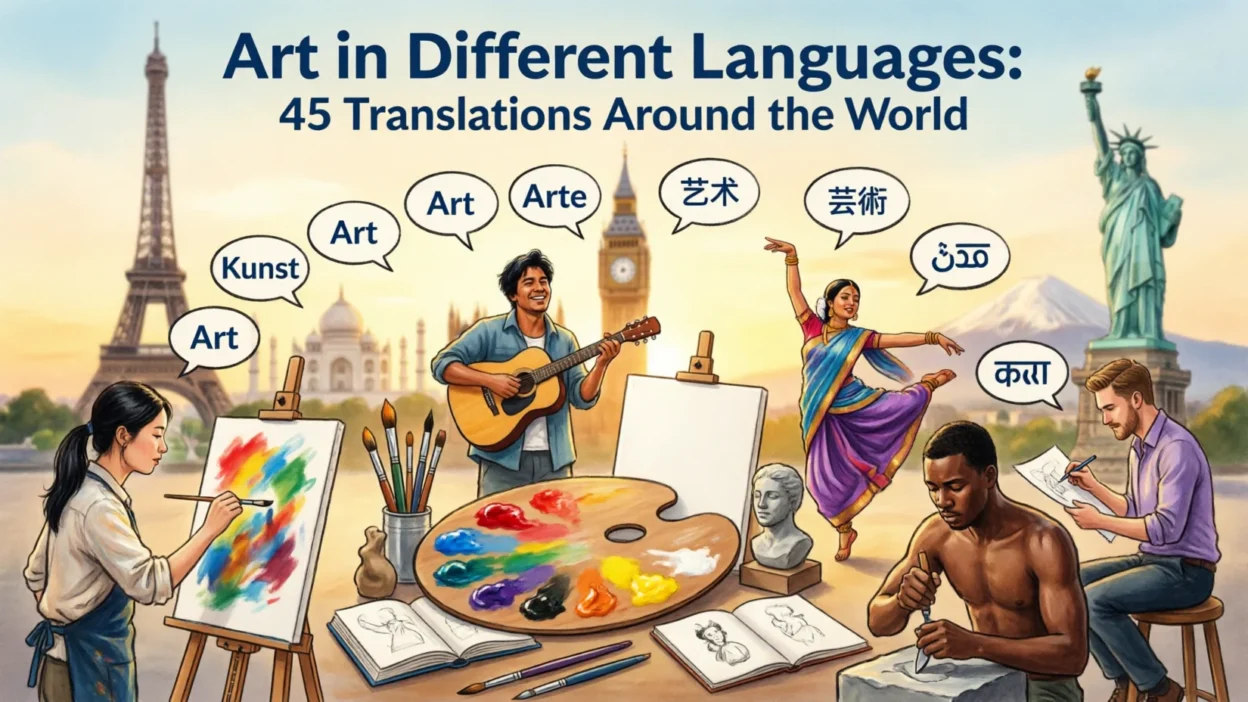
Learning art in different languages is a great way to expand your vocabulary and explore how creativity is expressed across cultures.
If you’re an artist, student, teacher, traveler, or language learner, knowing how to say art in multiple languages can help you communicate more effectively and appreciate the global world of painting, sculpture, music, literature, and design.
Many people search for art in all languages to compare translations and discover how different cultures describe creative expression.
Understanding how to say art in different languages is useful when visiting museums, reading books, studying foreign languages, or discussing creative projects with people from around the world.
These art translations are valuable for education, travel, and everyday conversations.
While the meaning of art is universal, the word itself differs across languages. Some languages have similar spellings because of shared linguistic roots, while others use unique terms.
The table below features art around the world in 45 popular languages, along with the native word and an easy English pronunciation.
| Language | Native Word | English Pronunciation |
| English | Art | Art |
| Spanish | Arte | AR-teh |
| French | Art | Ar |
| German | Kunst | Koonst |
| Italian | Arte | AR-teh |
| Portuguese | Arte | AR-chee |
| Dutch | Kunst | Koonst |
| Swedish | Konst | Konst |
| Norwegian | Kunst | Koonst |
| Danish | Kunst | Koonst |
| Finnish | Taide | TIE-deh |
| Polish | Sztuka | SHTOO-ka |
| Czech | Umění | OO-men-yee |
| Slovak | Umenie | OO-meh-nye |
| Hungarian | Művészet | Mew-vay-zet |
| Romanian | Artă | AR-tuh |
| Greek | Τέχνη | TEKH-nee |
| Russian | Искусство | Is-KOOS-stvo |
| Ukrainian | Мистецтво | Mis-TET-stvo |
| Turkish | Sanat | Sa-NAT |
| Arabic | فن | Fann |
| Hebrew | אמנות | O-ma-NOOT |
| Persian | هنر | Ho-nar |
| Hindi | कला | Ka-la |
| Urdu | فن | Fan |
| Bengali | শিল্প | Shil-po |
| Punjabi | ਕਲਾ | Ka-la |
| Gujarati | કલા | Ka-la |
| Marathi | कला | Ka-la |
| Tamil | கலை | Ka-lai |
| Telugu | కళ | Ka-la |
| Kannada | ಕಲೆ | Ka-le |
| Malayalam | കല | Ka-la |
| Chinese (Mandarin) | 艺术 | Yee Shoo |
| Japanese | 芸術 | Gay-jut-su |
| Korean | 예술 | Ye-sool |
| Thai | ศิลปะ | Sin-la-pa |
| Vietnamese | Nghệ thuật | Nghe Thuat |
| Indonesian | Seni | Seh-nee |
| Malay | Seni | Seh-nee |
| Filipino | Sining | See-ning |
| Swahili | Sanaa | Sa-naa |
| Zulu | Ubuciko | Oo-boo-CHEE-ko |
| Afrikaans | Kuns | Koons |
| Icelandic | List | List |
Why should I learn “art” in different languages?
Learning the word art helps you communicate in museums, galleries, schools, and creative industries while expanding your vocabulary in different languages.
Is the word “art” similar in every language?
No. Some languages use words derived from Latin, such as Arte, while others have unique words like Kunst in German and Sanat in Turkish.
Can I use these translations while traveling?
Yes. These translations are useful when visiting museums, art exhibitions, cultural festivals, universities, and creative workshops around the world.
Which languages have the easiest translation for “art”?
Languages such as Spanish (Arte), Italian (Arte), Portuguese (Arte), and French (Art) are easy for English speakers to recognize and remember.
What is the easiest way to remember “art” in different languages?
Practice a few translations each day, repeat the pronunciation aloud, and use the words while reading about art, visiting museums, or learning new languages.
Conclusion
Learning art in different languages is a simple way to improve your vocabulary while exploring the creative traditions of cultures around the world.
If you’re studying a foreign language, traveling, teaching, or working in a creative field, these translations can help you communicate with greater confidence.
Keep this guide bookmarked whenever you want to learn art in all languages, explore art translations, or discover how to say art in different languages.

Evelyn Grace is a language enthusiast and content writer at LingoMean, where she explains the meaning of words, phrases, and expressions. She creates clear, practical, and engaging content that helps readers confidently understand what to say in everyday conversations.