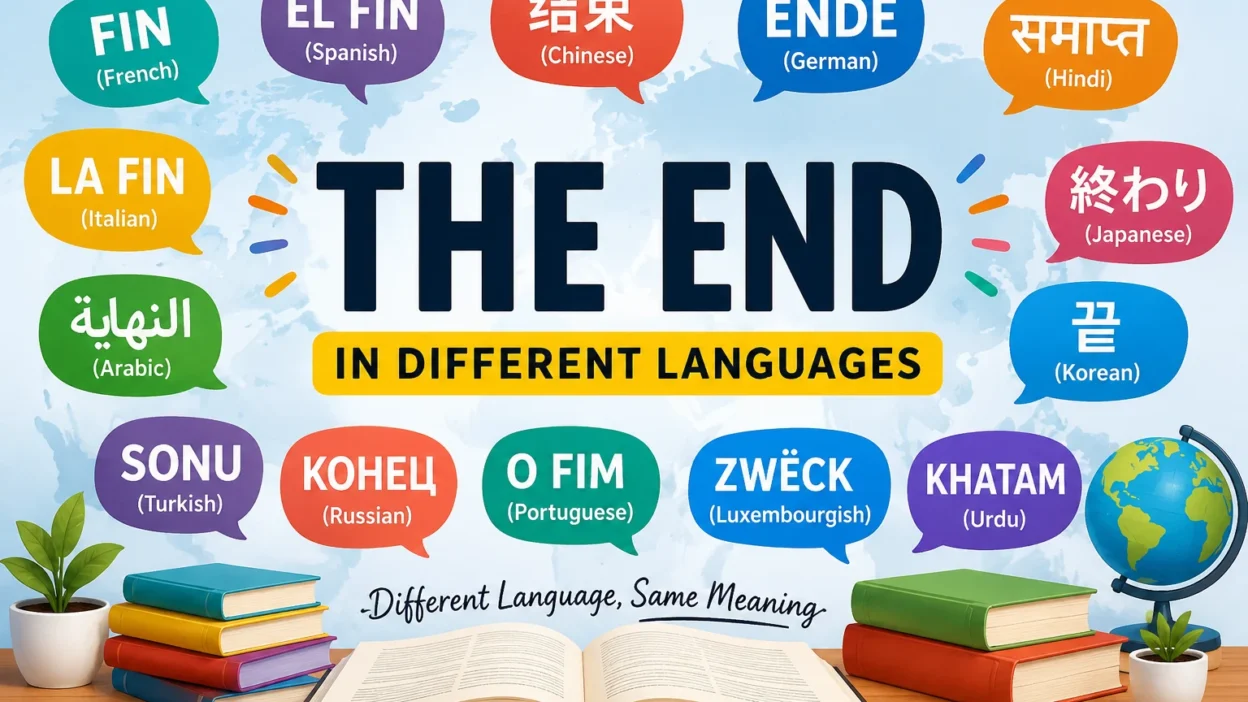
Have you ever wondered how to say the end in different languages? If you’re writing a book, creating a movie, learning a new language, or simply curious about world cultures, knowing how different languages express “the end” is both interesting and useful.
In this guide, you’ll discover the end in all languages through a simple, easy-to-read table. You’ll also learn the correct native phrase, an easy English pronunciation, and a real-life example sentence with its English meaning.
This article is designed to help language learners, travelers, writers, and anyone interested in the end translations used around the world.
How to Say “The End” in Different Languages
| # | Language | Native Phrase | English Pronunciation | Example Sentence | English Meaning |
|---|---|---|---|---|---|
| 1 | English | The End | thee end | The movie ends with “The End.” | The movie finishes with “The End.” |
| 2 | Spanish | Fin | feen | La película termina con “Fin”. | The movie ends with “The End.” |
| 3 | French | Fin | fan | Le livre se termine par “Fin”. | The book ends with “The End.” |
| 4 | German | Ende | EN-duh | Der Film endet mit “Ende”. | The film ends with “The End.” |
| 5 | Italian | Fine | FEE-neh | Il film finisce con “Fine”. | The movie ends with “The End.” |
| 6 | Portuguese | Fim | feem | O filme termina com “Fim”. | The movie ends with “The End.” |
| 7 | Dutch | Einde | EYEN-duh | De film eindigt met “Einde”. | The film ends with “The End.” |
| 8 | Swedish | Slut | sloot | Filmen slutar med “Slut”. | The film ends with “The End.” |
| 9 | Norwegian | Slutt | sloot | Filmen slutter med “Slutt”. | The film ends with “The End.” |
| 10 | Danish | Slut | sloot | Filmen slutter med “Slut”. | The film ends with “The End.” |
| 11 | Finnish | Loppu | LOP-poo | Elokuva päättyy sanoihin “Loppu”. | The movie ends with “The End.” |
| 12 | Icelandic | Endir | EN-dir | Myndin endar með “Endir”. | The movie ends with “The End.” |
| 13 | Irish | Críoch | KREE-ukh | Críoch an scéil. | The story is over. |
| 14 | Welsh | Diwedd | DEE-weth | Diwedd y ffilm. | The film is over. |
| 15 | Scottish Gaelic | Deireadh | JER-uh | Deireadh an fhilm. | The film has ended. |
| 16 | Polish | Koniec | KO-nyets | Film kończy się napisem “Koniec”. | The film ends with “The End.” |
| 17 | Czech | Konec | KO-nets | Film končí slovem “Konec”. | The movie ends with “The End.” |
| 18 | Slovak | Koniec | KO-niets | Film sa končí slovom “Koniec”. | The movie ends with “The End.” |
| 19 | Slovenian | Konec | KO-nets | Film se konča z “Konec”. | The film ends with “The End.” |
| 20 | Croatian | Kraj | kry | Film završava s “Kraj”. | The film ends with “The End.” |
| 21 | Serbian | Крај | krahy | Film se završava sa “Kraj”. | The film ends with “The End.” |
| 22 | Bosnian | Kraj | kry | Film završava sa “Kraj”. | The film ends with “The End.” |
| 23 | Romanian | Sfârșit | sfur-SHEET | Filmul se termină cu “Sfârșit”. | The movie ends with “The End.” |
| 24 | Hungarian | Vége | VAY-gheh | A film “Vége” felirattal ér véget. | The movie ends with “The End.” |
| 25 | Bulgarian | Край | kry | Филмът завършва с “Край”. | The movie ends with “The End.” |
| 26 | Ukrainian | Кінець | KEE-nets | Фільм закінчується словом “Кінець”. | The movie ends with “The End.” |
| 27 | Russian | Конец | ka-NYETS | Фильм заканчивается словом “Конец”. | The film ends with “The End.” |
| 28 | Belarusian | Канец | ka-NYETS | Фільм заканчваецца словам “Канец”. | The movie ends with “The End.” |
| 29 | Greek | Τέλος | TEH-los | Η ταινία τελειώνει με “Τέλος”. | The movie ends with “The End.” |
| 30 | Albanian | Fund | foond | Filmi mbaron me “Fund”. | The film ends with “The End.” |
| 31 | Turkish | Son | sohn | Film “Son” yazısıyla biter. | The movie ends with “The End.” |
| 32 | Arabic | النهاية | an-ni-ha-ya | ينتهي الفيلم بـ”النهاية”. | The movie ends with “The End.” |
| 33 | Hebrew | הסוף | ha-sof | הסרט מסתיים ב”הסוף”. | The movie ends with “The End.” |
| 34 | Persian | پایان | pa-yan | فیلم با “پایان” تمام میشود. | The movie ends with “The End.” |
| 35 | Urdu | اختتام | ikh-ti-taam | فلم اختتام پر پہنچتی ہے۔ | The movie reaches the end. |
| 36 | Hindi | समाप्त | samaapt | फिल्म समाप्त होती है। | The movie ends. |
| 37 | Bengali | সমাপ্তি | sho-map-ti | সিনেমাটি সমাপ্তি হয়। | The movie ends. |
| 38 | Punjabi | ਅੰਤ | ant | ਫਿਲਮ ਦਾ ਅੰਤ ਹੋ ਗਿਆ। | The movie has ended. |
| 39 | Gujarati | અંત | ant | ફિલ્મનો અંત આવ્યો. | The movie ended. |
| 40 | Marathi | शेवट | she-vut | चित्रपटाचा शेवट झाला. | The movie ended. |
| 41 | Nepali | अन्त | ant | चलचित्रको अन्त भयो। | The movie ended. |
| 42 | Sinhala | අවසානය | a-va-sa-na-ya | චිත්රපටය අවසානය විය. | The movie ended. |
| 43 | Tamil | முடிவு | mu-di-vu | படம் முடிவடைந்தது. | The movie ended. |
| 44 | Telugu | ముగింపు | mu-gim-poo | సినిమా ముగిసింది. | The movie ended. |
| 45 | Kannada | ಅಂತ್ಯ | an-thya | ಸಿನಿಮಾ ಅಂತ್ಯವಾಯಿತು. | The movie ended. |
| 46 | Malayalam | അവസാനം | a-va-sa-nam | സിനിമ അവസാനിച്ചു. | The movie ended. |
| 47 | Thai | จบ | jop | หนังจบแล้ว | The movie has ended. |
| 48 | Vietnamese | Kết thúc | ket took | Bộ phim kết thúc. | The movie ended. |
| 49 | Indonesian | Tamat | ta-mat | Film ini tamat. | This movie has ended. |
| 50 | Malay | Tamat | ta-mat | Filem ini tamat. | This movie has ended. |
| 51 | Filipino | Wakas | wa-kas | Ang pelikula ay wakas na. | The movie has ended. |
| 52 | Chinese (Simplified) | 结束 | jie-shoo | 电影结束了。 | The movie has ended. |
| 53 | Chinese (Traditional) | 結束 | jie-shoo | 電影結束了。 | The movie has ended. |
| 54 | Japanese | 終わり | o-wa-ri | 映画は終わりです。 | The movie is over. |
| 55 | Korean | 끝 | kkeut | 영화가 끝났어요. | The movie has ended. |
| 56 | Mongolian | Төгсөв | tug-suv | Кино төгсөв. | The movie ended. |
| 57 | Khmer | ចប់ | chop | ភាពយន្តចប់ហើយ។ | The movie has ended. |
| 58 | Lao | ຈົບ | jop | ຮູບເງົາຈົບແລ້ວ. | The movie has ended. |
| 59 | Burmese | အဆုံး | a-sone | ရုပ်ရှင်အဆုံးရောက်ပြီ။ | The movie has ended. |
| 60 | Swahili | Mwisho | mwee-sho | Filamu imefika mwisho. | The movie has ended. |
| 61 | Zulu | Isiphetho | ee-see-PETH-o | Ifilimu isiphelile. | The movie has ended. |
| 62 | Afrikaans | Einde | AYN-duh | Die film eindig met “Einde”. | The film ends with “The End.” |
| 63 | Hausa | Ƙarshe | kar-she | Fim ɗin ya ƙare. | The movie has ended. |
| 64 | Yoruba | Opin | o-peen | Fiimu naa ti pari. | The movie has ended. |
| 65 | Amharic | መጨረሻ | me-cha-re-sha | ፊልሙ ተጠናቀቀ። | The movie ended. |
| 66 | Somali | Dhammaad | dham-maad | Filimku wuu dhammaaday. | The movie ended. |
| 67 | Maori | Mutunga | moo-toong-ah | Kua mutu te kiriata. | The movie has ended. |
| 68 | Hawaiian | Pau | pow | Ua pau ke kiʻiʻoniʻoni. | The movie is finished. |
| 69 | Esperanto | Fino | FEE-no | La filmo finiĝas per “Fino”. | The film ends with “The End.” |
| 70 | Latin | Finis | FEE-nees | Liber verbo “Finis” terminatur. | The book ends with “The End.” |
Why Learn “The End” in All Languages?
Learning the end in all languages is useful for many reasons. Writers can use authentic endings in books and stories, filmmakers can create culturally accurate credits, language learners can expand their vocabulary, and travelers can better understand signs, books, and entertainment in different countries.
Knowing these translations also helps you appreciate how languages express completion and closure in unique ways.
Common Uses of “The End” Around the World
People use the end translations in many everyday situations, including:
- Books and novels
- Movies and television credits
- Theater performances
- School presentations
- Storytelling
- Short films
- Video games
- Creative writing
- Language learning
- Cultural studies
Although many modern films simply fade to black or display credits, the phrase “The End” remains a recognizable symbol of a completed story across many cultures.
Tips for Pronouncing “The End” in Different Languages
If you’re learning how to say the end in different languages, keep these tips in mind:
- Listen to native speakers whenever possible.
- Practice one language at a time.
- Focus on correct pronunciation before speed.
- Repeat short example sentences aloud.
- Learn both the written form and spoken form together.
These habits make it easier to remember new vocabulary and improve your speaking skills.
Conclusion
Now you know the end in different languages across 70 widely spoken and historically important languages.
If you’re learning languages, creating multilingual content, or simply satisfying your curiosity, these translations provide a helpful reference.
Keep practicing the pronunciation and example sentences to make each phrase easier to remember.
FAQs:
1. How do you say “the end” in different languages?
Different languages have their own translation for “the end.” For example, Spanish uses Fin, French uses Fin, German uses Ende, Italian uses Fine, and Japanese uses 終わり.
2. Why do movies use “The End”?
Many classic films displayed “The End” to clearly indicate the story had finished. While modern movies often skip it, the phrase is still widely recognized around the world.
3. Is “The End” the same in every language?
No. Every language has its own word or phrase for “the end,” reflecting its grammar, writing system, and cultural traditions.
4. Can I use these translations in books or creative projects?
Yes. These translations are commonly used to represent the conclusion of a story, book, presentation, or film. However, always verify context if you need formal or literary usage.
5. What is the easiest way to learn “the end” around the world?
The easiest approach is to study one language at a time, practice pronunciation, and use example sentences. Reviewing a multilingual table regularly also helps improve memory.

Anthony Dylan is a language enthusiast and content writer at LingoMean, where he helps readers understand what to say in different situations. He creates clear, practical, and engaging guides that improve communication, confidence, and everyday conversations.