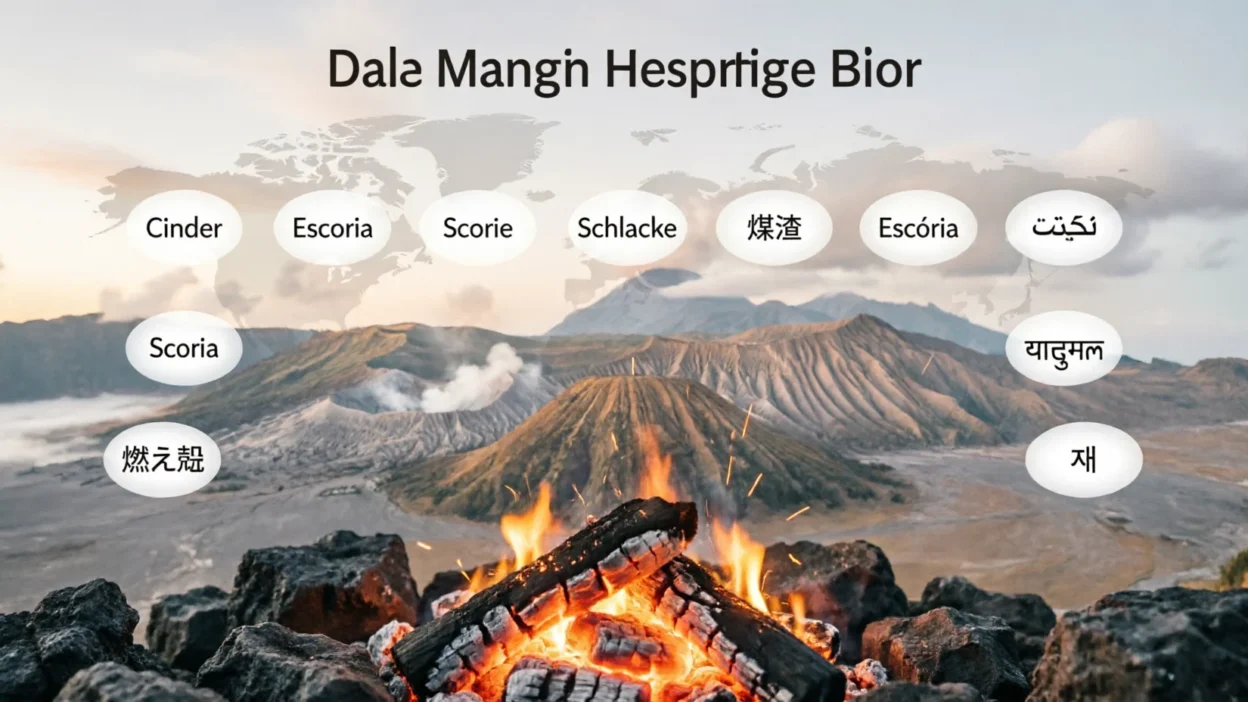
Learning cinder in different languages is a great way to expand your vocabulary, especially if you’re interested in nature, construction, geology, or everyday English.
A cinder is a small piece of partially burned coal, wood, or volcanic rock left after combustion. The word is commonly used in fireplaces, campfires, volcano-related discussions, landscaping, and construction materials such as cinder blocks.
Many people search for cinder in all languages to compare translations and improve their language skills. Learning how to say cinder in different languages is useful for students, travelers, translators, writers, and anyone interested in multilingual communication.
These cinder translations are often found in science books, construction guides, and environmental discussions.
Although the meaning of cinder is similar across many cultures, some languages use words that specifically mean ember, ash, or volcanic cinder, depending on the context.
The table below lists the most common translation for cinder in 45 popular languages, along with the native word and an easy English pronunciation.
| Language | Native Phrase | English Pronunciation |
|---|---|---|
| English | Cinder | SIN-der |
| Spanish | Escoria | Es-KOH-ree-ah |
| French | Scorie | Skoh-REE |
| German | Schlacke | SHLAK-uh |
| Italian | Scoria | SKOH-ree-ah |
| Portuguese | Escória | Es-KOH-ree-ah |
| Dutch | Slak | Slak |
| Swedish | Slagg | Slag |
| Norwegian | Slagg | Slag |
| Danish | Slagge | SLAG-eh |
| Finnish | Kuona | KOO-oh-na |
| Polish | Żużel | ZHOO-zhel |
| Czech | Struska | STROOS-ka |
| Slovak | Troska | TROS-ka |
| Hungarian | Salak | SHA-lak |
| Romanian | Zgură | ZGOO-ruh |
| Greek | Σκωρία | Sko-REE-ah |
| Russian | Шлак | Shlak |
| Ukrainian | Шлак | Shlak |
| Turkish | Cüruf | JOO-roof |
| Arabic | خبث | Khabath |
| Hebrew | סיגים | See-GEEM |
| Persian | سرباره | Sar-BAA-reh |
| Hindi | धातुमल | Dhaa-tu-mal |
| Urdu | سلیگ | Slag |
| Bengali | স্ল্যাগ | Slag |
| Punjabi | ਸਲੇਗ | Slag |
| Gujarati | સ્લેગ | Slag |
| Marathi | धातुमल | Dhaa-tu-mal |
| Tamil | கழிவு சாம்பல் | Ka-zhivu Saam-bal |
| Telugu | బూడిద ముక్క | Boo-di-da Muk-ka |
| Kannada | ಕಲ್ಲಿದ್ದಲು ಅವಶೇಷ | Kal-lid-da-loo A-va-shay-sha |
| Malayalam | ചാരക്കഷണം | Chaa-ra Ka-sha-nam |
| Chinese (Mandarin) | 煤渣 | May Zha |
| Japanese | 燃え殻 | Mo-e-ga-ra |
| Korean | 재 | Jae |
| Thai | ขี้เถ้า | Khee Thao |
| Vietnamese | Xỉ than | See Than |
| Indonesian | Terak | Te-rak |
| Malay | Sanga | Sang-a |
| Filipino | Abo | Ah-bo |
| Swahili | Mabaki ya makaa | Ma-ba-kee Ya Ma-kaa |
| Zulu | Umlotha | Um-LO-tha |
| Afrikaans | Slak | Slak |
| Icelandic | Gjall | Gyatl |
What does “cinder” mean?
A cinder is a small piece of burned material, such as coal or wood, or a porous fragment of volcanic rock formed during an eruption.
Why should I learn “cinder” in different languages?
Learning this word is useful for understanding books, construction materials, geology, volcanoes, fireplaces, and outdoor activities in different languages.
Is “cinder” the same as “ash”?
No. Ash is the fine powder left after burning, while a cinder is a larger, partially burned or hardened fragment.
Can I use these translations while traveling?
Yes. These translations may be helpful when discussing campfires, volcanic landscapes, construction materials, or scientific topics in other countries.
What is the easiest way to remember “cinder” in different languages?
Practice similar words together, such as Scoria, Scorie, and Escoria, then learn the unique translations by repeating them in context.
Conclusion
Learning cinder in different languages is an excellent way to build specialized vocabulary related to nature, science, and construction.
If you’re studying geology, traveling to volcanic regions, reading technical material, or simply expanding your language skills, these translations can help you communicate more effectively.
Save this guide whenever you want to learn cinder in all languages, discover cinder translations, or explore how to say cinder in different languages.

Evelyn Grace is a language enthusiast and content writer at LingoMean, where she explains the meaning of words, phrases, and expressions. She creates clear, practical, and engaging content that helps readers confidently understand what to say in everyday conversations.