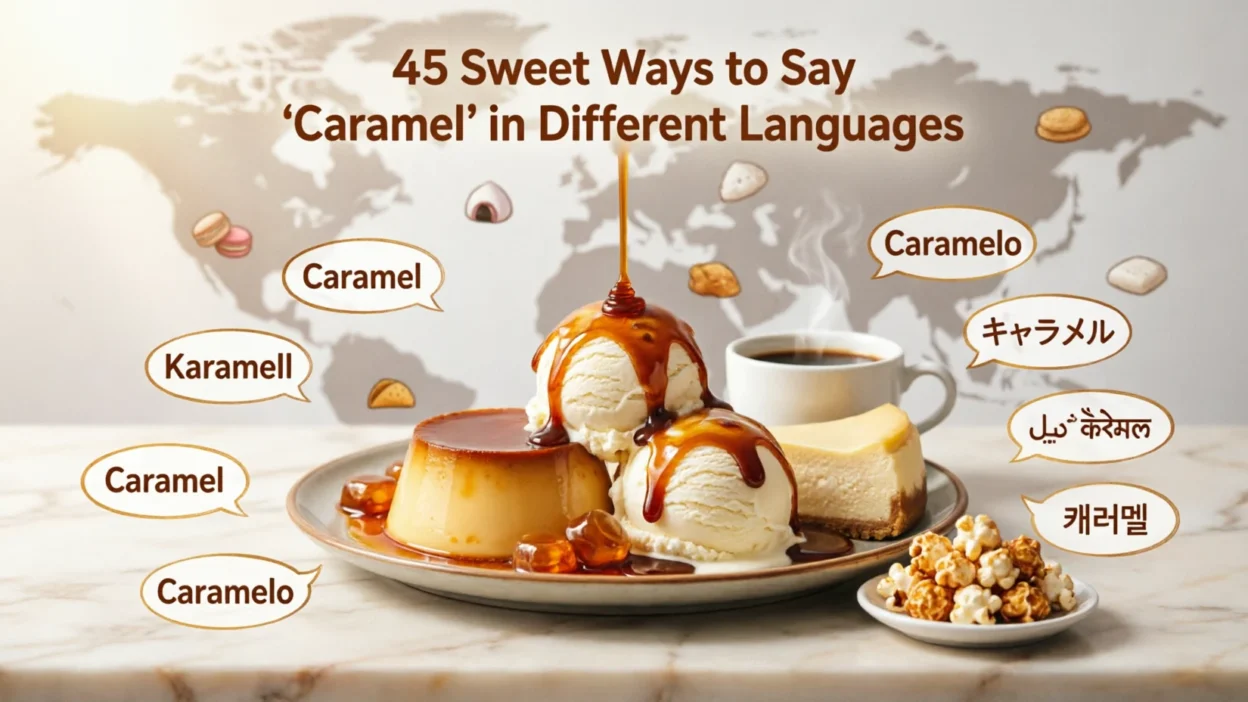
Learning caramel in different languages is a delicious way to expand your food vocabulary while exploring desserts and sweets from around the world.
Caramel is made by heating sugar until it turns golden brown, creating a rich, sweet flavor that is used in candies, cakes, ice cream, coffee, sauces, chocolates, and many other desserts. It is loved in cuisines across the globe.
Many people search for caramel in all languages to compare translations and improve their language skills. Learning how to say caramel in different languages is useful for travelers, chefs, bakers, food bloggers, students, translators, and anyone interested in international cuisine.
These caramel translations are commonly found on dessert menus, recipes, food labels, and cooking guides.
Although caramel is enjoyed worldwide, each language has its own word and pronunciation. The table below features caramel around the world in 45 popular languages, along with the native translation and an easy English pronunciation.
| Language | Native Phrase | English Pronunciation |
|---|---|---|
| English | Caramel | KAR-uh-mel |
| Spanish | Caramelo | Ka-ra-MEH-lo |
| French | Caramel | Ka-ra-MEL |
| German | Karamell | Ka-ra-MELL |
| Italian | Caramello | Ka-ra-MEL-lo |
| Portuguese | Caramelo | Ka-ra-MEH-lo |
| Dutch | Karamel | Ka-ra-MEL |
| Swedish | Karamell | Ka-ra-MELL |
| Norwegian | Karamell | Ka-ra-MELL |
| Danish | Karamel | Ka-ra-MEL |
| Finnish | Karamelli | Ka-ra-MEL-lee |
| Polish | Karmel | KAR-mel |
| Czech | Karamel | Ka-ra-MEL |
| Slovak | Karamel | Ka-ra-MEL |
| Hungarian | Karamell | Ka-ra-MELL |
| Romanian | Caramel | Ka-ra-MEL |
| Greek | Καραμέλα | Ka-ra-ME-la |
| Russian | Карамель | Ka-ra-MEL |
| Ukrainian | Карамель | Ka-ra-MEL |
| Turkish | Karamel | Ka-ra-MEL |
| Arabic | كراميل | Ka-ra-MEEL |
| Hebrew | קרמל | Kar-MEL |
| Persian | کارامل | Ka-ra-MEL |
| Hindi | कैरेमल | Kai-re-mal |
| Urdu | کیریمل | Kai-re-mal |
| Bengali | ক্যারামেল | Kya-ra-mel |
| Punjabi | ਕੈਰਾਮਲ | Kai-ra-mal |
| Gujarati | કેરામેલ | Ke-ra-mel |
| Marathi | कॅरमेल | Kai-ra-mel |
| Tamil | கேரமல் | Kay-ra-mal |
| Telugu | కారమెల్ | Kaa-ra-mel |
| Kannada | ಕ್ಯಾರಮೆಲ್ | Kyaa-ra-mel |
| Malayalam | കാരമൽ | Kaa-ra-mal |
| Chinese (Mandarin) | 焦糖 | Jyao Tang |
| Japanese | キャラメル | Kya-ra-me-ru |
| Korean | 캐러멜 | Kae-reo-mel |
| Thai | คาราเมล | Kaa-raa-mel |
| Vietnamese | Caramen | Ka-ra-men |
| Indonesian | Karamel | Ka-ra-mel |
| Malay | Karamel | Ka-ra-mel |
| Filipino | Karamelo | Ka-ra-me-lo |
| Swahili | Karameli | Ka-ra-ME-lee |
| Zulu | Ikharameli | Ee-kha-ra-ME-lee |
| Afrikaans | Karamel | Ka-ra-mel |
| Icelandic | Karamella | Ka-ra-MET-la |
What is caramel?
Caramel is a sweet food made by heating sugar until it melts and turns golden brown. It is commonly used in desserts, candies, beverages, and sauces.
Why should I learn “caramel” in different languages?
Learning this word helps you read recipes, understand restaurant menus, shop for sweets, and communicate while traveling in different countries.
Is the word “caramel” similar in every language?
Many languages use a similar word because the term has been widely adopted internationally. However, pronunciation and spelling may vary slightly.
Can I use these translations while traveling?
Yes. These translations are useful when ordering desserts, reading food labels, visiting bakeries, and exploring local cuisines around the world.
What is the easiest way to remember “caramel” in different languages?
Since many languages use similar forms like Caramel, Caramelo, Karamel, and Karamell, start with those before learning the unique pronunciations.
Conclusion
Learning caramel in different languages is a fun and tasty way to improve your vocabulary while discovering international desserts and sweets.
If you’re studying a foreign language, traveling, baking, or simply exploring world cuisines, these translations will help you communicate with confidence.
Save this guide whenever you want to learn caramel in all languages, discover caramel translations, or explore how to say caramel in different languages.

Evelyn Grace is a language enthusiast and content writer at LingoMean, where she explains the meaning of words, phrases, and expressions. She creates clear, practical, and engaging content that helps readers confidently understand what to say in everyday conversations.