
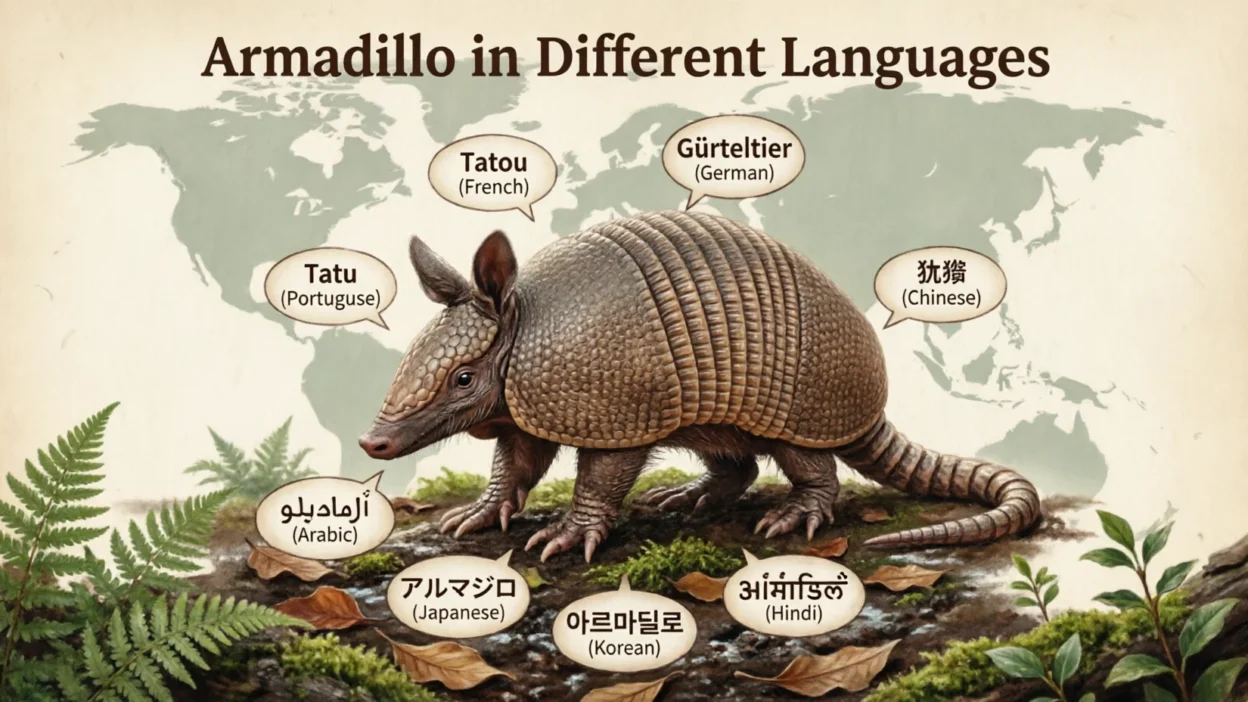
Armadillo in different languages is an interesting phrase to learn if you’re studying wildlife, traveling, learning new languages, or expanding your animal vocabulary.
The armadillo is a unique mammal known for its hard protective shell, excellent digging ability, and natural habitat throughout the Americas.
In this complete guide, you’ll discover 70 different languages with accurate translations, easy English pronunciations, real-life example sentences, and English meanings.
If you’re searching for armadillo in all languages, how to say armadillo in different languages, or armadillo translations around the world, you’ll find everything you need here.
Learning animal names like armadillo helps improve your vocabulary while introducing you to different languages and cultures.
Armadillo in Different Languages (70 Languages)
| # | Language | Native Phrase | Easy Pronunciation | Example Sentence | English Meaning |
|---|---|---|---|---|---|
| 1 | English | Armadillo | Ar-ma-DIL-oh | The armadillo dug a burrow. | The armadillo dug a burrow. |
| 2 | Spanish | Armadillo | Ar-ma-DEE-yo | El armadillo cavó una madriguera. | The armadillo dug a burrow. |
| 3 | French | Tatou | Ta-TOO | Le tatou vit dans la forêt. | The armadillo lives in the forest. |
| 4 | German | Gürteltier | GUR-tel-teer | Das Gürteltier gräbt schnell. | The armadillo digs quickly. |
| 5 | Italian | Armadillo | Ar-ma-DEEL-lo | L’armadillo vive sottoterra. | The armadillo lives underground. |
| 6 | Portuguese | Tatu | Ta-TOO | O tatu cava a terra. | The armadillo digs the ground. |
| 7 | Dutch | Gordeldier | GOR-del-deer | Het gordeldier graaft een hol. | The armadillo digs a burrow. |
| 8 | Russian | Броненосец | Bro-ne-NO-sets | Броненосец роет нору. | The armadillo digs a burrow. |
| 9 | Ukrainian | Броненосець | Bro-ne-NO-sets | Броненосець живе в норі. | The armadillo lives in a burrow. |
| 10 | Polish | Pancernik | Pan-TSER-nik | Pancernik kopie norę. | The armadillo digs a burrow. |
| 11 | Czech | Pásovec | PAA-so-vets | Pásovec žije v lese. | The armadillo lives in the forest. |
| 12 | Slovak | Pásavec | PAA-sa-vets | Pásavec kope noru. | The armadillo digs a burrow. |
| 13 | Hungarian | Tatú | Ta-TOO | A tatú gyorsan ás. | The armadillo digs quickly. |
| 14 | Romanian | Armadillo | Ar-ma-DEE-lo | Armadillo sapă o vizuină. | The armadillo digs a burrow. |
| 15 | Bulgarian | Броненосец | Bro-ne-NO-sets | Броненосецът живее в гората. | The armadillo lives in the forest. |
| 16 | Serbian | Оклопник | Ok-LOP-nik | Оклопник копа рупу. | The armadillo digs a burrow. |
| 17 | Croatian | Pojasnik | Po-YAS-nik | Pojasnik živi u prirodi. | The armadillo lives in nature. |
| 18 | Bosnian | Oklopnik | Ok-LOP-nik | Oklopnik kopa zemlju. | The armadillo digs the ground. |
| 19 | Slovenian | Pasavec | Pa-SA-vets | Pasavec živi v gozdu. | The armadillo lives in the forest. |
| 20 | Greek | Αρμαδίλο | Ar-ma-DEE-lo | Το αρμαδίλο σκάβει. | The armadillo digs. |
| 21 | Turkish | Armadillo | Ar-ma-DIL-lo | Armadillo yuva kazar. | The armadillo digs a burrow. |
| 22 | Albanian | Armadilo | Ar-ma-DEE-lo | Armadilo jeton në pyll. | The armadillo lives in the forest. |
| 23 | Lithuanian | Šarvuotis | Shar-VUO-tis | Šarvuotis kasa urvą. | The armadillo digs a burrow. |
| 24 | Latvian | Bruņnesis | BROON-ne-sis | Bruņnesis dzīvo mežā. | The armadillo lives in the forest. |
| 25 | Estonian | Vöölane | VUH-la-ne | Vöölane kaevab uru. | The armadillo digs a burrow. |
| 26 | Finnish | Vyötiäinen | VYUH-tee-ai-nen | Vyötiäinen kaivaa kolon. | The armadillo digs a burrow. |
| 27 | Swedish | Bältdjur | BELT-yur | Bältdjuret gräver. | The armadillo digs. |
| 28 | Norwegian | Beltedyr | BEL-te-dyr | Beltedyret lever i skogen. | The armadillo lives in the forest. |
| 29 | Danish | Bæltedyr | BEL-te-dyr | Bæltedyret graver. | The armadillo digs. |
| 30 | Icelandic | Beltidýr | BEL-ti-deer | Beltidýr grefur holu. | The armadillo digs a hole. |
| 31 | Irish | Armadail | Ar-ma-DAIL | Tá an armadail sa choill. | The armadillo is in the forest. |
| 32 | Welsh | Armadilo | Ar-ma-DEE-lo | Mae’r armadilo yn cloddio. | The armadillo digs. |
| 33 | Scottish Gaelic | Armadillo | Ar-ma-DIL-lo | Tha an armadillo a’ cladhach. | The armadillo is digging. |
| 34 | Maltese | Armadill | Ar-ma-DEEL | L-armadill iħaffer. | The armadillo digs. |
| 35 | Arabic | أرماديلو | Ar-ma-DEE-lo | الأرماديلو يحفر جحرًا. | The armadillo digs a burrow. |
| 36 | Hebrew | ארמדילו | Ar-ma-DEE-lo | הארמדילו חופר מחילה. | The armadillo digs a burrow. |
| 37 | Persian | آرمادیلو | Ar-ma-DEE-lo | آرمادیلو لانه میکند. | The armadillo digs a burrow. |
| 38 | Urdu | آرماڈیلو | Ar-ma-DEE-lo | آرماڈیلو بل کھودتا ہے۔ | The armadillo digs a burrow. |
| 39 | Hindi | आर्माडिलो | Ar-ma-DEE-lo | आर्माडिलो बिल खोदता है। | The armadillo digs a burrow. |
| 40 | Punjabi | ਆਰਮਾਡਿਲੋ | Ar-ma-DEE-lo | ਆਰਮਾਡਿਲੋ ਬਿਲ ਖੋਦਦਾ ਹੈ। | The armadillo digs a burrow. |
| 41 | Bengali | আরমাডিলো | Ar-ma-DEE-lo | আরমাডিলো গর্ত খোঁড়ে। | The armadillo digs a burrow. |
| 42 | Gujarati | આર્માડિલો | Ar-ma-DEE-lo | આર્માડિલો બિલ્લું ખોદે છે. | The armadillo digs a burrow. |
| 43 | Marathi | आर्माडिलो | Ar-ma-DEE-lo | आर्माडिलो बिळ खणतो. | The armadillo digs a burrow. |
| 44 | Nepali | आर्माडिलो | Ar-ma-DEE-lo | आर्माडिलोले दुलो खन्छ। | The armadillo digs a burrow. |
| 45 | Sinhala | ආර්මඩිලෝ | Ar-ma-DEE-lo | ආර්මඩිලෝ බිම හාරයි. | The armadillo digs the ground. |
| 46 | Tamil | ஆர்மடில்லோ | Ar-ma-DIL-lo | ஆர்மடில்லோ குழி தோண்டுகிறது. | The armadillo digs a burrow. |
| 47 | Telugu | ఆర్మడిల్లో | Ar-ma-DIL-lo | ఆర్మడిల్లో గుంత త్రవ్వుతుంది. | The armadillo digs a burrow. |
| 48 | Kannada | ಆರ್ಮಡಿಲೋ | Ar-ma-DIL-lo | ಆರ್ಮಡಿಲೋ ಗುಂಡಿ ತೋಡುತ್ತದೆ. | The armadillo digs a burrow. |
| 49 | Malayalam | ആർമഡില്ലോ | Ar-ma-DIL-lo | ആർമഡില്ലോ കുഴി കുഴിക്കുന്നു. | The armadillo digs a burrow. |
| 50 | Odia | ଆର୍ମାଡିଲୋ | Ar-ma-DEE-lo | ଆର୍ମାଡିଲୋ ଗହ୍ୱର ଖୋଦେ। | The armadillo digs a burrow. |
| 51 | Assamese | আৰ্মাডিলো | Ar-ma-DEE-lo | আৰ্মাডিলোৱে গাঁত খনন কৰে। | The armadillo digs a burrow. |
| 52 | Chinese (Simplified) | 犰狳 | Chyoh-YOO | 犰狳会挖洞。 | The armadillo digs burrows. |
| 53 | Japanese | アルマジロ | A-ru-ma-JI-ro | アルマジロは穴を掘ります。 | The armadillo digs burrows. |
| 54 | Korean | 아르마딜로 | A-reu-ma-DIL-lo | 아르마딜로는 굴을 팝니다. | The armadillo digs burrows. |
| 55 | Vietnamese | Con tatu | Kon Ta-Too | Con tatu đào hang. | The armadillo digs a burrow. |
| 56 | Thai | อาร์มาดิลโล | Ar-ma-DIL-lo | อาร์มาดิลโลขุดโพรง | The armadillo digs a burrow. |
| 57 | Indonesian | Armadilo | Ar-ma-DEE-lo | Armadilo menggali liang. | The armadillo digs a burrow. |
| 58 | Malay | Armadilo | Ar-ma-DEE-lo | Armadilo menggali lubang. | The armadillo digs a burrow. |
| 59 | Filipino | Armadilyo | Ar-ma-DIL-yo | Ang armadilyo ay naghuhukay. | The armadillo digs. |
| 60 | Khmer | អាម៉ាឌីឡូ | Ar-ma-DEE-lo | អាម៉ាឌីឡូជីករូង។ | The armadillo digs a burrow. |
| 61 | Lao | ອາມາດິໂລ | Ar-ma-DEE-lo | ອາມາດິໂລຂຸດຮູ. | The armadillo digs a burrow. |
| 62 | Burmese | အာမာဒီလို | Ar-ma-DEE-lo | အာမာဒီလိုသည် တွင်းတူးသည်။ | The armadillo digs a burrow. |
| 63 | Mongolian | Армадилло | Ar-ma-DIL-lo | Армадилло нүх ухдаг. | The armadillo digs a burrow. |
| 64 | Swahili | Armadilo | Ar-ma-DEE-lo | Armadilo huchimba shimo. | The armadillo digs a burrow. |
| 65 | Zulu | I-Armadillo | Ee Ar-ma-DIL-lo | I-armadillo limba umgodi. | The armadillo digs a burrow. |
| 66 | Afrikaans | Gordeldier | GOR-del-deer | Die gordeldier grawe ‘n gat. | The armadillo digs a hole. |
| 67 | Yoruba | Armadilo | Ar-ma-DEE-lo | Armadilo ń wa ihò. | The armadillo digs a burrow. |
| 68 | Hausa | Armadilo | Ar-ma-DEE-lo | Armadilo yana tona rami. | The armadillo digs a burrow. |
| 69 | Amharic | አርማዲሎ | Ar-ma-DEE-lo | አርማዲሎ ጉድጓድ ይቆፍራል። | The armadillo digs a burrow. |
| 70 | Somali | Armaadiilo | Ar-maa-DEE-lo | Armaadiiladu god bay qoddaa. | The armadillo digs a burrow. |
How to Say Armadillo in Different Languages
The word armadillo is translated differently across languages. In many languages, a version of the Spanish-derived word is used, while others have their own native terms. Learning armadillo in different languages is useful for wildlife enthusiasts, students, travelers, and language learners.
Why Learn Armadillo Translations?
Learning armadillo translations can help you:
- Expand your animal vocabulary.
- Improve foreign language skills.
- Understand wildlife documentaries and books.
- Communicate about nature and conservation.
- Learn scientific and educational terms.
Armadillo Around the World
Armadillos are native to the Americas and are recognized for their protective shell and digging abilities. Although they are not found naturally in every country, their name appears in zoology books, wildlife documentaries, and educational materials worldwide.
Tips for Remembering Armadillo in Different Languages
- Practice five translations each day.
- Repeat the pronunciations aloud.
- Use the word in simple sentences.
- Watch wildlife videos in different languages.
- Review with flashcards regularly.
Common Uses of the Word “Armadillo”
- Learning animal names.
- Reading wildlife books.
- Watching nature documentaries.
- Visiting zoos and wildlife parks.
- Studying biology and conservation.
Conclusion
Learning armadillo in different languages is a fun way to improve your vocabulary while discovering more about one of nature’s most unique mammals. If you’re studying languages, wildlife, or traveling, these armadillo translations will help you communicate confidently across cultures.
FAQs:
1. How do you say armadillo in different languages?
Armadillo is translated differently around the world, including Tatou in French, Gürteltier in German, Tatu in Portuguese, 犰狳 in Chinese, and アルマジロ in Japanese.
2. Why should I learn armadillo translations?
Learning armadillo translations improves your wildlife vocabulary and helps when reading books, documentaries, or educational materials in different languages.
3. Is the word armadillo similar in many languages?
Yes. Many languages use a borrowed form of the Spanish word “armadillo,” while others have unique native names.
4. Can I use these translations while traveling?
Yes. They are useful in zoos, wildlife parks, museums, nature reserves, and educational settings.
5. Where can I learn more animal names in different languages?
You can continue learning words like elephant, tiger, lion, bear, fox, wolf, rabbit, and dolphin in different languages.

Carter Connor is a language enthusiast and content writer at LingoMean, helping readers discover what to say in everyday conversations with clear explanations, practical examples, and easy-to-understand communication tips.