Armor in different languages is a fascinating phrase to learn if you’re studying history, playing video games, reading fantasy novels, or learning a new language.
The word “armor” refers to protective clothing or equipment worn by soldiers, knights, warriors, and modern military personnel to defend against attacks.
In this complete guide, you’ll discover 70 different languages with accurate translations, easy English pronunciations, real-life example sentences, and English meanings.
If you’re searching for armor in all languages, how to say armor in different languages, or armor translations around the world, you’ll find everything you need here.
Learning historical and military vocabulary like armor helps expand your language skills while giving you insight into cultures and history worldwide.
Armor in Different Languages (70 Languages)
| # | Language | Native Phrase | Easy Pronunciation | Example Sentence | English Meaning |
|---|---|---|---|---|---|
| 1 | English | Armor | AR-mer | The knight wore heavy armor. | The knight wore heavy armor. |
| 2 | Spanish | Armadura | Ar-ma-DOO-ra | El caballero llevaba armadura. | The knight wore armor. |
| 3 | French | Armure | Ar-MYOOR | Le chevalier portait une armure. | The knight wore armor. |
| 4 | German | Rüstung | ROOS-toong | Der Ritter trug eine Rüstung. | The knight wore armor. |
| 5 | Italian | Armatura | Ar-ma-TOO-ra | Il cavaliere indossava un’armatura. | The knight wore armor. |
| 6 | Portuguese | Armadura | Ar-ma-DOO-ra | O cavaleiro usava armadura. | The knight wore armor. |
| 7 | Dutch | Harnas | HAR-nas | De ridder droeg een harnas. | The knight wore armor. |
| 8 | Russian | Броня | BRO-nya | Рыцарь носил броню. | The knight wore armor. |
| 9 | Ukrainian | Броня | BRO-nya | Лицар носив броню. | The knight wore armor. |
| 10 | Polish | Zbroja | ZBRO-ya | Rycerz nosił zbroję. | The knight wore armor. |
| 11 | Czech | Brnění | BER-ne-nee | Rytíř měl brnění. | The knight wore armor. |
| 12 | Slovak | Brnenie | BER-ne-nye | Rytier mal brnenie. | The knight wore armor. |
| 13 | Hungarian | Páncél | PAAN-tsale | A lovag páncélt viselt. | The knight wore armor. |
| 14 | Romanian | Armură | Ar-moo-RA | Cavalerul purta armură. | The knight wore armor. |
| 15 | Bulgarian | Броня | BRO-nya | Рицарят носеше броня. | The knight wore armor. |
| 16 | Serbian | Оклоп | OK-lop | Витез је носио оклоп. | The knight wore armor. |
| 17 | Croatian | Oklop | OK-lop | Vitez je nosio oklop. | The knight wore armor. |
| 18 | Bosnian | Oklop | OK-lop | Vitez je nosio oklop. | The knight wore armor. |
| 19 | Slovenian | Oklep | OK-lep | Vitez je nosil oklep. | The knight wore armor. |
| 20 | Greek | Πανοπλία | Pa-no-plee-A | Ο ιππότης φορούσε πανοπλία. | The knight wore armor. |
| 21 | Turkish | Zırh | Zurh | Şövalye zırh giydi. | The knight wore armor. |
| 22 | Albanian | Parzmore | Parz-MO-re | Kalorësi mbante parzmore. | The knight wore armor. |
| 23 | Lithuanian | Šarvai | SHAR-vai | Riteris dėvėjo šarvus. | The knight wore armor. |
| 24 | Latvian | Bruņas | BROO-nyas | Bruņinieks valkāja bruņas. | The knight wore armor. |
| 25 | Estonian | Rüü | Ruu | Rüütel kandis rüüd. | The knight wore armor. |
| 26 | Finnish | Haarniska | HAAR-nis-ka | Ritari käytti haarniskaa. | The knight wore armor. |
| 27 | Swedish | Rustning | ROOST-ning | Riddaren bar rustning. | The knight wore armor. |
| 28 | Norwegian | Rustning | ROOST-ning | Ridderen brukte rustning. | The knight wore armor. |
| 29 | Danish | Rustning | ROOST-ning | Ridderen bar rustning. | The knight wore armor. |
| 30 | Icelandic | Brynja | BRIN-ya | Riddarinn var í brynju. | The knight wore armor. |
| 31 | Irish | Armúr | Ar-MOOR | Chaith an ridire armúr. | The knight wore armor. |
| 32 | Welsh | Arfwisg | Ar-VOO-isk | Roedd y marchog yn gwisgo arfwisg. | The knight wore armor. |
| 33 | Scottish Gaelic | Armachd | AR-mahk | Bha armachd air an ridire. | The knight wore armor. |
| 34 | Maltese | Armatura | Ar-ma-TOO-ra | Il-kavallier kien liebes armatura. | The knight wore armor. |
| 35 | Arabic | درع | Dir’ | ارتدى الفارس درعًا. | The knight wore armor. |
| 36 | Hebrew | שריון | Shir-YON | האביר לבש שריון. | The knight wore armor. |
| 37 | Persian | زره | Ze-reh | شوالیه زره پوشید. | The knight wore armor. |
| 38 | Urdu | زرہ | Zir-ah | سپاہی نے زرہ پہنی۔ | The soldier wore armor. |
| 39 | Hindi | कवच | Ka-vach | योद्धा ने कवच पहना। | The warrior wore armor. |
| 40 | Punjabi | ਕਵਚ | Ka-vach | ਯੋਧੇ ਨੇ ਕਵਚ ਪਹਿਨਿਆ। | The warrior wore armor. |
| 41 | Bengali | বর্ম | Bor-mo | যোদ্ধা বর্ম পরেছিল। | The warrior wore armor. |
| 42 | Gujarati | કવચ | Ka-vach | યોદ્ધાએ કવચ પહેર્યું. | The warrior wore armor. |
| 43 | Marathi | कवच | Ka-vach | योद्ध्याने कवच घातले. | The warrior wore armor. |
| 44 | Nepali | कवच | Ka-vach | योद्धाले कवच लगाए। | The warrior wore armor. |
| 45 | Sinhala | සන්නාහය | San-na-ha-ya | සොල්දාදියා සන්නාහය පැළඳියේය. | The soldier wore armor. |
| 46 | Tamil | கவசம் | Ka-va-sam | வீரன் கவசம் அணிந்திருந்தான். | The warrior wore armor. |
| 47 | Telugu | కవచం | Ka-va-cham | యోధుడు కవచం ధరించాడు. | The warrior wore armor. |
| 48 | Kannada | ಕವಚ | Ka-va-cha | ಯೋಧನು ಕವಚ ಧರಿಸಿದ್ದನು. | The warrior wore armor. |
| 49 | Malayalam | കവചം | Ka-va-cham | യോദ്ധാവ് കവചം ധരിച്ചു. | The warrior wore armor. |
| 50 | Odia | କବଚ | Ka-ba-cha | ଯୋଦ୍ଧା କବଚ ପିନ୍ଧିଥିଲେ। | The warrior wore armor. |
| 51 | Assamese | কৱচ | Ko-boch | যোদ্ধাই কৱচ পিন্ধিছিল। | The warrior wore armor. |
| 52 | Chinese (Simplified) | 盔甲 | Kway Jya | 骑士穿着盔甲。 | The knight wore armor. |
| 53 | Japanese | 鎧 | Yo-roi | 騎士は鎧を着ていました。 | The knight wore armor. |
| 54 | Korean | 갑옷 | Gap-ot | 기사는 갑옷을 입었습니다. | The knight wore armor. |
| 55 | Vietnamese | Áo giáp | Ao Zap | Hiệp sĩ mặc áo giáp. | The knight wore armor. |
| 56 | Thai | ชุดเกราะ | Chut Grao | อัศวินสวมชุดเกราะ | The knight wore armor. |
| 57 | Indonesian | Baju zirah | Ba-joo Zee-rah | Ksatria memakai baju zirah. | The knight wore armor. |
| 58 | Malay | Perisai badan | Pe-ri-sai Ba-dan | Pahlawan memakai perisai badan. | The warrior wore armor. |
| 59 | Filipino | Baluti | Ba-loo-tee | Ang kabalyero ay may baluti. | The knight wore armor. |
| 60 | Khmer | គ្រឿងសឹក | Kreung Seuk | អង្គរក្សពាក់គ្រឿងសឹក។ | The knight wore armor. |
| 61 | Lao | ເກາະ | Kaw | ນັກຮົບໃສ່ເກາະ. | The warrior wore armor. |
| 62 | Burmese | သံချပ်ကာ | Than Chat Kar | စစ်သား သံချပ်ကာ ဝတ်ထားသည်။ | The soldier wore armor. |
| 63 | Mongolian | Хуяг | Hoo-yag | Баатар хуяг өмссөн. | The warrior wore armor. |
| 64 | Swahili | Silaha za kujikinga | See-LA-ha Za Ku-jee-KING-ga | Shujaa alivaa silaha za kujikinga. | The warrior wore armor. |
| 65 | Zulu | Izikhali zokuzivikela | Ee-zee-KHA-lee Zo-ku-zee-vee-KAY-la | Iqhawe laligqoke izikhali zokuzivikela. | The warrior wore armor. |
| 66 | Afrikaans | Wapenrusting | VAA-pen-rus-ting | Die ridder het wapenrusting gedra. | The knight wore armor. |
| 67 | Yoruba | Ìhámọ́ra | Ee-ha-MO-ra | Jagunjagun wọ ìhámọ́ra. | The warrior wore armor. |
| 68 | Hausa | Sulke | SOOL-keh | Jarumin ya sa sulke. | The warrior wore armor. |
| 69 | Amharic | ጋሻ | Ga-sha | ተዋጊው ጋሻ ለበሰ። | The warrior wore armor. |
| 70 | Somali | Gaashaan | GAA-shaan | Dagaalyahanku wuxuu xirnaa gaashaan. | The warrior wore armor. |
How to Say Armor in Different Languages
The word armor refers to protective equipment designed to defend the body from weapons or physical attacks. Learning armor in different languages is useful for history enthusiasts, students, travelers, gamers, writers, and anyone interested in military or medieval vocabulary.
Why Learn Armor Translations?
Learning armor translations can help you:
- Expand your historical vocabulary.
- Understand books, movies, and games.
- Improve your foreign language skills.
- Read historical documents more easily.
- Communicate about military history and culture.
Armor Around the World
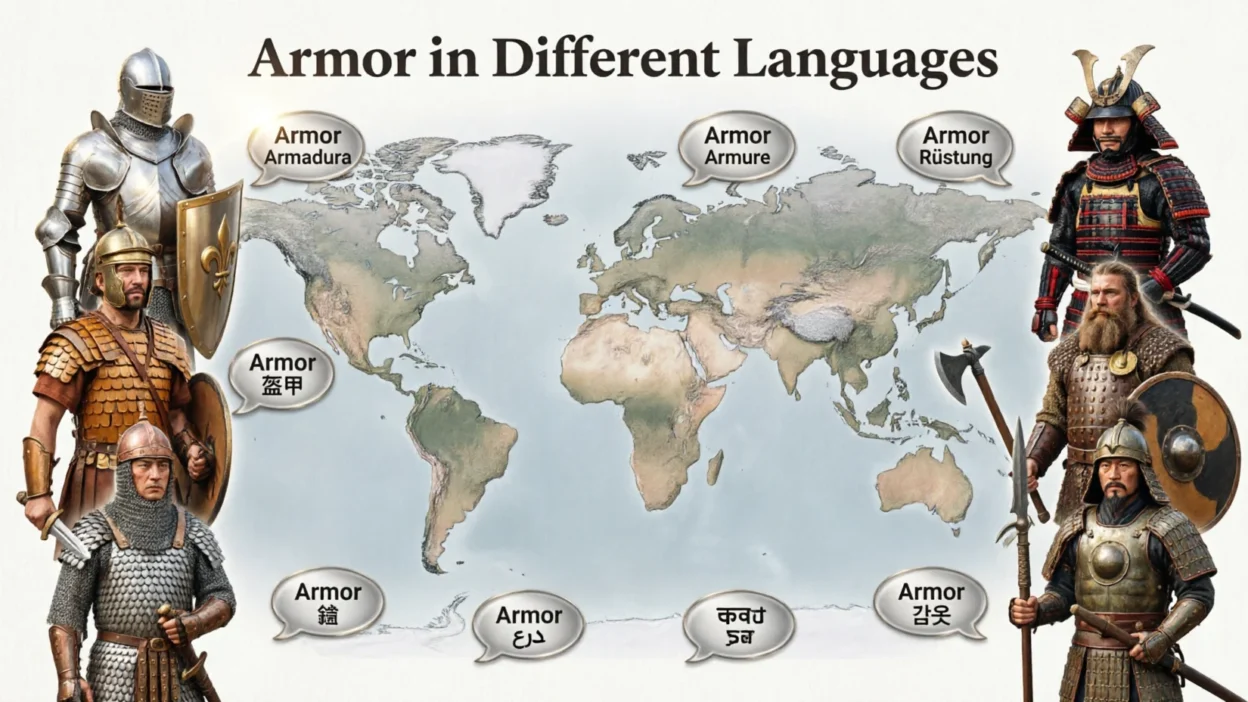
Armor has been used throughout history by knights, samurai, soldiers, and warriors in many civilizations. From medieval European plate armor to Japanese samurai armor, different cultures developed unique protective equipment suited to their needs and traditions.
Tips for Remembering Armor in Different Languages
- Practice five new translations each day.
- Say each pronunciation aloud.
- Use the word in simple example sentences.
- Watch historical documentaries in your target language.
- Review vocabulary with flashcards.
Common Uses of the Word “Armor”
- Discussing medieval history.
- Reading fantasy novels.
- Playing role-playing or strategy games.
- Visiting museums and historical sites.
- Learning military vocabulary.
Conclusion
Learning armor in different languages is a great way to expand your vocabulary while exploring world history and cultures. If you’re studying history, writing fiction, playing games, or learning a new language, these armor translations will help you communicate more effectively across languages.
FAQs:
1. How do you say armor in different languages?
Armor is translated differently across languages, including Armadura in Spanish, Armure in French, Rüstung in German, 盔甲 in Chinese, and 鎧 in Japanese.
2. Why should I learn armor translations?
Learning armor translations helps you understand historical texts, games, films, museums, and conversations about military history.
3. Is the meaning of armor the same in every language?
Generally, yes. It refers to protective clothing or equipment worn to defend the body, although the specific type of armor may vary by culture and historical period.
4. Can I use these translations while traveling?
Yes. They are useful when visiting museums, castles, historical landmarks, cultural exhibitions, and historical reenactments.
5. Where can I learn more historical words in different languages?
You can continue learning words like sword, shield, helmet, castle, king, queen, knight, and warrior in different languages.

Brandon Cody is the Administrator of LingoMean, a platform dedicated to helping people discover the right words for every situation. He oversees content quality, website management, and user experience, ensuring readers receive accurate, practical, and easy-to-understand communication guidance.