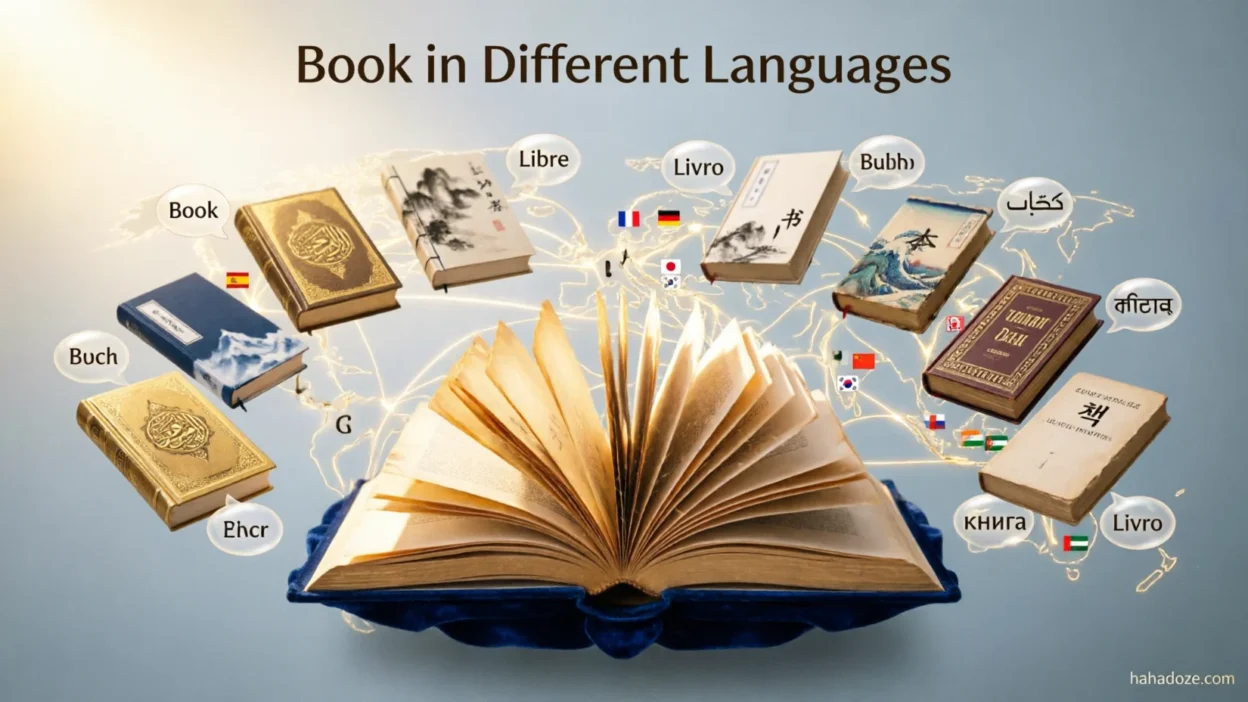
Books connect people across cultures, languages, and generations. If you are traveling, learning a new language, teaching students, or simply curious about world languages, knowing how to say book in different languages is both useful and fascinating.
In this guide, you’ll discover book in all languages, accurate book translations, simple English pronunciations, and real-life examples to help you use each word naturally. If you’ve ever wondered how to say book in different languages, this comprehensive table makes learning quick and easy.
From Europe and Asia to Africa and the Americas, these translations show how the simple word “book” is expressed around the world. The table below is designed for easy reading on mobile devices and is optimized for quick reference.
Book in Different Languages (70 Languages)
| Language | Native Phrase | English Pronunciation | Example Sentence | English Meaning |
|---|---|---|---|---|
| English | Book | Book | This is my book. | This is my book. |
| Spanish | Libro | LEE-broh | Este es mi libro. | This is my book. |
| French | Livre | LEE-vruh | C’est mon livre. | This is my book. |
| German | Buch | Bookh | Das ist mein Buch. | This is my book. |
| Italian | Libro | LEE-bro | Questo è il mio libro. | This is my book. |
| Portuguese | Livro | LEE-vroo | Este é meu livro. | This is my book. |
| Dutch | Boek | Book | Dit is mijn boek. | This is my book. |
| Swedish | Bok | Book | Det här är min bok. | This is my book. |
| Norwegian | Bok | Book | Dette er min bok. | This is my book. |
| Danish | Bog | Bohg | Dette er min bog. | This is my book. |
| Finnish | Kirja | KEER-yah | Tämä on minun kirjani. | This is my book. |
| Icelandic | Bók | Bohk | Þetta er bókin mín. | This is my book. |
| Irish | Leabhar | LYOW-er | Seo é mo leabhar. | This is my book. |
| Welsh | Llyfr | HLUV-er | Dyma fy llyfr. | This is my book. |
| Polish | Książka | KSHONZH-kah | To jest moja książka. | This is my book. |
| Czech | Kniha | KNEE-ha | To je moje kniha. | This is my book. |
| Slovak | Kniha | KNEE-ha | Toto je moja kniha. | This is my book. |
| Slovenian | Knjiga | KNEE-gah | To je moja knjiga. | This is my book. |
| Croatian | Knjiga | KNEE-gah | Ovo je moja knjiga. | This is my book. |
| Serbian | Књига | KNEE-gah | Ово је моја књига. | This is my book. |
| Bosnian | Knjiga | KNEE-gah | Ovo je moja knjiga. | This is my book. |
| Romanian | Carte | KAR-te | Aceasta este cartea mea. | This is my book. |
| Hungarian | Könyv | KURNV | Ez az én könyvem. | This is my book. |
| Greek | Βιβλίο | Vee-VLEE-o | Αυτό είναι το βιβλίο μου. | This is my book. |
| Russian | Книга | KNEE-gah | Это моя книга. | This is my book. |
| Ukrainian | Книга | KNEE-ha | Це моя книга. | This is my book. |
| Belarusian | Кніга | KNEE-ha | Гэта мая кніга. | This is my book. |
| Bulgarian | Книга | KNEE-gah | Това е моята книга. | This is my book. |
| Macedonian | Книга | KNEE-gah | Ова е мојата книга. | This is my book. |
| Albanian | Libër | LEE-ber | Ky është libri im. | This is my book. |
| Turkish | Kitap | Kee-TAP | Bu benim kitabım. | This is my book. |
| Arabic | كتاب | Kee-TAB | هذا كتابي. | This is my book. |
| Hebrew | ספר | SEH-fer | זה הספר שלי. | This is my book. |
| Persian | کتاب | Keh-TAB | این کتاب من است. | This is my book. |
| Urdu | کتاب | Ki-TAAB | یہ میری کتاب ہے۔ | This is my book. |
| Hindi | किताब | Ki-TAAB | यह मेरी किताब है। | This is my book. |
| Punjabi | ਕਿਤਾਬ | Ki-TAAB | ਇਹ ਮੇਰੀ ਕਿਤਾਬ ਹੈ। | This is my book. |
| Gujarati | પુસ્તક | PUS-tak | આ મારું પુસ્તક છે. | This is my book. |
| Marathi | पुस्तक | PUS-tak | हे माझे पुस्तक आहे. | This is my book. |
| Bengali | বই | BOI | এটি আমার বই। | This is my book. |
| Assamese | কিতাপ | Kee-TAP | এইখন মোৰ কিতাপ। | This is my book. |
| Odia | ବହି | BO-hi | ଏହା ମୋର ବହି। | This is my book. |
| Nepali | किताब | Ki-TAAB | यो मेरो किताब हो। | This is my book. |
| Sinhala | පොත | PO-tha | මේ මගේ පොතයි. | This is my book. |
| Tamil | புத்தகம் | PUTH-tha-gam | இது என் புத்தகம். | This is my book. |
| Telugu | పుస్తకం | PUS-ta-kam | ఇది నా పుస్తకం. | This is my book. |
| Kannada | ಪುಸ್ತಕ | PUS-ta-ka | ಇದು ನನ್ನ ಪುಸ್ತಕ. | This is my book. |
| Malayalam | പുസ്തകം | PUS-tha-kam | ഇത് എന്റെ പുസ്തകമാണ്. | This is my book. |
| Chinese (Simplified) | 书 | SHOO | 这是我的书。 | This is my book. |
| Japanese | 本 | Hon | これは私の本です。 | This is my book. |
| Korean | 책 | Chek | 이것은 제 책입니다. | This is my book. |
| Vietnamese | Sách | Sahk | Đây là sách của tôi. | This is my book. |
| Thai | หนังสือ | Nang-Sue | นี่คือหนังสือของฉัน | This is my book. |
| Indonesian | Buku | BOO-koo | Ini buku saya. | This is my book. |
| Malay | Buku | BOO-koo | Ini buku saya. | This is my book. |
| Filipino | Aklat | Ak-LAT | Ito ang aking aklat. | This is my book. |
| Burmese | စာအုပ် | Sa-Oke | ဒါက ကျွန်တော့်စာအုပ်ပါ။ | This is my book. |
| Khmer | សៀវភៅ | Seev-Pov | នេះជាសៀវភៅរបស់ខ្ញុំ។ | This is my book. |
| Lao | ປຶ້ມ | Peum | ນີ້ແມ່ນປຶ້ມຂອງຂ້ອຍ. | This is my book. |
| Mongolian | Ном | Nom | Энэ бол миний ном. | This is my book. |
| Swahili | Kitabu | Kee-TA-boo | Hiki ni kitabu changu. | This is my book. |
| Zulu | Incwadi | In-CWA-dee | Lena yincwadi yami. | This is my book. |
| Xhosa | Incwadi | In-CWA-dee | Le yincwadi yam. | This is my book. |
| Afrikaans | Boek | Book | Dit is my boek. | This is my book. |
| Hausa | Littafi | Lit-TA-fi | Wannan littafina ne. | This is my book. |
| Yoruba | Ìwé | EE-weh | Èyí ni ìwé mi. | This is my book. |
| Igbo | Akwụkwọ | Ah-KWOO-kwo | Nke a bụ akwụkwọ m. | This is my book. |
| Amharic | መጽሐፍ | Mets-haf | ይህ መጽሐፌ ነው። | This is my book. |
| Somali | Buug | BOOG | Kani waa buuggayga. | This is my book. |
| Hawaiian | Puke | POO-keh | ʻO kēia kaʻu puke. | This is my book. |
| Maori | Pukapuka | POO-ka-POO-ka | Ko taku pukapuka tenei. | This is my book. |
| Latin | Liber | LEE-ber | Hic est liber meus. | This is my book. |
| Esperanto | Libro | LEE-bro | Ĉi tiu estas mia libro. | This is my book. |
What Does “Book” Mean?
A book is a collection of written, printed, or digital pages containing information, stories, knowledge, or ideas. Books are one of the oldest and most important ways people preserve history, education, culture, and entertainment.
Today, books are available in printed and digital formats, making them accessible to readers across the globe.
Why Learn “Book” in Different Languages?
Learning the word book in multiple languages offers several benefits:
- Improve your vocabulary quickly.
- Communicate more confidently while traveling.
- Understand multilingual conversations.
- Help children and students learn new languages.
- Expand your cultural knowledge.
- Support translation and language-learning projects.
Book Translations Around the World
Although pronunciation and spelling vary widely, every language has its own unique word for book. Many European languages share similar roots, while Asian and African languages often have completely different words influenced by their own linguistic history.
Knowing these translations can make communication easier and deepen your appreciation for global cultures.
Tips to Remember the Word “Book” in Different Languages
- Practice five new languages each day.
- Say each word aloud to improve pronunciation.
- Use the example sentences in everyday practice.
- Create flashcards for faster memorization.
- Watch videos or read books in your target language.
Conclusion
Learning book in different languages is a simple yet meaningful way to explore cultures from around the world. If you’re a traveler, student, teacher, writer, or language enthusiast, these translations help you communicate more effectively and expand your vocabulary.
Keep practicing the words and example sentences to remember them more easily and build confidence in multilingual conversations.
FAQs:
1. How do you say book in different languages?
The word “book” has different translations depending on the language. For example, Libro in Spanish, Livre in French, Buch in German, 书 in Chinese, and 本 in Japanese.
2. What is the most common translation of book?
Common translations include Libro, Livre, Buch, Kitab, and 书, depending on the language being spoken.
3. Why do book translations differ between languages?
Languages evolved independently over centuries, so each developed its own vocabulary, pronunciation, and writing system.
4. Is “book” pronounced the same in every language?
No. Every language has its own pronunciation rules, accents, and sounds, making each translation unique.
5. Can learning simple words like “book” improve language skills?
Yes. Learning everyday vocabulary such as “book” builds a strong foundation for speaking, reading, and understanding a new language.

Brandon Cody is the Administrator of LingoMean, a platform dedicated to helping people discover the right words for every situation. He oversees content quality, website management, and user experience, ensuring readers receive accurate, practical, and easy-to-understand communication guidance.