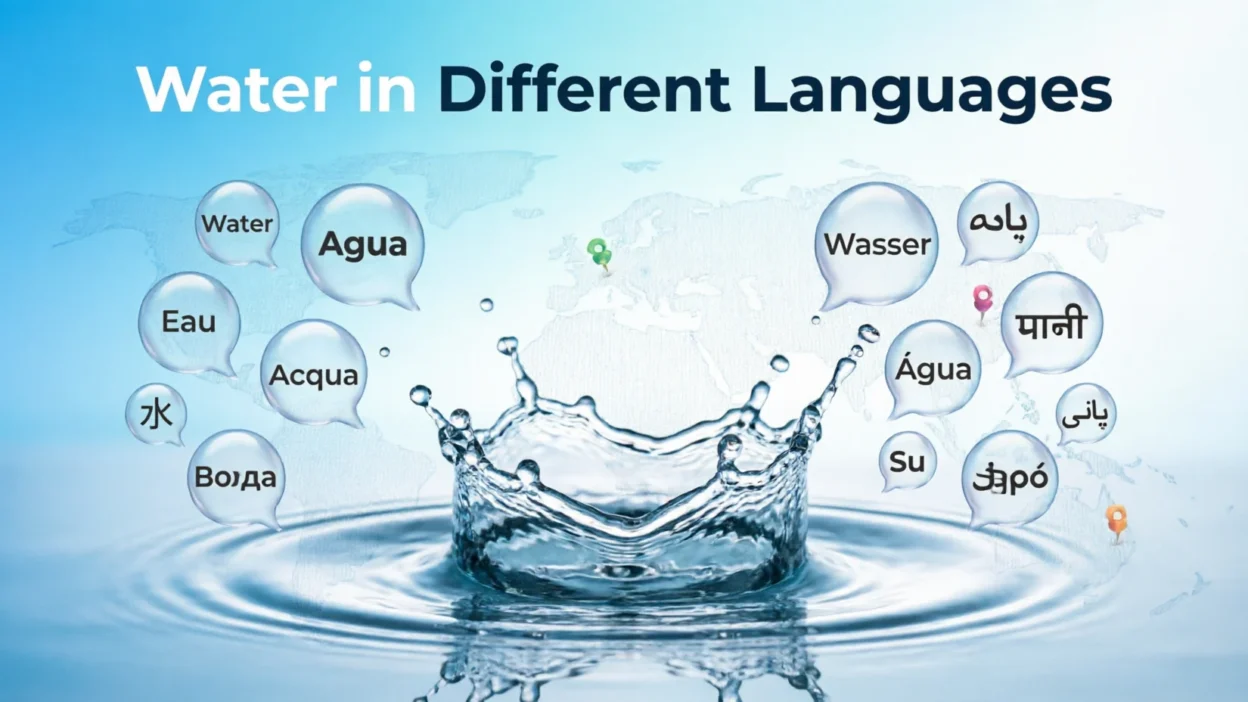
If is one of the most essential words to know when traveling, learning a new language, or exploring different cultures. If you’re asking for a drink, reading a menu, or practicing vocabulary, learning water in different languages can be incredibly useful.
This guide features water in all languages, making it easy to discover how to say water in different languages, understand common water translations, and explore how people refer to this vital resource around the world.
Each translation includes the native word, an easy English pronunciation, a simple real-life example sentence, and its English meaning to help you remember the word naturally.
If you’re a student, traveler, language learner, or simply curious about world languages, this complete list will help you expand your vocabulary while appreciating linguistic diversity.
Water in Different Languages (70 Languages)
| Language | Native Phrase | Easy English Pronunciation | Example Sentence | English Meaning |
|---|---|---|---|---|
| English | Water | WAW-ter | Can I have some water? | Can I have some water? |
| Spanish | Agua | AH-gwah | Quiero agua. | I want water. |
| French | Eau | Oh | Je veux de l’eau. | I want water. |
| German | Wasser | VAH-ser | Ich brauche Wasser. | I need water. |
| Italian | Acqua | AHK-kwah | Voglio acqua. | I want water. |
| Portuguese | Água | AH-gwah | Eu quero água. | I want water. |
| Dutch | Water | VAH-ter | Ik wil water. | I want water. |
| Danish | Vand | Van | Jeg vil have vand. | I want water. |
| Swedish | Vatten | VAHT-en | Jag vill ha vatten. | I want water. |
| Norwegian | Vann | Vahn | Jeg vil ha vann. | I want water. |
| Finnish | Vesi | VEH-see | Haluan vettä. | I want water. |
| Icelandic | Vatn | Vahtn | Ég vil fá vatn. | I want water. |
| Irish | Uisce | ISH-ka | Ba mhaith liom uisce. | I would like water. |
| Welsh | Dŵr | Door | Hoffwn ddŵr. | I would like water. |
| Scottish Gaelic | Uisge | OOSH-keh | Bu toil leam uisge. | I would like water. |
| Russian | Вода | Va-DA | Мне нужна вода. | I need water. |
| Ukrainian | Вода | Vo-DA | Мені потрібна вода. | I need water. |
| Belarusian | Вада | VA-da | Мне патрэбна вада. | I need water. |
| Polish | Woda | VO-da | Poproszę wodę. | Water, please. |
| Czech | Voda | VO-da | Chci vodu. | I want water. |
| Slovak | Voda | VO-da | Chcem vodu. | I want water. |
| Slovenian | Voda | VO-da | Rad bi vodo. | I would like water. |
| Croatian | Voda | VO-da | Molim vodu. | Water, please. |
| Serbian | Вода | VO-da | Molim vodu. | Water, please. |
| Bosnian | Voda | VO-da | Molim vodu. | Water, please. |
| Bulgarian | Вода | Vo-DA | Искам вода. | I want water. |
| Romanian | Apă | AH-puh | Vreau apă. | I want water. |
| Albanian | Ujë | OO-yuh | Dua ujë. | I want water. |
| Greek | Νερό | Ne-RO | Θέλω νερό. | I want water. |
| Turkish | Su | Soo | Su istiyorum. | I want water. |
| Arabic | ماء | Mah | أريد ماء. | I want water. |
| Hebrew | מים | MA-yim | אני רוצה מים. | I want water. |
| Persian | آب | Aab | آب میخواهم. | I want water. |
| Urdu | پانی | PAA-ni | مجھے پانی چاہیے۔ | I need water. |
| Hindi | पानी | PAA-ni | मुझे पानी चाहिए। | I need water. |
| Punjabi | ਪਾਣੀ | PAA-nee | ਮੈਨੂੰ ਪਾਣੀ ਚਾਹੀਦਾ ਹੈ। | I need water. |
| Bengali | পানি | PAA-ni | আমার পানি চাই। | I want water. |
| Gujarati | પાણી | PAA-ni | મને પાણી જોઈએ. | I need water. |
| Marathi | पाणी | PAA-ni | मला पाणी पाहिजे. | I need water. |
| Nepali | पानी | PAA-ni | मलाई पानी चाहिन्छ। | I need water. |
| Sinhala | වතුර | Va-thu-ra | මට වතුර ඕනෑ. | I need water. |
| Tamil | தண்ணீர் | Thun-NEER | எனக்கு தண்ணீர் வேண்டும். | I need water. |
| Telugu | నీరు | NEE-roo | నాకు నీరు కావాలి. | I need water. |
| Kannada | ನೀರು | NEE-roo | ನನಗೆ ನೀರು ಬೇಕು. | I need water. |
| Malayalam | വെള്ളം | VEL-lum | എനിക്ക് വെള്ളം വേണം. | I need water. |
| Thai | น้ำ | Nam | ฉันต้องการน้ำ | I need water. |
| Vietnamese | Nước | Nook | Tôi muốn nước. | I want water. |
| Indonesian | Air | AH-eer | Saya mau air. | I want water. |
| Malay | Air | AH-eer | Saya mahu air. | I want water. |
| Filipino | Tubig | TOO-big | Gusto ko ng tubig. | I want water. |
| Chinese (Mandarin) | 水 | Shway | 我要水。 | I want water. |
| Cantonese | 水 | Soy | 我要水。 | I want water. |
| Japanese | 水 | Mee-zoo | 水をください。 | Water, please. |
| Korean | 물 | Mool | 물 주세요. | Water, please. |
| Mongolian | Ус | Oos | Надад ус хэрэгтэй. | I need water. |
| Khmer | ទឹក | Teuk | ខ្ញុំចង់បានទឹក។ | I want water. |
| Lao | ນ້ຳ | Nam | ຂ້ອຍຕ້ອງການນ້ຳ. | I need water. |
| Burmese | ရေ | Yay | ရေလိုချင်တယ်။ | I want water. |
| Swahili | Maji | MAH-jee | Nataka maji. | I want water. |
| Zulu | Amanzi | Ah-MAHN-zee | Ngifuna amanzi. | I want water. |
| Xhosa | Amanzi | Ah-MAHN-zee | Ndifuna amanzi. | I want water. |
| Afrikaans | Water | VAA-ter | Ek wil water hê. | I want water. |
| Amharic | ውሃ | Woo-ha | ውሃ እፈልጋለሁ። | I need water. |
| Somali | Biyo | BEE-yo | Biyo ayaan rabaa. | I want water. |
| Hausa | Ruwa | ROO-wa | Ina son ruwa. | I want water. |
| Yoruba | Omi | OH-mee | Mo fẹ omi. | I want water. |
| Igbo | Mmiri | M-MEE-ree | Achọrọ m mmiri. | I need water. |
| Maori | Wai | Why | Kei te hiahia ahau ki te wai. | I want water. |
| Hawaiian | Wai | Why | Makemake au i ka wai. | I want water. |
| Samoan | Vai | VAI | Ou te manaʻo i le vai. | I want water. |
| Esperanto | Akvo | AHK-vo | Mi volas akvon. | I want water. |
| Latin | Aqua | AH-kwa | Aquam volo. | I want water. |
Why Learn the Word “Water” in Different Languages?
Knowing how to say “water” is one of the most practical language skills you can have. It helps in everyday conversations, especially when traveling, dining out, or asking for assistance.
Learning common vocabulary like this also improves pronunciation, strengthens memory, and builds confidence when speaking with native speakers.
How to Remember Water Translations Easily
Here are a few simple ways to remember these words:
- Practice five new languages each day.
- Repeat the pronunciation aloud.
- Use the example sentences in conversation.
- Create flashcards with the native word and pronunciation.
- Review regularly to improve long-term memory.
Interesting Facts About the Word “Water”
- Many European languages have similar words, such as water, wasser, water, and vatten, because they share historical language roots.
- In many South Asian languages, the word for water is very similar, such as pani in Hindi, Urdu, Punjabi, Marathi, Nepali, and Gujarati.
- The Latin word aqua is still used in many English words, including aquarium, aquatic, and aqueduct.
- Some languages use completely unique words, reflecting their own cultural and linguistic history.
Water Around the World
Although every culture has its own language, water remains one of the most universal human needs. Learning water in different languages helps travelers communicate more easily, enriches vocabulary for students, and provides fascinating insights into global cultures.
Whether you’re preparing for international travel or simply exploring languages for fun, these translations are a practical addition to your language-learning journey.
Conclusion
Learning water in different languages is a simple yet valuable way to connect with people across cultures. From Europe and Asia to Africa and the Pacific Islands, every language has its own unique word for this everyday necessity.
By practicing these translations and example sentences, you’ll improve your vocabulary, gain confidence while traveling, and better appreciate the richness of world languages.
FAQs:
1. How do you say water in different languages?
The word varies by language. For example, Agua in Spanish, Eau in French, Wasser in German, Mizu in Japanese, and Pani in Hindi and Urdu.
2. Why should I learn the word “water” in multiple languages?
It is one of the most useful travel words and helps you communicate in restaurants, hotels, airports, and everyday situations.
3. Which languages use similar words for water?
Many European languages share similar words due to common linguistic origins, while several South Asian languages use forms of Pani.
4. Is “water” one of the first words language learners should know?
Yes. It is considered an essential vocabulary word because it is frequently used in daily life and travel.
5. What is the easiest way to remember water in different languages?
Practice a few words each day, repeat their pronunciation aloud, and use example sentences to reinforce your memory.

Evelyn Grace is a language enthusiast and content writer at LingoMean, where she explains the meaning of words, phrases, and expressions. She creates clear, practical, and engaging content that helps readers confidently understand what to say in everyday conversations.