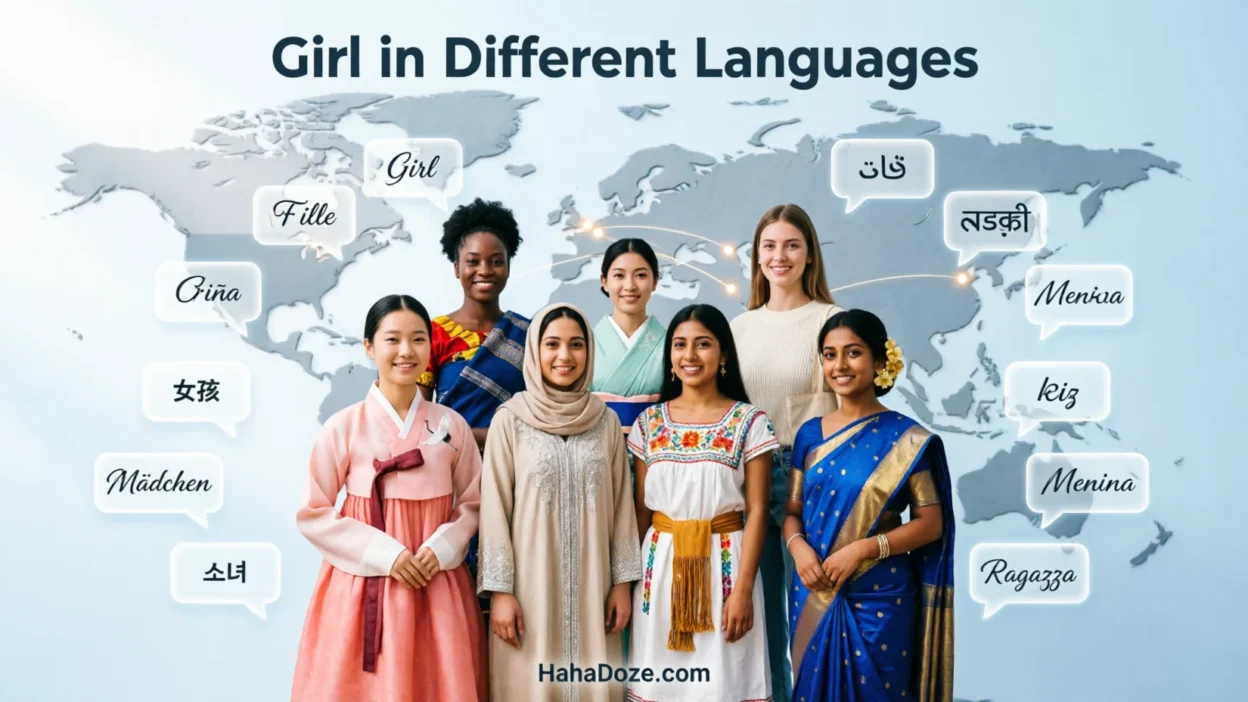
Have you ever wondered how to say girl in different languages? If you’re learning a new language, traveling, writing a story, or simply expanding your vocabulary, knowing how different cultures refer to a girl is both interesting and useful.
Every language has its own unique word for “girl,” and many of these terms reflect cultural traditions, pronunciation styles, and linguistic history.
In this guide, you’ll discover 70 translations of girl in different languages, along with their pronunciations, example sentences, and English meanings.
This easy-to-read resource is perfect for students, travelers, language learners, and anyone curious about languages around the world.
Girl in Different Languages Table
| Language | Native Word | Pronunciation | Example Sentence | English Meaning |
|---|---|---|---|---|
| English | Girl | gurl | The girl is reading a book. | The girl is reading a book. |
| Spanish | Niña | NEE-nyah | La niña juega en el parque. | The girl plays in the park. |
| French | Fille | fee | La fille est heureuse. | The girl is happy. |
| German | Mädchen | MED-chen | Das Mädchen lacht. | The girl is laughing. |
| Italian | Ragazza | rah-GAHT-tsah | La ragazza canta. | The girl is singing. |
| Portuguese | Menina | meh-NEE-nah | A menina sorri. | The girl smiles. |
| Dutch | Meisje | MICE-yuh | Het meisje leest. | The girl is reading. |
| Swedish | Flicka | FLIK-ah | Flickan springer. | The girl is running. |
| Norwegian | Jente | YEN-teh | Jenta synger. | The girl sings. |
| Danish | Pige | PEE-geh | Pigen danser. | The girl dances. |
| Finnish | Tyttö | TUUT-to | Tyttö hymyilee. | The girl smiles. |
| Icelandic | Stelpa | STEL-pa | Stelpan hlær. | The girl laughs. |
| Irish | Cailín | kah-LEEN | Tá an cailín ag rith. | The girl is running. |
| Welsh | Merch | merkh | Mae’r ferch yn darllen. | The girl is reading. |
| Scottish Gaelic | Nighean | NEE-an | Tha an nighean toilichte. | The girl is happy. |
| Polish | Dziewczynka | jev-CHIN-kah | Dziewczynka śpiewa. | The girl sings. |
| Czech | Dívka | DEEV-kah | Dívka čte. | The girl is reading. |
| Slovak | Dievča | DEE-ev-cha | Dievča sa usmieva. | The girl smiles. |
| Slovenian | Deklica | deh-KLEE-tsa | Deklica teče. | The girl runs. |
| Croatian | Djevojčica | dye-VOY-chee-tsa | Djevojčica pjeva. | The girl sings. |
| Serbian | Девојчица | deh-VOY-chee-tsa | Девојчица трчи. | The girl runs. |
| Bosnian | Djevojčica | dye-VOY-chee-tsa | Djevojčica čita. | The girl reads. |
| Romanian | Fată | FAH-tuh | Fata zâmbește. | The girl smiles. |
| Albanian | Vajzë | VAI-zuh | Vajza këndon. | The girl sings. |
| Greek | Κορίτσι | ko-REE-tsee | Το κορίτσι γελάει. | The girl is laughing. |
| Russian | Девочка | DYE-voch-ka | Девочка играет. | The girl is playing. |
| Ukrainian | Дівчинка | DEEV-chyn-ka | Дівчинка читає. | The girl is reading. |
| Belarusian | Дзяўчынка | DZYOW-chin-ka | Дзяўчынка спявае. | The girl sings. |
| Bulgarian | Момиче | MO-mi-che | Момичето тича. | The girl is running. |
| Macedonian | Девојче | deh-VOY-che | Девојчето игра. | The girl is playing. |
| Turkish | Kız | kuz | Kız gülümsüyor. | The girl is smiling. |
| Arabic | فتاة | fa-TAH | الفتاة تدرس. | The girl is studying. |
| Hebrew | ילדה | yal-DAH | הילדה רצה. | The girl is running. |
| Persian | دختر | dokh-TAR | دختر میخندد. | The girl is laughing. |
| Urdu | لڑکی | LUR-kee | لڑکی کتاب پڑھ رہی ہے۔ | The girl is reading a book. |
| Hindi | लड़की | LUR-kee | लड़की गाना गा रही है। | The girl is singing. |
| Punjabi | ਕੁੜੀ | koo-REE | ਕੁੜੀ ਹੱਸ ਰਹੀ ਹੈ। | The girl is laughing. |
| Bengali | মেয়ে | MAY-eh | মেয়েটি খেলছে। | The girl is playing. |
| Gujarati | છોકરી | cho-KREE | છોકરી વાંચે છે. | The girl is reading. |
| Marathi | मुलगी | MOOL-gee | मुलगी हसते. | The girl smiles. |
| Tamil | பெண் | pen | பெண் பாடுகிறாள். | The girl is singing. |
| Telugu | అమ్మాయి | am-MY-ee | అమ్మాయి చదువుతోంది. | The girl is studying. |
| Kannada | ಹುಡುಗಿ | hoo-DOO-gi | ಹುಡುಗಿ ಓದುತ್ತಾಳೆ. | The girl is reading. |
| Malayalam | പെൺകുട്ടി | pen-KOO-tee | പെൺകുട്ടി ഓടുന്നു. | The girl is running. |
| Sinhala | ගැහැණු ළමයා | geh-HAY-nu la-MA-ya | ඇය සිනාසෙයි. | The girl smiles. |
| Nepali | केटी | KAY-tee | केटी पढ्दैछ। | The girl is studying. |
| Chinese (Mandarin) | 女孩 | nyoo-HIGH | 女孩在看书。 | The girl is reading. |
| Cantonese | 女仔 | neoi-JAI | 女仔笑緊。 | The girl is smiling. |
| Japanese | 女の子 | on-na-no-ko | 女の子は遊んでいます。 | The girl is playing. |
| Korean | 소녀 | so-NYUH | 소녀가 웃어요. | The girl is smiling. |
| Vietnamese | Cô gái | koh GAI | Cô gái đang hát. | The girl is singing. |
| Thai | เด็กผู้หญิง | dek POO-ying | เด็กผู้หญิงกำลังวิ่ง. | The girl is running. |
| Indonesian | Gadis | GAH-dis | Gadis itu tersenyum. | The girl is smiling. |
| Malay | Gadis | GAH-dis | Gadis itu membaca. | The girl is reading. |
| Filipino | Babae | ba-BAH-eh | Ang babae ay masaya. | The girl is happy. |
| Burmese | မိန်းကလေး | main-ka-LAY | မိန်းကလေး ရယ်နေသည်။ | The girl is laughing. |
| Khmer | ក្មេងស្រី | kmeng SREY | ក្មេងស្រីអានសៀវភៅ។ | The girl is reading. |
| Lao | ເດັກຍິງ | dek YING | ເດັກຍິງກຳລັງແລ່ນ. | The girl is running. |
| Mongolian | Охин | OH-khin | Охин инээж байна. | The girl is smiling. |
| Kazakh | Қыз | kuz | Қыз ән айтып тұр. | The girl is singing. |
| Uzbek | Qiz | kiz | Qiz kitob o‘qiyapti. | The girl is reading. |
| Azerbaijani | Qız | guz | Qız gülür. | The girl is laughing. |
| Georgian | გოგონა | go-go-NA | გოგონა კითხულობს. | The girl is reading. |
| Armenian | Աղջիկ | agh-JEEK | Աղջիկը երգում է։ | The girl is singing. |
| Swahili | Msichana | msee-CHA-na | Msichana anakimbia. | The girl is running. |
| Zulu | Intombazane | in-tom-ba-ZAH-neh | Intombazane iyahleka. | The girl is laughing. |
| Xhosa | Intombazana | in-tom-ba-ZAH-na | Intombazana iyacula. | The girl is singing. |
| Afrikaans | Meisie | MAY-see | Die meisie lees. | The girl is reading. |
| Yoruba | Ọmọbìnrin | oh-moh-BEEN-rin | Ọmọbìnrin náà ń rẹ́rìn-ín. | The girl is smiling. |
| Igbo | Nwata nwanyị | nwa-ta nwan-YEE | Nwata nwanyị na-agụ akwụkwọ. | The girl is reading. |
| Hausa | Yarinya | yah-RIN-ya | Yarinya tana dariya. | The girl is laughing. |
| Amharic | ልጃገረድ | lij-ja-ge-RED | ልጃገረዷ ትስቃለች። | The girl is smiling. |
| Esperanto | Knabino | knah-bee-NO | La knabino kuras. | The girl is running. |
| Latin | Puella | poo-EL-la | Puella cantat. | The girl sings. |
Why Learn “Girl” in Different Languages?
Learning girl in all languages helps improve communication, cultural understanding, and vocabulary. It is especially useful for travelers, students, translators, writers, and anyone interested in world languages.
How to Say Girl in Different Languages Correctly
Although translations are easy to memorize, pronunciation varies from language to language. Listening to native speakers and practicing aloud can improve your accuracy and confidence.
Common Uses of Girl Translations Around the World
People commonly search for girl translations to:
- Learn foreign languages
- Prepare for international travel
- Create multilingual educational content
- Write books or stories
- Improve cultural awareness
Conclusion
Knowing girl in different languages is a fun and practical way to explore global cultures. With these 70 translations, pronunciations, and example sentences, you can confidently recognize and use the word “girl” in many parts of the world while expanding your language skills.
FAQs:
1. How do you say girl in different languages?
Different languages use different words, such as niña in Spanish, fille in French, Mädchen in German, and 女孩 in Chinese.
2. Why are there different translations for girl?
Each language has its own vocabulary, grammar, and cultural history, which creates unique words for the same concept.
3. Which language has the easiest word for girl?
Words like girl, gadis, qiz, and niña are generally easy for beginners to learn.
4. Can I use these translations while traveling?
Yes. Learning basic words like “girl” can help you communicate more naturally and understand local conversations.
5. Are these translations accurate?
Yes. These are commonly accepted translations, though pronunciation and usage may vary slightly by region and dialect.

Anthony Dylan is a language enthusiast and content writer at LingoMean, where he helps readers understand what to say in different situations. He creates clear, practical, and engaging guides that improve communication, confidence, and everyday conversations.