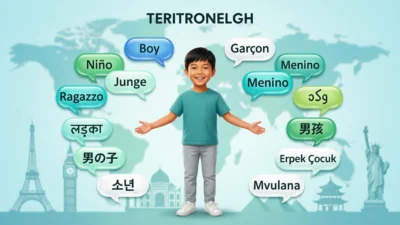
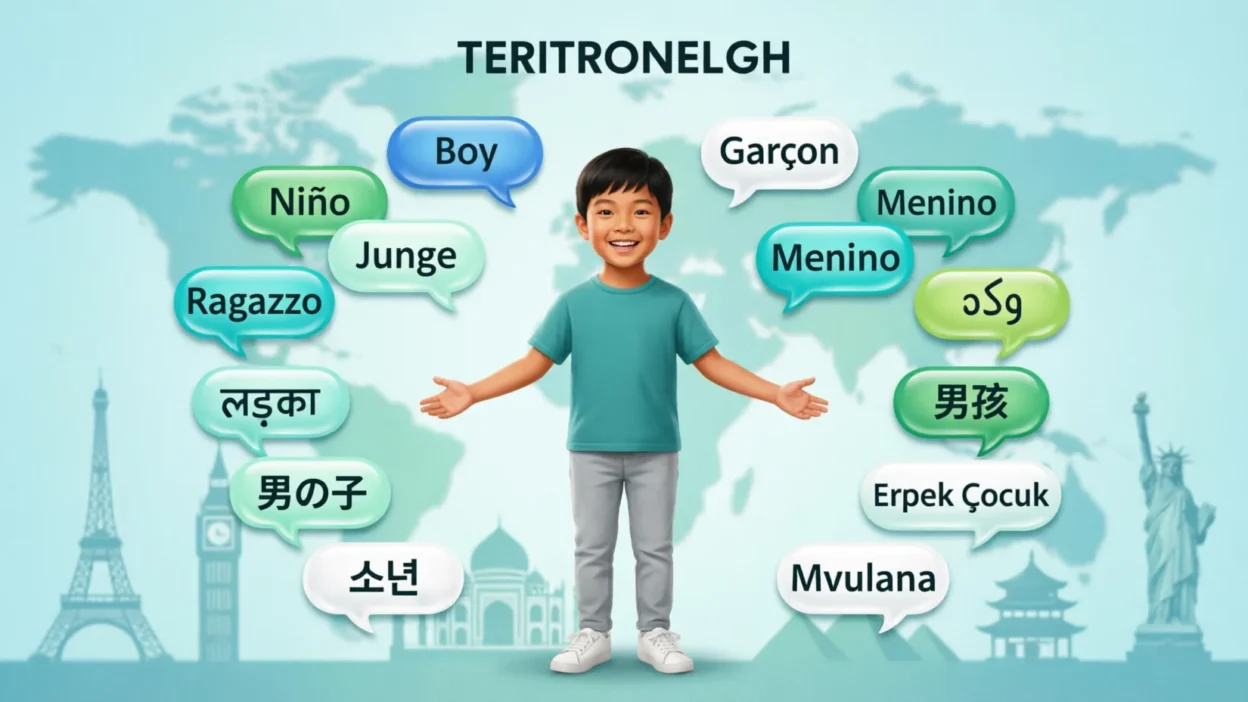
A single word can connect people across cultures, and boy is one of those universal words. If you’re traveling, learning a new language, teaching children, or simply curious about world languages, knowing how to say boy in different languages is both fun and useful.
This guide brings together 70 different languages with their native translations, easy English pronunciations, and practical examples.
If you’ve ever wondered how to say boy in different languages, or wanted to explore boy translations from around the world, this comprehensive table has everything you need in one place.
Boy in All Languages
| Language | Native Word | Pronunciation | Example Sentence | English Meaning |
|---|---|---|---|---|
| English | Boy | Boy | The boy is playing outside. | The boy is playing outside. |
| Spanish | Niño | NEE-nyoh | El niño juega en el parque. | The boy plays in the park. |
| French | Garçon | Gar-son | Le garçon court vite. | The boy runs fast. |
| German | Junge | YOON-guh | Der Junge liest ein Buch. | The boy is reading a book. |
| Italian | Ragazzo | Rah-GAHT-so | Il ragazzo sorride. | The boy is smiling. |
| Portuguese | Menino | Meh-NEE-noo | O menino canta. | The boy is singing. |
| Dutch | Jongen | YONG-en | De jongen lacht. | The boy is laughing. |
| Swedish | Pojke | POY-keh | Pojken springer. | The boy is running. |
| Norwegian | Gutt | Goot | Gutten svømmer. | The boy is swimming. |
| Danish | Dreng | Dreng | Drengen leger. | The boy is playing. |
| Finnish | Poika | POY-kah | Poika lukee. | The boy is reading. |
| Icelandic | Drengur | DREN-gur | Drengurinn brosir. | The boy is smiling. |
| Irish | Buachaill | BOO-ah-kil | Tá an buachaill anseo. | The boy is here. |
| Welsh | Bachgen | BAKH-gen | Mae’r bachgen yn hapus. | The boy is happy. |
| Scottish Gaelic | Balach | BAL-akh | Tha am balach òg. | The boy is young. |
| Polish | Chłopiec | HWOH-pyets | Chłopiec biegnie. | The boy is running. |
| Czech | Chlapec | HLAH-pets | Chlapec čte. | The boy is reading. |
| Slovak | Chlapec | HLAH-pets | Chlapec spieva. | The boy is singing. |
| Slovenian | Fant | Fahnt | Fant se smeje. | The boy is laughing. |
| Croatian | Dječak | DJEH-chak | Dječak trči. | The boy is running. |
| Serbian | Дечак | DEH-chak | Дечак чита. | The boy is reading. |
| Bosnian | Dječak | DJEH-chak | Dječak igra. | The boy is playing. |
| Romanian | Băiat | Buh-YAT | Băiatul vine. | The boy is coming. |
| Bulgarian | Момче | MOM-che | Момчето играе. | The boy is playing. |
| Greek | Αγόρι | Ah-GO-ree | Το αγόρι γελάει. | The boy is laughing. |
| Albanian | Djalë | DJAH-luh | Djali vrapon. | The boy is running. |
| Russian | Мальчик | MAL-chik | Мальчик читает. | The boy is reading. |
| Ukrainian | Хлопчик | HLOP-chyk | Хлопчик грається. | The boy is playing. |
| Belarusian | Хлопчык | HLOP-chik | Хлопчык усміхаецца. | The boy is smiling. |
| Lithuanian | Berniukas | Ber-nee-OO-kas | Berniukas bėga. | The boy is running. |
| Latvian | Zēns | ZAYNS | Zēns lasa. | The boy is reading. |
| Estonian | Poiss | POYS | Poiss mängib. | The boy is playing. |
| Turkish | Erkek çocuk | Er-kek cho-joouk | Erkek çocuk koşuyor. | The boy is running. |
| Arabic | ولد | Walad | الولد يقرأ. | The boy is reading. |
| Hebrew | ילד | Yeled | הילד משחק. | The boy is playing. |
| Persian | پسر | Pesar | پسر میخندد. | The boy is laughing. |
| Urdu | لڑکا | Larka | لڑکا دوڑ رہا ہے۔ | The boy is running. |
| Hindi | लड़का | Ladka | लड़का खेल रहा है। | The boy is playing. |
| Punjabi | ਮੁੰਡਾ | Munda | ਮੁੰਡਾ ਹੱਸ ਰਿਹਾ ਹੈ। | The boy is laughing. |
| Bengali | ছেলে | Chele | ছেলেটি দৌড়াচ্ছে। | The boy is running. |
| Gujarati | છોકરો | Chhokro | છોકરો રમે છે. | The boy is playing. |
| Marathi | मुलगा | Mulga | मुलगा वाचतो. | The boy is reading. |
| Nepali | केटा | Keta | केटा हाँस्छ। | The boy is smiling. |
| Sinhala | පිරිමි ළමයා | Pirimi Lamaya | පිරිමි ළමයා දුවයි. | The boy runs. |
| Tamil | சிறுவன் | Siruvan | சிறுவன் ஓடுகிறான். | The boy is running. |
| Telugu | అబ్బాయి | Abbayi | అబ్బాయి చదువుతున్నాడు. | The boy is studying. |
| Kannada | ಹುಡುಗ | Huduga | ಹುಡುಗ ಆಡುತ್ತಿದ್ದಾನೆ. | The boy is playing. |
| Malayalam | ആൺകുട്ടി | Aankutty | ആൺകുട്ടി ചിരിക്കുന്നു. | The boy is smiling. |
| Assamese | ল’ৰা | Lora | ল’ৰাটো দৌৰিছে। | The boy is running. |
| Odia | ପୁଅ | Pua | ପୁଅ ଖେଳୁଛି। | The boy is playing. |
| Sanskrit | बालकः | Balakah | बालकः पठति। | The boy reads. |
| Chinese (Mandarin) | 男孩 | Nan Hai | 男孩在跑。 | The boy is running. |
| Cantonese | 男仔 | Naam Jai | 男仔笑緊。 | The boy is smiling. |
| Japanese | 男の子 | Otoko no Ko | 男の子が遊んでいます。 | The boy is playing. |
| Korean | 소년 | So-nyeon | 소년이 달립니다. | The boy is running. |
| Vietnamese | Cậu bé | Cow Bay | Cậu bé cười. | The boy is smiling. |
| Thai | เด็กชาย | Dek Chai | เด็กชายวิ่ง. | The boy is running. |
| Indonesian | Anak laki-laki | Anak Lah-kee Lah-kee | Anak laki-laki bermain. | The boy is playing. |
| Malay | Budak lelaki | Boo-dak Luh-luh-kee | Budak lelaki ketawa. | The boy is laughing. |
| Filipino | Batang lalaki | Ba-tang Lah-lah-kee | Batang lalaki tumatakbo. | The boy is running. |
| Khmer | ក្មេងប្រុស | Kmeng Pros | ក្មេងប្រុសលេង។ | The boy is playing. |
| Lao | ເດັກຊາຍ | Dek Chai | ເດັກຊາຍແລ່ນ. | The boy runs. |
| Burmese | ကောင်လေး | Kaung Lay | ကောင်လေးရယ်တယ်။ | The boy is laughing. |
| Mongolian | Хүү | Huu | Хүү уншиж байна. | The boy is reading. |
| Swahili | Mvulana | Mvoo-LAH-na | Mvulana anakimbia. | The boy is running. |
| Zulu | Umfana | Oom-FAH-na | Umfana uyadlala. | The boy is playing. |
| Xhosa | Inkwenkwe | In-kwen-kweh | Inkwenkwe iyahleka. | The boy is laughing. |
| Afrikaans | Seun | Say-un | Die seun lees. | The boy is reading. |
| Hausa | Yaro | YAH-ro | Yaro yana wasa. | The boy is playing. |
| Yoruba | Ọmọkùnrin | O-mo-koon-rin | Ọmọkùnrin náà ń rẹ́rìn-ín. | The boy is smiling. |
| Igbo | Nwoke nta | Nwo-kay Nta | Nwoke nta na-agba ọsọ. | The boy is running. |
| Amharic | ልጅ | Lij | ልጁ ይሮጣል። | The boy is running. |
| Maori | Tama | TAH-ma | Kei te oma te tama. | The boy is running. |
Why Learn “Boy” in Different Languages?
Learning boy in different languages helps you communicate with people from diverse cultures, improve your vocabulary, and better understand how languages express everyday family words. It is especially helpful for travelers, language learners, teachers, and students.
How to Say Boy in Different Languages Correctly
The pronunciation of the word changes from language to language. Listening to native speakers and practicing the word in short sentences is one of the best ways to improve your pronunciation. Repeating common examples also helps you remember the translations more naturally.
Boy Translations Around the World
Although every language has its own unique word for boy, the meaning remains largely the same—a young male child. Some languages have formal and informal variations, while others use different words depending on age or context.
Tips for Remembering Boy in All Languages
- Practice five new languages each day.
- Read the example sentences aloud.
- Group similar languages together.
- Use flashcards for better memory.
- Review the words regularly.
Conclusion
Learning boy in different languages is a simple way to expand your vocabulary and appreciate cultures around the world. If you’re studying languages, traveling internationally, or satisfying your curiosity, these 70 translations provide an excellent starting point.
FAQs:
1. How do you say boy in different languages?
The word varies by language, such as Niño in Spanish, Garçon in French, Junge in German, and 男孩 (Nan Hai) in Chinese.
2. Why are there different translations for boy?
Each language has its own vocabulary, pronunciation, and cultural history, resulting in unique words for the same concept.
3. Which language has the easiest pronunciation for English speakers?
Languages like Spanish, Italian, and Dutch often have pronunciations that many English speakers find easier to learn.
4. Is the meaning of boy the same in every language?
Generally yes. It refers to a young male child, although some languages may have additional words for teenagers or young men.
5. Where can I use these boy translations?
You can use them while traveling, learning new languages, teaching students, creating multilingual content, or communicating with people from different countries.

Carter Connor is a language enthusiast and content writer at LingoMean, helping readers discover what to say in everyday conversations with clear explanations, practical examples, and easy-to-understand communication tips.