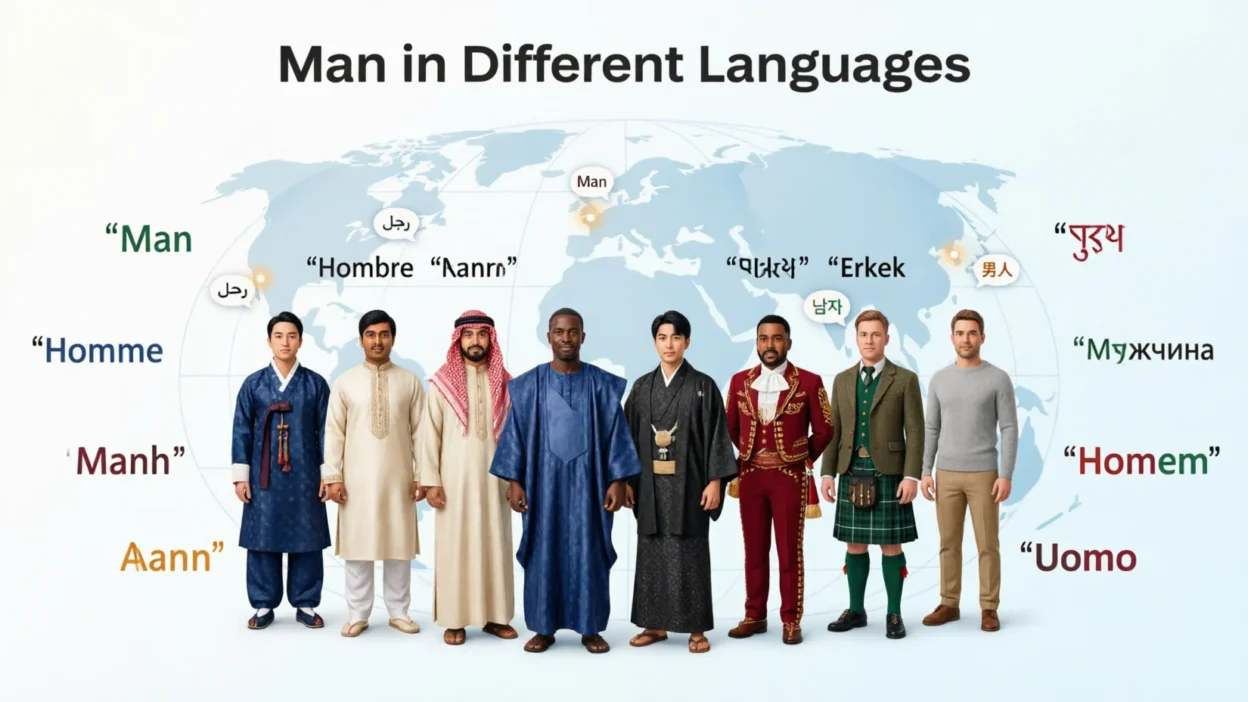
Learning how to say man in different languages is a fun and practical way to explore cultures, improve vocabulary, and communicate with people from around the world.
If you’re a student, traveler, language learner, or simply curious about global languages, knowing these translations helps you understand how different societies express one of the most common everyday words.
In this guide, you’ll discover 70 translations of “man”, along with their native spelling, easy English pronunciation, and real-life example sentences.
This complete resource also answers common questions about how to say man in different languages, man translations, and man around the world.
Man in Different Languages (70 Languages)
| Language | Native Word | Easy Pronunciation | Example Sentence | English Meaning |
|---|---|---|---|---|
| English | Man | man | The man is waiting outside. | The man is waiting outside. |
| Spanish | Hombre | OM-bray | El hombre sonríe. | The man is smiling. |
| French | Homme | om | L’homme est gentil. | The man is kind. |
| German | Mann | mahn | Der Mann liest. | The man is reading. |
| Italian | Uomo | WOH-mo | L’uomo corre. | The man is running. |
| Portuguese | Homem | OH-men | O homem trabalha. | The man works. |
| Dutch | Man | mahn | De man lacht. | The man laughs. |
| Swedish | Man | mahn | Mannen kommer. | The man is coming. |
| Norwegian | Mann | mahn | Mannen snakker. | The man is speaking. |
| Danish | Mand | mand | Manden smiler. | The man is smiling. |
| Finnish | Mies | mee-es | Mies odottaa. | The man is waiting. |
| Icelandic | Maður | MA-thur | Maðurinn gengur. | The man is walking. |
| Irish | Fear | far | Tá an fear anseo. | The man is here. |
| Welsh | Dyn | dun | Mae’r dyn yn hapus. | The man is happy. |
| Scottish Gaelic | Duine | DOO-nya | Tha an duine math. | The man is good. |
| Polish | Mężczyzna | men-CHIZ-na | Mężczyzna biegnie. | The man is running. |
| Czech | Muž | moosh | Muž čeká. | The man is waiting. |
| Slovak | Muž | moosh | Muž číta. | The man is reading. |
| Slovenian | Moški | MOHSH-kee | Moški govori. | The man is speaking. |
| Croatian | Muškarac | MOOSH-ka-rats | Muškarac radi. | The man is working. |
| Serbian | Мушкарац | MOOSH-ka-rats | Мушкарац долази. | The man is coming. |
| Bosnian | Muškarac | MOOSH-ka-rats | Muškarac pjeva. | The man is singing. |
| Romanian | Bărbat | bur-BAT | Bărbatul zâmbește. | The man smiles. |
| Bulgarian | Мъж | muzh | Мъжът чете. | The man is reading. |
| Ukrainian | Чоловік | cho-lo-VEEK | Чоловік працює. | The man works. |
| Russian | Мужчина | moosh-CHEE-na | Мужчина идет. | The man is walking. |
| Belarusian | Мужчына | moosh-CHI-na | Мужчына чакае. | The man is waiting. |
| Greek | Άντρας | AN-dras | Ο άντρας γελάει. | The man is laughing. |
| Albanian | Burrë | BOOR | Burri flet. | The man is talking. |
| Turkish | Adam | AH-dam | Adam geliyor. | The man is coming. |
| Arabic | رجل | RA-jul | الرجل يبتسم. | The man is smiling. |
| Hebrew | איש | eesh | האיש רץ. | The man is running. |
| Persian | مرد | mard | مرد آمد. | The man came. |
| Kurdish | Pîaw | pee-aw | Pîaw hat. | The man arrived. |
| Pashto | سړی | sa-RAY | سړی ولاړ دی. | The man is standing. |
| Urdu | مرد | mard | وہ مرد ہنس رہا ہے۔ | The man is laughing. |
| Hindi | आदमी | AA-dmee | आदमी चल रहा है। | The man is walking. |
| Punjabi | ਆਦਮੀ | AA-dmee | ਆਦਮੀ ਆ ਰਿਹਾ ਹੈ। | The man is coming. |
| Bengali | মানুষ | MA-nush | মানুষ হাসছে। | The man is smiling. |
| Gujarati | માણસ | MAA-nas | માણસ દોડી રહ્યો છે. | The man is running. |
| Marathi | माणूस | MAA-noos | माणूस बोलतो. | The man speaks. |
| Nepali | मानिस | maa-NEES | मानिस हाँस्छ। | The man laughs. |
| Sinhala | මිනිසා | mi-ni-SA | මිනිසා එයි. | The man comes. |
| Tamil | மனிதன் | ma-ni-than | மனிதன் சிரிக்கிறார். | The man is smiling. |
| Telugu | మనిషి | ma-ni-shee | మనిషి వస్తున్నాడు. | The man is coming. |
| Kannada | ಮನುಷ್ಯ | ma-NOO-shya | ಮನುಷ್ಯ ನಡೆಯುತ್ತಿದ್ದಾನೆ. | The man is walking. |
| Malayalam | മനുഷ്യൻ | ma-nu-SHYAN | മനുഷ്യൻ വായിക്കുന്നു. | The man is reading. |
| Thai | ผู้ชาย | poo-CHAI | ผู้ชายกำลังเดิน | The man is walking. |
| Lao | ຜູ້ຊາຍ | poo-CHAI | ຜູ້ຊາຍມາ | The man came. |
| Khmer | បុរស | bo-ROH | បុរសញញឹម | The man smiles. |
| Vietnamese | Đàn ông | dan-ong | Người đàn ông cười. | The man laughs. |
| Indonesian | Pria | PREE-ah | Pria itu datang. | The man arrived. |
| Malay | Lelaki | le-LAH-kee | Lelaki itu bekerja. | The man works. |
| Filipino | Lalaki | la-LA-kee | Ang lalaki ay tumatakbo. | The man is running. |
| Chinese (Simplified) | 男人 | nan-ren | 那个男人来了。 | That man came. |
| Chinese (Traditional) | 男人 | nan-ren | 那個男人笑了。 | That man smiled. |
| Japanese | 男 | otoko | 男が歩いています。 | The man is walking. |
| Korean | 남자 | nam-ja | 남자가 웃어요. | The man is smiling. |
| Mongolian | Эрэгтэй | e-reg-TAY | Эрэгтэй ирлээ. | The man arrived. |
| Kazakh | Ер адам | yer a-DAM | Ер адам келді. | The man came. |
| Uzbek | Erkak | er-KAK | Erkak kuldi. | The man laughed. |
| Azerbaijani | Kişi | kee-SHEE | Kişi gəlir. | The man is coming. |
| Georgian | კაცი | KA-tsi | კაცი მოდის. | The man is coming. |
| Armenian | Տղամարդ | tgha-MARD | Տղամարդը կարդում է։ | The man is reading. |
| Swahili | Mwanaume | mwa-na-OO-me | Mwanaume anatembea. | The man is walking. |
| Zulu | Indoda | in-DO-da | Indoda iyahleka. | The man is laughing. |
| Afrikaans | Man | man | Die man glimlag. | The man smiles. |
| Hausa | Namiji | na-MEE-jee | Namiji yana zuwa. | The man is coming. |
| Yoruba | Ọkùnrin | oh-KOON-rin | Ọkùnrin náà ń rìn. | The man is walking. |
| Igbo | Nwoke | nwoh-KAY | Nwoke ahụ na-achị ọchị. | The man is laughing. |
| Amharic | ወንድ | won-de | ወንዱ መጣ። | The man came. |
| Maori | Tāne | TAA-neh | Kei te haere te tāne. | The man is walking. |
| Hawaiian | Kāne | KAA-neh | Hele ke kāne. | The man is walking. |
How to Say Man in Different Languages
The word man changes across languages, but its basic meaning remains the same. While some languages have separate words for an adult male and a human being in general, others use a single term depending on the context.
Learning these expressions improves communication, expands vocabulary, and helps you understand everyday conversations in different cultures.
Why Learn Man Translations?
Knowing man translations offers several benefits:
- Improves your language skills.
- Makes international travel easier.
- Helps with school assignments.
- Supports translation projects.
- Enhances cultural understanding.
- Builds a stronger multilingual vocabulary.
Man Around the World
Every culture has its own unique word for man, reflecting its language history and traditions. Although pronunciation varies widely, these words are among the first vocabulary items taught to new language learners because they appear in everyday conversations, books, news, and media.
Tips for Remembering Foreign Words
- Practice speaking each word aloud.
- Learn one language every day.
- Repeat example sentences.
- Listen to native speakers.
- Review vocabulary regularly.
- Use flashcards for quick revision.
Conclusion
Learning man in different languages is an excellent way to expand your vocabulary and appreciate the diversity of world languages.
If you’re studying a new language, traveling abroad, or simply curious, these 70 translations provide a practical reference you can return to anytime.
FAQs:
1. How do you say man in different languages?
Different languages use different words, such as hombre in Spanish, homme in French, uomo in Italian, 男人 in Chinese, and 男 in Japanese.
2. Why are there different translations for man?
Each language developed independently, creating unique vocabulary based on its history, culture, and grammar.
3. Is the word for man always the same as male?
Not always. Some languages distinguish between an adult male and a human being depending on context.
4. Which language has the easiest word for English speakers?
Languages such as Dutch, German, Swedish, and Afrikaans have words that are similar to the English word man.
5. Can I use these translations while traveling?
Yes. These common words are widely understood and useful for learning basic vocabulary and improving everyday communication.

Brandon Cody is the Administrator of LingoMean, a platform dedicated to helping people discover the right words for every situation. He oversees content quality, website management, and user experience, ensuring readers receive accurate, practical, and easy-to-understand communication guidance.