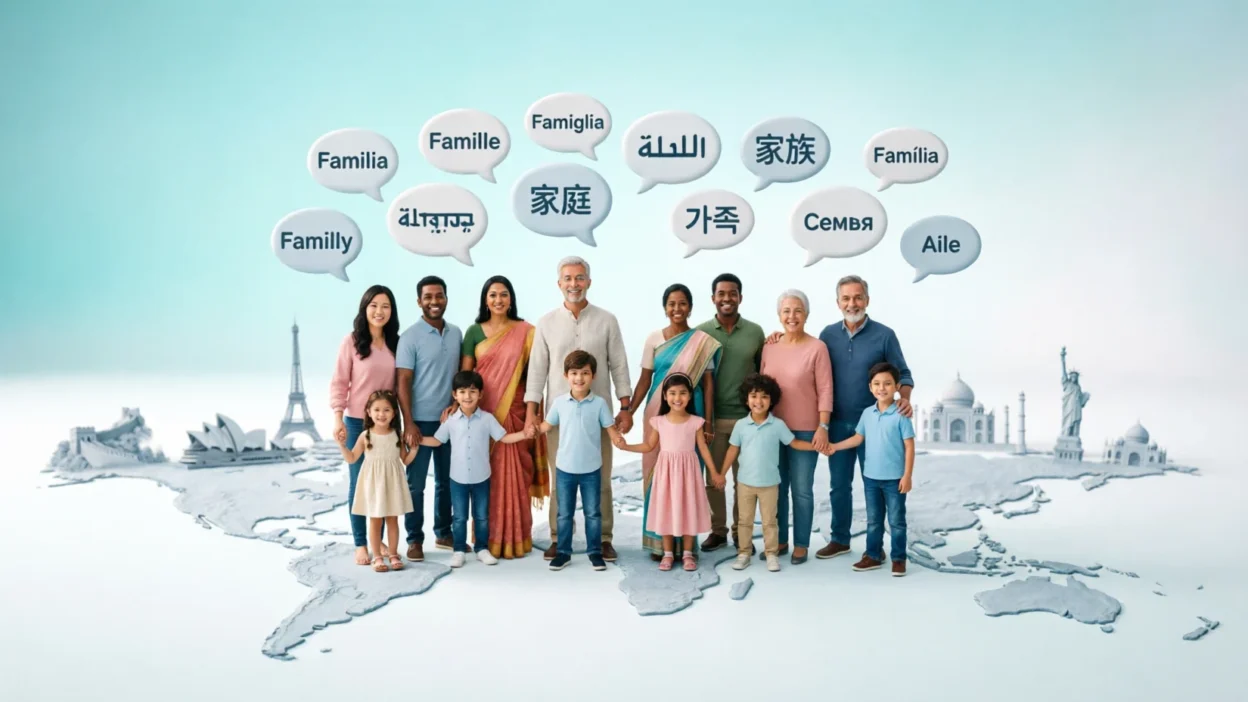
Family is one of the most meaningful words in every culture. If you are traveling, learning a new language, studying linguistics, or simply curious about global cultures, knowing how to say family in different languages helps you connect with people on a deeper level.
Although pronunciation and spelling differ from one country to another, the idea of love, support, and belonging remains universal.
In this guide, you’ll discover family in all languages, learn how to say family in different languages, explore accurate family translations, and see how people refer to family around the world through a simple, easy-to-read table.
Family in Different Languages (70 Languages)
| Language | Native Word | Easy Pronunciation | Example Sentence | English Meaning |
|---|---|---|---|---|
| English | Family | FAM-uh-lee | My family is very supportive. | My family is very supportive. |
| Spanish | Familia | Fah-MEE-lee-ah | Mi familia vive aquí. | My family lives here. |
| French | Famille | Fah-MEEY | Ma famille est grande. | My family is big. |
| German | Familie | Fah-mee-LEE-uh | Meine Familie ist nett. | My family is kind. |
| Italian | Famiglia | Fah-MEEL-yah | Amo la mia famiglia. | I love my family. |
| Portuguese | Família | Fah-MEE-lee-ah | Minha família é feliz. | My family is happy. |
| Dutch | Familie | Fah-MEE-lee | Mijn familie is dichtbij. | My family is nearby. |
| Danish | Familie | Fah-mee-LEE | Min familie er stor. | My family is large. |
| Swedish | Familj | Fah-MEELY | Min familj är viktig. | My family is important. |
| Norwegian | Familie | Fah-mee-LEE | Familien min er snill. | My family is kind. |
| Finnish | Perhe | PEHR-heh | Perheeni rakastaa minua. | My family loves me. |
| Icelandic | Fjölskylda | FYOL-skil-da | Fjölskyldan mín er góð. | My family is good. |
| Irish | Teaghlach | CHYAH-lakh | Tá mo theaghlach anseo. | My family is here. |
| Welsh | Teulu | TAY-lee | Mae fy nheulu yn hapus. | My family is happy. |
| Scottish Gaelic | Teaghlach | CHAL-akh | Tha mo theaghlach mòr. | My family is big. |
| Polish | Rodzina | Roh-JEE-nah | Moja rodzina jest miła. | My family is nice. |
| Czech | Rodina | ROH-dee-nah | Moje rodina je skvělá. | My family is wonderful. |
| Slovak | Rodina | ROH-dee-nah | Moja rodina je doma. | My family is at home. |
| Slovenian | Družina | DROO-zhee-na | Moja družina je prijazna. | My family is friendly. |
| Croatian | Obitelj | OH-bee-tell | Moja obitelj je velika. | My family is large. |
| Serbian | Porodica | Poh-ro-DEE-tsa | Moja porodica je ovde. | My family is here. |
| Bosnian | Porodica | Poh-ro-DEE-tsa | Moja porodica je sretna. | My family is happy. |
| Bulgarian | Семейство | Se-MEY-stvo | Моето семейство е добро. | My family is good. |
| Romanian | Familie | Fah-MEE-lee-eh | Familia mea este mare. | My family is big. |
| Hungarian | Család | CHA-laad | A családom fontos. | My family is important. |
| Greek | Οικογένεια | Ee-ko-YEH-nee-ah | Η οικογένειά μου είναι μεγάλη. | My family is big. |
| Russian | Семья | Sem-YA | Моя семья дружная. | My family is close. |
| Ukrainian | Сім’я | Seem-YA | Моя сім’я тут. | My family is here. |
| Belarusian | Сям’я | Syam-YA | Мая сям’я вялікая. | My family is large. |
| Lithuanian | Šeima | SHAY-ma | Mano šeima gera. | My family is good. |
| Latvian | Ģimene | GHI-me-ne | Mana ģimene ir laimīga. | My family is happy. |
| Estonian | Perekond | PEH-re-kond | Minu perekond on tore. | My family is wonderful. |
| Albanian | Familje | Fah-MEEL-ye | Familja ime është këtu. | My family is here. |
| Turkish | Aile | Eye-LEH | Ailem çok büyük. | My family is very big. |
| Arabic | عائلة | AA-ee-lah | عائلتي سعيدة. | My family is happy. |
| Hebrew | משפחה | Mish-pa-KHA | המשפחה שלי גדולה. | My family is big. |
| Persian | خانواده | Khah-ne-vah-DEH | خانواده من خوب است. | My family is good. |
| Kurdish | Malbat | MAL-bat | Malbata min mezin e. | My family is large. |
| Hindi | परिवार | Pari-vaar | मेरा परिवार खुश है। | My family is happy. |
| Urdu | خاندان | Khaan-daan | میرا خاندان بڑا ہے۔ | My family is big. |
| Punjabi | ਪਰਿਵਾਰ | Pari-vaar | ਮੇਰਾ ਪਰਿਵਾਰ ਚੰਗਾ ਹੈ। | My family is good. |
| Bengali | পরিবার | Pori-bar | আমার পরিবার ভালো। | My family is good. |
| Gujarati | પરિવાર | Pari-vaar | મારું પરિવાર મોટું છે. | My family is big. |
| Marathi | कुटुंब | Ku-tumb | माझे कुटुंब आनंदी आहे. | My family is happy. |
| Tamil | குடும்பம் | Ku-dum-bam | என் குடும்பம் பெரியது. | My family is big. |
| Telugu | కుటుంబం | Ku-tuM-bam | నా కుటుంబం మంచిది. | My family is good. |
| Kannada | ಕುಟುಂಬ | Ku-tuM-ba | ನನ್ನ ಕುಟುಂಬ ಸಂತೋಷವಾಗಿದೆ. | My family is happy. |
| Malayalam | കുടുംബം | Ku-duM-bam | എന്റെ കുടുംബം വലുതാണ്. | My family is large. |
| Sinhala | පවුල | Pau-la | මගේ පවුල හොඳයි. | My family is good. |
| Nepali | परिवार | Pari-vaar | मेरो परिवार ठूलो छ। | My family is big. |
| Chinese (Simplified) | 家庭 | Jia-ting | 我的家庭很好。 | My family is good. |
| Japanese | 家族 | Ka-zoku | 私の家族は優しいです。 | My family is kind. |
| Korean | 가족 | Ga-jok | 우리 가족은 행복합니다. | Our family is happy. |
| Vietnamese | Gia đình | Zya Dinh | Gia đình tôi rất tốt. | My family is very good. |
| Thai | ครอบครัว | Krop-Krua | ครอบครัวของฉันอบอุ่น. | My family is warm. |
| Indonesian | Keluarga | Keh-loo-AR-ga | Keluarga saya besar. | My family is big. |
| Malay | Keluarga | Keh-loo-AR-ga | Keluarga saya bahagia. | My family is happy. |
| Filipino | Pamilya | Pah-MIL-ya | Masaya ang pamilya ko. | My family is happy. |
| Burmese | မိသားစု | Mi-tha-zu | မိသားစုကချစ်တယ်။ | My family is loving. |
| Khmer | គ្រួសារ | Kru-sa | គ្រួសារខ្ញុំធំណាស់។ | My family is very big. |
| Lao | ຄອບຄົວ | Khop-Khua | ຄອບຄົວຂ້ອຍດີ. | My family is good. |
| Mongolian | Гэр бүл | Ger Bul | Миний гэр бүл сайхан. | My family is wonderful. |
| Swahili | Familia | Fah-MEE-lee-ah | Familia yangu ni kubwa. | My family is big. |
| Zulu | Umndeni | Oom-NDEH-nee | Umndeni wami mkhulu. | My family is large. |
| Xhosa | Usapho | Oo-SA-po | Usapho lwam luhle. | My family is nice. |
| Afrikaans | Familie | Fah-MEE-lee | My familie is gelukkig. | My family is happy. |
| Yoruba | Ìdílé | Ee-DEE-lay | Ìdílé mi dára. | My family is good. |
| Igbo | Ezinụlọ | Eh-zee-NO-loo | Ezinụlọ m buru ibu. | My family is big. |
| Hausa | Iyali | Ee-YAH-lee | Iyalina tana da kyau. | My family is good. |
| Amharic | ቤተሰብ | Bay-te-seb | ቤተሰቤ ታላቅ ነው። | My family is big. |
| Somali | Qoys | Koys | Qoyskaygu waa weyn yahay. | My family is big. |
| Maori | Whānau | FAH-now | He nui taku whānau. | My family is big. |
| Hawaiian | ʻOhana | Oh-HA-na | Nui koʻu ʻohana. | My family is large. |
Why Learn Family in Different Languages?
Learning the word family in multiple languages improves your vocabulary and helps you communicate respectfully with people from different cultures. It is especially useful for travelers, students, language learners, teachers, and anyone interested in world cultures.
How to Say Family in Different Languages Correctly
The easiest way to remember new translations is by practicing the pronunciation along with simple example sentences. Listening to native speakers and repeating the words regularly will also improve your speaking confidence.
Family Translations Around the World
Although each language has its own spelling and pronunciation, the meaning of family remains remarkably similar across cultures. Some languages use a single word for both immediate and extended family, while others have separate terms depending on the context.
Tips for Remembering Family in All Languages
- Learn five new words each day.
- Practice the pronunciation aloud.
- Use flashcards with native writing.
- Read example sentences regularly.
- Speak with native speakers whenever possible.
Conclusion
Learning family in different languages is a simple yet meaningful way to understand cultures from around the world.
If you’re studying languages, traveling internationally, or expanding your vocabulary, these 70 translations will help you communicate with greater confidence and appreciation for global diversity.
FAQs:
1. How do you say family in different languages?
Different languages use different words, such as Familia in Spanish, Famille in French, 家族 (Kazoku) in Japanese, and परिवार (Parivaar) in Hindi.
2. What is the most common translation of family?
Many European languages use similar words derived from Latin, including Familia, Famille, Familie, and Famiglia.
3. Why are family translations different around the world?
Languages evolve independently, so each develops unique vocabulary while expressing the same universal concept.
4. Which language uses the word “Ohana” for family?
Hawaiian uses ʻOhana, a word that represents family, community, and close relationships.
5. Is family pronounced similarly in every language?
No. While some languages have similar pronunciation due to shared linguistic roots, many others use completely different words and sounds.Meta Description:

Carter Connor is a language enthusiast and content writer at LingoMean, helping readers discover what to say in everyday conversations with clear explanations, practical examples, and easy-to-understand communication tips.