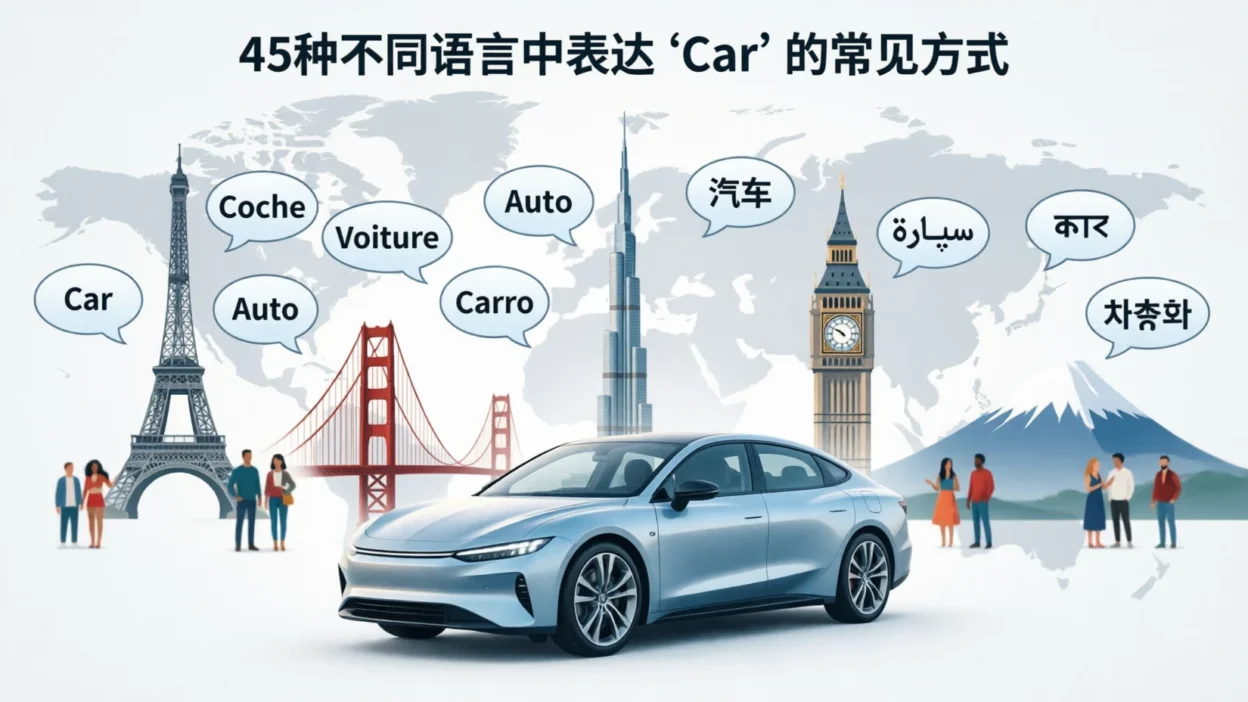
Learning car in different languages is a practical way to improve your vocabulary and communicate more confidently while traveling or learning a new language.
A car is one of the most commonly used means of transportation, helping millions of people travel for work, school, shopping, and leisure every day.
If you’re renting a vehicle abroad, asking for directions, or discussing transportation, knowing how to say car in different languages can be extremely useful.
Many people search for car in all languages to compare translations and improve their language skills. Learning car translations is beneficial for travelers, students, drivers, translators, automotive enthusiasts, and language learners.
These translations commonly appear on road signs, rental agreements, insurance documents, driving manuals, and everyday conversations.
Although cars are used worldwide, every language has its own word and pronunciation. The table below features car around the world in 45 popular languages, along with the native translation and an easy English pronunciation.
| Language | Native Phrase | English Pronunciation |
|---|---|---|
| English | Car | Kar |
| Spanish | Coche | KO-che |
| French | Voiture | Vwah-TYOOR |
| German | Auto | OW-toh |
| Italian | Auto | OW-toh |
| Portuguese | Carro | KAH-ho |
| Dutch | Auto | OW-toh |
| Swedish | Bil | Beel |
| Norwegian | Bil | Beel |
| Danish | Bil | Beel |
| Finnish | Auto | OW-toh |
| Polish | Samochód | Sa-mo-HOOD |
| Czech | Auto | OW-toh |
| Slovak | Auto | OW-toh |
| Hungarian | Autó | OW-toh |
| Romanian | Mașină | Ma-SHEE-nuh |
| Greek | Αυτοκίνητο | Af-to-KEE-ni-to |
| Russian | Машина | Ma-SHEE-na |
| Ukrainian | Автомобіль | Av-to-mo-BEEL |
| Turkish | Araba | A-ra-BA |
| Arabic | سيارة | Sa-ya-ra |
| Hebrew | מכונית | Me-kho-NEET |
| Persian | ماشین | Maa-SHEEN |
| Hindi | कार | Kaar |
| Urdu | کار | Kaar |
| Bengali | গাড়ি | Gaa-ri |
| Punjabi | ਕਾਰ | Kaar |
| Gujarati | કાર | Kaar |
| Marathi | कार | Kaar |
| Tamil | கார் | Kaar |
| Telugu | కారు | Kaa-roo |
| Kannada | ಕಾರು | Kaa-roo |
| Malayalam | കാർ | Kaar |
| Chinese (Mandarin) | 汽车 | Chee Chuh |
| Japanese | 車 | Kuruma |
| Korean | 자동차 | Ja-dong-cha |
| Thai | รถยนต์ | Rot Yon |
| Vietnamese | Xe hơi | Seh Hoy |
| Indonesian | Mobil | Mo-beel |
| Malay | Kereta | Ke-re-ta |
| Filipino | Kotse | Kot-se |
| Swahili | Gari | GAH-ree |
| Zulu | Imoto | Ee-MO-to |
| Afrikaans | Motor | MO-tor |
| Icelandic | Bíll | Beetl |
What is a car?
A car is a motor vehicle with four wheels that is primarily used to transport people from one place to another.
Why should I learn “car” in different languages?
Learning this word helps you communicate while renting a vehicle, asking for transportation, reading road signs, or discussing travel in different countries.
Is the word “car” the same in every language?
No. Some languages use similar words like Auto, while others have unique translations such as Voiture in French, Araba in Turkish, and 汽车 in Chinese.
Can I use these translations while traveling?
Yes. These translations are useful when renting a car, visiting a mechanic, reading traffic signs, asking for directions, or using transportation services abroad.
What is the easiest way to remember “car” in different languages?
Start by learning similar words like Auto, Autó, and Carro, then gradually practice unique translations such as Voiture, Kuruma, and Samochód.
Conclusion
Learning car in different languages is an excellent way to improve your travel vocabulary and communicate more naturally around the world.
If you’re studying a foreign language, planning an international trip, or simply expanding your knowledge, these translations will help you discuss one of the most common forms of transportation with confidence.
Bookmark this guide whenever you want to learn car in all languages, discover car translations, or explore how to say car in different languages.

Brandon Cody is the Administrator of LingoMean, a platform dedicated to helping people discover the right words for every situation. He oversees content quality, website management, and user experience, ensuring readers receive accurate, practical, and easy-to-understand communication guidance.