
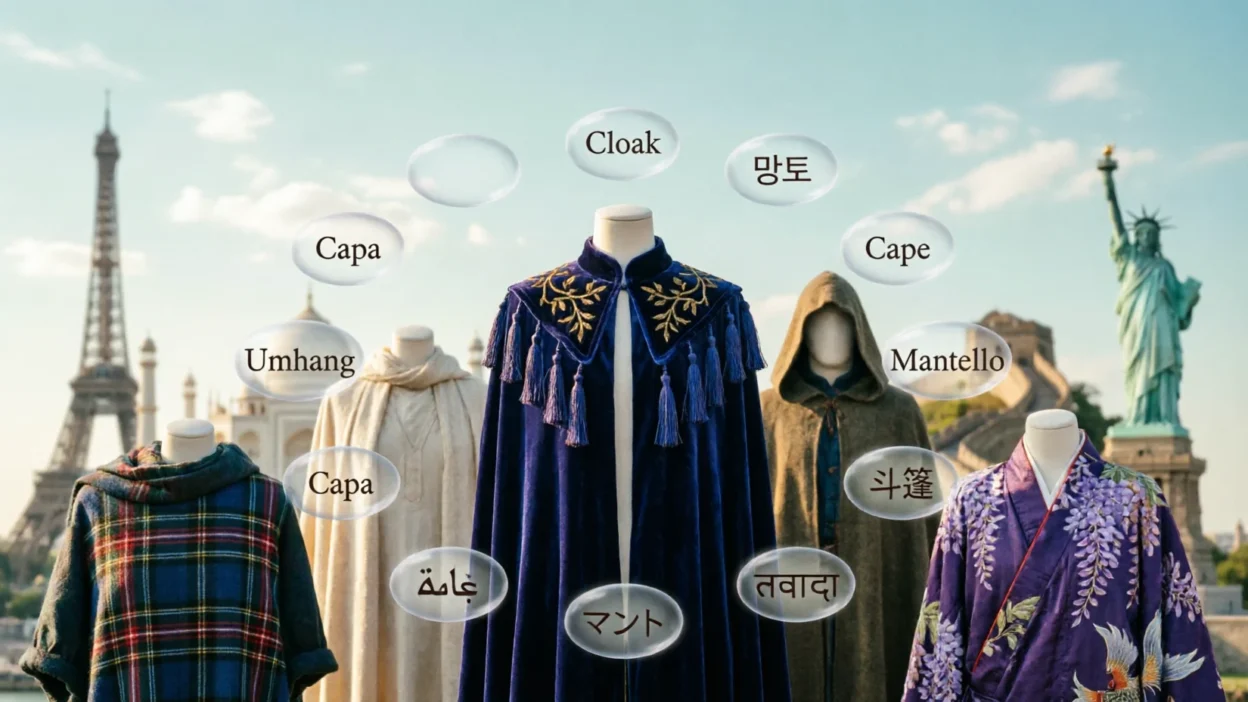
Learning cloak in different languages is a great way to expand your vocabulary and discover how different cultures describe this classic piece of clothing.
A cloak is a loose outer garment worn over other clothes, often fastened around the neck.
Throughout history, cloaks have been used for warmth, protection, ceremonial purposes, fashion, and storytelling.
Today, they are commonly seen in historical reenactments, fantasy literature, movies, and cultural traditions.
Many people search for cloak in all languages to compare translations and improve their language skills.
Learning how to say cloak in different languages is useful for students, travelers, translators, writers, and anyone interested in multilingual vocabulary.
These cloak translations can also help you understand books, films, games, and historical texts.
Although the purpose of a cloak is similar worldwide, each language has its own word and pronunciation.
The table below features cloak around the world in 45 popular languages, along with the native word and an easy English pronunciation.
| Language | Native Word | English Pronunciation |
|---|---|---|
| English | Cloak | Klohk |
| Spanish | Capa | KAH-pah |
| French | Cape | Kap |
| German | Umhang | OOM-hang |
| Italian | Mantello | Man-TEL-lo |
| Portuguese | Capa | KAH-pah |
| Dutch | Mantel | MAN-tel |
| Swedish | Kappa | KAP-pa |
| Norwegian | Kappe | KAP-peh |
| Danish | Kappe | KAP-peh |
| Finnish | Viitta | VEE-ta |
| Polish | Płaszcz | PWASHCH |
| Czech | Plášť | Plaasht |
| Slovak | Plášť | Plaasht |
| Hungarian | Köpeny | KUR-pe-ny |
| Romanian | Pelerină | Pe-le-REE-nuh |
| Greek | Μανδύας | Man-THEE-as |
| Russian | Плащ | Plashch |
| Ukrainian | Плащ | Plashch |
| Turkish | Pelerin | Pe-le-RIN |
| Arabic | عباءة | A-ba-ya |
| Hebrew | גלימה | Glee-MAH |
| Persian | شنل | Sha-nel |
| Hindi | लबादा | La-baa-da |
| Urdu | چغہ | Chu-gha |
| Bengali | চাদর | Cha-dor |
| Punjabi | ਚੋਗਾ | Cho-ga |
| Gujarati | ચોગો | Cho-go |
| Marathi | झगा | Jha-ga |
| Tamil | மேலங்கி | May-lang-gee |
| Telugu | అంగి | An-gee |
| Kannada | ಮೇಲಂಗಿ | May-lang-gee |
| Malayalam | മേലങ്കി | May-lan-kee |
| Chinese (Mandarin) | 斗篷 | Doh Peng |
| Japanese | マント | Man-to |
| Korean | 망토 | Mang-to |
| Thai | เสื้อคลุม | Suea Kloom |
| Vietnamese | Áo choàng | Ao Chwang |
| Indonesian | Jubah | Joo-bah |
| Malay | Jubah | Joo-bah |
| Filipino | Balabal | Ba-la-bal |
| Swahili | Joho | Jo-ho |
| Zulu | Ingubo | In-goo-bo |
| Afrikaans | Mantel | MAN-tel |
| Icelandic | Skikkja | Skik-ya |
What is a cloak?
A cloak is a sleeveless outer garment that hangs loosely over the shoulders and back. It has been worn throughout history for warmth, protection, fashion, and ceremonial purposes.
Why should I learn “cloak” in different languages?
Learning clothing vocabulary helps you read books, understand movies, communicate while traveling, and improve your overall language skills.
Is a cloak the same as a cape?
Not always. A cloak is usually longer and may cover the entire body, while a cape is generally shorter and covers only the shoulders or upper back.
Can I use these translations while traveling?
Yes. These translations can help you understand clothing descriptions, costume shops, museums, cultural events, and historical sites.
What is the easiest way to remember “cloak” in different languages?
Practice a few translations each day, repeat the pronunciations aloud, and associate each word with pictures or stories featuring cloaks.
Conclusion
Learning cloak in different languages is an easy way to expand your vocabulary while exploring fashion, history, and culture around the world.
If you’re studying a foreign language, reading fantasy novels, visiting museums, or traveling, these translations can help you communicate more confidently.
Keep this guide bookmarked whenever you want to learn cloak in all languages, explore cloak translations, or discover how to say cloak in different languages.

Brandon Cody is the Administrator of LingoMean, a platform dedicated to helping people discover the right words for every situation. He oversees content quality, website management, and user experience, ensuring readers receive accurate, practical, and easy-to-understand communication guidance.