If you love dogs, are learning languages, or simply want to know how different cultures refer to our four-legged friends, learning the word “dog” in different languages is a fun way to explore vocabulary around the world. The word may sound completely different from one language to another, but its meaning remains familiar.
In this guide, you will discover dog translations in 70 different languages, along with easy English pronunciations and simple example sentences. If you are a student, traveler, writer, pet lover, or language enthusiast, this list makes it easy to learn how to say “dog” in different languages.
Quick Answer: How Do You Say Dog in Different Languages?
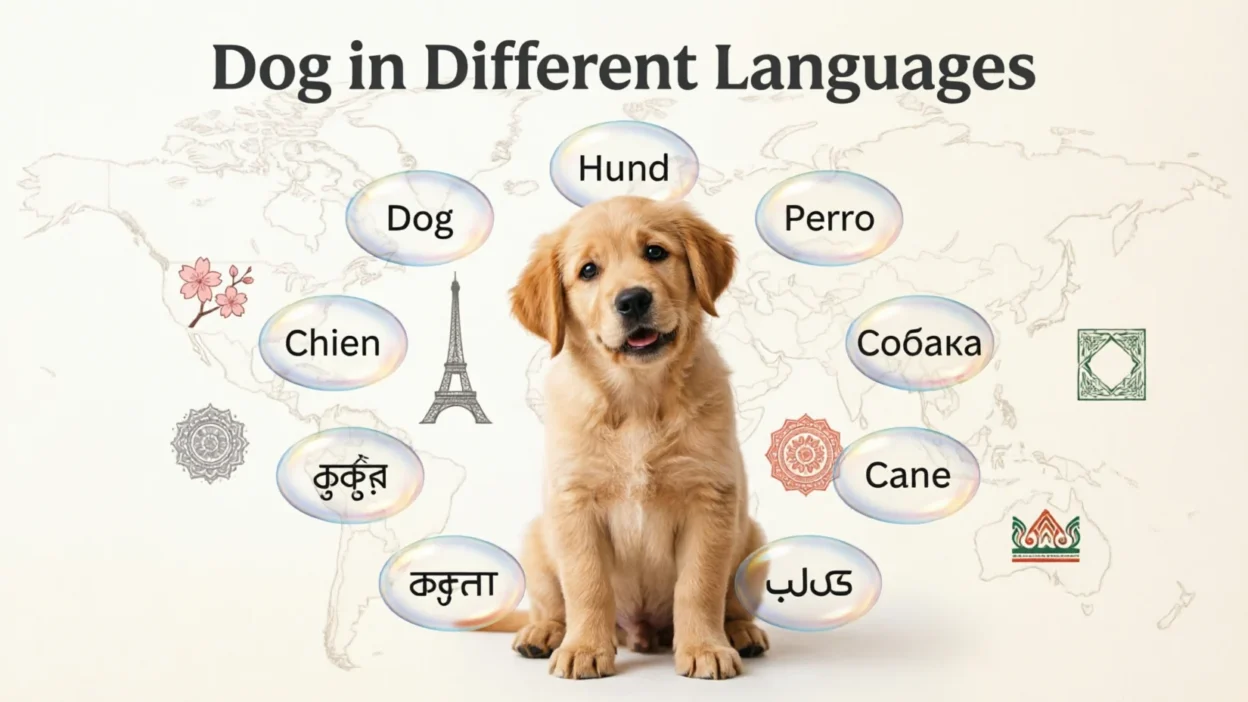
The word “dog” has many different forms around the world. For example, it is perro in Spanish, chien in French, Hund in German, cane in Italian, perro in Portuguese, and собака (sobaka) in Russian. Below is a complete list of 70 languages with native terms, pronunciations, and examples.
Dog in Different Languages: 70 Translations
| # | Language | Native Phrase | Easy English Pronunciation | Example Sentence | English Meaning |
|---|---|---|---|---|---|
| 1 | English | Dog | Dawg | The dog is sleeping. | The dog is sleeping. |
| 2 | Spanish | Perro | PEH-rro | El perro está durmiendo. | The dog is sleeping. |
| 3 | French | Chien | Shee-ahn | Le chien dort. | The dog is sleeping. |
| 4 | German | Hund | Hoont | Der Hund schläft. | The dog is sleeping. |
| 5 | Italian | Cane | KAH-neh | Il cane dorme. | The dog is sleeping. |
| 6 | Portuguese | Cão | Kown | O cão está dormindo. | The dog is sleeping. |
| 7 | Dutch | Hond | Hohnt | De hond slaapt. | The dog is sleeping. |
| 8 | Russian | Собака | Soh-BAH-kah | Собака спит. | The dog is sleeping. |
| 9 | Ukrainian | Собака | Soh-BAH-kah | Собака спить. | The dog is sleeping. |
| 10 | Polish | Pies | Pyess | Pies śpi. | The dog is sleeping. |
| 11 | Czech | Pes | Pess | Pes spí. | The dog is sleeping. |
| 12 | Slovak | Pes | Pess | Pes spí. | The dog is sleeping. |
| 13 | Slovenian | Pes | Pess | Pes spi. | The dog is sleeping. |
| 14 | Croatian | Pas | Pahs | Pas spava. | The dog is sleeping. |
| 15 | Serbian | Пас | Pahs | Пас спава. | The dog is sleeping. |
| 16 | Bosnian | Pas | Pahs | Pas spava. | The dog is sleeping. |
| 17 | Bulgarian | Куче | KOO-cheh | Кучето спи. | The dog is sleeping. |
| 18 | Macedonian | Куче | KOO-cheh | Кучето спие. | The dog is sleeping. |
| 19 | Romanian | Câine | KUEEN-eh | Câinele doarme. | The dog is sleeping. |
| 20 | Hungarian | Kutya | KOOT-yah | A kutya alszik. | The dog is sleeping. |
| 21 | Greek | Σκύλος | SKEE-los | Ο σκύλος κοιμάται. | The dog is sleeping. |
| 22 | Albanian | Qen | Chen | Qeni po fle. | The dog is sleeping. |
| 23 | Lithuanian | Šuo | SHOO-oh | Šuo miega. | The dog is sleeping. |
| 24 | Latvian | Suns | Soons | Suns guļ. | The dog is sleeping. |
| 25 | Estonian | Koer | KOH-er | Koer magab. | The dog is sleeping. |
| 26 | Finnish | Koira | KOY-rah | Koira nukkuu. | The dog is sleeping. |
| 27 | Swedish | Hund | Hoond | Hunden sover. | The dog is sleeping. |
| 28 | Danish | Hund | Hoon | Hunden sover. | The dog is sleeping. |
| 29 | Norwegian | Hund | Hoond | Hunden sover. | The dog is sleeping. |
| 30 | Icelandic | Hundur | HOON-dur | Hundurinn sefur. | The dog is sleeping. |
| 31 | Irish | Madra | MAH-drah | Tá an madra ina chodladh. | The dog is sleeping. |
| 32 | Welsh | Ci | Kee | Mae’r ci’n cysgu. | The dog is sleeping. |
| 33 | Scottish Gaelic | Cù | Koo | Tha an cù a’ cadal. | The dog is sleeping. |
| 34 | Basque | Txakur | CHAH-koor | Txakurra lo dago. | The dog is sleeping. |
| 35 | Catalan | Gos | Gohs | El gos dorm. | The dog is sleeping. |
| 36 | Galician | Can | Kahn | O can dorme. | The dog is sleeping. |
| 37 | Maltese | Kelb | Kelb | Il-kelb rieqed. | The dog is sleeping. |
| 38 | Arabic | كلب | Kalb | الكلب نائم. | The dog is sleeping. |
| 39 | Hebrew | כלב | Keh-LEV | הכלב ישן. | The dog is sleeping. |
| 40 | Persian | سگ | Sag | سگ خواب است. | The dog is sleeping. |
| 41 | Urdu | کتا | KUT-ta | کتا سو رہا ہے۔ | The dog is sleeping. |
| 42 | Hindi | कुत्ता | KOOT-ta | कुत्ता सो रहा है। | The dog is sleeping. |
| 43 | Bengali | কুকুর | KOO-koor | কুকুরটি ঘুমাচ্ছে। | The dog is sleeping. |
| 44 | Punjabi | ਕੁੱਤਾ | KUT-ta | ਕੁੱਤਾ ਸੌਂ ਰਿਹਾ ਹੈ। | The dog is sleeping. |
| 45 | Gujarati | કૂતરો | KOO-tro | કૂતરો સૂઈ રહ્યો છે. | The dog is sleeping. |
| 46 | Marathi | कुत्रा | KOOT-ra | कुत्रा झोपला आहे. | The dog is sleeping. |
| 47 | Nepali | कुकुर | KOO-koor | कुकुर सुतिरहेको छ। | The dog is sleeping. |
| 48 | Sinhala | බල්ලා | BAL-lah | බල්ලා නිදාගෙන සිටී. | The dog is sleeping. |
| 49 | Tamil | நாய் | Naai | நாய் தூங்குகிறது. | The dog is sleeping. |
| 50 | Telugu | కుక్క | KOO-kah | కుక్క నిద్రపోతోంది. | The dog is sleeping. |
| 51 | Kannada | ನಾಯಿ | NAA-yee | ನಾಯಿ ಮಲಗಿದೆ. | The dog is sleeping. |
| 52 | Malayalam | നായ | Naaya | നായ ഉറങ്ങുന്നു. | The dog is sleeping. |
| 53 | Chinese | 狗 | Goh | 狗在睡觉。 | The dog is sleeping. |
| 54 | Japanese | 犬 | Ee-nu | 犬が寝ています。 | The dog is sleeping. |
| 55 | Korean | 개 | Gae | 개가 자고 있어요. | The dog is sleeping. |
| 56 | Vietnamese | Chó | Chaw | Con chó đang ngủ. | The dog is sleeping. |
| 57 | Thai | สุนัข | Soo-nak | สุนัขกำลังนอนหลับ | The dog is sleeping. |
| 58 | Indonesian | Anjing | AHN-jing | Anjing itu sedang tidur. | The dog is sleeping. |
| 59 | Malay | Anjing | AHN-jing | Anjing itu sedang tidur. | The dog is sleeping. |
| 60 | Filipino | Aso | AH-soh | Natutulog ang aso. | The dog is sleeping. |
| 61 | Burmese | ခွေး | Khway | ခွေးအိပ်နေတယ်။ | The dog is sleeping. |
| 62 | Khmer | ឆ្កែ | Ch-kai | ឆ្កែកំពុងដេក។ | The dog is sleeping. |
| 63 | Mongolian | Нохой | NO-khoy | Нохой унтаж байна. | The dog is sleeping. |
| 64 | Turkish | Köpek | KUR-pek | Köpek uyuyor. | The dog is sleeping. |
| 65 | Azerbaijani | İt | Eet | İt yatır. | The dog is sleeping. |
| 66 | Georgian | ძაღლი | DZAGH-lee | ძაღლს სძინავს. | The dog is sleeping. |
| 67 | Armenian | Շուն | Shoon | Շունը քնած է։ | The dog is sleeping. |
| 68 | Swahili | Mbwa | M-bwah | Mbwa amelala. | The dog is sleeping. |
| 69 | Zulu | Inja | EEN-yah | Inja ilele. | The dog is sleeping. |
| 70 | Afrikaans | Hond | Hohnt | Die hond slaap. | The dog is sleeping. |
Dog in European Languages
European languages offer a fascinating variety of words for dog. Some are quite different, such as chien in French and cane in Italian, while others share similarities. German, Swedish, Danish, Norwegian, and Afrikaans all use closely related forms of Hund or hond.
Romance languages also have interesting variations. Spanish uses perro, Portuguese uses cão, Italian uses cane, Catalan uses gos, and Romanian uses câine.
Dog in Asian Languages
Asian languages provide some of the most recognizable and distinctive dog translations. In Japanese, dog is 犬 (inu), while Chinese uses 狗 (gǒu). Korean uses 개 (gae), Hindi uses कुत्ता (kutta), and Urdu uses کتا (kutta).
These translations demonstrate how the same everyday animal can have completely different names across languages and writing systems.
Dog in Middle Eastern Languages
The word for dog also varies across Middle Eastern languages. Arabic uses كلب (kalb), Hebrew uses כלב (kelev), and Persian uses سگ (sag). Learning these words can be useful when traveling, studying languages, or communicating with people from different linguistic backgrounds.
Dog in African Languages
African languages have their own distinctive terms for dog. In Swahili, the word is mbwa, while Zulu uses inja and Afrikaans uses hond.
These dog translations are useful examples of the incredible linguistic diversity found across Africa.
Dog in Different Languages Around the World
The word “dog” is one of the most common animal names people encounter when learning a new language. Although the pronunciation and spelling may change, the concept is universal.
From perro in Spanish to 犬 (inu) in Japanese and mbwa in Swahili, these words show how languages create their own vocabulary for familiar animals.
How to Say Dog in Different Languages
If you want a quick selection of the most commonly searched dog translations, here are several useful examples:
- Spanish: Perro
- French: Chien
- German: Hund
- Italian: Cane
- Portuguese: Cão
- Russian: Собака
- Arabic: كلب
- Hindi: कुत्ता
- Urdu: کتا
- Chinese: 狗
- Japanese: 犬
- Korean: 개
- Turkish: Köpek
- Swahili: Mbwa
Why Learn Dog Translations?
Learning how to say dog in different languages can improve vocabulary and make language study more enjoyable. Animal names are often among the first words beginners learn because they are easy to connect with everyday experiences.
Dog translations can also be useful for travelers, students, writers, pet owners, and anyone interested in cultures around the world.
Dog Translations for Language Learners
For language learners, memorizing short and familiar words is an effective way to build vocabulary. “Dog” is especially useful because it appears frequently in conversations, stories, children’s books, social media posts, and everyday descriptions.
Try learning a few translations at a time rather than memorizing all 70 words at once. Start with languages you are most interested in and practice them in simple sentences.
FAQs:
1. What is dog in Spanish?
The word for dog in Spanish is perro. It is pronounced approximately “PEH-rro.”
2. What is dog in French?
The French word for dog is chien, pronounced approximately “shee-ahn.”
3. What is dog in Japanese?
Dog in Japanese is 犬, written as inu in Romanized form and pronounced approximately “ee-noo.”
4. What is dog in Arabic?
Dog in Arabic is كلب, transliterated as kalb and pronounced approximately “kalb.”
5. What is dog in Hindi?
Dog in Hindi is कुत्ता, transliterated as kutta and pronounced approximately “KOOT-ta.”
Conclusion
Learning the word dog in different languages is a simple and enjoyable way to explore global vocabulary. From perro and chien to inu, kutta, kalb, and mbwa, each translation reflects the unique sounds and writing systems of its language.
Use this list to improve your vocabulary, support language learning, or discover how people refer to dogs around the world.

Anthony Dylan is a language enthusiast and content writer at LingoMean, where he helps readers understand what to say in different situations. He creates clear, practical, and engaging guides that improve communication, confidence, and everyday conversations.