
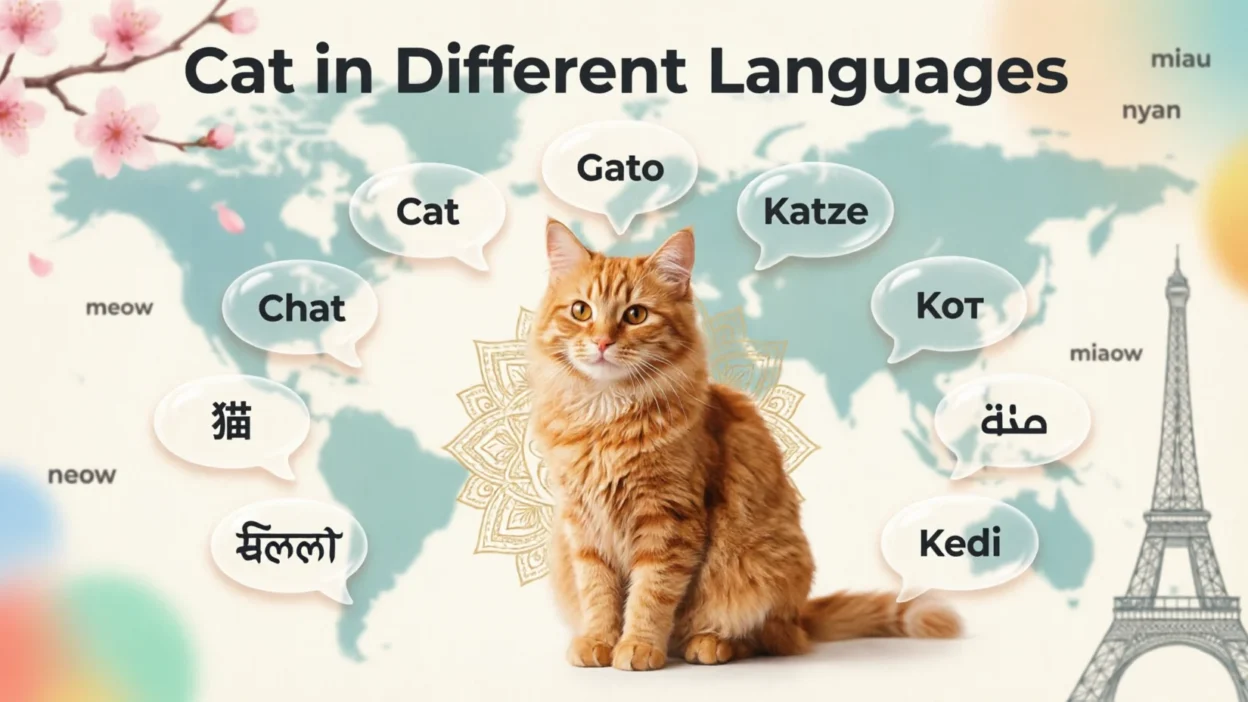
Cats are among the most popular animals in the world, and the word “cat” has a unique form in almost every language. If you are learning a new language, traveling, studying vocabulary, or simply curious about international words, learning how to say cat in different languages is a fun way to explore global cultures.
From the familiar Spanish “gato” to the Japanese “neko,” these cat translations show how languages describe one of the world’s most beloved pets. Below, you will find 70 languages, their native words for cat, easy English pronunciations, and simple examples you can use in everyday conversation.
Cat in Different Languages: 70 Translations
The table below answers the common question, “How do you say cat in different languages?” Each translation includes a native word or phrase, an easy pronunciation guide, and a short real-life example with its English meaning.
| # | Language | Native Phrase | Easy English Pronunciation | Example Sentence | English Meaning |
|---|---|---|---|---|---|
| 1 | English | cat | kat | The cat is sleeping. | The cat is sleeping. |
| 2 | Spanish | gato | GAH-toh | El gato está durmiendo. | The cat is sleeping. |
| 3 | French | chat | shah | Le chat dort. | The cat is sleeping. |
| 4 | German | Katze | KAT-suh | Die Katze schläft. | The cat is sleeping. |
| 5 | Italian | gatto | GAT-toh | Il gatto dorme. | The cat is sleeping. |
| 6 | Portuguese | gato | GAH-too | O gato está dormindo. | The cat is sleeping. |
| 7 | Dutch | kat | kaht | De kat slaapt. | The cat is sleeping. |
| 8 | Swedish | katt | kat | Katten sover. | The cat is sleeping. |
| 9 | Norwegian | katt | kaht | Katten sover. | The cat is sleeping. |
| 10 | Danish | kat | kaht | Katten sover. | The cat is sleeping. |
| 11 | Finnish | kissa | KIS-sah | Kissa nukkuu. | The cat is sleeping. |
| 12 | Icelandic | köttur | KUR-tur | Kötturinn sefur. | The cat is sleeping. |
| 13 | Irish | cat | kaht | Tá an cat ina chodladh. | The cat is sleeping. |
| 14 | Welsh | cath | kath | Mae’r gath yn cysgu. | The cat is sleeping. |
| 15 | Scottish Gaelic | cat | kaht | Tha an cat a’ cadal. | The cat is sleeping. |
| 16 | Polish | kot | koht | Kot śpi. | The cat is sleeping. |
| 17 | Czech | kočka | KOTCH-kah | Kočka spí. | The cat is sleeping. |
| 18 | Slovak | mačka | MATCH-kah | Mačka spí. | The cat is sleeping. |
| 19 | Slovenian | mačka | MATCH-kah | Mačka spi. | The cat is sleeping. |
| 20 | Croatian | mačka | MATCH-kah | Mačka spava. | The cat is sleeping. |
| 21 | Serbian | мачка | MACH-kah | Мачка спава. | The cat is sleeping. |
| 22 | Bosnian | mačka | MATCH-kah | Mačka spava. | The cat is sleeping. |
| 23 | Bulgarian | котка | KOT-kah | Котката спи. | The cat is sleeping. |
| 24 | Macedonian | мачка | MACH-kah | Мачката спие. | The cat is sleeping. |
| 25 | Russian | кошка | KOSH-kah | Кошка спит. | The cat is sleeping. |
| 26 | Ukrainian | кішка | KISH-kah | Кішка спить. | The cat is sleeping. |
| 27 | Belarusian | котка | KOT-kah | Котка спіць. | The cat is sleeping. |
| 28 | Lithuanian | katė | kah-TEH | Katė miega. | The cat is sleeping. |
| 29 | Latvian | kaķis | KAH-kis | Kaķis guļ. | The cat is sleeping. |
| 30 | Estonian | kass | kahss | Kass magab. | The cat is sleeping. |
| 31 | Hungarian | macska | MAHCH-kah | A macska alszik. | The cat is sleeping. |
| 32 | Romanian | pisică | pee-SIH-kuh | Pisica doarme. | The cat is sleeping. |
| 33 | Greek | γάτα | GAH-tah | Η γάτα κοιμάται. | The cat is sleeping. |
| 34 | Albanian | mace | MAH-tseh | Macja po fle. | The cat is sleeping. |
| 35 | Armenian | կատու | kah-TOO | Կատուն քնած է։ | The cat is sleeping. |
| 36 | Georgian | კატა | KAH-tah | კატას სძინავს. | The cat is sleeping. |
| 37 | Turkish | kedi | keh-DEE | Kedi uyuyor. | The cat is sleeping. |
| 38 | Azerbaijani | pişik | pee-SHEEK | Pişik yatır. | The cat is sleeping. |
| 39 | Persian | گربه | gor-BAH | گربه خواب است. | The cat is sleeping. |
| 40 | Arabic | قطة | QIT-tah | القطة نائمة. | The cat is sleeping. |
| 41 | Hebrew | חתול | kha-TOOL | החתול ישן. | The cat is sleeping. |
| 42 | Maltese | qattus | KAT-tus | Il-qattus rieqed. | The cat is sleeping. |
| 43 | Hindi | बिल्ली | BILL-lee | बिल्ली सो रही है। | The cat is sleeping. |
| 44 | Urdu | بلی | BAL-lee | بلی سو رہی ہے۔ | The cat is sleeping. |
| 45 | Bengali | বিড়াল | BEE-ral | বিড়ালটি ঘুমাচ্ছে। | The cat is sleeping. |
| 46 | Punjabi | ਬਿੱਲੀ | BILL-lee | ਬਿੱਲੀ ਸੌਂ ਰਹੀ ਹੈ। | The cat is sleeping. |
| 47 | Gujarati | બિલાડી | bih-LAH-dee | બિલાડી સૂઈ રહી છે. | The cat is sleeping. |
| 48 | Marathi | मांजर | MAAN-jar | मांजर झोपले आहे. | The cat is sleeping. |
| 49 | Nepali | बिरालो | bee-RAH-loh | बिरालो सुतिरहेको छ। | The cat is sleeping. |
| 50 | Sinhala | බළලා | ba-LA-la | බළලා නිදාගෙන සිටී. | The cat is sleeping. |
| 51 | Tamil | பூனை | POO-nai | பூனை தூங்குகிறது. | The cat is sleeping. |
| 52 | Telugu | పిల్లి | PIL-lee | పిల్లి నిద్రపోతోంది. | The cat is sleeping. |
| 53 | Kannada | ಬೆಕ್ಕು | BEK-koo | ಬೆಕ್ಕು ಮಲಗಿದೆ. | The cat is sleeping. |
| 54 | Malayalam | പൂച്ച | POO-cha | പൂച്ച ഉറങ്ങുന്നു. | The cat is sleeping. |
| 55 | Odia | ବିଲେଇ | bih-LAY | ବିଲେଇ ଶୋଇଛି। | The cat is sleeping. |
| 56 | Assamese | মেকুৰী | meh-KOO-ree | মেকুৰীটো শুই আছে। | The cat is sleeping. |
| 57 | Thai | แมว | maew | แมวนอนหลับ | The cat is sleeping. |
| 58 | Lao | ແມວ | maew | ແມວກຳລັງນອນ. | The cat is sleeping. |
| 59 | Khmer | ឆ្មា | chma | ឆ្មាកំពុងដេក។ | The cat is sleeping. |
| 60 | Vietnamese | mèo | meh-oh | Con mèo đang ngủ. | The cat is sleeping. |
| 61 | Indonesian | kucing | KOO-ching | Kucing itu sedang tidur. | The cat is sleeping. |
| 62 | Malay | kucing | KOO-ching | Kucing itu sedang tidur. | The cat is sleeping. |
| 63 | Filipino | pusa | POO-sah | Natutulog ang pusa. | The cat is sleeping. |
| 64 | Chinese | 猫 | maow | 猫在睡觉。 | The cat is sleeping. |
| 65 | Japanese | 猫 | NEH-koh | 猫が寝ています。 | The cat is sleeping. |
| 66 | Korean | 고양이 | go-YANG-ee | 고양이가 자고 있어요. | The cat is sleeping. |
| 67 | Mongolian | муур | moor | Муур унтаж байна. | The cat is sleeping. |
| 68 | Swahili | paka | PAH-kah | Paka analala. | The cat is sleeping. |
| 69 | Afrikaans | kat | kaht | Die kat slaap. | The cat is sleeping. |
| 70 | Zulu | ikati | ee-KAH-tee | Ikati lilele. | The cat is sleeping. |
How to Say Cat in Different Languages
The word for cat varies considerably across languages. Many European languages have words that are historically related, such as Spanish gato, Italian gatto, and Portuguese gato. Other languages use completely different forms, such as Japanese neko, Korean goyangi, and Hindi billi.
These differences make cat in different languages a useful vocabulary topic for language learners. Learning even a few of these words can help you recognize animal-related vocabulary when reading, traveling, or communicating with people from other countries.
Cat Translations in European Languages
European languages offer some interesting similarities. Spanish, Italian, and Portuguese all use forms related to “gato,” while German uses “Katze” and French uses “chat.”
Slavic languages also show related forms. Polish uses kot, while Czech, Slovak, Croatian, Slovenian, and several neighboring languages have words beginning with similar sounds.
Cat in Asian Languages
Asian languages have many distinctive words for cat. In Hindi and Urdu, the common word is billi, while Bengali uses biral. Japanese uses neko, Chinese uses mao, and Korean uses goyangi.
Learning these words is particularly useful for travelers and students interested in Asian languages and cultures.
Cat Around the World
Cats are familiar animals across almost every region of the world, but their names change from language to language. The cat around the world vocabulary in this guide covers European, Asian, African, and other major language groups.
Although pronunciation can vary depending on regional accents, the native forms listed above provide a useful starting point for understanding how people refer to cats in everyday speech.
Why Learn Cat in Different Languages?
Learning animal names in other languages is a simple way to expand vocabulary. The word “cat” is also useful because it appears frequently in conversations, books, children’s stories, social media, and everyday descriptions.
For language learners, studying common words such as cat can make it easier to recognize related vocabulary and build confidence in basic conversations.
Fun Facts About the Word Cat
The word for cat is often short and easy to remember. Several European languages use words that sound somewhat similar to English “cat,” while other languages have entirely different forms.
Another interesting point is that some languages have separate words for male and female cats, while others commonly use one general word for the animal. Context can also affect the form of a word in languages that use grammatical gender or noun cases.
How to Use Cat Translations in Everyday Conversation
If you are learning a new language, try placing the word for cat into a short sentence rather than memorizing it alone. For example, learn how to say “The cat is sleeping,” “I have a cat,” or “Where is the cat?”
Using vocabulary in complete sentences makes it easier to remember pronunciation and understand how the word works naturally.
FAQs:
1. What is “cat” in different languages?
“Cat” has different translations around the world. Examples include gato in Spanish, chat in French, Katze in German, neko in Japanese, mao in Chinese, and billi in Hindi and Urdu.
2. How do you say cat in Spanish?
In Spanish, “cat” is gato. It is pronounced approximately “GAH-toh.” The feminine form is gata when referring specifically to a female cat.
3. What is cat called in Japanese?
In Japanese, cat is 猫 (neko), pronounced approximately “NEH-koh.” It is one of the most common Japanese words for a cat.
4. What is cat in Hindi and Urdu?
In Hindi, cat is बिल्ली (billi), while Urdu commonly uses بلی (billi). Both are pronounced approximately “BILL-lee.”
5. What is the most common word for cat around the world?
There is no single most common word because every language has its own vocabulary. However, forms such as cat, gato, chat, kat, and kot are widely used across different language families.
Conclusion
Learning cat in different languages is an easy and enjoyable way to discover how languages differ around the world. From Spanish gato and French chat to Japanese neko and Hindi billi, these 70 translations provide a useful introduction to international animal vocabulary.
If you are studying languages, traveling, or simply curious about global words, knowing how to say “cat” in another language is a small but memorable step toward understanding different cultures.

Anthony Dylan is a language enthusiast and content writer at LingoMean, where he helps readers understand what to say in different situations. He creates clear, practical, and engaging guides that improve communication, confidence, and everyday conversations.