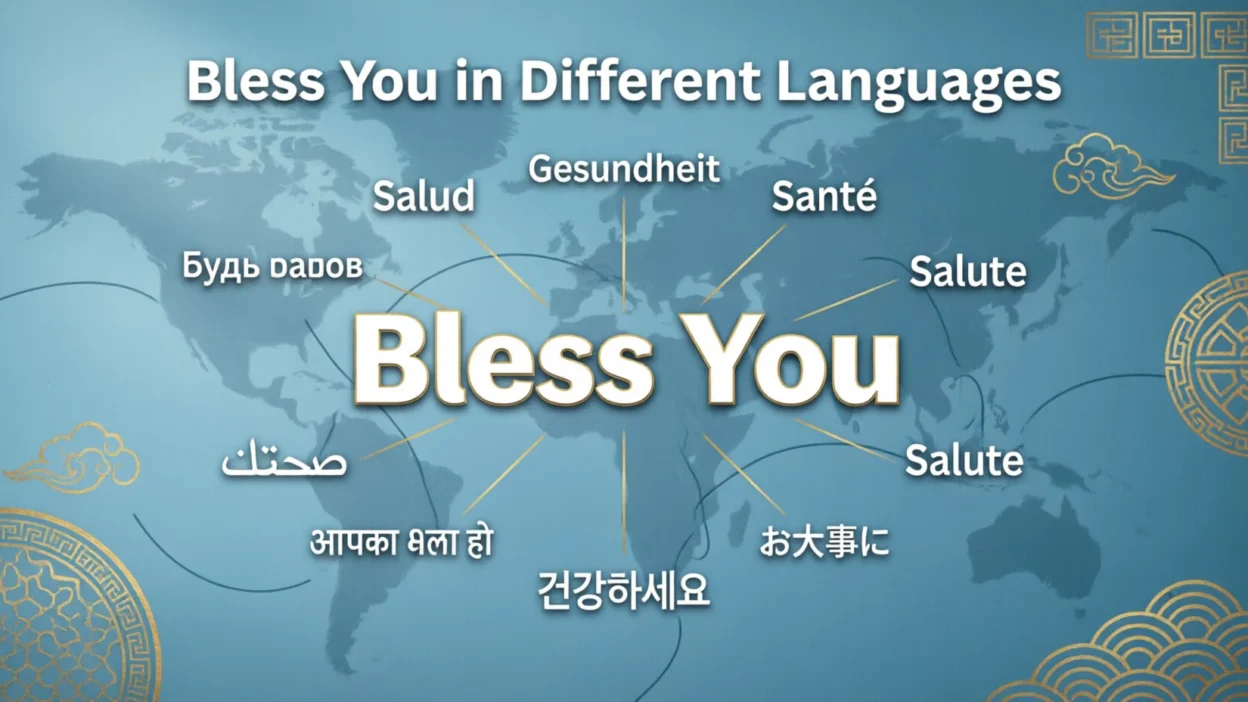
Saying “bless you” after someone sneezes is a common social custom in many parts of the world. While the exact expression differs from language to language, the meaning is often connected with wishing someone good health, protection, or well-being.
If you want to learn how to say bless you in different languages, this guide gives you 70 useful translations with easy English pronunciations and real-life examples. If you are learning a new language, traveling, writing, or simply curious about international expressions, these bless you translations make it easy to understand how the phrase is used around the world.
How to Say Bless You in Different Languages
The phrase “bless you” does not always translate word-for-word. In some languages, people use an expression meaning “God bless you,” while others use a traditional response specifically associated with sneezing.
The table below provides bless you in all languages with the native expression, pronunciation, an example sentence, and its English meaning.
| # | Language | Native Phrase | Easy English Pronunciation | Example Sentence | English Meaning |
|---|---|---|---|---|---|
| 1 | English | Bless you! | Bless yoo | Bless you after that sneeze! | Bless you after that sneeze! |
| 2 | Spanish | ¡Salud! | Sah-LOOD | ¡Salud! That was a big sneeze. | Bless you! That was a big sneeze. |
| 3 | French | À tes souhaits ! | Ah tay sweh | À tes souhaits after your sneeze! | Bless you after your sneeze! |
| 4 | German | Gesundheit! | Geh-ZOONT-hite | Gesundheit! Are you okay? | Bless you! Are you okay? |
| 5 | Italian | Salute! | Sah-LOO-tay | Salute! That was quite a sneeze. | Bless you! That was quite a sneeze. |
| 6 | Portuguese | Saúde! | Sah-OO-dee | Saúde! I hope you feel fine. | Bless you! I hope you feel fine. |
| 7 | Dutch | Gezondheid! | Geh-ZOONT-hite | Gezondheid! | Bless you! |
| 8 | Swedish | Prosit! | PROH-sit | Prosit! That was a loud sneeze. | Bless you! That was a loud sneeze. |
| 9 | Norwegian | Prosit! | PROH-sit | Prosit! Are you feeling okay? | Bless you! Are you feeling okay? |
| 10 | Danish | Prosit! | PROH-sit | Prosit! That sneeze surprised me. | Bless you! That sneeze surprised me. |
| 11 | Finnish | Terveydeksi! | TEHR-vay-deks-ee | Terveydeksi! | Bless you! |
| 12 | Icelandic | Guð hjálpi þér! | Guth HYOWL-pee thyehr | Guð hjálpi þér after the sneeze. | May God help you after the sneeze. |
| 13 | Irish | Dia linn! | DEE-ah lin | Dia linn! | God be with us! |
| 14 | Scottish Gaelic | Slàinte mhath! | SLAHN-chuh vah | Slàinte mhath! | Good health! |
| 15 | Welsh | Bendith arnat! | BEN-dith AR-nat | Bendith arnat! | Bless you! |
| 16 | Polish | Na zdrowie! | Nah ZDROH-vyeh | Na zdrowie! | To your health! |
| 17 | Czech | Na zdraví! | Nah ZDRAH-vee | Na zdraví! | To your health! |
| 18 | Slovak | Na zdravie! | Nah ZDRAH-vyeh | Na zdravie! | To your health! |
| 19 | Slovenian | Na zdravje! | Nah ZDRAHV-yeh | Na zdravje! | To your health! |
| 20 | Croatian | Nazdravlje! | Nahz-DRAHV-lyeh | Nazdravlje! | To your health! |
| 21 | Serbian | Nazdravlje! | Nahz-DRAHV-lyeh | Nazdravlje! | To your health! |
| 22 | Bosnian | Nazdravlje! | Nahz-DRAHV-lyeh | Nazdravlje! | To your health! |
| 23 | Macedonian | На здравје! | Nah ZDRAHV-yeh | На здравје! | To your health! |
| 24 | Bulgarian | Наздраве! | Nahz-DRAH-veh | Наздраве! | To your health! |
| 25 | Russian | Будь здоров! | Boot zdah-ROHF | Будь здоров! | Be healthy! |
| 26 | Ukrainian | Будь здоров! | Boot zdah-ROHF | Будь здоров! | Be healthy! |
| 27 | Belarusian | Будзь здароў! | Bootz zah-DAROW | Будзь здароў! | Be healthy! |
| 28 | Lithuanian | Į sveikatą! | Ee svay-KAH-tah | Į sveikatą! | To your health! |
| 29 | Latvian | Uz veselību! | Ooz veh-SEH-lee-boo | Uz veselību! | To your health! |
| 30 | Estonian | Terviseks! | TEHR-vee-seks | Terviseks! | To your health! |
| 31 | Hungarian | Egészségedre! | Eh-GAY-shay-geh-dreh | Egészségedre! | To your health! |
| 32 | Romanian | Sănătate! | S uh-nuh-TAH-teh | Sănătate! | Good health! |
| 33 | Greek | Γείτσες! | YIT-ses | Γείτσες! | Bless you! |
| 34 | Albanian | Shëndet! | SHUN-det | Shëndet! | Good health! |
| 35 | Armenian | Առողջություն | Ah-roh-joo-TOON | Առողջություն! | Good health! |
| 36 | Georgian | ჯანმრთელობა! | JAHN-mrtheh-LOH-bah | ჯანმრთელობა! | Good health! |
| 37 | Turkish | Çok yaşa! | Chok yah-SHAH | Çok yaşa! | Live long! |
| 38 | Azerbaijani | Çox yaşa! | Chok yah-SHAH | Çox yaşa! | Live long! |
| 39 | Persian | عافیت باشه | Ah-fee-yat BAH-sheh | عافیت باشه! | May you have good health! |
| 40 | Arabic | يرحمك الله | Yar-HAM-uk Allah | يرحمك الله بعد العطسة. | May God have mercy on you after the sneeze. |
| 41 | Hebrew | לבריאות! | Lee-vree-OOT | לבריאות! | To your health! |
| 42 | Maltese | Evviva! | Eh-VEE-vah | Evviva! | Bless you / good health! |
| 43 | Hindi | भगवान आपका भला करे | Bhag-waan AAP-ka bha-la ka-ray | भगवान आपका भला करे! | May God bless you! |
| 44 | Urdu | اللہ آپ کو سلامت رکھے | Allah aap ko salaamat rakhay | اللہ آپ کو سلامت رکھے! | May God keep you safe and well! |
| 45 | Bengali | ঈশ্বর তোমার মঙ্গল করুন | Eesh-shor to-mar mong-gol koo-roon | ঈশ্বর তোমার মঙ্গল করুন! | May God bless you! |
| 46 | Punjabi | ਰੱਬ ਤੁਹਾਨੂੰ ਖੁਸ਼ ਰੱਖੇ | Rabb tuhanu khush rakhay | ਰੱਬ ਤੁਹਾਨੂੰ ਖੁਸ਼ ਰੱਖੇ! | May God keep you happy! |
| 47 | Gujarati | ભગવાન તમારું ભલું કરે | Bhag-waan ta-ma-ro bha-loo ka-ray | ભગવાન તમારું ભલું કરે! | May God bless you! |
| 48 | Marathi | देव तुझं भलं करो | Dev tu-jham bha-lam ka-ro | देव तुझं भलं करो! | May God bless you! |
| 49 | Nepali | भगवानले तपाईंलाई आशीर्वाद दिऊन् | Bhag-wan-lay tapai-lai aa-sheer-waad dee-oon | भगवानले तपाईंलाई आशीर्वाद दिऊन्! | May God bless you! |
| 50 | Sinhala | ආයුබෝවන් | Aa-yu-bo-wan | ආයුබෝවන්! | May you have a long life! |
| 51 | Tamil | கடவுள் உங்களை ஆசீர்வதிப்பாராக | Kadavul ung-galai aa-sheer-va-dhip-pa-ra-ga | கடவுள் உங்களை ஆசீர்வதிப்பாராக! | May God bless you! |
| 52 | Telugu | దేవుడు మిమ్మల్ని ఆశీర్వదించుగాక | De-vu-du mim-mal-ni aa-sheer-va-din-chu-gaaka | దేవుడు మిమ్మల్ని ఆశీర్వదించుగాక! | May God bless you! |
| 53 | Kannada | ದೇವರು ನಿಮ್ಮನ್ನು ಆಶೀರ್ವದಿಸಲಿ | De-va-ru nim-man-nu aa-sheer-va-di-sa-lee | ದೇವರು ನಿಮ್ಮನ್ನು ಆಶೀರ್ವದಿಸಲಿ! | May God bless you! |
| 54 | Malayalam | ദൈവം നിങ്ങളെ അനുഗ്രഹിക്കട്ടെ | Dai-vam nin-ga-le a-nu-gra-hi-kat-te | ദൈവം നിങ്ങളെ അനുഗ്രഹിക്കട്ടെ! | May God bless you! |
| 55 | Chinese (Mandarin) | 保重身体 | Bao-jhong shen-tee | 保重身体! | Take care of your health! |
| 56 | Japanese | お大事に | Oh-dai-jee-nee | お大事に! | Take care! |
| 57 | Korean | 건강하세요 | Geon-gang-ha-se-yo | 건강하세요! | Stay healthy! |
| 58 | Vietnamese | Chúc bạn mạnh khỏe! | Chook ban manh khweh | Chúc bạn mạnh khỏe! | Wishing you good health! |
| 59 | Thai | ขอให้สุขภาพแข็งแรง | Kaw hai sook-ka-pap khaeng-raeng | ขอให้สุขภาพแข็งแรง! | May you have good health! |
| 60 | Indonesian | Semoga sehat! | Seh-MOH-gah seh-HAHT | Semoga sehat! | May you stay healthy! |
| 61 | Malay | Semoga sihat! | Seh-MOH-gah see-HAHT | Semoga sihat! | May you stay healthy! |
| 62 | Filipino | Pagpalain ka! | Pag-pa-LAH-in ka | Pagpalain ka! | May you be blessed! |
| 63 | Swahili | Ubarikiwe! | Oo-bah-ree-KI-weh | Ubarikiwe! | May you be blessed! |
| 64 | Afrikaans | Gesondheid! | Geh-SOONT-hite | Gesondheid! | Good health! |
| 65 | Zulu | Busisiwe! | Boo-see-SI-weh | Busisiwe! | Be blessed! |
| 66 | Xhosa | Usikelelwe! | Oo-see-keh-LEL-weh | Usikelelwe! | Be blessed! |
| 67 | Yoruba | Aláfíà! | Ah-lah-FEE-ah | Aláfíà! | Good health! |
| 68 | Igbo | Ka Chineke gozie gị | Kah Chee-neh-keh GOH-zee jee | Ka Chineke gozie gị! | May God bless you! |
| 69 | Haitian Creole | Bondye beni ou! | Bon-dyay beh-nee oo | Bondye beni ou! | God bless you! |
| 70 | Latin | Deus te benedicat! | Day-oos tay beh-neh-DEE-kaht | Deus te benedicat! | May God bless you! |
What Does “Bless You” Mean?
“Bless you” is traditionally said after someone sneezes. In English, it is a polite expression of goodwill. Similar expressions in other languages may focus on health, long life, protection, or divine blessing.
The meaning can also depend on culture. Some languages use a direct equivalent of “bless you,” while others use phrases such as “good health,” “live long,” or “may God bless you.”
Why Do People Say “Bless You” After a Sneeze?
The custom of responding to a sneeze has a long history in different cultures. Over time, people developed expressions intended to wish the person health, safety, or protection.
Today, saying “bless you” is usually a simple social courtesy. It does not necessarily carry a religious meaning for the person saying it.
Bless You Around the World
The way people respond to sneezing varies greatly around the world. For example, German speakers commonly say “Gesundheit,” which is related to good health. Turkish speakers commonly say “Çok yaşa,” meaning “Live long,” while Japanese speakers can use “お大事に,” meaning “Take care.”
These differences show why direct translations are not always enough when learning bless you in different languages. Understanding the cultural meaning behind each phrase can make communication more natural.
Bless You Translations for Travel and Conversation
Learning a simple expression such as “bless you” can be useful when traveling or communicating with people from different countries. It is a short phrase that can show politeness and cultural awareness.
If you are studying languages, remember that pronunciation is only a guide. Native speakers may use different accents, regional expressions, or more formal versions depending on the situation.
How to Use “Bless You” Naturally
In English, “Bless you!” is normally said immediately after someone sneezes. It can be used with friends, family members, coworkers, or strangers.
In other languages, the expression may be more closely connected with health or well-being. When learning a new phrase, it is helpful to understand both its literal translation and how native speakers actually use it.
Are “Bless You” and “Good Health” the Same?
Not always. Some expressions are direct equivalents of “bless you,” while others are traditional responses that wish someone good health.
For example, “Gesundheit” literally relates to health, while “Çok yaşa” expresses the wish that someone will live a long life. Both can function as responses to a sneeze, even though their literal meanings differ.
Quick Guide to Bless You in 10 Popular Languages
Here are ten commonly searched bless you translations:
- English: Bless you!
- Spanish: ¡Salud!
- French: À tes souhaits!
- German: Gesundheit!
- Italian: Salute!
- Portuguese: Saúde!
- Dutch: Gezondheid!
- Russian: Будь здоров!
- Turkish: Çok yaşa!
- Arabic: يرحمك الله
These expressions are useful starting points for anyone searching for how to say bless you in different languages.
FAQs:
1. How do you say “bless you” in Spanish?
In Spanish, “¡Salud!” is commonly said after someone sneezes. It literally means “health” and is used as a friendly wish for good health.
2. How do you say “bless you” in French?
In French, “À tes souhaits!” is commonly used informally after someone sneezes. It can be translated as “to your wishes” and functions as the traditional response to a sneeze.
3. What is “bless you” in German?
In German, people commonly say “Gesundheit!” after someone sneezes. The word is associated with health and can be understood as wishing the person good health.
4. How do you say “bless you” in Japanese?
A common Japanese expression is “お大事に” (odaiji ni), which means “take care” or “take good care of yourself.” It can be used when showing concern for someone’s health.
5. What is the most common meaning of “bless you” around the world?
The exact wording differs, but many expressions communicate a similar idea: wishing someone health, safety, protection, or well-being after a sneeze.
Conclusion
Learning bless you in different languages is a simple way to explore how cultures express kindness and concern. While some languages use a direct blessing, others refer to good health, long life, or taking care of oneself.
With these 70 translations, you can discover how people respond to sneezing across different languages and cultures. Remember that pronunciation and everyday usage can vary by region, so listening to native speakers is the best way to develop natural communication skills.

Carter Connor is a language enthusiast and content writer at LingoMean, helping readers discover what to say in everyday conversations with clear explanations, practical examples, and easy-to-understand communication tips.