The word “by” is one of the most useful and versatile words in English. It can describe a method, a person who performs an action, a deadline, movement near a place, or a means of transportation. Because its meaning changes with context, there is not always one direct translation in every language.
If you are searching for by in different languages, this guide provides 70 translations with easy pronunciations and practical example sentences. These by translations can help students, travelers, writers, language learners, and anyone interested in how to say “by” around the world.
Quick Answer: How Do You Say “By” in Different Languages?
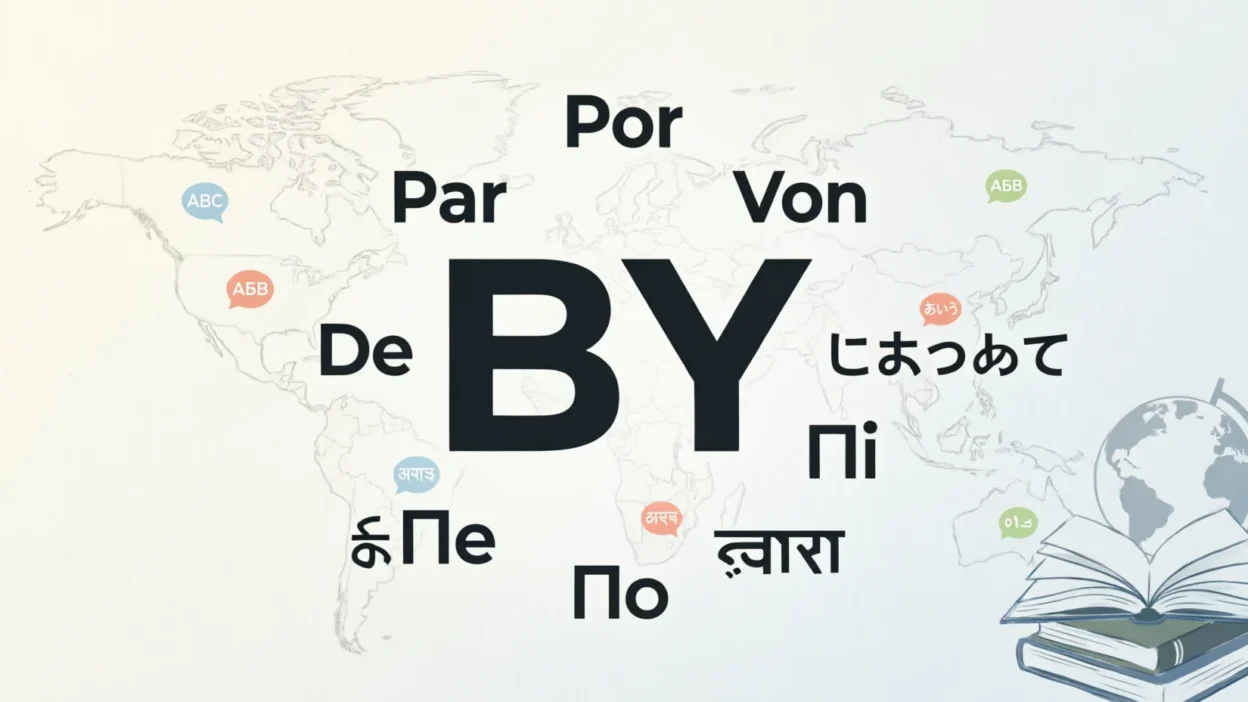
The translation of “by” depends on its meaning. For example, Spanish commonly uses por for “by” in passive sentences and en for transportation, while French often uses par for an agent and en for transportation. The table below gives a useful everyday equivalent for each language.
“By” in Different Languages Around the World
| # | Language | Native Phrase | Easy English Pronunciation | Example Sentence | English Meaning |
|---|---|---|---|---|---|
| 1 | English | by | bai | The letter was sent by John. | The letter was sent by John. |
| 2 | Spanish | por | por | The book was written by María. | The book was written by María. |
| 3 | French | par | par | The song was written by Paul. | The song was written by Paul. |
| 4 | German | von | fon | The painting was made by Anna. | The painting was made by Anna. |
| 5 | Italian | da | dah | This book was written by Marco. | This book was written by Marco. |
| 6 | Portuguese | por | por | The letter was sent by Ana. | The letter was sent by Ana. |
| 7 | Dutch | door | door | The book was written by him. | The book was written by him. |
| 8 | Swedish | av | ahv | The song was written by her. | The song was written by her. |
| 9 | Norwegian | av | ahv | The picture was painted by Lars. | The picture was painted by Lars. |
| 10 | Danish | af | ahf | The book was written by Peter. | The book was written by Peter. |
| 11 | Finnish | toimesta | toy-MES-tah | The decision was made by the committee. | The decision was made by the committee. |
| 12 | Estonian | poolt | poolt | The proposal was approved by the group. | The proposal was approved by the group. |
| 13 | Latvian | ar | ahr | I travel by train. | I travel by train. |
| 14 | Lithuanian | per | pehr | I sent it by mail. | I sent it by mail. |
| 15 | Polish | przez | pshehz | The book was written by Anna. | The book was written by Anna. |
| 16 | Czech | od | oht | I received a letter by mail. | I received a letter by mail. |
| 17 | Slovak | od | oht | The message came by email. | The message came by email. |
| 18 | Slovenian | od | oht | The story was written by him. | The story was written by him. |
| 19 | Croatian | od | ohd | The book was written by Ivan. | The book was written by Ivan. |
| 20 | Serbian | од стране | od STRAH-neh | The decision was made by the team. | The decision was made by the team. |
| 21 | Bulgarian | от | oht | The painting was made by Maria. | The painting was made by Maria. |
| 22 | Macedonian | од | oht | The song was performed by Elena. | The song was performed by Elena. |
| 23 | Russian | посредством | pos-red-STVOM | The message was sent by email. | The message was sent by email. |
| 24 | Ukrainian | за допомогою | zah do-po-MOH-ho-yu | I did it by using a computer. | I did it using a computer. |
| 25 | Belarusian | з дапамогай | z da-pa-MOH-hai | We solved it by using a map. | We solved it using a map. |
| 26 | Greek | από | ah-PO | The painting was created by Nikos. | The painting was created by Nikos. |
| 27 | Albanian | nga | ngah | The book was written by Arben. | The book was written by Arben. |
| 28 | Romanian | de | deh | The song was written by Elena. | The song was written by Elena. |
| 29 | Hungarian | által | AHL-tahl | The work was completed by the team. | The work was completed by the team. |
| 30 | Turkish | tarafından | tah-rah-FUN-dahn | The book was written by Ali. | The book was written by Ali. |
| 31 | Azerbaijani | tərəfindən | teh-reh-FEEN-den | The work was completed by the team. | The work was completed by the team. |
| 32 | Georgian | მიერ | mee-EHR | The book was written by him. | The book was written by him. |
| 33 | Armenian | կողմից | kohg-MEETS | The work was done by Anna. | The work was done by Anna. |
| 34 | Persian | توسط | tavassot | The book was written by Ali. | The book was written by Ali. |
| 35 | Arabic | بواسطة | bee-WA-si-tah | The message was sent by email. | The message was sent by email. |
| 36 | Hebrew | על ידי | al yeh-DEE | The book was written by David. | The book was written by David. |
| 37 | Hindi | द्वारा | dwa-RAH | The book was written by Prem. | The book was written by Prem. |
| 38 | Urdu | کے ذریعے | kay zaree-ay | The message was sent by email. | The message was sent by email. |
| 39 | Bengali | দ্বারা | dwa-ra | The work was completed by him. | The work was completed by him. |
| 40 | Punjabi | ਦੁਆਰਾ | doo-RAH | The letter was sent by Ali. | The letter was sent by Ali. |
| 41 | Gujarati | દ્વારા | dwa-ra | The work was completed by the team. | The work was completed by the team. |
| 42 | Marathi | द्वारे | dwa-ray | The message was sent by email. | The message was sent by email. |
| 43 | Nepali | द्वारा | dwa-RAH | The book was written by him. | The book was written by him. |
| 44 | Sinhala | විසින් | wi-SIN | The song was sung by her. | The song was sung by her. |
| 45 | Tamil | மூலம் | moo-lam | I sent it by email. | I sent it by email. |
| 46 | Telugu | ద్వారా | dwa-ra | The message was sent by email. | The message was sent by email. |
| 47 | Kannada | ಮೂಲಕ | moo-la-ka | I sent the document by email. | I sent the document by email. |
| 48 | Malayalam | വഴി | vazhi | I sent it by email. | I sent it by email. |
| 49 | Odia | ଦ୍ୱାରା | dwa-ra | The work was completed by him. | The work was completed by him. |
| 50 | Assamese | দ্বাৰা | dwa-ra | The letter was sent by him. | The letter was sent by him. |
| 51 | Chinese | 由 | yoh | The book was written by Li. | The book was written by Li. |
| 52 | Japanese | によって | nee-YOH-teh | The book was written by Yuki. | The book was written by Yuki. |
| 53 | Korean | 에 의해 | eh heh | The work was done by the team. | The work was done by the team. |
| 54 | Vietnamese | bởi | buh-ee | The song was written by Lan. | The song was written by Lan. |
| 55 | Thai | โดย | doy | The book was written by him. | The book was written by him. |
| 56 | Indonesian | oleh | oh-leh | The book was written by Budi. | The book was written by Budi. |
| 57 | Malay | oleh | oh-leh | The letter was written by Ali. | The letter was written by Ali. |
| 58 | Filipino | ni | nee | The book was written by Maria. | The book was written by Maria. |
| 59 | Swahili | na | nah | The book was written by Amina. | The book was written by Amina. |
| 60 | Afrikaans | deur | deur | The book was written by him. | The book was written by him. |
| 61 | Zulu | ngu- | ngoo | The song was sung by her. | The song was sung by her. |
| 62 | Xhosa | ngu- | ngoo | The song was sung by him. | The song was sung by him. |
| 63 | Yoruba | nípasẹ̀ | nee-pah-SEH | The work was done by him. | The work was done by him. |
| 64 | Igbo | site na | see-teh nah | The message was sent by email. | The message was sent by email. |
| 65 | Haitian Creole | pa | pah | The song was written by him. | The song was written by him. |
| 66 | Latin | a | ah | The book was written by Cicero. | The book was written by Cicero. |
| 67 | Esperanto | de | deh | The book was written by Anna. | The book was written by Anna. |
| 68 | Icelandic | af | ahv | The poem was written by Jón. | The poem was written by Jón. |
| 69 | Irish | ag | ahg | The work was completed by him. | The work was completed by him. |
| 70 | Welsh | gan | gan | The book was written by her. | The book was written by her. |
What Does “By” Mean in Different Contexts?
The English word “by” has several meanings, so its translation changes depending on the sentence.
It can identify the person who performs an action, as in “The novel was written by Jane.” It can also describe a method or means, such as “I traveled by train.”
“By” can also indicate a deadline, as in “Finish the work by Friday,” or location, as in “She walked by the house.” This is why direct word-for-word translation is not always accurate.
How to Say “By” in Different Languages for Transportation
When “by” describes transportation, many languages use a completely different word from the one used for an agent.
For example, English says “by train,” “by car,” and “by plane.” In Spanish, transportation is commonly expressed with en, while French uses en for several forms of transportation. Always consider the complete sentence rather than translating “by” alone.
“By” Translations for Passive Sentences
One of the most common uses of “by” is identifying who performed an action in a passive sentence.
Examples include:
- The book was written by John.
- The song was performed by the singer.
- The painting was created by the artist.
Languages such as Spanish, French, German, Italian, and Portuguese have established grammatical forms for expressing this relationship.
“By” as a Way or Method
Another important meaning appears when “by” describes how something happens.
For example:
- I sent the document by email.
- She learned English by watching movies.
- We traveled by train.
In these situations, the correct translation may be closer to “through,” “using,” “with,” or a transportation expression rather than a direct equivalent of “by.”
“By” for Deadlines and Time
English also uses “by” to express a deadline.
For example, “Please finish the project by Monday” means the project should be completed no later than Monday.
This meaning is different from the “by” used in “The book was written by Sarah.” Therefore, translations for time-related uses should be checked according to the grammar of the target language.
Common Mistakes When Translating “By”
A common mistake is assuming that “by” always has one fixed translation. Because English uses the word in many grammatical situations, a direct translation can sometimes sound unnatural or incorrect.
For accurate by translations, identify the meaning first. Ask whether “by” refers to an agent, method, transportation, location, or deadline. Then choose the natural expression used in the target language.
Why Learn “By” in All Languages?
Learning common words such as “by” can make language study easier because they appear frequently in everyday speech and writing. Understanding their different uses also helps learners avoid literal translation mistakes.
This list of by in all languages provides a starting point for comparing grammatical patterns across Europe, Asia, Africa, and other regions.
Conclusion
The word “by” has many meanings in English, and its translation can change depending on context. The 70 languages above show how different languages express ideas involving agents, methods, communication, transportation, and other relationships.
When learning by in different languages, focus on the meaning of the complete sentence rather than translating the single word in isolation.
FAQs:
1. How do you say “by” in Spanish?
“By” can commonly be translated as por when identifying the agent of a passive action, while other meanings may require different Spanish words such as en for certain transportation expressions.
2. How do you say “by” in French?
The common translation is par when “by” identifies the person or agent performing an action. Other meanings of “by” can use different French expressions.
3. What is “by” in Urdu?
A common Urdu expression for “by” when describing a method or means is کے ذریعے (kay zaree-ay). The correct Urdu translation depends on the context.
4. What is “by” in Hindi?
A common Hindi equivalent for “by” when identifying the agent of an action is द्वारा (dwa-RAH). Other meanings can require different Hindi expressions.
5. Why does “by” have different translations in different languages?
“By” has several grammatical meanings in English. It can indicate an agent, method, transportation, location, or deadline. Since languages organize these ideas differently, there is not always one universal translation.

Anthony Dylan is a language enthusiast and content writer at LingoMean, where he helps readers understand what to say in different situations. He creates clear, practical, and engaging guides that improve communication, confidence, and everyday conversations.