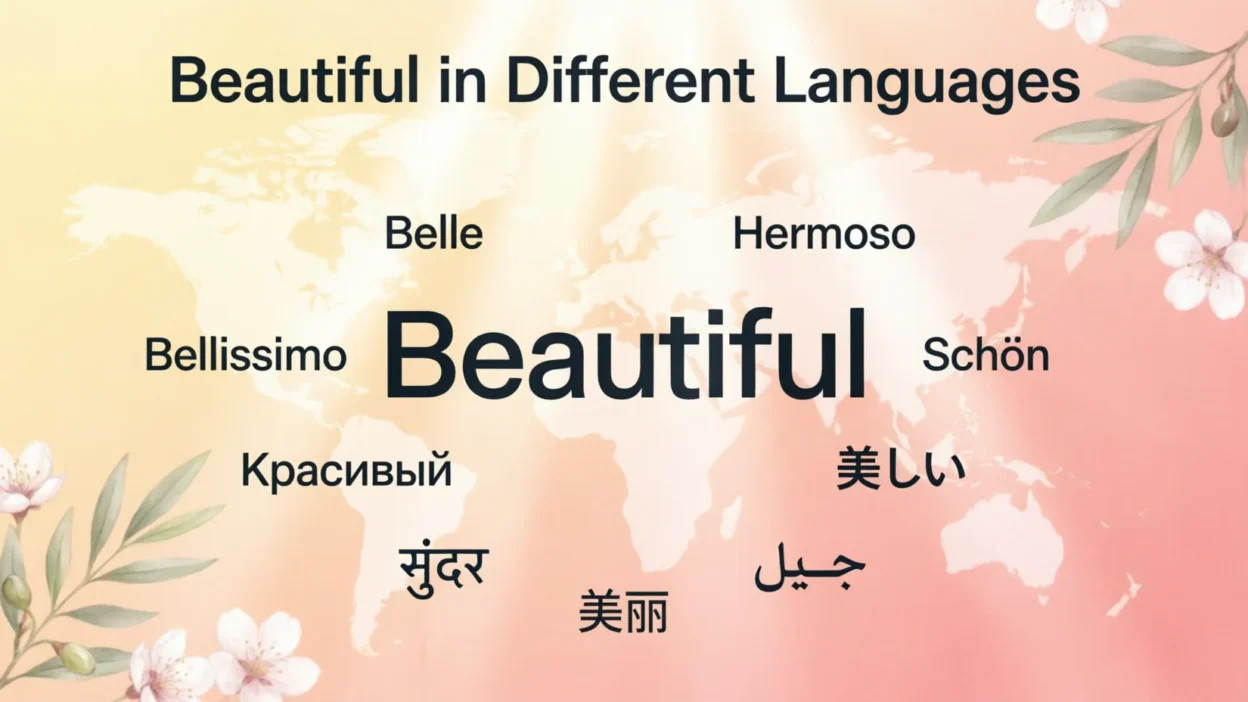
The word “beautiful” is one of the most useful compliments in any language. If you are describing a person, place, view, piece of art, or special moment, knowing how to say beautiful in different languages can help you communicate appreciation more naturally.
If you are searching for beautiful in all languages, this guide gives you 70 translations along with simple English pronunciations and real-life examples. These beautiful translations are useful for travelers, language learners, writers, students, social media creators, and anyone interested in languages around the world.
Because some languages change adjectives according to gender, number, or grammatical context, the table below uses common and natural forms. This makes it easier to understand how to say beautiful in different languages in everyday situations.
Beautiful in Different Languages: 70 Translations
| # | Language | Native Phrase | Easy English Pronunciation | Example Sentence | English Meaning |
|---|---|---|---|---|---|
| 1 | English | Beautiful | BYOO-ti-ful | The garden is beautiful. | The garden is beautiful. |
| 2 | Spanish | Hermoso / Hermosa | er-MOH-so / er-MOH-sa | La vista es hermosa. | The view is beautiful. |
| 3 | French | Beau / Belle | boh / bell | Cette ville est belle. | This city is beautiful. |
| 4 | German | Schön | shurn | Der Garten ist schön. | The garden is beautiful. |
| 5 | Italian | Bello / Bella | BEL-lo / BEL-la | Questa città è bella. | This city is beautiful. |
| 6 | Portuguese | Bonito / Bonita | boh-NEE-to / boh-NEE-ta | A praia é bonita. | The beach is beautiful. |
| 7 | Dutch | Mooi | moy | De tuin is mooi. | The garden is beautiful. |
| 8 | Swedish | Vacker | VAK-er | Utsikten är vacker. | The view is beautiful. |
| 9 | Norwegian | Vakker | VAK-er | Byen er vakker. | The city is beautiful. |
| 10 | Danish | Smuk | smook | Hun er smuk. | She is beautiful. |
| 11 | Finnish | Kaunis | KOW-nis | Maisema on kaunis. | The landscape is beautiful. |
| 12 | Icelandic | Fallegur / Falleg | FAT-leh-gur / FAT-leh | Borgin er falleg. | The city is beautiful. |
| 13 | Irish | Álainn | AW-lin | Tá an áit álainn. | The place is beautiful. |
| 14 | Scottish Gaelic | Bòidheach | BOY-ach | Tha an sealladh bòidheach. | The view is beautiful. |
| 15 | Welsh | Hardd | hardh | Mae’r ardd yn hardd. | The garden is beautiful. |
| 16 | Latin | Pulcher / Pulchra | POOL-ker / POOL-kra | Puella pulchra est. | The girl is beautiful. |
| 17 | Romanian | Frumos / Frumoasă | froo-MOHS / froo-MWA-sa | Orașul este frumos. | The city is beautiful. |
| 18 | Catalan | Bonic / Bonica | boh-NEEK / boh-NEE-ka | La casa és bonica. | The house is beautiful. |
| 19 | Galician | Fermoso / Fermosa | fer-MOH-so / fer-MOH-sa | A praia é fermosa. | The beach is beautiful. |
| 20 | Basque | Eder | EH-der | Paisaia ederra da. | The landscape is beautiful. |
| 21 | Albanian | I bukur / E bukur | ee BOO-kur / eh BOO-kur | Qyteti është i bukur. | The city is beautiful. |
| 22 | Greek | Όμορφος / Όμορφη | OH-mor-fos / OH-mor-fee | Η πόλη είναι όμορφη. | The city is beautiful. |
| 23 | Russian | Красивый / Красивая | kra-SEE-vy / kra-SEE-va-ya | Этот город красивый. | This city is beautiful. |
| 24 | Ukrainian | Красивий / Красива | kra-SY-vyi / kra-SY-va | Це красиве місто. | This is a beautiful city. |
| 25 | Polish | Piękny / Piękna | PYENK-ny / PYENK-na | To piękne miejsce. | This is a beautiful place. |
| 26 | Czech | Krásný / Krásná | KRAHS-nee / KRAHS-na | To je krásné město. | This is a beautiful city. |
| 27 | Slovak | Krásny / Krásna | KRAHS-nee / KRAHS-na | Tá záhrada je krásna. | That garden is beautiful. |
| 28 | Slovenian | Lep / Lepa | lep / LEH-pa | Hiša je lepa. | The house is beautiful. |
| 29 | Croatian | Lijep / Lijepa | LYEH-p / LYEH-pa | More je lijepo. | The sea is beautiful. |
| 30 | Serbian | Lep / Lepa | lep / LEH-pa | Grad je lep. | The city is beautiful. |
| 31 | Bosnian | Lijep / Lijepa | LYEH-p / LYEH-pa | Ovo je lijepo mjesto. | This is a beautiful place. |
| 32 | Bulgarian | Красив / Красива | kra-SEEV / kra-SEE-va | Градът е красив. | The city is beautiful. |
| 33 | Macedonian | Убав / Убава | OO-bav / OO-ba-va | Градот е убав. | The city is beautiful. |
| 34 | Lithuanian | Gražus / Graži | GRAH-zoos / GRAH-zhee | Miestas gražus. | The city is beautiful. |
| 35 | Latvian | Skaists / Skaista | sky-ists / SKY-sta | Dārzs ir skaists. | The garden is beautiful. |
| 36 | Estonian | Ilus | EE-loos | Linn on ilus. | The city is beautiful. |
| 37 | Hungarian | Gyönyörű | DYURN-yuh-roo | A város gyönyörű. | The city is beautiful. |
| 38 | Maltese | Sabiħ / Sabiħa | SA-beeh / sa-BEE-ha | Il-belt sabiħa. | The city is beautiful. |
| 39 | Turkish | Güzel | goo-ZEL | Bu şehir güzel. | This city is beautiful. |
| 40 | Azerbaijani | Gözəl | guh-ZEL | Bu şəhər gözəldir. | This city is beautiful. |
| 41 | Armenian | Գեղեցիկ | gheh-TSHEE-keek | Քաղաքը գեղեցիկ է։ | The city is beautiful. |
| 42 | Georgian | ლამაზი | la-MA-zee | ქალაქი ლამაზია. | The city is beautiful. |
| 43 | Persian | زیبا | zee-BA | این شهر زیباست. | This city is beautiful. |
| 44 | Arabic | جميل / جميلة | ja-MEEL / ja-MEE-la | المدينة جميلة. | The city is beautiful. |
| 45 | Hebrew | יפה | ya-FAH | העיר יפה. | The city is beautiful. |
| 46 | Hindi | सुंदर | SOON-dar | यह जगह सुंदर है। | This place is beautiful. |
| 47 | Urdu | خوبصورت | khoob-SOO-rat | یہ جگہ خوبصورت ہے۔ | This place is beautiful. |
| 48 | Bengali | সুন্দর | SHUN-dor | জায়গাটি সুন্দর। | The place is beautiful. |
| 49 | Punjabi | ਸੁੰਦਰ | SOON-dar | ਇਹ ਜਗ੍ਹਾ ਸੁੰਦਰ ਹੈ। | This place is beautiful. |
| 50 | Gujarati | સુંદર | SOON-dar | આ જગ્યા સુંદર છે. | This place is beautiful. |
| 51 | Marathi | सुंदर | SOON-dar | हे ठिकाण सुंदर आहे. | This place is beautiful. |
| 52 | Nepali | सुन्दर | SOON-dar | यो ठाउँ सुन्दर छ। | This place is beautiful. |
| 53 | Sinhala | ලස්සන | LAS-sa-na | මේ ස්ථානය ලස්සනයි. | This place is beautiful. |
| 54 | Tamil | அழகான | a-la-GAA-na | இந்த இடம் அழகானது. | This place is beautiful. |
| 55 | Telugu | అందమైన | an-da-MY-na | ఈ ప్రదేశం అందమైనది. | This place is beautiful. |
| 56 | Kannada | ಸುಂದರ | SOON-da-ra | ಈ ಸ್ಥಳ ಸುಂದರವಾಗಿದೆ. | This place is beautiful. |
| 57 | Malayalam | മനോഹരം | ma-no-HA-ram | ഈ സ്ഥലം മനോഹരമാണ്. | This place is beautiful. |
| 58 | Odia | ସୁନ୍ଦର | SOON-dar | ଏହି ସ୍ଥାନ ସୁନ୍ଦର। | This place is beautiful. |
| 59 | Assamese | ধুনীয়া | dhuh-NEE-ya | ঠাইখন ধুনীয়া। | The place is beautiful. |
| 60 | Chinese (Mandarin) | 美丽 | MAY-lee | 这个地方很美丽。 | This place is beautiful. |
| 61 | Japanese | 美しい | utsu-SHEE | この場所は美しいです。 | This place is beautiful. |
| 62 | Korean | 아름답다 | a-reum-dap-da | 이곳은 아름답습니다. | This place is beautiful. |
| 63 | Vietnamese | Đẹp | dep | Nơi này đẹp. | This place is beautiful. |
| 64 | Thai | สวย | suay | สถานที่นี้สวย | This place is beautiful. |
| 65 | Indonesian | Indah | IN-dah | Tempat ini indah. | This place is beautiful. |
| 66 | Malay | Cantik | CHAN-tik | Tempat ini cantik. | This place is beautiful. |
| 67 | Filipino | Maganda | ma-GAN-da | Maganda ang lugar na ito. | This place is beautiful. |
| 68 | Swahili | Nzuri | n-ZOO-ree | Mahali hapa ni pazuri. | This place is beautiful. |
| 69 | Afrikaans | Mooi | moy | Die plek is mooi. | The place is beautiful. |
| 70 | Esperanto | Bela | BEH-la | La ĝardeno estas bela. | The garden is beautiful. |
What Does “Beautiful” Mean?
“Beautiful” is an adjective used to describe something that creates a strong feeling of attractiveness, pleasure, elegance, or admiration. It can describe people, nature, buildings, artwork, objects, experiences, and even ideas.
For example, you can say “a beautiful sunset,” “a beautiful person,” “a beautiful painting,” or “a beautiful memory.” The exact translation may change depending on the language and the thing being described.
How to Say Beautiful in Different Languages
Learning how to say beautiful in different languages is a simple way to expand your vocabulary. In many European languages, the word changes according to grammatical gender. For example, Spanish uses “hermoso” for masculine nouns and “hermosa” for feminine nouns.
Other languages use a single common form in many everyday situations. Turkish “güzel,” Indonesian “indah,” Vietnamese “đẹp,” and Dutch “mooi” are examples of commonly used forms.
When learning beautiful translations, it is helpful to learn the phrase in a complete sentence rather than memorizing the word alone.
Beautiful in European Languages
European languages offer many interesting ways to express beauty. French uses “beau” and “belle,” Italian uses “bello” and “bella,” while German uses the versatile word “schön.”
Slavic languages also have several forms depending on grammatical gender. Polish uses “piękny” and “piękna,” while Russian uses “красивый” and “красивая.”
These differences show why understanding the context is important when using beautiful in different languages.
Beautiful in Asian Languages
Asian languages have their own unique ways of expressing beauty. Hindi, Urdu, Bengali, Punjabi, Gujarati, Marathi, and Nepali commonly use forms related to the word “sundar.”
Mandarin Chinese uses “美丽” (měilì), Japanese uses “美しい” (utsukushii), and Korean uses “아름답다” (areumdapda). In Southeast Asia, Vietnamese uses “đẹp,” Indonesian uses “indah,” Malay uses “cantik,” and Filipino uses “maganda.”
These beautiful translations can be especially useful for travelers and language learners who want to give compliments respectfully.
Beautiful in Middle Eastern Languages
Arabic, Hebrew, Persian, Turkish, Azerbaijani, Armenian, and Georgian each have distinctive expressions for beauty.
Arabic commonly uses “جميل” for masculine contexts and “جميلة” for feminine contexts. Persian uses “زیبا,” while Turkish uses “güzel.” These words can describe people, places, objects, and experiences depending on the sentence.
Beautiful in African Languages
African languages also offer expressive ways to describe beauty. Swahili uses “nzuri,” which can communicate the idea of something being good, beautiful, or pleasant depending on context.
Afrikaans uses “mooi,” a word that can describe people, places, objects, and scenery. Learning these forms gives you a broader understanding of how beauty is expressed around the world.
Beautiful Around the World
The idea of beauty is universal, but the words used to describe it vary greatly. Some languages have several forms based on grammatical gender, while others use a more general adjective.
Looking at beautiful around the world also shows how languages connect culture, grammar, and everyday communication. A simple compliment can therefore provide an interesting introduction to another language and culture.
Beautiful Translations for Travel and Conversation
Knowing a few beautiful translations can make conversations more personal when traveling. A simple compliment about a city, landscape, meal, artwork, or traditional building can be a friendly way to interact with local people.
Before using a compliment, pay attention to the situation and cultural context. Some expressions may sound natural for objects or places but require a different grammatical form when describing a person.
How to Use “Beautiful” Naturally
The easiest way to use a new translation is to practice it in a short sentence. Instead of memorizing only the word, learn a phrase such as “The city is beautiful” or “This place is beautiful.”
You should also listen to native speakers when possible. Pronunciation can vary considerably between languages, and the English pronunciations in the table are simplified guides rather than exact phonetic transcriptions.
Why Learn Beautiful in All Languages?
Learning beautiful in all languages is useful for several reasons. It can improve vocabulary, support travel conversations, help with creative writing, and make language study more enjoyable.
It can also help you understand how different cultures express admiration. Although the word changes from language to language, the basic idea of appreciating something attractive or special is widely shared.
Conclusion
Learning how to say beautiful in different languages is a simple and enjoyable way to explore global vocabulary. The 70 translations above cover languages from Europe, Asia, Africa, and other regions, giving you practical words, pronunciations, and examples.
If you need beautiful translations for travel, study, writing, conversation, or personal interest, learning these expressions can make your communication more thoughtful and memorable.
FAQs:
1. What is “beautiful” in the most commonly spoken languages?
“Beautiful” has different forms across languages. Examples include “hermosa” in Spanish, “belle” in French, “schön” in German, “bella” in Italian, “güzel” in Turkish, “美丽” in Mandarin Chinese, and “सुंदर” in Hindi.
2. How do you say beautiful in 70 languages?
There are many ways to say beautiful in 70 languages. This guide provides 70 translations with native phrases, easy English pronunciations, example sentences, and English meanings for practical learning.
3. What is the word for beautiful in Spanish?
In Spanish, “beautiful” can be translated as “hermoso” for masculine contexts and “hermosa” for feminine contexts. For example, “La vista es hermosa” means “The view is beautiful.”
4. How do you say beautiful in French?
In French, “beau” and “belle” are common translations of beautiful. “Beau” is generally used with masculine nouns, while “belle” is generally used with feminine nouns.
5. What is beautiful in different Asian languages?
Examples include “सुंदर” in Hindi, “خوبصورت” in Urdu, “美丽” in Mandarin Chinese, “美しい” in Japanese, “아름답다” in Korean, “đẹp” in Vietnamese, “สวย” in Thai, and “indah” in Indonesian.

Carter Connor is a language enthusiast and content writer at LingoMean, helping readers discover what to say in everyday conversations with clear explanations, practical examples, and easy-to-understand communication tips.