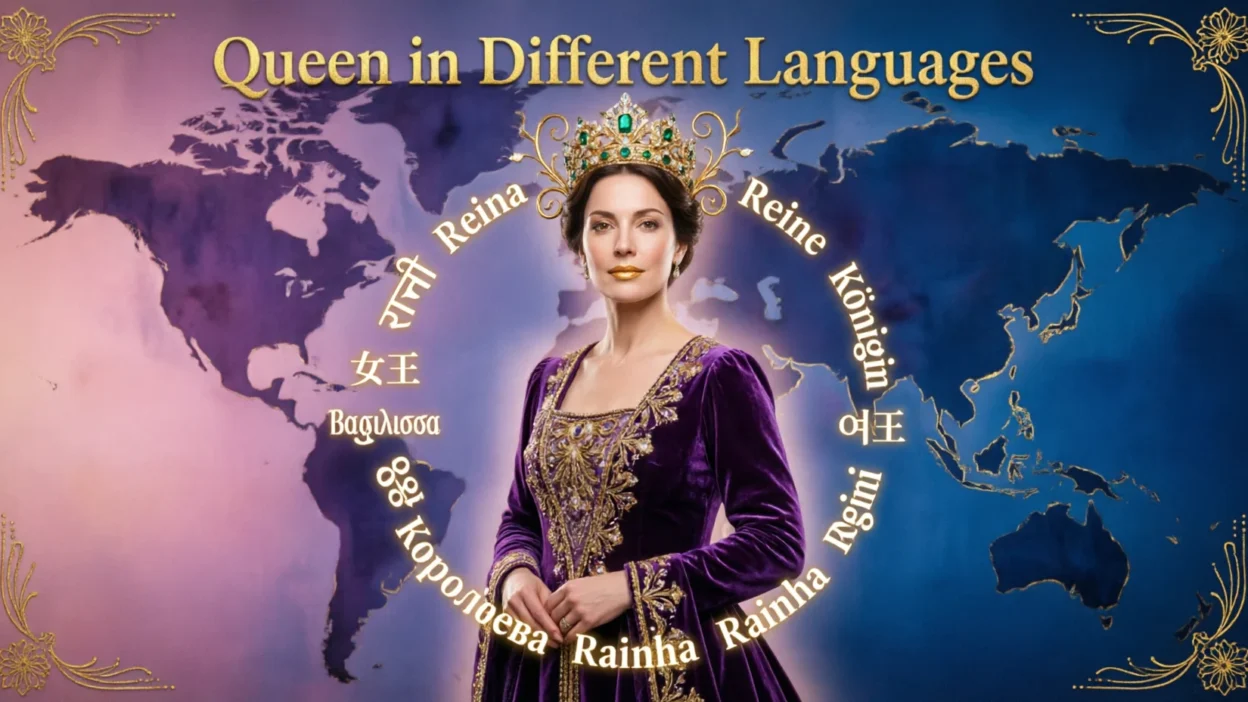
The word queen represents a female ruler, royal leader, or, in some contexts, an admired and powerful woman. Across the world, different languages have their own unique words for this royal title.
Learning how to say queen in different languages is useful for language learners, writers, travelers, students, and anyone interested in global cultures.
In this guide, you will discover queen in all languages through 70 different translations. Each entry includes the native word, an easy English pronunciation, a short real-life example sentence, and its English meaning.
If you are searching for queen translations, wondering how to say queen in different languages, or simply exploring the word queen around the world, this list provides a simple and practical reference.
Queen in Different Languages
The translation of “queen” can differ depending on the language and cultural context. In most cases, the word refers specifically to a female monarch or royal woman.
| Language | Native Phrase | English Pronunciation | Example Sentence | English Meaning |
|---|---|---|---|---|
| English | Queen | KWEEN | The queen arrived today. | The queen arrived today. |
| Spanish | Reina | RAY-na | La reina llegó hoy. | The queen arrived today. |
| French | Reine | REN | La reine est arrivée. | The queen has arrived. |
| German | Königin | KUR-nig-in | Die Königin ist hier. | The queen is here. |
| Italian | Regina | reh-JEE-na | La regina è arrivata. | The queen has arrived. |
| Portuguese | Rainha | rah-EEN-ya | A rainha chegou. | The queen arrived. |
| Dutch | Koningin | KOH-nuh-ngin | De koningin is hier. | The queen is here. |
| Afrikaans | Koningin | KOH-nuh-ngin | Die koningin is hier. | The queen is here. |
| Swedish | Drottning | DROT-ning | Drottningen är här. | The queen is here. |
| Norwegian | Dronning | DRON-ning | Dronningen er her. | The queen is here. |
| Danish | Dronning | DRON-ning | Dronningen er her. | The queen is here. |
| Finnish | Kuningatar | KOO-ning-ah-tar | Kuningatar on täällä. | The queen is here. |
| Icelandic | Drottning | DROT-ning | Drottningin er hér. | The queen is here. |
| Irish | Banríon | BAN-ree-un | Tháinig an banríon. | The queen arrived. |
| Scottish Gaelic | Banrìgh | BAN-ree | Ràinig a’ bhanrìgh. | The queen arrived. |
| Welsh | Brenhines | BREN-hin-es | Mae’r brenhines yma. | The queen is here. |
| Basque | Erregina | er-reh-GEE-na | Erregina hemen dago. | The queen is here. |
| Catalan | Reina | RAY-na | La reina és aquí. | The queen is here. |
| Galician | Raíña | rye-EEN-ya | A raíña chegou. | The queen arrived. |
| Romanian | Regină | reh-JEE-nuh | Regina este aici. | The queen is here. |
| Polish | Królowa | kroo-LO-va | Królowa jest tutaj. | The queen is here. |
| Czech | Královna | KRAAL-ov-na | Královna je tady. | The queen is here. |
| Slovak | Kráľovná | KRAA-lyov-na | Kráľovná je tu. | The queen is here. |
| Slovenian | Kraljica | kra-LYEE-tsa | Kraljica je tukaj. | The queen is here. |
| Croatian | Kraljica | kra-LYEE-tsa | Kraljica je ovdje. | The queen is here. |
| Serbian | Kraljica | kra-LYEE-tsa | Kraljica je ovde. | The queen is here. |
| Bosnian | Kraljica | kra-LYEE-tsa | Kraljica je ovdje. | The queen is here. |
| Bulgarian | Кралица | KRAH-lee-tsa | Кралицата е тук. | The queen is here. |
| Macedonian | Кралица | KRAH-lee-tsa | Кралицата е тука. | The queen is here. |
| Russian | Королева | kuh-roh-LEH-vah | Королева здесь. | The queen is here. |
| Ukrainian | Королева | kuh-roh-LEH-vah | Королева тут. | The queen is here. |
| Belarusian | Каралева | kah-rah-LEH-vah | Каралева тут. | The queen is here. |
| Greek | Βασίλισσα | va-SEE-li-sa | Η βασίλισσα είναι εδώ. | The queen is here. |
| Albanian | Mbretëreshë | mbreh-TUH-resh-uh | Mbretëresha është këtu. | The queen is here. |
| Armenian | Թագուհի | ta-goo-HEE | Թագուհին այստեղ է։ | The queen is here. |
| Georgian | დედოფალი | deh-doh-PAH-lee | დედოფალი აქ არის. | The queen is here. |
| Lithuanian | Karalienė | kah-rah-lee-EH-neh | Karalienė yra čia. | The queen is here. |
| Latvian | Karaliene | kah-rah-lee-EH-neh | Karaliene ir šeit. | The queen is here. |
| Estonian | Kuninganna | KOO-ning-an-na | Kuninganna on siin. | The queen is here. |
| Hungarian | Királynő | kee-RAAL-y-noe | A királynő itt van. | The queen is here. |
| Turkish | Kraliçe | kra-lee-CHEH | Kraliçe burada. | The queen is here. |
| Azerbaijani | Kraliça | kra-lee-CHA | Kraliça buradadır. | The queen is here. |
| Arabic | ملكة | MA-li-ka | الملكة هنا. | The queen is here. |
| Hebrew | מלכה | MAL-ka | המלכה כאן. | The queen is here. |
| Persian | ملکه | ma-LE-keh | ملکه اینجاست. | The queen is here. |
| Urdu | ملکہ | MA-li-ka | ملکہ یہاں ہے۔ | The queen is here. |
| Hindi | रानी | RAA-nee | रानी यहाँ है। | The queen is here. |
| Bengali | রানি | RAA-nee | রানি এখানে আছেন। | The queen is here. |
| Punjabi | ਰਾਣੀ | RAA-nee | ਰਾਣੀ ਇੱਥੇ ਹੈ। | The queen is here. |
| Gujarati | રાણી | RAA-nee | રાણી અહીં છે. | The queen is here. |
| Marathi | राणी | RAA-nee | राणी येथे आहे. | The queen is here. |
| Nepali | रानी | RAA-nee | रानी यहाँ छिन्। | The queen is here. |
| Sinhala | රැජින | RA-jee-na | රැජින මෙහි සිටී. | The queen is here. |
| Tamil | ராணி | RAA-nee | ராணி இங்கே இருக்கிறார். | The queen is here. |
| Telugu | రాణి | RAA-nee | రాణి ఇక్కడ ఉంది. | The queen is here. |
| Kannada | ರಾಣಿ | RAA-nee | ರಾಣಿ ಇಲ್ಲಿದ್ದಾರೆ. | The queen is here. |
| Malayalam | രാജ്ഞി | RAAJ-nyee | രാജ്ഞി ഇവിടെ ഉണ്ട്. | The queen is here. |
| Odia | ରାଣୀ | RAA-nee | ରାଣୀ ଏଠାରେ ଅଛନ୍ତି। | The queen is here. |
| Assamese | ৰাণী | RAA-nee | ৰাণী ইয়াত আছে। | The queen is here. |
| Chinese | 女王 | NYOO-wahng | 女王来了。 | The queen has arrived. |
| Japanese | 女王 | JOH-oh | 女王が来ました。 | The queen has arrived. |
| Korean | 여왕 | YUH-wahng | 여왕이 왔어요. | The queen has arrived. |
| Vietnamese | Nữ hoàng | NOO hwang | Nữ hoàng đã đến. | The queen has arrived. |
| Thai | ราชินี | RAA-chee-nee | ราชินีมาถึงแล้ว | The queen has arrived. |
| Indonesian | Ratu | RAH-too | Ratu sudah tiba. | The queen has arrived. |
| Malay | Ratu | RAH-too | Ratu sudah tiba. | The queen has arrived. |
| Filipino | Reyna | RAY-na | Dumating ang reyna. | The queen arrived. |
| Swahili | Malkia | mal-KEE-ah | Malkia amefika. | The queen has arrived. |
| Zulu | Indlovukazi | in-dloh-voo-KAH-zee | Indlovukazi lifikile. | The queen has arrived. |
| Xhosa | Ukumkanikazi | oo-koom-kah-nee-KAH-zee | Ukumkanikazi ufikile. | The queen has arrived. |
How to Say Queen in Different Languages
The easiest way to learn how to say queen in different languages is to compare the native word with its pronunciation. Some translations are closely related because languages share historical roots.
For example, Spanish reina, Catalan reina, and Portuguese rainha have similarities because these languages developed from Latin. Likewise, several Slavic languages use words related to kraljica, królowa, or kráľovná.
In South Asian languages, the word is often related to rani, while Arabic, Persian, and Urdu use closely related forms of malika or malika.
Queen in All Languages: Common Patterns
When exploring queen in all languages, it is important to remember that a direct translation may have slightly different cultural meanings.
In some languages, the word specifically means a female monarch. In others, it may also be used metaphorically for a woman who is considered powerful, respected, beautiful, or dominant in a particular field.
The pronunciation can also vary significantly even when the written forms look similar.
Queen Translations Around the World
The word queen around the world shows how languages express royalty in different ways.
European languages often have words derived from older Germanic, Latin, or Slavic roots. Asian languages may use words connected with royal titles, while African languages can use terms that describe a female ruler or royal woman.
These differences make queen translations especially interesting for language learners and people studying international cultures.
Queen in European Languages
European translations of queen include reina in Spanish, reine in French, regina in Italian, Königin in German, rainha in Portuguese, and drottning in Swedish.
Several Eastern European languages use related forms of words such as kraljica, královna, królowa, and королева. Although these words sound different, many are connected to historical concepts of kingship and royalty.
Queen in Asian Languages
Asian languages offer a wide range of words for queen.
Hindi, Bengali, Punjabi, Gujarati, Marathi, Nepali, and several other South Asian languages commonly use forms of rani. Arabic, Persian, and Urdu use related forms of malika.
In East Asia, Chinese uses 女王, Japanese uses 女王, and Korean uses 여왕. These words are pronounced differently but clearly communicate the idea of a female monarch.
Queen as a Royal Title
A queen can refer to a woman who rules a kingdom in her own right, known as a queen regnant. It can also refer to the wife of a king, traditionally called a queen consort.
Because royal systems differ between countries and historical periods, the exact use of the word may vary by culture.
The word can also have non-royal meanings. For example, queen is commonly used in chess for the most powerful piece and can sometimes be used as an informal compliment or title.
Why Learn Queen in Different Languages?
Learning the word queen in different languages can be useful for:
- Language learning and vocabulary building
- Travel and cultural exploration
- Writing and translation
- School and research projects
- Creative names and character development
- Understanding royal terminology
- Comparing related languages
Knowing a simple word such as “queen” can also help learners recognize similarities between languages and understand how cultures describe royalty.
Conclusion
Learning queen in different languages is a simple way to explore vocabulary, culture, and the history of language. From reina in Spanish and reine in French to rani in Hindi, 女王 in Chinese, and malkia in Swahili, each translation reflects the linguistic traditions of its speakers.
This list of 70 languages provides useful queen translations along with pronunciations and real-life examples.
If you are studying languages, researching royal terminology, or simply curious about queen in all languages, these translations offer a helpful starting point for exploring how people around the world express the idea of a queen.
FAQs:
1. How do you say queen in Spanish?
Queen in Spanish is reina, pronounced approximately RAY-na.
2. What is queen in French?
Queen in French is reine, pronounced approximately REN.
3. How do you say queen in Hindi?
Queen in Hindi is रानी (rani), pronounced approximately RAA-nee.
4. What is the word for queen in Chinese?
Queen in Chinese is 女王 (nǚwáng), pronounced approximately NYOO-wahng.
5. What is queen in Arabic?
Queen in Arabic is ملكة (malika), pronounced approximately MA-li-ka.

Carter Connor is a language enthusiast and content writer at LingoMean, helping readers discover what to say in everyday conversations with clear explanations, practical examples, and easy-to-understand communication tips.