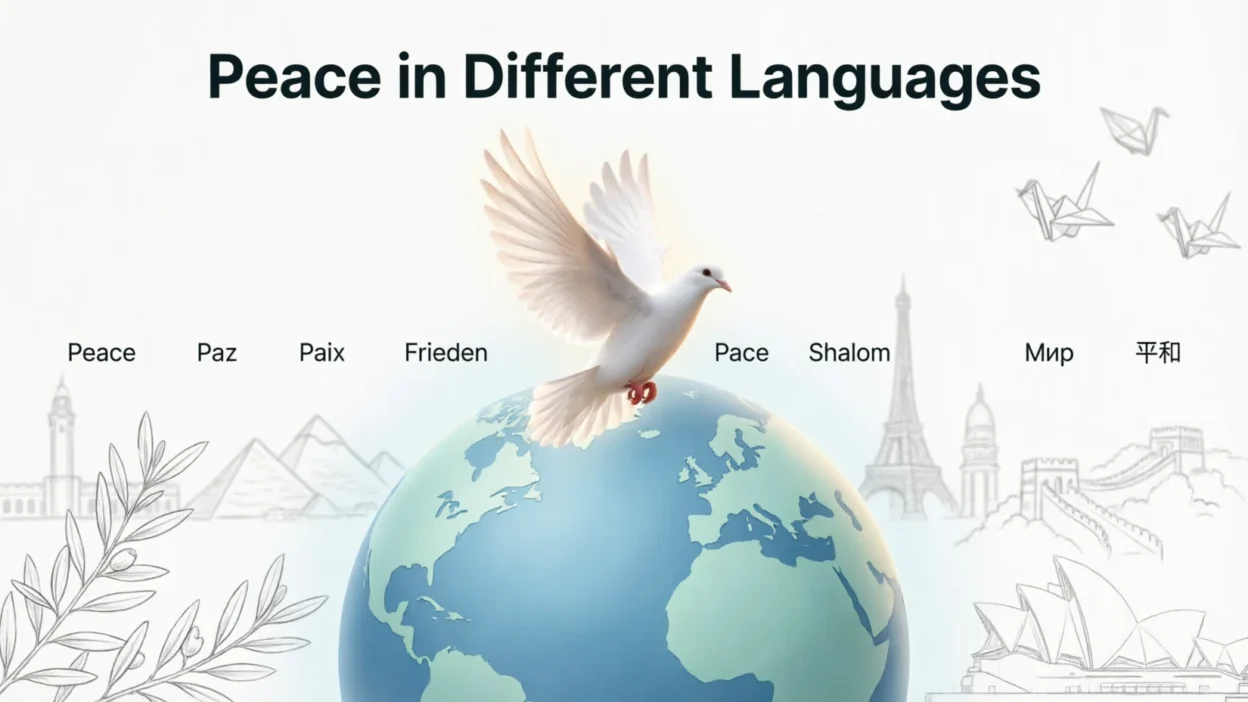
Peace is one of the most meaningful words in every culture. It represents calm, harmony, safety, and freedom from conflict. Although the word sounds different from one language to another, its message remains universal.
If you are searching for peace in different languages, this guide provides 70 translations from around the world. You can discover peace in all languages, learn how to say peace in different languages, and explore common peace translations with easy English pronunciations.
From European languages to Asian, African, and Middle Eastern languages, these translations show how people express the idea of peace around the world. The table also includes a short real-life example for every language, making it easier to understand how the word can be used naturally.
If you are learning languages, creating international content, choosing a meaningful word for a project, or simply curious about world languages, this list makes finding the right translation simple.
Peace in Different Languages: 70 Translations
| # | Language | Native Phrase | English Pronunciation | Example Sentence | English Meaning |
|---|---|---|---|---|---|
| 1 | English | Peace | pees | We all want peace. | We all want peace. |
| 2 | Spanish | Paz | pahs | Todos queremos paz. | We all want peace. |
| 3 | French | Paix | pay | Nous voulons la paix. | We want peace. |
| 4 | German | Frieden | FREE-den | Wir wollen Frieden. | We want peace. |
| 5 | Italian | Pace | PAH-cheh | Tutti vogliamo la pace. | We all want peace. |
| 6 | Portuguese | Paz | pahs | Todos queremos paz. | We all want peace. |
| 7 | Dutch | Vrede | VRAH-duh | We willen vrede. | We want peace. |
| 8 | Swedish | Fred | frehd | Vi vill ha fred. | We want peace. |
| 9 | Norwegian | Fred | frehd | Vi ønsker fred. | We want peace. |
| 10 | Danish | Fred | freth | Vi ønsker fred. | We want peace. |
| 11 | Finnish | Rauha | ROW-ha | Me haluamme rauhaa. | We want peace. |
| 12 | Icelandic | Friður | FRI-thur | Við viljum frið. | We want peace. |
| 13 | Irish | Síocháin | SHEE-khawn | Teastaíonn síocháin uainn. | We need peace. |
| 14 | Scottish Gaelic | Sìth | shee | Tha sinn ag iarraidh sìth. | We want peace. |
| 15 | Welsh | Heddwch | HETH-ookh | Rydyn ni eisiau heddwch. | We want peace. |
| 16 | Polish | Pokój | POH-kooy | Chcemy pokoju. | We want peace. |
| 17 | Czech | Mír | meer | Chceme mír. | We want peace. |
| 18 | Slovak | Mier | mee-er | Chceme mier. | We want peace. |
| 19 | Slovenian | Mir | meer | Želimo mir. | We want peace. |
| 20 | Croatian | Mir | meer | Želimo mir. | We want peace. |
| 21 | Serbian | Мир (Mir) | meer | Желимо мир. | We want peace. |
| 22 | Bosnian | Mir | meer | Želimo mir. | We want peace. |
| 23 | Macedonian | Мир (Mir) | meer | Сакаме мир. | We want peace. |
| 24 | Bulgarian | Мир (Mir) | meer | Искаме мир. | We want peace. |
| 25 | Russian | Мир (Mir) | meer | Мы хотим мира. | We want peace. |
| 26 | Ukrainian | Мир (Myr) | meer | Ми хочемо миру. | We want peace. |
| 27 | Belarusian | Мір (Mir) | meer | Мы хочам міру. | We want peace. |
| 28 | Lithuanian | Taika | TAI-kah | Mes norime taikos. | We want peace. |
| 29 | Latvian | Miers | mee-ers | Mēs vēlamies mieru. | We want peace. |
| 30 | Estonian | Rahu | RAH-hoo | Me tahame rahu. | We want peace. |
| 31 | Hungarian | Béke | BAY-keh | Békét akarunk. | We want peace. |
| 32 | Romanian | Pace | PAH-cheh | Vrem pace. | We want peace. |
| 33 | Albanian | Paqe | PAH-cheh | Ne duam paqe. | We want peace. |
| 34 | Greek | Ειρήνη (Eiríni) | ee-REE-nee | Θέλουμε ειρήνη. | We want peace. |
| 35 | Turkish | Barış | bah-RISH | Barış istiyoruz. | We want peace. |
| 36 | Maltese | Paċi | PAH-chee | Irridu l-paċi. | We want peace. |
| 37 | Arabic | سلام (Salām) | sah-LAHM | نريد السلام. | We want peace. |
| 38 | Hebrew | שלום (Shalom) | shah-LOHM | אנחנו רוצים שלום. | We want peace. |
| 39 | Persian | صلح (Solh) | sohl | ما صلح میخواهیم. | We want peace. |
| 40 | Urdu | امن (Aman) | uh-MUN | ہمیں امن چاہیے۔ | We need peace. |
| 41 | Hindi | शांति (Shānti) | SHAAN-tee | हमें शांति चाहिए। | We need peace. |
| 42 | Bengali | শান্তি (Shānti) | SHAAN-tee | আমরা শান্তি চাই। | We want peace. |
| 43 | Punjabi | ਸ਼ਾਂਤੀ (Shānti) | SHAAN-tee | ਸਾਨੂੰ ਸ਼ਾਂਤੀ ਚਾਹੀਦੀ ਹੈ। | We need peace. |
| 44 | Gujarati | શાંતિ (Shānti) | SHAAN-tee | અમને શાંતિ જોઈએ. | We need peace. |
| 45 | Marathi | शांतता (Shāntatā) | SHAAN-ta-taa | आम्हाला शांतता हवी आहे. | We want peace. |
| 46 | Nepali | शान्ति (Shānti) | SHAAN-tee | हामी शान्ति चाहन्छौँ। | We want peace. |
| 47 | Sanskrit | शान्तिः (Śāntiḥ) | SHAAN-tih | सर्वे शान्तिं इच्छन्ति। | Everyone desires peace. |
| 48 | Tamil | அமைதி (Amaiti) | uh-MAI-thee | எங்களுக்கு அமைதி வேண்டும். | We want peace. |
| 49 | Telugu | శాంతి (Śānti) | SHAAN-tee | మాకు శాంతి కావాలి. | We want peace. |
| 50 | Kannada | ಶಾಂತಿ (Śānti) | SHAAN-tee | ನಮಗೆ ಶಾಂತಿ ಬೇಕು. | We need peace. |
| 51 | Malayalam | സമാധാനം (Samādhānam) | sa-MAA-dhaa-nam | ഞങ്ങൾക്ക് സമാധാനം വേണം. | We want peace. |
| 52 | Sinhala | සාමය (Sāmaya) | SAA-ma-ya | අපට සාමය අවශ්යයි. | We need peace. |
| 53 | Chinese (Mandarin) | 和平 (Hépíng) | huh-PING | 我们希望和平。 | We hope for peace. |
| 54 | Japanese | 平和 (Heiwa) | HAY-wah | 私たちは平和を願っています。 | We wish for peace. |
| 55 | Korean | 평화 (Pyeonghwa) | pyung-HWAH | 우리는 평화를 원합니다. | We want peace. |
| 56 | Vietnamese | Hòa bình | hwa bing | Chúng ta cần hòa bình. | We need peace. |
| 57 | Thai | สันติภาพ (Santiphāp) | san-tee-PAHP | เราต้องการสันติภาพ | We want peace. |
| 58 | Indonesian | Perdamaian | per-dah-MAI-an | Kami menginginkan perdamaian. | We want peace. |
| 59 | Malay | Kedamaian | kuh-dah-MAI-an | Kami mahukan kedamaian. | We want peace. |
| 60 | Filipino | Kapayapaan | kah-pah-yah-PAH-an | Gusto namin ng kapayapaan. | We want peace. |
| 61 | Swahili | Amani | ah-MAH-nee | Tunataka amani. | We want peace. |
| 62 | Afrikaans | Vrede | FRAY-duh | Ons wil vrede hê. | We want peace. |
| 63 | Zulu | Ukuthula | oo-koo-TOO-lah | Sifuna ukuthula. | We want peace. |
| 64 | Xhosa | Uxolo | oo-KHOH-loh | Sifuna uxolo. | We want peace. |
| 65 | Yoruba | Àlàáfíà | ah-laa-FEE-ah | A fẹ́ àlàáfíà. | We want peace. |
| 66 | Igbo | Udo | oo-DOH | Anyị chọrọ udo. | We want peace. |
| 67 | Amharic | ሰላም (Selam) | seh-LAHM | ሰላም እንፈልጋለን። | We want peace. |
| 68 | Somali | Nabad | NAH-bad | Waxaan rabnaa nabad. | We want peace. |
| 69 | Armenian | Խաղաղություն (Khaghaghutyun) | kha-gha-ghoo-TYOON | Մենք խաղաղություն ենք ուզում։ | We want peace. |
| 70 | Georgian | მშვიდობა (Mshvidoba) | mshvee-DOH-bah | ჩვენ მშვიდობა გვინდა. | We want peace. |
What Does Peace Mean?
Peace generally means a state of calm, harmony, safety, or freedom from conflict. It can describe peace between countries, communities, families, or individuals.
The meaning can also extend beyond the absence of war. In everyday life, peace may refer to inner calm, peaceful relationships, quiet surroundings, or a sense of emotional balance.
That is why the word peace has such a powerful place in languages and cultures around the world.
How to Say Peace in Different Languages
If you want to know how to say peace in different languages, the table above provides 70 useful translations. Some languages use words that are closely related to ideas such as calmness, harmony, safety, or friendship.
For example, Spanish uses paz, French uses paix, German uses Frieden, and Italian uses pace. Several Slavic languages use forms related to mir, while many South Asian languages use forms related to shanti, meaning peace or tranquility.
The pronunciation column makes these words easier for English speakers to read and practice.
Peace in All Languages and Cultures
The idea of peace is universal, but different cultures express it in their own ways.
In many languages, peace is connected with social harmony and the absence of conflict. In others, it can also describe personal tranquility and a calm state of mind.
For example, shalom in Hebrew is widely associated with peace and well-being, while salaam in Arabic is strongly connected with peace and is also used as a greeting.
These differences make peace translations especially interesting because a single English word can carry a broader cultural meaning in another language.
Peace Around the World
From Europe and Asia to Africa and the Middle East, people have developed unique words to express the desire for peace.
Some translations are very different in pronunciation and spelling, while others share historical or linguistic connections. Words such as paz, pace, and paqe show similarities across several languages.
Likewise, mir appears in multiple Slavic languages, while forms of shanti occur across several South Asian languages.
Learning peace around the world is therefore more than memorizing vocabulary. It provides a small window into how different societies understand harmony, cooperation, and peaceful living.
Why Is Peace Important?
Peace is important because it allows individuals and communities to live with greater security and stability. Without peace, conflict can affect families, education, businesses, communities, and entire countries.
On a personal level, peace can also mean having a calm mind and healthy relationships.
Learning the word peace in another language can be a simple way to appreciate another culture. It can also be useful for travelers, language learners, students, writers, designers, and anyone interested in international communication.
FAQs:
1. What is the word for peace in Spanish?
The Spanish word for peace is paz, pronounced approximately like “pahs.”
2. How do you say peace in French?
Peace in French is paix, pronounced approximately “pay.”
3. What is peace called in Arabic?
Peace in Arabic is سلام (Salām), commonly pronounced “sah-LAHM.”
4. How do you say peace in Hindi?
Peace in Hindi is शांति (Shānti), pronounced approximately “SHAAN-tee.”
5. What is peace in Japanese?
Peace in Japanese is 平和 (Heiwa), pronounced approximately “HAY-wah.”
Conclusion
The word peace may look and sound different across the world’s languages, but its central message remains widely understood. From paz in Spanish and paix in French to salaam in Arabic and heiwa in Japanese, these 70 translations show the incredible diversity of human language.
Learning peace in different languages can help you understand vocabulary, culture, history, and the values shared by communities around the world.
If you are studying a new language or simply exploring international words, these translations offer a useful starting point for discovering how people express harmony and calm across cultures.

Brandon Cody is the Administrator of LingoMean, a platform dedicated to helping people discover the right words for every situation. He oversees content quality, website management, and user experience, ensuring readers receive accurate, practical, and easy-to-understand communication guidance.