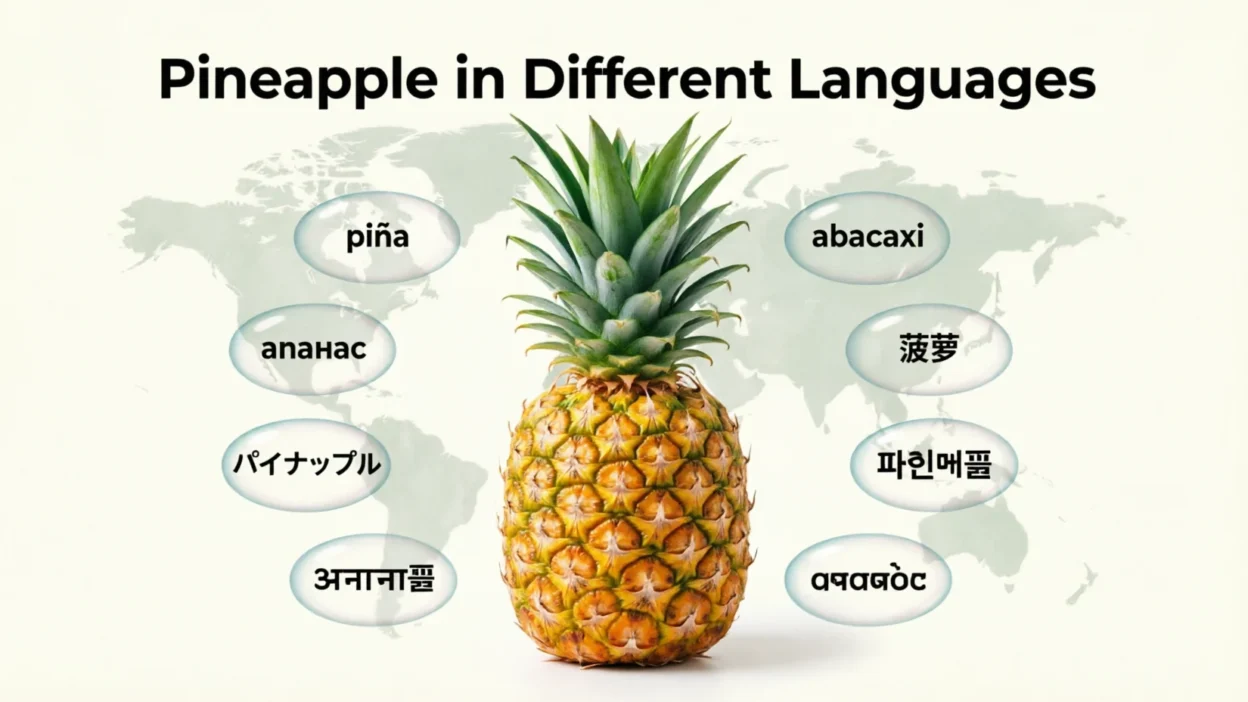
Pineapple is a popular tropical fruit known for its sweet, juicy flavor and refreshing taste. But how do people say pineapple in different languages?
Learning the word for pineapple can be useful when traveling, studying languages, communicating with international friends, or simply exploring how everyday words change across cultures.
In many languages, the word for pineapple has an interesting history. Some languages use words closely related to the English “pineapple,” while others use terms that come from local languages or historical trade connections. These pineapple translations offer a simple way to discover how languages influence one another.
If you are searching for how to say pineapple in different languages, the table below provides 70 translations along with easy English pronunciations and short real-life examples. This makes it easier to understand and remember each word.
From Spanish and French to Japanese, Arabic, Hindi, and Korean, these pineapple translations around the world show how one familiar fruit can have many different names.
Pineapple in Different Languages
The following table gives pineapple in all languages with the native word, an easy pronunciation, and a practical example sentence.
| # | Language | Native Phrase | English Pronunciation | Example Sentence | English Meaning |
|---|---|---|---|---|---|
| 1 | English | Pineapple | PIE-nap-uhl | I bought a pineapple today. | I bought a pineapple today. |
| 2 | Spanish | Piña | PEE-nyah | Compré una piña fresca. | I bought a fresh pineapple. |
| 3 | French | Ananas | ah-nah-NAH | J’aime l’ananas frais. | I like fresh pineapple. |
| 4 | German | Ananas | ah-NAH-nahs | Die Ananas ist süß. | The pineapple is sweet. |
| 5 | Italian | Ananas | ah-nah-NAHS | Mangio ananas fresco. | I am eating fresh pineapple. |
| 6 | Portuguese | Abacaxi | ah-bah-kah-SHEE | Eu gosto de abacaxi. | I like pineapple. |
| 7 | Dutch | Ananas | ah-nah-NAHS | Ik koop een ananas. | I am buying a pineapple. |
| 8 | Swedish | Ananas | ah-nah-NAHS | Jag gillar ananas. | I like pineapple. |
| 9 | Norwegian | Ananas | ah-nah-NAHS | Jeg liker ananas. | I like pineapple. |
| 10 | Danish | Ananas | ah-nah-NAHS | Jeg spiser ananas. | I am eating pineapple. |
| 11 | Finnish | Ananas | AH-nah-nahs | Syön ananasta. | I am eating pineapple. |
| 12 | Icelandic | Ananas | AH-nah-nahs | Ég borða ananas. | I am eating pineapple. |
| 13 | Estonian | Ananass | ah-nah-NAHS | Ma söön ananassi. | I am eating pineapple. |
| 14 | Latvian | Ananass | ah-nah-NAHS | Es ēdu ananāsu. | I am eating pineapple. |
| 15 | Lithuanian | Ananasas | ah-nah-NAH-sahs | Aš valgau ananasą. | I am eating pineapple. |
| 16 | Polish | Ananas | ah-NAH-nahs | Lubię ananasa. | I like pineapple. |
| 17 | Czech | Ananas | AH-nah-nahs | Mám rád ananas. | I like pineapple. |
| 18 | Slovak | Ananás | AH-nah-naas | Mám rád ananás. | I like pineapple. |
| 19 | Slovenian | Ananas | ah-NAH-nahs | Rad jem ananas. | I like eating pineapple. |
| 20 | Croatian | Ananas | ah-NAH-nahs | Volim ananas. | I like pineapple. |
| 21 | Serbian | Ananas | ah-NAH-nahs | Volim ananas. | I like pineapple. |
| 22 | Bosnian | Ananas | ah-NAH-nahs | Volim ananas. | I like pineapple. |
| 23 | Macedonian | Ананас | ah-nah-NAHS | Сакам ананас. | I like pineapple. |
| 24 | Bulgarian | Ананас | ah-nah-NAHS | Обичам ананас. | I love pineapple. |
| 25 | Russian | Ананас | ah-nah-NAHS | Я люблю ананас. | I love pineapple. |
| 26 | Ukrainian | Ананас | ah-nah-NAHS | Я люблю ананас. | I love pineapple. |
| 27 | Belarusian | Ананас | ah-nah-NAHS | Я люблю ананас. | I love pineapple. |
| 28 | Greek | Ανανάς | ah-nah-NAHS | Μου αρέσει ο ανανάς. | I like pineapple. |
| 29 | Romanian | Ananas | ah-nah-NAHS | Îmi place ananasul. | I like pineapple. |
| 30 | Hungarian | Ananász | AH-nah-naas | Szeretem az ananászt. | I like pineapple. |
| 31 | Albanian | Ananas | ah-nah-NAHS | Më pëlqen ananasi. | I like pineapple. |
| 32 | Turkish | Ananas | ah-nah-NAHS | Ananas yemeyi seviyorum. | I like eating pineapple. |
| 33 | Arabic | أناناس | ah-nah-NAAS | أحب الأناناس. | I love pineapple. |
| 34 | Hebrew | אננס | ah-NAH-nahs | אני אוהב אננס. | I like pineapple. |
| 35 | Persian | آناناس | ah-nah-NAAS | من آناناس دوست دارم. | I like pineapple. |
| 36 | Hindi | अनानास | ah-nah-NAAS | मुझे अनानास पसंद है। | I like pineapple. |
| 37 | Urdu | انناس | ah-nah-NAAS | مجھے انناس پسند ہے۔ | I like pineapple. |
| 38 | Bengali | আনারস | ah-NAH-rosh | আমি আনারস পছন্দ করি। | I like pineapple. |
| 39 | Punjabi | ਅਨਾਨਾਸ | ah-nah-NAAS | ਮੈਨੂੰ ਅਨਾਨਾਸ ਪਸੰਦ ਹੈ। | I like pineapple. |
| 40 | Gujarati | અનાનસ | ah-nah-NAAS | મને અનાનસ ગમે છે. | I like pineapple. |
| 41 | Marathi | अननस | ah-nah-NAHS | मला अननस आवडतो. | I like pineapple. |
| 42 | Nepali | भुइँकटहर | bhoo-een-kuh-TAR | मलाई भुइँकटहर मन पर्छ। | I like pineapple. |
| 43 | Sinhala | අන්නාසි | ahn-NAA-see | මම අන්නාසි කනවා. | I am eating pineapple. |
| 44 | Tamil | அன்னாசிப்பழம் | ahn-naa-see-pah-lum | எனக்கு அன்னாசிப்பழம் பிடிக்கும். | I like pineapple. |
| 45 | Telugu | అనాస పండు | ah-nah-sah PAN-doo | నాకు అనాస పండు ఇష్టం. | I like pineapple. |
| 46 | Kannada | ಅನಾನಸ್ | ah-nah-nahs | ನನಗೆ ಅನಾನಸ್ ಇಷ್ಟ. | I like pineapple. |
| 47 | Malayalam | കൈതച്ചക്ക | kai-thuh-CHAK-kah | എനിക്ക് കൈതച്ചക്ക ഇഷ്ടമാണ്. | I like pineapple. |
| 48 | Odia | ସପୁରି | sah-poo-ree | ମୁଁ ସପୁରି ଖାଏ। | I eat pineapple. |
| 49 | Assamese | মাটি কঠাল | mah-tee ko-THAAL | মই মাটি কঠাল খাওঁ। | I eat pineapple. |
| 50 | Chinese (Mandarin) | 菠萝 | BWO-luo | 我喜欢菠萝。 | I like pineapple. |
| 51 | Cantonese | 菠蘿 | boh-loh | 我鍾意菠蘿。 | I like pineapple. |
| 52 | Japanese | パイナップル | pie-nah-POO-roo | パイナップルが好きです。 | I like pineapple. |
| 53 | Korean | 파인애플 | pa-in-eh-peul | 파인애플을 좋아해요. | I like pineapple. |
| 54 | Vietnamese | Dứa | ZOO-ah | Tôi thích dứa. | I like pineapple. |
| 55 | Thai | สับปะรด | sap-pa-ROT | ฉันชอบสับปะรด | I like pineapple. |
| 56 | Indonesian | Nanas | NAH-nahs | Saya suka nanas. | I like pineapple. |
| 57 | Malay | Nanas | NAH-nahs | Saya suka nanas. | I like pineapple. |
| 58 | Filipino | Pinya | PEEN-yah | Gusto ko ang pinya. | I like pineapple. |
| 59 | Javanese | Nanas | NAH-nahs | Aku seneng nanas. | I like pineapple. |
| 60 | Swahili | Nanasi | nah-NAH-see | Ninapenda nanasi. | I like pineapple. |
| 61 | Afrikaans | Pynappel | PIE-nah-pel | Ek hou van pynappel. | I like pineapple. |
| 62 | Zulu | Uphayinaphu | oo-pie-yah-NAH-poo | Ngiyawuthanda uphayinaphu. | I like pineapple. |
| 63 | Xhosa | Iphayinaphu | ee-pie-yah-NAH-poo | Ndiyayithanda iphayinaphu. | I like pineapple. |
| 64 | Haitian Creole | Anana | ah-nah-NAH | Mwen renmen anana. | I love pineapple. |
| 65 | Esperanto | Ananaso | ah-nah-NAH-so | Mi ŝatas ananason. | I like pineapple. |
| 66 | Latin | Ananas | ah-NAH-nahs | Ananas dulcis est. | The pineapple is sweet. |
| 67 | Hawaiian | Hala kahiki | HAH-lah kah-HEE-kee | Makemake au i ka hala kahiki. | I like pineapple. |
| 68 | Māori | Paināporo | pie-NAH-paw-raw | He pai ki ahau te paināporo. | I like pineapple. |
| 69 | Samoan | Fala | FAH-lah | Ou te fiafia i le fala. | I like pineapple. |
| 70 | Tongan | Fainā | fie-NAH | ʻOku ou saiʻia ʻi he fainā. | I like pineapple. |
Why Is Pineapple Called Different Names?
The word for pineapple changes significantly from one language to another. In many European languages, including French, German, Italian, Dutch, and several Slavic languages, the word resembles ananas.
This similarity comes from the long history of the fruit and the movement of words through trade and cultural contact.
English uses the word “pineapple,” which combines “pine” and “apple.” The name describes the fruit’s rough, pine-like appearance while comparing it to an apple in shape or texture.
Other languages have completely different names. For example, Spanish uses piña, Portuguese uses abacaxi, and Filipino uses pinya.
How to Say Pineapple in Different Languages
If you want to know how to say pineapple in different languages, start by focusing on the pronunciation as well as the written word. Some languages use familiar Latin letters, while others use writing systems such as Arabic, Devanagari, Chinese characters, Japanese kana, or Korean Hangul.
Learning both the native phrase and pronunciation can help you use the word naturally when speaking with native speakers.
For example:
- Spanish: Piña
- French: Ananas
- Portuguese: Abacaxi
- Arabic: أناناس
- Hindi: अनानास
- Chinese: 菠萝
- Japanese: パイナップル
- Korean: 파인애플
- Indonesian: Nanas
- Swahili: Nanasi
Pineapple Translations Around the World
Pineapple is grown and enjoyed in many tropical and subtropical regions. As a result, the fruit has become part of everyday food culture in countries across Asia, Africa, the Americas, Europe, and the Pacific.
The pineapple translations around the world also show interesting patterns. Words such as “ananas,” “ananaso,” and “nanas” appear in several languages, while other languages have unique terms.
In some languages, the word is closely connected to the original name used in the region. In others, pronunciation or spelling changed as the word moved between languages.
Pineapple in All Languages: Interesting Word Patterns
One of the most interesting things about pineapple in all languages is how many translations sound similar.
Languages such as German, Italian, Dutch, Swedish, Norwegian, Polish, Romanian, Turkish, Russian, and Greek use words that are related to the ananas form.
At the same time, languages such as Spanish, Portuguese, Filipino, Chinese, Japanese, and Hawaiian use noticeably different terms.
These differences make fruit vocabulary a fun way to explore language history and cultural exchange.
Pineapple in Different Cultures
Pineapple is more than just a fruit. It is commonly used in juices, desserts, fruit salads, smoothies, sauces, and savory dishes.
In many cultures, pineapple is associated with tropical food and hospitality. Its sweet flavor and distinctive appearance have also made it a popular ingredient in celebrations and traditional dishes.
Learning the local word for pineapple can therefore be useful when traveling, ordering food, shopping in markets, or reading menus.
FAQs:
1. How do you say pineapple in Spanish?
Pineapple in Spanish is piña, pronounced approximately “PEE-nyah.” For example, “Me gusta la piña” means “I like pineapple.”
2. What is pineapple called in French?
Pineapple in French is ananas, pronounced approximately “ah-nah-NAH.” The word is similar to pineapple names used in several other European languages.
3. How do you say pineapple in Hindi?
Pineapple in Hindi is अनानास (ananas), commonly pronounced “ah-nah-NAAS.” It is a commonly understood word for the tropical fruit.
4. What is pineapple called in Japanese?
Pineapple in Japanese is パイナップル (painappuru), pronounced approximately “pie-nah-POO-roo.” The term is based on the English word “pineapple.”
5. What is pineapple called in Chinese?
In Mandarin Chinese, pineapple is 菠萝 (bōluó), commonly pronounced approximately “BWO-luo.” It is the standard term used for pineapple in Mandarin.
Conclusion
Learning pineapple in different languages is a simple and enjoyable way to explore vocabulary, pronunciation, and cultural differences. While many languages use words related to “ananas,” others have unique terms such as Spanish piña, Portuguese abacaxi, Chinese 菠萝, and Hawaiian hala kahiki.
These 70 pineapple translations provide a useful reference for travelers, language learners, students, writers, and anyone interested in words from around the world.
If you are searching for how to say pineapple in different languages or exploring pineapple around the world, these translations show how one familiar fruit can have many fascinating names.

Carter Connor is a language enthusiast and content writer at LingoMean, helping readers discover what to say in everyday conversations with clear explanations, practical examples, and easy-to-understand communication tips.