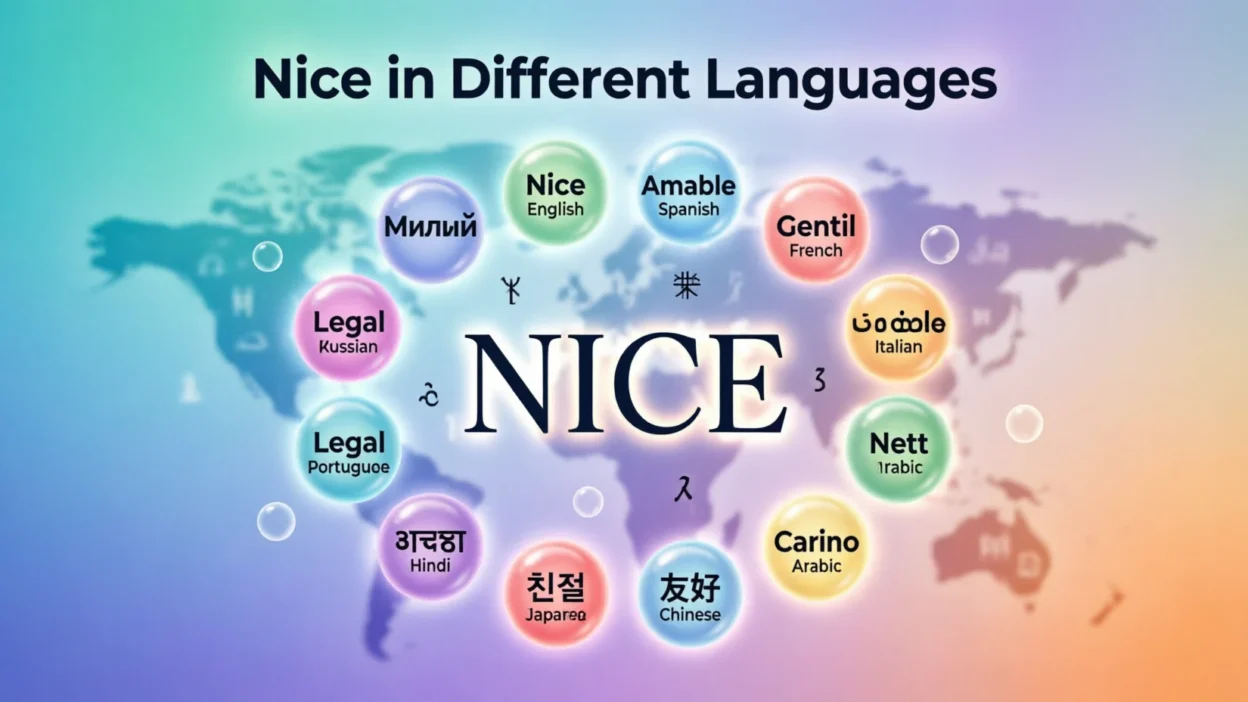
The word “nice” is one of the most useful words in everyday communication. It can describe a kind person, a pleasant experience, an attractive place, or something enjoyable. But how do you say nice in different languages?
Learning the word “nice” in another language is a simple way to expand your vocabulary and communicate more naturally with people from different cultures. In some languages, the best translation depends on whether you mean kind, pleasant, beautiful, friendly, good, or enjoyable.
This guide shows nice in all languages with the native phrase, an easy English pronunciation, and a practical example sentence. If you are searching for how to say nice in different languages, this list provides useful everyday translations from around the world.
If you are learning a language, traveling, writing, studying vocabulary, or simply exploring nice translations, these 70 languages give you a helpful starting point for understanding how the idea of “nice” is expressed around the world.
Nice in Different Languages: 70 Translations
| # | Language | Native Phrase | English Pronunciation | Example Sentence | English Meaning |
|---|---|---|---|---|---|
| 1 | Spanish | agradable | ah-grah-DAH-bleh | El lugar es agradable. | The place is nice. |
| 2 | French | gentil / agréable | zhon-TEE / ah-gray-AH-bluh | C’est un endroit agréable. | It is a nice place. |
| 3 | German | nett | net | Er ist sehr nett. | He is very nice. |
| 4 | Italian | gentile | jen-TEE-leh | Lei è molto gentile. | She is very nice. |
| 5 | Portuguese | agradável | ah-grah-DAH-vel | O lugar é agradável. | The place is nice. |
| 6 | Dutch | aardig | AHR-dikh | Hij is erg aardig. | He is very nice. |
| 7 | Swedish | trevlig | TREHV-lig | Det är en trevlig plats. | It is a nice place. |
| 8 | Norwegian | hyggelig | HIG-geh-lig | Det var en hyggelig kveld. | It was a nice evening. |
| 9 | Danish | rar | rahr | Hun er meget rar. | She is very nice. |
| 10 | Finnish | mukava | MOO-kah-vah | Se on mukava paikka. | It is a nice place. |
| 11 | Icelandic | notalegur | NOH-tah-leh-gur | Þetta er notalegur staður. | This is a nice place. |
| 12 | Irish | deas | dass | Is duine deas é. | He is a nice person. |
| 13 | Welsh | neis | nice | Mae hi’n neis iawn. | She is very nice. |
| 14 | Scottish Gaelic | snog | snok | Is duine snog e. | He is a nice person. |
| 15 | Polish | miły | MEE-wih | To bardzo miłe. | That is very nice. |
| 16 | Czech | milý | MEE-lee | Je velmi milý. | He is very nice. |
| 17 | Slovak | milý | MEE-lee | Je veľmi milý. | He is very nice. |
| 18 | Slovenian | prijazen | pree-YAH-zehn | On je zelo prijazen. | He is very nice. |
| 19 | Croatian | lijep | LEE-yep | To je lijepo mjesto. | It is a nice place. |
| 20 | Serbian | леп / fin | lep / feen | Ovo je lepo mesto. | This is a nice place. |
| 21 | Bosnian | lijep | LEE-yep | Ovo je lijepo mjesto. | This is a nice place. |
| 22 | Bulgarian | приятен | pree-YAH-ten | Това е приятно място. | This is a nice place. |
| 23 | Macedonian | убав | OO-bav | Ова е убаво место. | This is a nice place. |
| 24 | Romanian | drăguț | druh-GOOTS | El este drăguț. | He is nice. |
| 25 | Hungarian | kedves | KED-vesh | Ő nagyon kedves. | He is very nice. |
| 26 | Greek | ωραίος | oh-REH-os | Είναι ωραίο μέρος. | It is a nice place. |
| 27 | Albanian | i këndshëm | ee KEND-shum | Është një vend i këndshëm. | It is a nice place. |
| 28 | Russian | милый | MEE-lee | Он очень милый. | He is very nice. |
| 29 | Ukrainian | милий | MY-lyy | Він дуже милий. | He is very nice. |
| 30 | Belarusian | мілы | MEE-lih | Ён вельмі мілы. | He is very nice. |
| 31 | Lithuanian | malonus | mah-loh-NOOS | Jis labai malonus. | He is very nice. |
| 32 | Latvian | jauks | yowks | Viņš ir ļoti jauks. | He is very nice. |
| 33 | Estonian | tore | TOH-reh | See on tore koht. | It is a nice place. |
| 34 | Turkish | güzel | goo-ZEL | Burası güzel bir yer. | This is a nice place. |
| 35 | Azerbaijani | gözəl | guh-ZEL | Bura gözəl yerdir. | This is a nice place. |
| 36 | Armenian | հաճելի | ha-cheh-LEE | Սա հաճելի վայր է։ | This is a nice place. |
| 37 | Georgian | სასიამოვნო | sah-see-ahm-NOH | ეს სასიამოვნო ადგილია. | This is a nice place. |
| 38 | Persian | خوب | khoob | او آدم خوبی است. | He is a nice person. |
| 39 | Arabic | لطيف | lah-TEEF | هو شخص لطيف. | He is a nice person. |
| 40 | Hebrew | נחמד | nekh-MAHD | הוא אדם נחמד. | He is a nice person. |
| 41 | Hindi | अच्छा | ACH-chha | यह एक अच्छी जगह है। | This is a nice place. |
| 42 | Urdu | اچھا | ach-chha | یہ ایک اچھی جگہ ہے۔ | This is a nice place. |
| 43 | Bengali | সুন্দর | shun-DOR | এটি একটি সুন্দর জায়গা। | This is a nice place. |
| 44 | Punjabi | ਵਧੀਆ | vad-HEE-ah | ਇਹ ਇੱਕ ਵਧੀਆ ਜਗ੍ਹਾ ਹੈ। | This is a nice place. |
| 45 | Gujarati | સરસ | suh-RUS | આ એક સરસ જગ્યા છે. | This is a nice place. |
| 46 | Marathi | छान | chhaan | ही छान जागा आहे. | This is a nice place. |
| 47 | Nepali | राम्रो | RAHM-roh | यो राम्रो ठाउँ हो। | This is a nice place. |
| 48 | Sinhala | ලස්සන | LAS-sah-nah | මේක ලස්සන තැනක්. | This is a nice place. |
| 49 | Tamil | நல்ல | NAL-la | இது ஒரு நல்ல இடம். | This is a nice place. |
| 50 | Telugu | మంచిది | man-CHI-dee | ఇది మంచి ప్రదేశం. | This is a nice place. |
| 51 | Kannada | ಒಳ್ಳೆಯ | OL-ley-ya | ಇದು ಒಳ್ಳೆಯ ಸ್ಥಳ. | This is a nice place. |
| 52 | Malayalam | നല്ല | NAL-la | ഇത് നല്ല സ്ഥലമാണ്. | This is a nice place. |
| 53 | Thai | ดี | dee | นี่เป็นสถานที่ที่ดี | This is a nice place. |
| 54 | Vietnamese | tốt | tote | Đây là một nơi tốt. | This is a nice place. |
| 55 | Indonesian | bagus | BAH-goos | Ini tempat yang bagus. | This is a nice place. |
| 56 | Malay | baik | bye-eek | Dia seorang yang baik. | He is a nice person. |
| 57 | Filipino | mabait | mah-BY-te | Mabait siya. | He is nice. |
| 58 | Chinese | 好 | how | 这是一个好地方。 | This is a nice place. |
| 59 | Japanese | 素敵 | suh-TEH-kee | 素敵な場所です。 | It is a nice place. |
| 60 | Korean | 좋은 | joh-eun | 좋은 곳이에요. | It is a nice place. |
| 61 | Mongolian | сайхан | SAI-khan | Энэ сайхан газар. | This is a nice place. |
| 62 | Swahili | nzuri | N-ZOO-ree | Hapa ni mahali pazuri. | This is a nice place. |
| 63 | Afrikaans | lekker | LEK-er | Dit is ‘n lekker plek. | It is a nice place. |
| 64 | Zulu | kuhle | KOOH-leh | Kuhle kakhulu. | It is very nice. |
| 65 | Xhosa | mnandi | m-NAHN-dee | Kumnandi apha. | It is nice here. |
| 66 | Yoruba | dára | DAH-rah | Ó dára gan-an. | It is very nice. |
| 67 | Hausa | mai kyau | my kyow | Wannan wuri yana da kyau. | This place is nice. |
| 68 | Amharic | ጥሩ | TIR-oo | ጥሩ ቦታ ነው። | It is a nice place. |
| 69 | Latin | bonus | BOH-noos | Locus bonus est. | The place is nice. |
| 70 | Esperanto | agrabla | ah-GRAH-blah | Ĝi estas agrabla loko. | It is a nice place. |
How to Say Nice in Different Languages
The translation of “nice” can change depending on what you are describing. When talking about a person, words such as “kind,” “friendly,” or “pleasant” may be more natural. When describing a place or object, “pleasant,” “beautiful,” “good,” or “lovely” may be a better choice.
For example, Spanish commonly uses agradable for something pleasant, while German uses nett when describing a kind or pleasant person. Japanese 素敵 (suteki) is often used for something wonderful, attractive, or lovely.
This is why learning nice in different languages is more than simply memorizing one word.
Nice Translations Around the World
Different cultures express positive feelings in different ways. Some languages have one common word that covers several meanings of “nice,” while others use different words depending on context.
For language learners, paying attention to the situation is important. A translation that works for a person may not sound natural when describing a restaurant, vacation, gift, or location.
The table above provides practical nice translations that can help you understand everyday usage and build useful vocabulary.
Why Learn Nice in Different Languages?
Learning common words such as “nice” can make conversations easier when traveling or communicating internationally.
It can also help you:
- Build basic vocabulary quickly.
- Understand everyday conversations.
- Give compliments naturally.
- Communicate more comfortably while traveling.
- Learn how different cultures express positive ideas.
- Improve your pronunciation and speaking confidence.
Because “nice” is such a flexible English word, learning its different meanings can also help you understand how languages organize ideas differently.
Nice in All Languages: Common Uses
In English, “nice” can describe many things. You can say a person is nice, a place is nice, a meal is nice, or an experience is nice.
However, another language may use a different adjective for each situation. For example, a word meaning “kind” may be used for people, while a word meaning “beautiful” may be preferred for places or objects.
When searching for nice in all languages, remember that direct dictionary translations do not always represent the most natural everyday expression.
Conclusion
Learning how to say nice in different languages is a simple and useful way to explore vocabulary from around the world. The word can describe kindness, beauty, friendliness, quality, or a pleasant experience, so its translation often depends on context.
From Spanish and French to Japanese, Arabic, Hindi, Swahili, and Korean, each language offers its own way to express the idea of something being nice. Use these translations as a starting point for learning, traveling, communicating, and discovering new cultures.
FAQs:
1. How do you say “nice” in different languages?
“Nice” has different translations depending on the language and context. Common examples include nett in German, gentile in Italian, agradable in Spanish, güzel in Turkish, and 素敵 (suteki) in Japanese.
2. What is the word for “nice” in 70 languages?
There are many ways to express “nice” across 70 languages. The table above provides the native phrase, English pronunciation, and an example sentence for each language.
3. How do you say “nice” in Spanish?
A common translation is agradable, pronounced approximately “ah-grah-DAH-bleh.” It can describe something pleasant or enjoyable. For a kind person, amable is also commonly used.
4. How do you say “nice” in Japanese?
A common expression is 素敵 (suteki), pronounced “suh-TEH-kee.” It can describe something lovely, wonderful, attractive, or nice.
5. Why does “nice” have different translations?
“Nice” has several meanings in English, including kind, pleasant, attractive, friendly, and enjoyable. Other languages may use separate words for these meanings, so the best translation depends on the context.

Brandon Cody is the Administrator of LingoMean, a platform dedicated to helping people discover the right words for every situation. He oversees content quality, website management, and user experience, ensuring readers receive accurate, practical, and easy-to-understand communication guidance.