
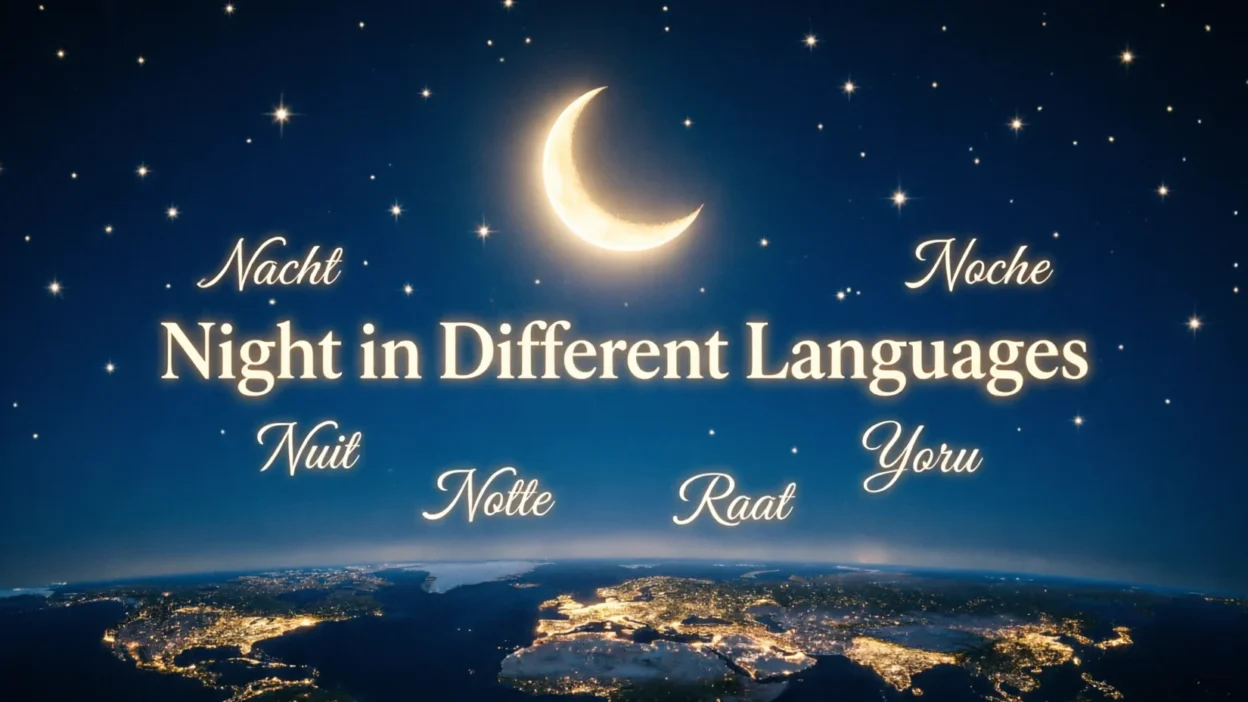
The word “night” is a simple but important part of everyday communication. It appears in greetings, conversations, songs, stories, travel phrases, and descriptions of daily routines.
Learning how to say night in different languages can also help you understand how people around the world describe the time after sunset.
If you are searching for night in all languages, this guide gives you 70 useful translations in one easy-to-read table. Each entry includes the language, the correct native word or phrase, an easy English pronunciation, a short real-life example, and its English meaning.
If you want to know how to say night in different languages, learn common night translations, or explore how the word is expressed around the world, this list provides a quick reference for learners, travelers, writers, and language enthusiasts.
Night in Different Languages
| # | Language | Native Phrase | English Pronunciation | Example Sentence | English Meaning |
|---|---|---|---|---|---|
| 1 | Spanish | noche | NO-cheh | Es de noche. | It is night. |
| 2 | French | nuit | nwee | Il fait nuit. | It is night. |
| 3 | German | Nacht | nahkt | Es ist Nacht. | It is night. |
| 4 | Italian | notte | NOT-teh | È notte. | It is night. |
| 5 | Portuguese | noite | NOY-teh | É noite. | It is night. |
| 6 | Dutch | nacht | nahkht | Het is nacht. | It is night. |
| 7 | Swedish | natt | naht | Det är natt. | It is night. |
| 8 | Danish | nat | naht | Det er nat. | It is night. |
| 9 | Norwegian | natt | naht | Det er natt. | It is night. |
| 10 | Finnish | yö | uh | On yö. | It is night. |
| 11 | Icelandic | nótt | noht | Það er nótt. | It is night. |
| 12 | Irish | oíche | EE-huh | Is oíche í. | It is night. |
| 13 | Welsh | nos | noss | Mae hi’n nos. | It is night. |
| 14 | Polish | noc | nots | Jest noc. | It is night. |
| 15 | Czech | noc | nots | Je noc. | It is night. |
| 16 | Slovak | noc | nots | Je noc. | It is night. |
| 17 | Slovenian | noč | notch | Noč je. | It is night. |
| 18 | Croatian | noć | notch | Noć je. | It is night. |
| 19 | Serbian | ноћ | notch | Ноћ је. | It is night. |
| 20 | Bulgarian | нощ | nosht | Нощ е. | It is night. |
| 21 | Macedonian | ноќ | nok | Ноќ е. | It is night. |
| 22 | Russian | ночь | notch | Сейчас ночь. | It is night now. |
| 23 | Ukrainian | ніч | neech | Зараз ніч. | It is night now. |
| 24 | Belarusian | ноч | noch | Зараз ноч. | It is night now. |
| 25 | Lithuanian | naktis | nak-TEES | Dabar naktis. | It is night now. |
| 26 | Latvian | nakts | nahkts | Tagad ir nakts. | It is night now. |
| 27 | Estonian | öö | uh | On öö. | It is night. |
| 28 | Hungarian | éjszaka | AY-sah-kah | Éjszaka van. | It is night. |
| 29 | Romanian | noapte | NWAHP-teh | Este noapte. | It is night. |
| 30 | Albanian | natë | NAH-tuh | Është natë. | It is night. |
| 31 | Greek | νύχτα | NEEKH-tah | Είναι νύχτα. | It is night. |
| 32 | Turkish | gece | GEH-jeh | Gece oldu. | It has become night. |
| 33 | Azerbaijani | gecə | geh-JEH | Gecədir. | It is night. |
| 34 | Armenian | գիշեր | gee-SHER | Գիշեր է։ | It is night. |
| 35 | Georgian | ღამე | GHAH-meh | ღამეა. | It is night. |
| 36 | Persian | شب | shab | شب است. | It is night. |
| 37 | Arabic | ليل | layl | إنه ليل. | It is night. |
| 38 | Hebrew | לילה | LAY-lah | זה לילה. | It is night. |
| 39 | Urdu | رات | raat | رات ہے۔ | It is night. |
| 40 | Hindi | रात | raat | रात है। | It is night. |
| 41 | Bengali | রাত | raat | রাত হয়েছে। | It has become night. |
| 42 | Punjabi | ਰਾਤ | raat | ਰਾਤ ਹੈ। | It is night. |
| 43 | Gujarati | રાત | raat | રાત છે. | It is night. |
| 44 | Marathi | रात्र | raat-ra | रात्र झाली आहे. | It has become night. |
| 45 | Nepali | रात | raat | रात भएको छ। | It has become night. |
| 46 | Sinhala | රාත්රිය | RAAT-ri-yah | දැන් රාත්රියයි. | It is night now. |
| 47 | Tamil | இரவு | EE-ra-voo | இது இரவு. | It is night. |
| 48 | Telugu | రాత్రి | RAA-tri | ఇది రాత్రి. | It is night. |
| 49 | Kannada | ರಾತ್ರಿ | RAA-tri | ಇದು ರಾತ್ರಿ. | It is night. |
| 50 | Malayalam | രാത്രി | RAA-thri | ഇത് രാത്രിയാണ്. | It is night. |
| 51 | Thai | กลางคืน | glang-kuen | ตอนนี้เป็นกลางคืน | It is nighttime now. |
| 52 | Vietnamese | đêm | dehm | Bây giờ là đêm. | It is night now. |
| 53 | Indonesian | malam | MAH-lam | Sekarang malam. | It is night now. |
| 54 | Malay | malam | MAH-lam | Sekarang malam. | It is night now. |
| 55 | Filipino | gabi | GAH-bee | Gabi na. | It is already night. |
| 56 | Khmer | យប់ | yup | ឥឡូវយប់ហើយ។ | It is night now. |
| 57 | Lao | ກາງຄືນ | kang-khuen | ຕອນນີ້ແມ່ນກາງຄືນ. | It is nighttime now. |
| 58 | Burmese | ည | nya | အခု ညပါ။ | It is night now. |
| 59 | Chinese | 夜晚 | yeh-wahn | 现在是夜晚。 | It is night now. |
| 60 | Japanese | 夜 | yoru | 今は夜です。 | It is night now. |
| 61 | Korean | 밤 | bahm | 지금은 밤이에요. | It is night now. |
| 62 | Mongolian | шөнө | shuh-nuh | Одоо шөнө байна. | It is night now. |
| 63 | Kazakh | түн | toohn | Қазір түн. | It is night now. |
| 64 | Uzbek | tun | toon | Hozir tun. | It is night now. |
| 65 | Kyrgyz | түн | toon | Азыр түн. | It is night now. |
| 66 | Tajik | шаб | shab | Ҳоло шаб аст. | It is night now. |
| 67 | Pashto | شپه | shpah | اوس شپه ده. | It is night now. |
| 68 | Swahili | usiku | oo-SEE-koo | Ni usiku. | It is night. |
| 69 | Hausa | dare | DAH-reh | Dare ne. | It is night. |
| 70 | Yoruba | alẹ́ | ah-LEH | Ó jẹ́ alẹ́. | It is night. |
How to Use “Night” in Different Languages
The word night can be used in several everyday situations. It may describe the period after sunset, refer to a particular evening, or appear in expressions such as “good night,” “last night,” and “at night.”
For example, in Spanish, noche is used for night, while in German, Nacht is the common word. In Japanese, 夜 (yoru) refers to night, while Korean commonly uses 밤 (bam).
Remember that the exact use of a word can change depending on the sentence. Some languages may use a different expression when talking about nighttime, evening, or wishing someone good night.
Night Translations Around the World
The translations above show how languages from Europe, Asia, Africa, and other regions express the idea of night. Many languages have a short single word, such as night, nuit, noche, Nacht, or usiku.
Other languages commonly use phrases that describe nighttime more specifically. This is why a direct word-for-word translation is not always the most natural expression in every language.
Learning these differences makes night in different languages more interesting and helps you use translations more naturally.
Why Learn How to Say Night in Different Languages?
Knowing the word for night can be useful when learning basic vocabulary. It is also helpful for travelers who want to recognize common words on signs, in conversations, or in local expressions.
Language learners can use this list to compare pronunciation and spelling across languages. Writers and content creators can also use these night translations when exploring multilingual phrases and cultural language differences.
Most importantly, learning simple words like “night” can be an easy starting point for building a larger vocabulary in a new language.
Night in All Languages: Quick Learning Tips
Start by learning a few languages at a time instead of trying to memorize all 70 words at once. Repeat the native phrase aloud and compare it with the English pronunciation.
You can also place each word into a simple sentence. For example, learn “noche” together with “Es de noche” rather than memorizing the word alone.
Using the word in context makes it easier to remember and helps you understand how native speakers naturally use it.
Conclusion
Learning how to say night in different languages is a simple way to explore vocabulary from around the world. Although the meaning remains similar, every language has its own spelling, pronunciation, and grammatical patterns.
This list of 70 languages provides useful night translations ranging from European and Asian languages to African and Middle Eastern languages.
If you are studying languages, preparing for travel, researching multilingual vocabulary, or simply curious about words around the world, these translations give you a convenient starting point.
By practicing each word with a short sentence, you can gradually build confidence and discover how people express the idea of night in different cultures.
FAQs:
1. How do you say night in different languages?
The word “night” changes from language to language. Examples include noche in Spanish, nuit in French, Nacht in German, notte in Italian, noche in Portuguese, ночь in Russian, and 夜 in Japanese.
2. What is night in Spanish?
“Night” in Spanish is noche. A common sentence is Es de noche, which means “It is night.”
3. What is night in French?
“Night” in French is nuit. The phrase Il fait nuit means “It is night.”
4. What is night in Japanese?
“Night” in Japanese is 夜 (yoru). The sentence 今は夜です (Ima wa yoru desu) means “It is night now.”
5. What is the word for night in Hindi?
“Night” in Hindi is रात (raat). A simple example is रात है, meaning “It is night.”

Evelyn Grace is a language enthusiast and content writer at LingoMean, where she explains the meaning of words, phrases, and expressions. She creates clear, practical, and engaging content that helps readers confidently understand what to say in everyday conversations.