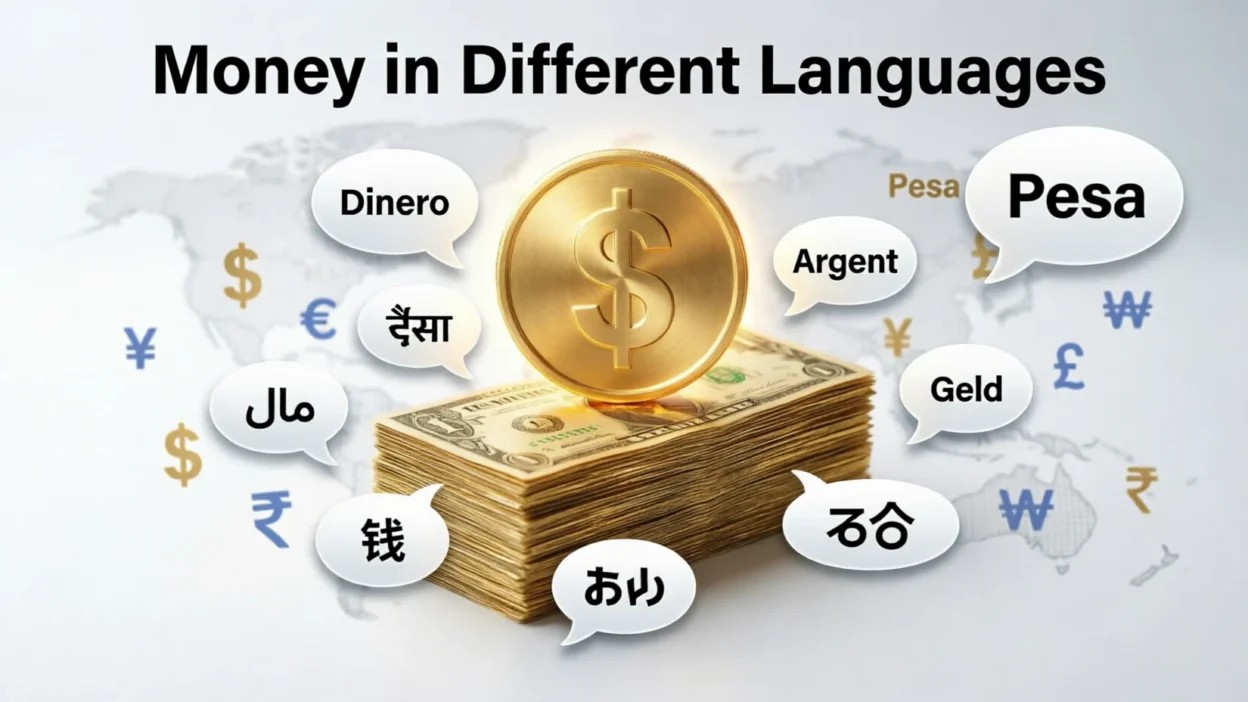
Money is one of the most universal concepts in everyday life, but the word used for it changes from language to language. Learning how to say money in different languages is useful for travelers, language learners, students, writers, and anyone interested in cultures around the world.
From English “money” and Spanish “dinero” to Japanese “お金 (okane)” and Arabic “مال (māl),” these words reflect the incredible diversity of human languages. This guide brings together money in all languages in one easy-to-read table, including the native word, simple English pronunciation, and a practical example.
If you are searching for how to say money in different languages, this list provides 70 useful translations. It also shows how the word appears naturally in everyday sentences, making these money translations easier to understand and remember.
Money in Different Languages: 70 Translations
| # | Language | Native Phrase | English Pronunciation | Example Sentence | English Meaning |
|---|---|---|---|---|---|
| 1 | English | money | MUH-nee | I need some money. | I need some money. |
| 2 | Spanish | dinero | dee-NEH-roh | Necesito dinero. | I need money. |
| 3 | French | argent | ar-ZHON | J’ai besoin d’argent. | I need money. |
| 4 | German | Geld | gelt | Ich brauche Geld. | I need money. |
| 5 | Italian | denaro | deh-NAH-roh | Ho bisogno di denaro. | I need money. |
| 6 | Portuguese | dinheiro | dee-NYAY-roo | Preciso de dinheiro. | I need money. |
| 7 | Dutch | geld | kheld | Ik heb geld nodig. | I need money. |
| 8 | Swedish | pengar | PENG-ar | Jag behöver pengar. | I need money. |
| 9 | Norwegian | penger | PENG-er | Jeg trenger penger. | I need money. |
| 10 | Danish | penge | PENG-eh | Jeg har brug for penge. | I need money. |
| 11 | Finnish | raha | RAH-ha | Tarvitsen rahaa. | I need money. |
| 12 | Icelandic | peningar | PEN-ing-ar | Ég þarf peninga. | I need money. |
| 13 | Irish | airgead | AR-ig-id | Teastaíonn airgead uaim. | I need money. |
| 14 | Welsh | arian | AR-yan | Mae angen arian arnaf. | I need money. |
| 15 | Scottish Gaelic | airgead | AR-uh-gat | Tha feum agam air airgead. | I need money. |
| 16 | Polish | pieniądze | pyeh-NYON-dzeh | Potrzebuję pieniędzy. | I need money. |
| 17 | Czech | peníze | PEH-nee-zeh | Potřebuji peníze. | I need money. |
| 18 | Slovak | peniaze | PEH-nyah-zeh | Potrebujem peniaze. | I need money. |
| 19 | Slovenian | denar | deh-NAR | Potrebujem denar. | I need money. |
| 20 | Croatian | novac | NOH-vats | Trebam novac. | I need money. |
| 21 | Serbian | новац | NOH-vats | Treba mi новац. | I need money. |
| 22 | Bosnian | novac | NOH-vats | Trebam novac. | I need money. |
| 23 | Bulgarian | пари | PAH-ree | Имам нужда от пари. | I need money. |
| 24 | Macedonian | пари | PAH-ree | Ми требаат пари. | I need money. |
| 25 | Russian | деньги | DEN-gee | Мне нужны деньги. | I need money. |
| 26 | Ukrainian | гроші | HROH-shee | Мені потрібні гроші. | I need money. |
| 27 | Belarusian | грошы | HROH-shy | Мне патрэбны грошы. | I need money. |
| 28 | Lithuanian | pinigai | pee-nee-GAI | Man reikia pinigų. | I need money. |
| 29 | Latvian | nauda | NOW-dah | Man vajag naudu. | I need money. |
| 30 | Estonian | raha | RAH-ha | Mul on raha vaja. | I need money. |
| 31 | Hungarian | pénz | paynz | Pénzre van szükségem. | I need money. |
| 32 | Romanian | bani | BAN | Am nevoie de bani. | I need money. |
| 33 | Greek | χρήματα | KHRI-ma-ta | Χρειάζομαι χρήματα. | I need money. |
| 34 | Albanian | para | PAH-rah | Kam nevojë për para. | I need money. |
| 35 | Turkish | para | PAH-rah | Paraya ihtiyacım var. | I need money. |
| 36 | Azerbaijani | pul | pool | Mənə pul lazımdır. | I need money. |
| 37 | Georgian | ფული | POO-lee | ფული მჭირდება. | I need money. |
| 38 | Armenian | փող | pohgh | Ինձ փող է պետք։ | I need money. |
| 39 | Arabic | مال | maal | أحتاج إلى مال. | I need money. |
| 40 | Hebrew | כסף | KEH-sef | אני צריך כסף. | I need money. |
| 41 | Persian | پول | pool | من پول لازم دارم. | I need money. |
| 42 | Urdu | پیسہ | PAY-sah | مجھے پیسے چاہیے۔ | I need money. |
| 43 | Hindi | पैसा | PAI-sa | मुझे पैसे चाहिए। | I need money. |
| 44 | Bengali | টাকা | TAH-ka | আমার টাকা দরকার। | I need money. |
| 45 | Punjabi | ਪੈਸਾ | PAI-sa | ਮੈਨੂੰ ਪੈਸੇ ਚਾਹੀਦੇ ਹਨ। | I need money. |
| 46 | Gujarati | પૈસા | PAI-sa | મને પૈસા જોઈએ છે. | I need money. |
| 47 | Marathi | पैसे | PAI-say | मला पैसे हवे आहेत. | I need money. |
| 48 | Nepali | पैसा | PAI-sa | मलाई पैसा चाहिन्छ। | I need money. |
| 49 | Sinhala | මුදල් | moo-dal | මට මුදල් අවශ්යයි. | I need money. |
| 50 | Tamil | பணம் | PA-nam | எனக்கு பணம் தேவை. | I need money. |
| 51 | Telugu | డబ్బు | DAB-boo | నాకు డబ్బు కావాలి. | I need money. |
| 52 | Kannada | ಹಣ | HA-na | ನನಗೆ ಹಣ ಬೇಕು. | I need money. |
| 53 | Malayalam | പണം | PA-nam | എനിക്ക് പണം വേണം. | I need money. |
| 54 | Thai | เงิน | ngern | ฉันต้องการเงิน | I need money. |
| 55 | Vietnamese | tiền | tee-en | Tôi cần tiền. | I need money. |
| 56 | Indonesian | uang | OO-ang | Saya butuh uang. | I need money. |
| 57 | Malay | wang | wahng | Saya perlukan wang. | I need money. |
| 58 | Filipino | pera | PEH-ra | Kailangan ko ng pera. | I need money. |
| 59 | Chinese (Mandarin) | 钱 | chyien | 我需要钱。 | I need money. |
| 60 | Japanese | お金 | oh-KAH-neh | お金が必要です。 | I need money. |
| 61 | Korean | 돈 | don | 돈이 필요해요. | I need money. |
| 62 | Mongolian | мөнгө | MUNG-guh | Надад мөнгө хэрэгтэй. | I need money. |
| 63 | Burmese | ငွေ | ngway | ငွေလိုတယ်။ | I need money. |
| 64 | Khmer | លុយ | luy | ខ្ញុំត្រូវការលុយ។ | I need money. |
| 65 | Lao | ເງິນ | ngun | ຂ້ອຍຕ້ອງການເງິນ. | I need money. |
| 66 | Swahili | pesa | PEH-sa | Ninahitaji pesa. | I need money. |
| 67 | Afrikaans | geld | khelt | Ek het geld nodig. | I need money. |
| 68 | Zulu | imali | ee-MAH-lee | Ngidinga imali. | I need money. |
| 69 | Xhosa | imali | ee-MAH-lee | Ndifuna imali. | I need money. |
| 70 | Amharic | ገንዘብ | gen-ZEHb | ገንዘብ እፈልጋለሁ። | I need money. |
How to Say Money in Different Languages
The word for money varies considerably across languages. Some languages use a word that specifically means money, while others may use terms associated with currency, cash, or wealth depending on the context.
For example, dinero is the common Spanish word for money, while French speakers commonly use argent. In German, the everyday word is Geld, and Italian uses denaro.
In South and Central Asia, common forms include paisa in Hindi and Punjabi, paise in Urdu, taka in Bengali, and pul in Persian. These differences make learning money translations an interesting way to explore vocabulary across cultures.
Money in All Languages Around the World
Money is an important part of everyday communication almost everywhere. People use the word when talking about shopping, salaries, savings, prices, bills, business, travel, and personal finances.
The examples above show money around the world in 70 languages. Although pronunciation and spelling differ, the basic idea remains easy to recognize.
Learning these words can also help travelers communicate more confidently. Knowing a simple word such as “money” can be useful when asking about prices, payments, or currency.
Common Uses of the Word “Money”
The word money appears in many common expressions. Here are a few simple examples:
- I need money.
- I saved some money.
- Do you have enough money?
- Where can I exchange money?
- I spent too much money.
- Money is important for daily life.
- I don’t have enough money today.
These basic sentences can be adapted to almost any language. Once you learn the native word for money, you can begin building useful everyday phrases around it.
Currency usually refers to a particular monetary system or form of money used in a country or region.
For example, the U.S. dollar, euro, Japanese yen, and Indian rupee are currencies. When speaking generally about funds or payment, the word “money” is more common.
This distinction can be useful when learning money in different languages, especially while traveling or studying economics.
Why Learn Money Translations?
Learning common words in multiple languages can make communication easier and more enjoyable. Money is especially useful because it appears frequently in real-life conversations.
Knowing the word can help you:
- Communicate while traveling.
- Understand basic conversations.
- Learn useful vocabulary faster.
- Recognize money-related words in foreign languages.
- Improve cultural and language awareness.
- Understand signs, conversations, and simple written text.
Even learning one new word from each language can be a fun way to discover how languages differ.
FAQs:
1. How do you say money in different languages?
“Money” has different words in different languages. Examples include dinero in Spanish, argent in French, Geld in German, denaro in Italian, paisa in Hindi, okane in Japanese, and pesa in Swahili.
2. What is the word for money in Spanish?
The Spanish word for money is dinero, pronounced approximately “dee-NEH-roh.” For example, “Necesito dinero” means “I need money.”
3. What is money called in Hindi?
Money is commonly called पैसा (paisa) in Hindi. The plural form पैसे (paise) is also widely used in everyday speech.
4. How do you say money in Japanese?
The common Japanese word for money is お金 (okane), pronounced approximately “oh-KAH-neh.” A simple sentence is “お金が必要です,” meaning “I need money.”
5. What are some common words for money around the world?
Common examples include dinero in Spanish, argent in French, Geld in German, penger in Norwegian, деньги (dengi) in Russian, مال (māl) in Arabic, पैसा (paisa) in Hindi, 钱 (qián) in Mandarin, お金 (okane) in Japanese, and pesa in Swahili.
Conclusion
Learning money in different languages is a simple and practical way to expand your vocabulary and discover how people communicate around the world. From dinero in Spanish to pesa in Swahili, each language has its own unique word and pronunciation.
This list of 70 languages makes it easy to explore money in all languages, understand common translations, and learn useful examples for everyday communication. If you are studying languages, preparing for travel, or simply curious about world languages, these translations provide a helpful starting point.
Learning one word at a time can open the door to a deeper understanding of different languages and cultures.

Evelyn Grace is a language enthusiast and content writer at LingoMean, where she explains the meaning of words, phrases, and expressions. She creates clear, practical, and engaging content that helps readers confidently understand what to say in everyday conversations.