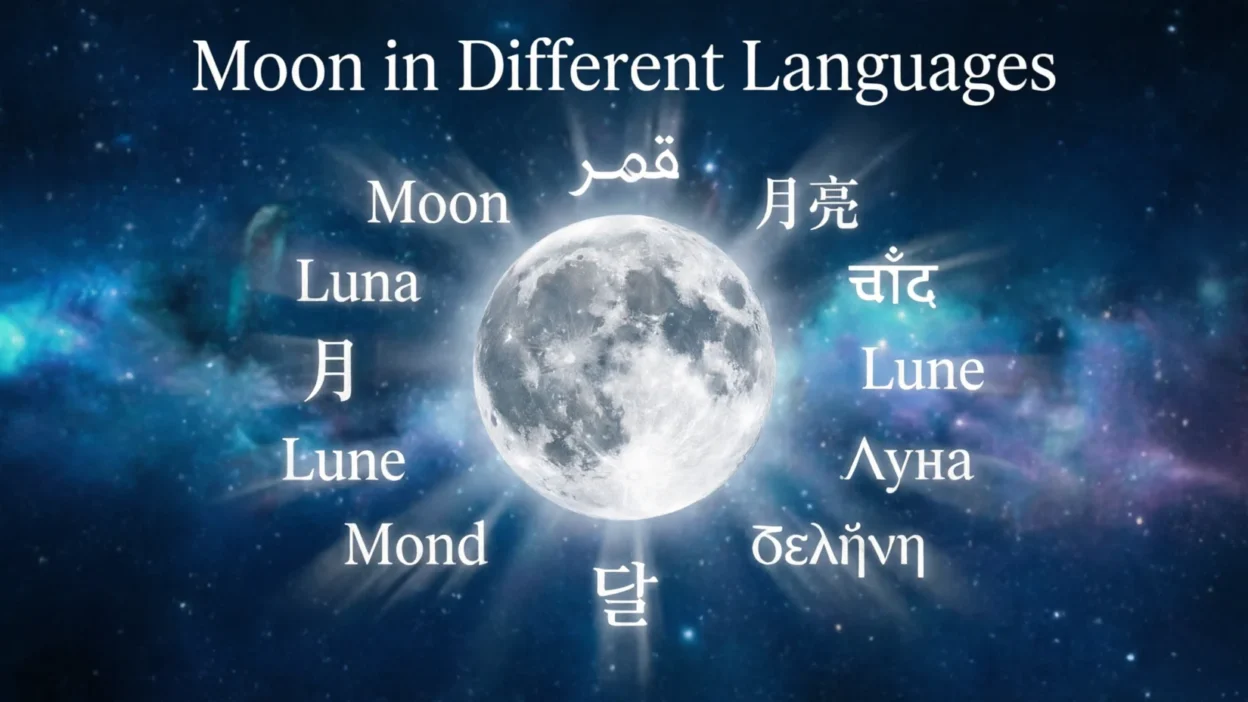
The moon is one of the most recognizable objects in the night sky, and it has inspired languages, stories, poems, songs, and traditions for centuries. Learning how to say moon in different languages is a simple way to discover how people around the world describe this beautiful celestial object.
If you are a student, language learner, writer, traveler, or simply curious about world languages, this guide provides 70 moon translations in one easy-to-read table. Each entry includes the native word, an easy English pronunciation, a short example sentence, and its English meaning.
If you are searching for moon in all languages, wondering how to say moon in different languages, or looking for moon translations around the world, this comprehensive list gives you useful answers in one place.
Moon in Different Languages: 70 Translations
| # | Language | Native Phrase | Easy English Pronunciation | Example Sentence | English Meaning |
|---|---|---|---|---|---|
| 1 | English | Moon | Moon | The moon is bright tonight. | The moon is bright tonight. |
| 2 | Spanish | Luna | LOO-na | La luna está brillante esta noche. | The moon is bright tonight. |
| 3 | French | Lune | Loon | La lune est belle ce soir. | The moon is beautiful tonight. |
| 4 | German | Mond | Mohnt | Der Mond ist hell. | The moon is bright. |
| 5 | Italian | Luna | LOO-na | La luna è bellissima. | The moon is very beautiful. |
| 6 | Portuguese | Lua | LOO-ah | A lua está brilhando. | The moon is shining. |
| 7 | Dutch | Maan | Maan | De maan is helder. | The moon is bright. |
| 8 | Swedish | Måne | MOH-neh | Månen lyser klart. | The moon shines brightly. |
| 9 | Norwegian | Måne | MOH-neh | Månen er vakker i kveld. | The moon is beautiful tonight. |
| 10 | Danish | Måne | MOH-neh | Månen er lys i aften. | The moon is bright this evening. |
| 11 | Finnish | Kuu | Koo | Kuu paistaa tänään. | The moon is shining today. |
| 12 | Icelandic | Tungl | Toongl | Tunglið er bjart. | The moon is bright. |
| 13 | Irish | Gealach | GYAL-akh | Tá an ghealach lán. | The moon is full. |
| 14 | Welsh | Lleuad | HLAY-ad | Mae’r lleuad yn llachar. | The moon is bright. |
| 15 | Scottish Gaelic | Gealach | GYAL-akh | Tha a’ ghealach làn. | The moon is full. |
| 16 | Latin | Luna | LOO-na | Luna clara est. | The moon is bright. |
| 17 | Greek | Φεγγάρι | Fen-GAH-ree | Το φεγγάρι είναι όμορφο. | The moon is beautiful. |
| 18 | Russian | Луна | Loo-NAH | Луна яркая сегодня. | The moon is bright today. |
| 19 | Ukrainian | Місяць | MEE-syats | Місяць яскравий сьогодні. | The moon is bright today. |
| 20 | Polish | Księżyc | KSHEN-zhits | Księżyc jest jasny. | The moon is bright. |
| 21 | Czech | Měsíc | MYEH-seets | Měsíc svítí. | The moon is shining. |
| 22 | Slovak | Mesiac | MEH-syats | Mesiac je jasný. | The moon is bright. |
| 23 | Slovenian | Luna | LOO-na | Luna je svetla. | The moon is bright. |
| 24 | Croatian | Mjesec | MYEH-sehts | Mjesec je sjajan. | The moon is shining. |
| 25 | Serbian | Месец | MEH-setz | Месец је светао. | The moon is bright. |
| 26 | Bulgarian | Луна | LOO-na | Луната е красива. | The moon is beautiful. |
| 27 | Macedonian | Месечина | Meh-SEH-chee-na | Месечината е убава. | The moon is beautiful. |
| 28 | Romanian | Lună | LOO-nuh | Luna este strălucitoare. | The moon is shining brightly. |
| 29 | Hungarian | Hold | Hold | A hold fényes. | The moon is bright. |
| 30 | Albanian | Hënë | HUH-nuh | Hëna është e bukur. | The moon is beautiful. |
| 31 | Estonian | Kuu | Koo | Kuu paistab eredalt. | The moon shines brightly. |
| 32 | Latvian | Mēness | MAY-ness | Mēness ir spožs. | The moon is bright. |
| 33 | Lithuanian | Mėnulis | MAY-noo-lis | Mėnulis yra ryškus. | The moon is bright. |
| 34 | Maltese | Qamar | AH-mar | Il-qamar huwa sabiħ. | The moon is beautiful. |
| 35 | Turkish | Ay | Eye | Ay bu gece çok güzel. | The moon is very beautiful tonight. |
| 36 | Azerbaijani | Ay | Eye | Ay bu gecə parlaqdır. | The moon is bright tonight. |
| 37 | Kazakh | Ай | Eye | Ай бүгін жарық. | The moon is bright today. |
| 38 | Uzbek | Oy | Oy | Oy bugun yorqin. | The moon is bright today. |
| 39 | Turkmen | Aý | Eye | Aý bu gün ýagty. | The moon is bright today. |
| 40 | Kyrgyz | Ай | Eye | Ай бүгүн жарык. | The moon is bright today. |
| 41 | Tajik | Моҳ | Moh | Моҳ имрӯз равшан аст. | The moon is bright today. |
| 42 | Persian | ماه | Maah | ماه امشب زیباست. | The moon is beautiful tonight. |
| 43 | Arabic | قمر | Qamar | القمر جميل الليلة. | The moon is beautiful tonight. |
| 44 | Hebrew | ירח | Ya-RE-ach | הירח יפה הלילה. | The moon is beautiful tonight. |
| 45 | Hindi | चाँद | Chaand | चाँद आज बहुत सुंदर है। | The moon is very beautiful today. |
| 46 | Urdu | چاند | Chaand | چاند آج بہت خوبصورت ہے۔ | The moon is very beautiful today. |
| 47 | Bengali | চাঁদ | Chaand | চাঁদ আজ খুব সুন্দর। | The moon is very beautiful today. |
| 48 | Punjabi | ਚੰਦ | Chand | ਚੰਦ ਅੱਜ ਬਹੁਤ ਸੋਹਣਾ ਹੈ। | The moon is very beautiful today. |
| 49 | Gujarati | ચંદ્ર | Chundra | ચંદ્ર આજે ખૂબ સુંદર છે. | The moon is very beautiful today. |
| 50 | Marathi | चंद्र | Chandra | चंद्र आज खूप सुंदर आहे. | The moon is very beautiful today. |
| 51 | Nepali | चन्द्रमा | Chandra-ma | चन्द्रमा आज सुन्दर छ। | The moon is beautiful today. |
| 52 | Sanskrit | चन्द्रः | Chandraha | चन्द्रः आकाशे शोभते। | The moon shines beautifully in the sky. |
| 53 | Tamil | நிலா | Nila | நிலா இன்று அழகாக இருக்கிறது. | The moon is beautiful today. |
| 54 | Telugu | చంద్రుడు | Chan-dru-du | చంద్రుడు ఈ రోజు అందంగా ఉన్నాడు. | The moon is beautiful today. |
| 55 | Kannada | ಚಂದ್ರ | Chandra | ಚಂದ್ರ ಇಂದು ಸುಂದರವಾಗಿದೆ. | The moon is beautiful today. |
| 56 | Malayalam | ചന്ദ്രൻ | Chan-dran | ചന്ദ്രൻ ഇന്ന് മനോഹരമാണ്. | The moon is beautiful today. |
| 57 | Sinhala | සඳ | Sand | සඳ අද ලස්සනයි. | The moon is beautiful today. |
| 58 | Chinese (Mandarin) | 月亮 | Yueh-lyang | 月亮今晚很美。 | The moon is beautiful tonight. |
| 59 | Japanese | 月 | Tsuki | 月がきれいです。 | The moon is beautiful. |
| 60 | Korean | 달 | Dal | 달이 밝아요. | The moon is bright. |
| 61 | Vietnamese | Mặt trăng | Muht trang | Mặt trăng rất đẹp tối nay. | The moon is very beautiful tonight. |
| 62 | Thai | พระจันทร์ | Phra-jan | พระจันทร์สวยมากคืนนี้ | The moon is very beautiful tonight. |
| 63 | Indonesian | Bulan | Boo-lan | Bulan terlihat indah malam ini. | The moon looks beautiful tonight. |
| 64 | Malay | Bulan | Boo-lan | Bulan sangat cantik malam ini. | The moon is very beautiful tonight. |
| 65 | Filipino | Buwan | Boo-wan | Maganda ang buwan ngayong gabi. | The moon is beautiful tonight. |
| 66 | Swahili | Mwezi | MWEH-zee | Mwezi unang’aa usiku huu. | The moon shines tonight. |
| 67 | Zulu | Inyanga | In-YAHN-ga | Inyanga ikhanya ebusuku. | The moon shines at night. |
| 68 | Xhosa | Inyanga | In-YAHN-ga | Inyanga iyakhanya ebusuku. | The moon shines at night. |
| 69 | Amharic | ጨረቃ | Che-re-ka | ጨረቃዋ ዛሬ ብሩህ ናት። | The moon is bright today. |
| 70 | Somali | Dayax | DAH-yakh | Dayaxu caawa wuu ifayaa. | The moon is shining tonight. |
What Does “Moon” Mean?
The moon is Earth’s natural satellite. It reflects sunlight and appears to change shape throughout the month because of its position relative to Earth and the Sun.
In everyday language, the word can also have cultural and poetic meanings. Across different societies, the moon is commonly associated with night, beauty, time, mystery, romance, and nature.
How to Say Moon in Different Languages
There are many different ways to say moon in different languages. Some languages use words that are historically related to ideas such as month, light, or measurement of time.
For example, luna appears in several European languages, including Spanish and Italian, while words such as moon, Mond, and maan belong to different Germanic language traditions.
In Asian languages, the words can look and sound very different. Japanese uses 月 (tsuki), Korean uses 달 (dal), and Mandarin Chinese uses 月亮 (yuèliang).
Moon in All Languages: Common Patterns
One interesting feature of moon translations is how different languages organize the concept. Some languages have short everyday words, while others use longer terms or words with broader meanings.
For example:
- Spanish: Luna
- French: Lune
- German: Mond
- Turkish: Ay
- Arabic: قمر
- Hindi: चाँद
- Japanese: 月
- Korean: 달
- Swahili: Mwezi
These examples show why exploring moon in all languages can be useful for language learners and writers.
Moon Translations Around the World
The moon has a special place in cultures around the world. It appears in traditional stories, calendars, poetry, music, and everyday conversation.
The same object can therefore have different linguistic associations depending on the language and culture. Learning these translations can help you understand vocabulary while also discovering similarities and differences between languages.
Why Learn the Word “Moon” in Different Languages?
Learning the word moon in multiple languages can be useful for several reasons:
- Language learning: It gives beginners practical vocabulary.
- Travel: Knowing simple words can make communication more enjoyable.
- Writing: Multilingual vocabulary can inspire names, poems, and creative projects.
- Culture: Words often reveal interesting connections between language and tradition.
- Education: Students can use multilingual vocabulary for language and geography projects.
Beautiful Uses of the Word Moon
The word moon is frequently used in creative and descriptive expressions. Writers may use it to describe a peaceful night, a romantic setting, a mysterious atmosphere, or a beautiful landscape.
For example, phrases such as “bright moon,” “full moon,” “moonlight,” and “under the moon” are common in English. Other languages have their own poetic expressions and cultural associations connected with the moon.
Moon Vocabulary for Language Learners
If you are studying a new language, learning basic nature words such as moon can be an effective way to expand your vocabulary. You can combine the word with simple expressions such as:
- The moon is bright.
- The moon is beautiful.
- I can see the moon.
- The moon is full tonight.
- Look at the moon.
Practicing these short sentences can make it easier to remember both the vocabulary and its everyday usage.
Conclusion
The word moon may be simple, but its translations reveal the incredible diversity of human languages. From luna in Spanish and Italian to tsuki in Japanese, dal in Korean, and mwezi in Swahili, each language gives this familiar object its own sound and character.
This list of 70 ways to say moon in different languages is useful for students, travelers, writers, language learners, and anyone interested in words from around the world.
FAQs:
1. What is “moon” in Spanish?
“Moon” in Spanish is luna, pronounced approximately LOO-na.
2. How do you say “moon” in Japanese?
“Moon” in Japanese is 月, commonly pronounced tsuki.
3. What is the word for moon in Arabic?
The Arabic word for moon is قمر, commonly pronounced qamar.
4. How do you say moon in Hindi and Urdu?
In Hindi, moon is commonly चाँद (chaand). In Urdu, it is چاند (chaand).
5. What is the most common translation of moon in different languages?
There is no single universal translation. Common forms include luna, lune, Mond, maan, ay, kuu, mwezi, bulan, tsuki, and dal, depending on the language.

Brandon Cody is the Administrator of LingoMean, a platform dedicated to helping people discover the right words for every situation. He oversees content quality, website management, and user experience, ensuring readers receive accurate, practical, and easy-to-understand communication guidance.