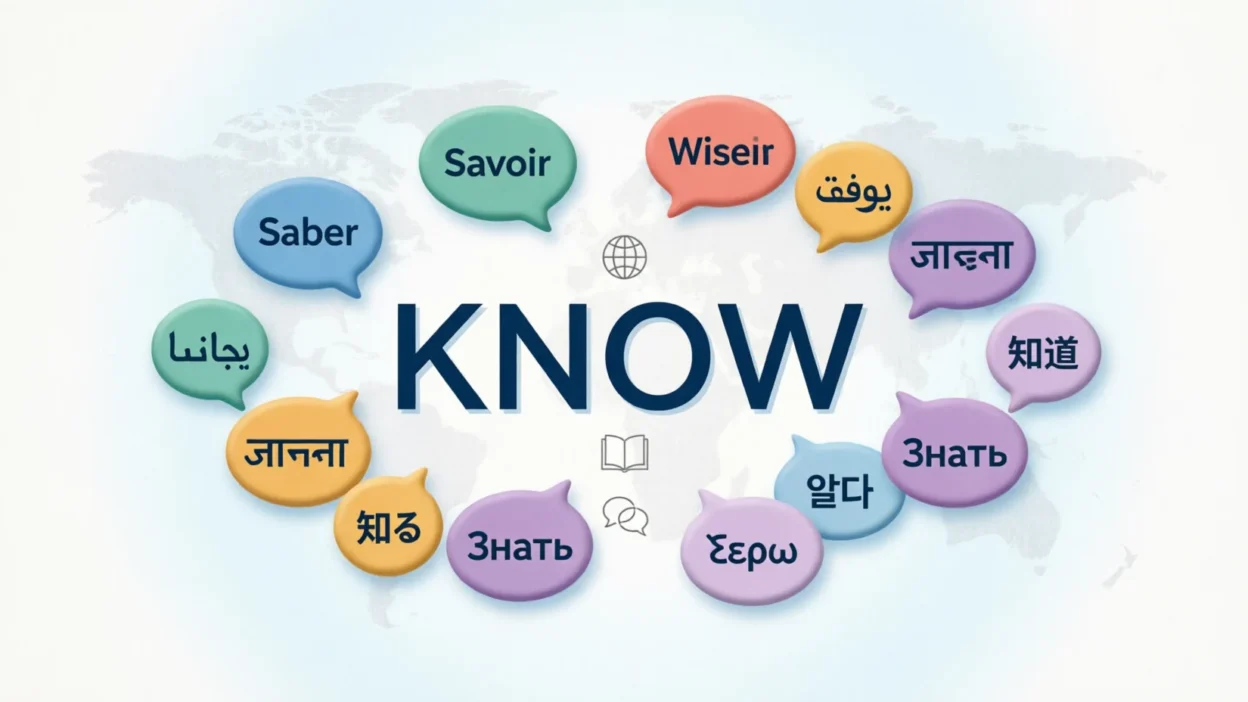
Learning how to say “know” in different languages is a simple and useful way to expand your vocabulary and understand how people express knowledge around the world.
The word “know” is commonly used in everyday conversations, from saying that you understand something to explaining that you are familiar with a person, place, or fact.
Because languages use different grammatical structures, the exact translation of “know” can change depending on context. For this guide, the phrases below use a natural first-person form such as “I know” where appropriate. This makes each translation easier to understand and use in real conversations.
If you are searching for “know” in all languages, looking for “how to say know in different languages,” or simply exploring know translations, the table below provides 70 useful examples. These translations show how the idea of knowing is expressed around the world.
Know in Different Languages: 70 Translations
| # | Language | Native Phrase | Easy English Pronunciation | Example Sentence | English Meaning |
|---|---|---|---|---|---|
| 1 | English | I know | Eye noh | I know the answer. | I know the answer. |
| 2 | Spanish | Yo sé | Yoh say | Yo sé la respuesta. | I know the answer. |
| 3 | French | Je sais | Zhuh say | Je sais la réponse. | I know the answer. |
| 4 | German | Ich weiß | Ikh vice | Ich weiß die Antwort. | I know the answer. |
| 5 | Italian | Io so | Ee-oh soh | Io so la risposta. | I know the answer. |
| 6 | Portuguese | Eu sei | Eh-oo say | Eu sei a resposta. | I know the answer. |
| 7 | Dutch | Ik weet | Ik vayt | Ik weet het antwoord. | I know the answer. |
| 8 | Swedish | Jag vet | Yahg vayt | Jag vet svaret. | I know the answer. |
| 9 | Norwegian | Jeg vet | Yay vet | Jeg vet svaret. | I know the answer. |
| 10 | Danish | Jeg ved | Yai vay | Jeg ved svaret. | I know the answer. |
| 11 | Finnish | Minä tiedän | Mee-na tee-eh-dan | Minä tiedän vastauksen. | I know the answer. |
| 12 | Icelandic | Ég veit | Yekh vayt | Ég veit svarið. | I know the answer. |
| 13 | Irish | Tá a fhios agam | Taw uh iss ah-gum | Tá a fhios agam an freagra. | I know the answer. |
| 14 | Welsh | Rwy’n gwybod | Roon goo-bod | Rwy’n gwybod yr ateb. | I know the answer. |
| 15 | Scottish Gaelic | Tha fios agam | Ha feess ah-gum | Tha fios agam an fhreagairt. | I know the answer. |
| 16 | Latin | Scio | Skee-oh | Scio responsum. | I know the answer. |
| 17 | Esperanto | Mi scias | Mee skee-as | Mi scias la respondon. | I know the answer. |
| 18 | Russian | Я знаю | Ya zná-yoo | Я знаю ответ. | I know the answer. |
| 19 | Ukrainian | Я знаю | Ya zna-yoo | Я знаю відповідь. | I know the answer. |
| 20 | Belarusian | Я ведаю | Ya veh-da-yoo | Я ведаю адказ. | I know the answer. |
| 21 | Polish | Wiem | V’yem | Wiem odpowiedź. | I know the answer. |
| 22 | Czech | Vím | Veem | Vím odpověď. | I know the answer. |
| 23 | Slovak | Viem | V’yem | Viem odpoveď. | I know the answer. |
| 24 | Slovenian | Vem | Vem | Vem odgovor. | I know the answer. |
| 25 | Croatian | Znam | Znahm | Znam odgovor. | I know the answer. |
| 26 | Serbian | Знам | Znahm | Знам одговор. | I know the answer. |
| 27 | Bosnian | Znam | Znahm | Znam odgovor. | I know the answer. |
| 28 | Bulgarian | Знам | Znahm | Знам отговора. | I know the answer. |
| 29 | Macedonian | Знам | Znahm | Знам го одговорот. | I know the answer. |
| 30 | Romanian | Știu | Shtyoo | Știu răspunsul. | I know the answer. |
| 31 | Hungarian | Tudom | Too-dom | Tudom a választ. | I know the answer. |
| 32 | Greek | Ξέρω | Kseh-roh | Ξέρω την απάντηση. | I know the answer. |
| 33 | Albanian | E di | Eh dee | E di përgjigjen. | I know the answer. |
| 34 | Armenian | Ես գիտեմ | Yes ghee-tem | Ես գիտեմ պատասխանը։ | I know the answer. |
| 35 | Georgian | მე ვიცი | Meh vee-see | მე ვიცი პასუხი. | I know the answer. |
| 36 | Turkish | Biliyorum | Bee-lee-yor-oom | Cevabı biliyorum. | I know the answer. |
| 37 | Azerbaijani | Bilirəm | Bee-lee-ram | Mən cavabı bilirəm. | I know the answer. |
| 38 | Kazakh | Мен білемін | Men bee-leh-min | Мен жауапты білемін. | I know the answer. |
| 39 | Uzbek | Men bilaman | Men bee-la-man | Men javobni bilaman. | I know the answer. |
| 40 | Kyrgyz | Мен билем | Men bee-lem | Мен жоопту билем. | I know the answer. |
| 41 | Tajik | Ман медонам | Man meh-do-nam | Ман ҷавобро медонам. | I know the answer. |
| 42 | Persian | میدانم | Mee-daa-nam | من جواب را میدانم. | I know the answer. |
| 43 | Arabic | أنا أعرف | Ana a’rif | أنا أعرف الجواب. | I know the answer. |
| 44 | Hebrew | אני יודע | Ah-nee yo-day-ah | אני יודע את התשובה. | I know the answer. |
| 45 | Hindi | मैं जानता हूँ | Main jaan-ta hoon | मैं जवाब जानता हूँ। | I know the answer. |
| 46 | Urdu | میں جانتا ہوں | Main jaan-ta hoon | میں جواب جانتا ہوں۔ | I know the answer. |
| 47 | Bengali | আমি জানি | A-mee ja-nee | আমি উত্তরটি জানি। | I know the answer. |
| 48 | Punjabi | ਮੈਂ ਜਾਣਦਾ ਹਾਂ | Main jaan-da haan | ਮੈਂ ਜਵਾਬ ਜਾਣਦਾ ਹਾਂ। | I know the answer. |
| 49 | Gujarati | હું જાણું છું | Hoon jaan-oon chhoon | હું જવાબ જાણું છું. | I know the answer. |
| 50 | Marathi | मला माहीत आहे | Ma-la maa-heet aa-he | मला उत्तर माहीत आहे. | I know the answer. |
| 51 | Nepali | मलाई थाहा छ | Ma-lai tha-ha chha | मलाई उत्तर थाहा छ। | I know the answer. |
| 52 | Sinhala | මම දන්නවා | Ma-ma dan-na-wa | මම පිළිතුර දන්නවා. | I know the answer. |
| 53 | Tamil | எனக்குத் தெரியும் | Eh-na-kut teh-ree-yoom | எனக்கு பதில் தெரியும். | I know the answer. |
| 54 | Telugu | నాకు తెలుసు | Naa-koo teh-loo-soo | నాకు సమాధానం తెలుసు. | I know the answer. |
| 55 | Kannada | ನನಗೆ ಗೊತ್ತು | Na-na-gay got-too | ನನಗೆ ಉತ್ತರ ಗೊತ್ತು. | I know the answer. |
| 56 | Malayalam | എനിക്ക് അറിയാം | Eh-nik ar-ee-yaam | എനിക്ക് ഉത്തരം അറിയാം. | I know the answer. |
| 57 | Odia | ମୁଁ ଜାଣେ | Moon ja-nay | ମୁଁ ଉତ୍ତର ଜାଣେ। | I know the answer. |
| 58 | Assamese | মই জানো | Moi ja-no | মই উত্তৰটো জানো। | I know the answer. |
| 59 | Chinese (Mandarin) | 我知道 | Wǒ zhī dào | 我知道答案。 | I know the answer. |
| 60 | Japanese | 知っています | Shee-teh ee-mas | 答えを知っています。 | I know the answer. |
| 61 | Korean | 알아요 | A-ra-yo | 답을 알아요. | I know the answer. |
| 62 | Vietnamese | Tôi biết | Toy byet | Tôi biết câu trả lời. | I know the answer. |
| 63 | Thai | ฉันรู้ | Chan roo | ฉันรู้คำตอบ | I know the answer. |
| 64 | Indonesian | Saya tahu | Sa-ya ta-hoo | Saya tahu jawabannya. | I know the answer. |
| 65 | Malay | Saya tahu | Sa-ya ta-hoo | Saya tahu jawapannya. | I know the answer. |
| 66 | Filipino | Alam ko | A-lam koh | Alam ko ang sagot. | I know the answer. |
| 67 | Swahili | Ninajua | Nee-na-joo-a | Ninajua jibu. | I know the answer. |
| 68 | Afrikaans | Ek weet | Ek vayt | Ek weet die antwoord. | I know the answer. |
| 69 | Zulu | Ngiyazi | Ngee-ya-zee | Ngiyazi impendulo. | I know the answer. |
| 70 | Xhosa | Ndiyazi | Ndee-ya-zee | Ndiyazi impendulo. | I know the answer. |
How to Say “Know” in Different Languages
The word “know” does not always translate into a single word that works in every situation. Some languages distinguish between knowing a fact, knowing a person, and being familiar with something.
For example, English uses “know” for both factual knowledge and familiarity. French commonly uses savoir for knowing information and connaître for being acquainted with someone or something. Spanish similarly uses saber and conocer for different meanings.
That is why learning “know” translations in context is more useful than memorizing isolated vocabulary.
Know in All Languages: Understanding the Meaning
In English, know can describe knowledge, awareness, familiarity, or understanding.
Common uses include:
- Knowing an answer or fact
- Knowing how to do something
- Knowing a person
- Knowing a place
- Knowing information
- Being aware of something
For example, “I know the answer” expresses knowledge of information, while “I know Sarah” means that the speaker is acquainted with Sarah.
Know Translations for Everyday Conversations
Learning how to say “I know” can be especially useful when traveling, studying a language, or communicating with international friends.
Simple phrases such as “I know,” “I don’t know,” and “Do you know?” appear frequently in everyday conversations. Once you learn the basic form, you can begin building longer sentences around it.
For language learners, it is also helpful to listen to native speakers because pronunciation can vary depending on region and accent.
Know Around the World
The concept of knowing is universal, but languages express it in different ways. European languages such as Spanish, French, German, Italian, and Portuguese have their own forms for expressing knowledge.
Asian languages can use different grammatical structures. For instance, Mandarin uses 我知道 (Wǒ zhī dào), while Japanese commonly uses 知っています (shitte imasu) to express that someone knows something.
Languages spoken in South Asia, Africa, and other regions also have distinctive ways of expressing knowledge. These differences make vocabulary learning interesting and show how languages organize ideas differently.
Why Learn “Know” in Different Languages?
Learning the word “know” in multiple languages can be useful for several reasons:
Travel: Knowing basic expressions makes communication easier when visiting another country.
Language learning: Common verbs are an excellent starting point for building vocabulary.
Cultural understanding: Different languages may divide meanings in ways that English does not.
Conversation: “I know” is a common phrase that can quickly make your everyday vocabulary more useful.
Education: Comparing translations can help students recognize similarities and differences between languages.
Tips for Remembering Know Translations
One of the easiest ways to remember new translations is to learn each word inside a short sentence instead of memorizing vocabulary by itself.
For example, remember “Yo sé la respuesta” as a complete expression rather than only memorizing sé. The same approach can be used with French, German, Arabic, Japanese, Hindi, Chinese, and other languages.
You can also group languages by region, practice pronunciation aloud, and review a few phrases every day.
FAQs:
1. How do you say “know” in different languages?
“Know” has different translations depending on the language. Examples include sé in Spanish, je sais in French, ich weiß in German, io so in Italian, я знаю in Russian, 我知道 in Mandarin, and tôi biết in Vietnamese.
2. What is “I know” in Spanish?
“I know” in Spanish is “Yo sé.” A common example is “Yo sé la respuesta,” meaning “I know the answer.”
3. How do you say “I know” in French?
“I know” in French is “Je sais.” It is commonly used when talking about knowing information or facts.
4. What is the difference between “know” translations in different languages?
Some languages use different verbs depending on what is being known. For example, French uses savoir for knowing information or how to do something and connaître for familiarity with a person or place. Other languages make similar distinctions.
5. What is “know” in the most commonly spoken languages?
Some common translations include yo sé in Spanish, je sais in French, ich weiß in German, 我知道 in Mandarin, 知っています in Japanese, 알아요 in Korean, أنا أعرف in Arabic, मैं जानता हूँ in Hindi, and tôi biết in Vietnamese.
Conclusion
Learning “know” in different languages is a practical way to expand your vocabulary while discovering how different cultures express knowledge and familiarity. From yo sé in Spanish and je sais in French to 我知道 in Mandarin and tôi biết in Vietnamese, each translation offers a useful glimpse into another language.
If you are a student, traveler, language enthusiast, or simply curious about know in all languages, these 70 translations provide a helpful starting point for learning and everyday communication.

Brandon Cody is the Administrator of LingoMean, a platform dedicated to helping people discover the right words for every situation. He oversees content quality, website management, and user experience, ensuring readers receive accurate, practical, and easy-to-understand communication guidance.