The word “kill” is a strong English verb that generally means causing the death of a person, animal, or living thing. It can also appear in non-literal expressions, such as “kill time” or “kill the mood.
” Because its meaning can change with context, learning its equivalent in another language requires attention to how the word is naturally used.
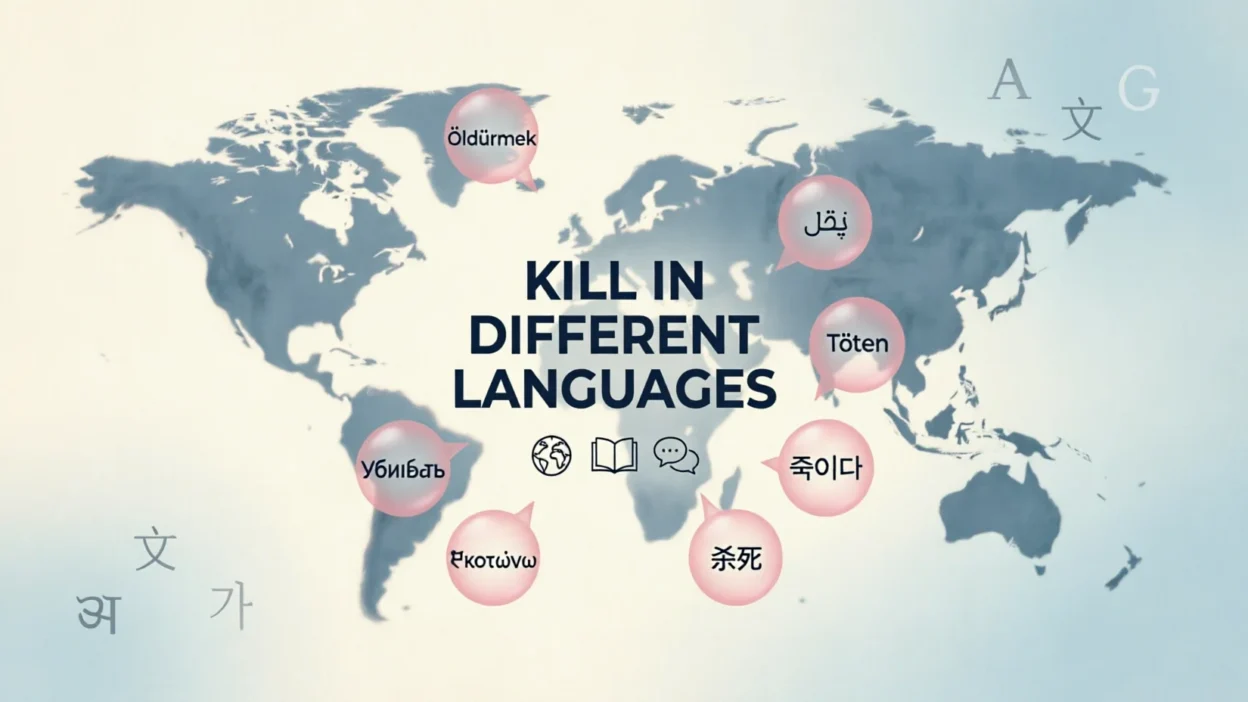
If you are searching for kill in different languages, this guide provides 70 translations along with simple pronunciations and short examples.
If you are studying languages, writing dialogue, researching vocabulary, or simply curious about how to say kill in different languages, the table below makes these translations easy to compare.
Kill in All Languages
The following table lists the common verb equivalent of “to kill” in 70 languages. Pronunciations are approximate English-friendly guides, so actual pronunciation may vary by accent or region.
| # | Language | Native Phrase | Easy English Pronunciation | Example Sentence | English Meaning |
|---|---|---|---|---|---|
| 1 | English | to kill | tuh kil | They want to kill the character. | They want to kill the character. |
| 2 | Spanish | matar | mah-TAR | El villano quiere matar al héroe. | The villain wants to kill the hero. |
| 3 | French | tuer | tweh-AY | Le personnage veut tuer le monstre. | The character wants to kill the monster. |
| 4 | German | töten | TUR-ten | Der Bösewicht will den Helden töten. | The villain wants to kill the hero. |
| 5 | Italian | uccidere | oot-chee-DEH-reh | Il cattivo vuole uccidere il mostro. | The villain wants to kill the monster. |
| 6 | Portuguese | matar | mah-TAR | O vilão quer matar o herói. | The villain wants to kill the hero. |
| 7 | Dutch | doden | DOH-den | De schurk wil de held doden. | The villain wants to kill the hero. |
| 8 | Russian | убивать | oo-bee-VAT | Он хочет убивать монстров. | He wants to kill monsters. |
| 9 | Ukrainian | вбивати | vby-va-TY | Він хоче вбивати монстрів. | He wants to kill monsters. |
| 10 | Polish | zabijać | zah-BY-yatch | Nie wolno zabijać zwierząt. | One must not kill animals. |
| 11 | Czech | zabít | ZAH-bit | Nie chcę zabít muchu. | I do not want to kill the fly. |
| 12 | Slovak | zabiť | ZAH-bit | Nechce zabiť vtáka. | He does not want to kill the bird. |
| 13 | Slovenian | ubiti | oo-BEE-tee | Ne želim ubiti živali. | I do not want to kill an animal. |
| 14 | Croatian | ubiti | oo-BEE-tee | Ne želim ubiti životinju. | I do not want to kill an animal. |
| 15 | Serbian | убити | oo-BEE-tee | Ne želim ubiti životinju. | I do not want to kill an animal. |
| 16 | Bosnian | ubiti | oo-BEE-tee | Ne treba ubiti životinju. | An animal should not be killed. |
| 17 | Bulgarian | убивам | oo-BEE-vam | Не трябва да убиваме животни. | We should not kill animals. |
| 18 | Macedonian | убива | oo-BEE-va | Не треба да убиваме животни. | We should not kill animals. |
| 19 | Greek | σκοτώνω | sko-TOH-no | Δεν θέλω να σκοτώσω το ζώο. | I do not want to kill the animal. |
| 20 | Romanian | a ucide | ah oo-CHEE-deh | Nu vreau să ucid animalul. | I do not want to kill the animal. |
| 21 | Hungarian | ölni | UHL-nee | Nem akarok ölni. | I do not want to kill. |
| 22 | Finnish | tappaa | TAP-pah | En halua tappaa eläintä. | I do not want to kill an animal. |
| 23 | Estonian | tapma | TAP-mah | Ma ei taha looma tappa. | I do not want to kill an animal. |
| 24 | Latvian | nogalināt | noh-gah-lee-NAHT | Es negribu nogalināt dzīvnieku. | I do not want to kill an animal. |
| 25 | Lithuanian | nužudyti | noo-ZHOO-dy-tee | Nenoriu nužudyti gyvūno. | I do not want to kill an animal. |
| 26 | Swedish | döda | DUR-dah | Han vill inte döda djuret. | He does not want to kill the animal. |
| 27 | Norwegian | drepe | DRAY-peh | Jeg vil ikke drepe dyret. | I do not want to kill the animal. |
| 28 | Danish | dræbe | DRAY-beh | Jeg vil ikke dræbe dyret. | I do not want to kill the animal. |
| 29 | Icelandic | drepa | DREH-pah | Ég vil ekki drepa dýrið. | I do not want to kill the animal. |
| 30 | Irish | a mharú | uh WAH-roo | Níor cheart an t-ainmhí a mharú. | The animal should not be killed. |
| 31 | Welsh | lladd | h-lahd | Ni ddylid lladd anifail. | An animal should not be killed. |
| 32 | Scottish Gaelic | marbhadh | MAR-oo | Chan eil e ceart marbhadh bheathaichean. | It is not right to kill animals. |
| 33 | Basque | hil | heel | Ez dut animalia hil nahi. | I do not want to kill the animal. |
| 34 | Catalan | matar | mah-TAR | No vull matar l’animal. | I do not want to kill the animal. |
| 35 | Galician | matar | mah-TAR | Non quero matar o animal. | I do not want to kill the animal. |
| 36 | Maltese | joqtol | YOK-tol | Ma rridx noqtol l-annimal. | I do not want to kill the animal. |
| 37 | Albanian | vras | vras | Nuk dua të vras. | I do not want to kill. |
| 38 | Turkish | öldürmek | UHL-dur-mek | Hayvanı öldürmek istemiyorum. | I do not want to kill the animal. |
| 39 | Azerbaijani | öldürmək | uhl-dur-MEK | Mən heyvanı öldürmək istəmirəm. | I do not want to kill the animal. |
| 40 | Georgian | მოკვლა | mok-VLA | ცხოველის მოკვლა არ მინდა. | I do not want to kill the animal. |
| 41 | Armenian | սպանել | spah-NEL | Ես չեմ ուզում սպանել։ | I do not want to kill. |
| 42 | Persian | کشتن | kosh-TAN | نمیخواهم کسی را بکشم. | I do not want to kill anyone. |
| 43 | Arabic | قتل | QAT-l | لا أريد أن أقتل أحدًا. | I do not want to kill anyone. |
| 44 | Hebrew | להרוג | lah-ha-ROHG | אני לא רוצה להרוג אף אחד. | I do not want to kill anyone. |
| 45 | Hindi | मारना | MAAR-na | मैं किसी को मारना नहीं चाहता। | I do not want to kill anyone. |
| 46 | Urdu | مارنا | MAAR-na | میں کسی کو مارنا نہیں چاہتا۔ | I do not want to kill anyone. |
| 47 | Bengali | হত্যা করা | hot-tya KOH-ra | আমি কাউকে হত্যা করতে চাই না। | I do not want to kill anyone. |
| 48 | Punjabi | ਮਾਰਨਾ | MAAR-na | ਮੈਂ ਕਿਸੇ ਨੂੰ ਮਾਰਨਾ ਨਹੀਂ ਚਾਹੁੰਦਾ। | I do not want to kill anyone. |
| 49 | Gujarati | મારવું | MAAR-voo | હું કોઈને મારવા માંગતો નથી. | I do not want to kill anyone. |
| 50 | Marathi | मारणे | MAA-ra-ne | मला कोणालाही मारायचे नाही. | I do not want to kill anyone. |
| 51 | Nepali | मार्नु | MAAR-noo | म कसैलाई मार्न चाहन्नँ। | I do not want to kill anyone. |
| 52 | Sinhala | මරනවා | mah-rah-nah-WAH | මට කාවවත් මරන්න ඕන නැහැ. | I do not want to kill anyone. |
| 53 | Tamil | கொல்ல | KOL-lah | நான் யாரையும் கொல்ல விரும்பவில்லை. | I do not want to kill anyone. |
| 54 | Telugu | చంపడం | CHAM-pa-dam | నేను ఎవరినీ చంపాలని అనుకోవడం లేదు. | I do not want to kill anyone. |
| 55 | Kannada | ಕೊಲ್ಲು | KOL-loo | ನಾನು ಯಾರನ್ನೂ ಕೊಲ್ಲಲು ಬಯಸುವುದಿಲ್ಲ. | I do not want to kill anyone. |
| 56 | Malayalam | കൊല്ലുക | KOL-loo-kah | എനിക്ക് ആരെയും കൊല്ലാൻ ആഗ്രഹമില്ല. | I do not want to kill anyone. |
| 57 | Odia | ମାରିବା | MAA-ree-bah | ମୁଁ କାହାକୁ ମାରିବାକୁ ଚାହେଁ ନାହିଁ। | I do not want to kill anyone. |
| 58 | Thai | ฆ่า | KAH | ฉันไม่ต้องการฆ่าใคร | I do not want to kill anyone. |
| 59 | Vietnamese | giết | zee-ET | Tôi không muốn giết ai. | I do not want to kill anyone. |
| 60 | Indonesian | membunuh | mem-BOO-nooh | Saya tidak ingin membunuh siapa pun. | I do not want to kill anyone. |
| 61 | Malay | membunuh | mem-BOO-nooh | Saya tidak mahu membunuh sesiapa. | I do not want to kill anyone. |
| 62 | Filipino | pumatay | poo-mah-TAY | Ayaw kong pumatay ng sinuman. | I do not want to kill anyone. |
| 63 | Javanese | mateni | mah-TEH-nee | Aku ora pengin mateni sapa wae. | I do not want to kill anyone. |
| 64 | Chinese (Mandarin) | 杀 | SHAH | 我不想杀任何人。 | I do not want to kill anyone. |
| 65 | Japanese | 殺す | koh-ROO-soo | 誰も殺したくない。 | I do not want to kill anyone. |
| 66 | Korean | 죽이다 | joo-gee-dah | 나는 누구도 죽이고 싶지 않다. | I do not want to kill anyone. |
| 67 | Mongolian | алах | ah-LAKH | Би хэнийг ч алахыг хүсэхгүй байна. | I do not want to kill anyone. |
| 68 | Swahili | kuua | koo-OO-ah | Sitaki kuua mtu yeyote. | I do not want to kill anyone. |
| 69 | Afrikaans | doodmaak | DOHT-mahk | Ek wil niemand doodmaak nie. | I do not want to kill anyone. |
| 70 | Zulu | ukubulala | oo-koo-boo-LAH-lah | Angifuni ukubulala muntu. | I do not want to kill anyone. |
How to Say “Kill” in Different Languages
The translation of “kill” varies considerably across languages. Some languages use a single infinitive or dictionary form, while others change the verb according to tense, person, number, or grammatical structure.
For example, Spanish uses matar, French uses tuer, German uses töten, Japanese uses 殺す (korosu), and Arabic commonly uses قتل (qatala). In Hindi and Urdu, मारना (maarna) can have several meanings depending on context, so the surrounding sentence is important.
Kill Translations Around the World
The word “kill” around the world can have both literal and figurative uses. In English, for example, “kill time” does not mean causing death; it means spending time while waiting. Similar expressions may use completely different verbs in other languages.
When using a translation in conversation, literature, subtitles, or creative writing, always consider the surrounding context. A dictionary translation may not always be the most natural expression in a complete sentence.
Literal and Figurative Uses of “Kill”
The literal meaning of “kill” is to cause the death of a living being. However, English also uses the word in several figurative expressions.
Common examples include:
- Kill time — spend time while waiting.
- Kill the mood — ruin an enjoyable atmosphere.
- Kill a conversation — cause a conversation to stop.
- Kill a project — cancel or discontinue a project.
- Kill the engine — turn off an engine.
- Kill the lights — switch off the lights.
These expressions should not automatically be translated word-for-word because other languages may use completely different idioms.
Why Learn “Kill” in Different Languages?
Learning kill in different languages can be useful for vocabulary development, language comparison, translation practice, fiction writing, and understanding international media.
It also demonstrates how different languages organize verbs. Some languages distinguish grammatical forms more strongly than English, while others rely heavily on context.
For students and language learners, studying the word alongside a complete example sentence is often more useful than memorizing a translation alone.
Tips for Using Kill Translations Correctly
When learning kill translations, keep these points in mind:
- Check the context. A literal meaning and an idiomatic meaning can be very different.
- Learn the pronunciation. The pronunciation guides in the table are simplified for English speakers.
- Study complete sentences. This helps you understand how the verb functions naturally.
- Watch grammatical forms. Verbs may change according to tense, person, gender, or number.
- Use sensitive wording carefully. Because “kill” describes death or can refer to violence, context and tone matter.
FAQs:
1. How do you say “kill” in different languages?
“Kill” has different translations across languages. Examples include matar in Spanish, tuer in French, töten in German, убивать in Russian, قتل in Arabic, मारना in Hindi, 殺す in Japanese, and 죽이다 in Korean.
2. What is “kill” in Spanish?
The common Spanish verb for “to kill” is matar. It is pronounced approximately “mah-TAR.”
3. What is “kill” in Japanese?
The Japanese verb 殺す (korosu) means “to kill.” Its pronunciation is approximately “koh-ROO-soo.”
4. What is “kill” in Hindi and Urdu?
In Hindi, “to kill” is commonly expressed as मारना (maarna). In Urdu, the corresponding form is مارنا (maarna). The exact meaning can depend on context and sentence construction.
5. Why can “kill” have different translations depending on context?
“Kill” can be literal or figurative. Expressions such as “kill time” and “kill the mood” have meanings that are different from causing death. Therefore, a natural translation should consider the complete sentence rather than translating the word in isolation.
Conclusion
Learning kill in different languages offers a useful way to compare vocabulary, pronunciation, grammar, and cultural expressions across languages.
The 70 translations above provide a convenient starting point for understanding how to say kill in different languages and exploring kill in all languages.
Remember that the best translation depends on context. For everyday communication, academic study, translation, or writing, looking at the complete sentence will usually produce a more natural result than relying on a single dictionary equivalent.

Brandon Cody is the Administrator of LingoMean, a platform dedicated to helping people discover the right words for every situation. He oversees content quality, website management, and user experience, ensuring readers receive accurate, practical, and easy-to-understand communication guidance.