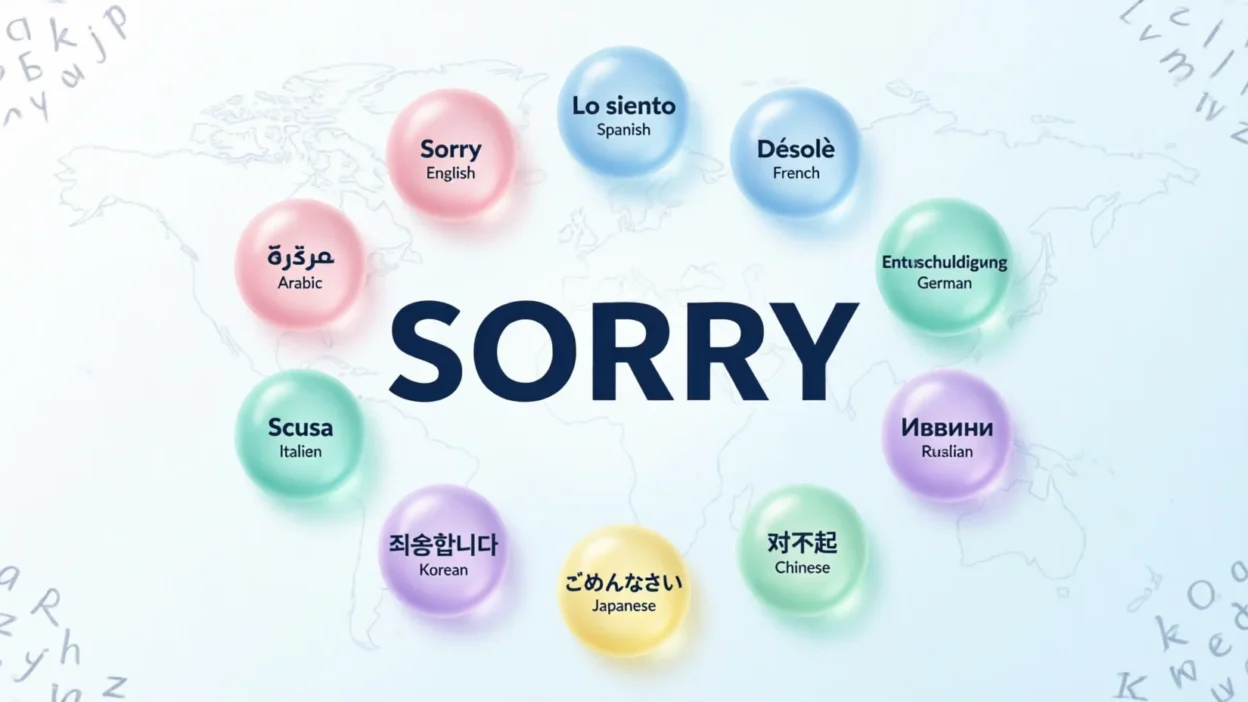
Saying sorry is one of the simplest ways to show regret, respect, and kindness. However, the way people apologize can vary greatly from one language and culture to another.
If you are traveling, learning a new language, chatting with international friends, or simply expanding your vocabulary, knowing how to say sorry in different languages can make communication feel more natural and thoughtful.
In this guide, you will discover 70 ways to say sorry around the world, including the native phrase, an easy English pronunciation, and a practical example. These sorry translations cover widely spoken languages from Europe, Asia, Africa, the Middle East, and other regions.
How to Say Sorry in Different Languages
The table below provides sorry in all languages in a simple format. Each example shows how the expression can naturally appear in everyday communication.
| # | Language | Native Phrase | Easy English Pronunciation | Example Sentence | English Meaning |
|---|---|---|---|---|---|
| 1 | English | Sorry | SAH-ree | Sorry, I’m late. | I apologize for being late. |
| 2 | Spanish | Lo siento | loh SYEN-toh | Lo siento, llegué tarde. | I’m sorry, I arrived late. |
| 3 | French | Désolé | day-zoh-LAY | Désolé, j’ai oublié. | Sorry, I forgot. |
| 4 | German | Entschuldigung | ent-SHOOL-dee-goong | Entschuldigung, ich bin spät. | Sorry, I’m late. |
| 5 | Italian | Mi dispiace | mee dee-SPYAH-cheh | Mi dispiace, ho sbagliato. | I’m sorry, I made a mistake. |
| 6 | Portuguese | Desculpe | des-KOOL-peh | Desculpe, cheguei tarde. | Sorry, I arrived late. |
| 7 | Dutch | Het spijt me | het SPITE muh | Het spijt me, ik was laat. | I’m sorry, I was late. |
| 8 | Swedish | Förlåt | fur-LOAT | Förlåt, jag glömde. | Sorry, I forgot. |
| 9 | Norwegian | Beklager | beh-KLAH-ger | Beklager, jeg er sen. | Sorry, I’m late. |
| 10 | Danish | Undskyld | OON-skool | Undskyld, jeg glemte det. | Sorry, I forgot it. |
| 11 | Finnish | Anteeksi | AHN-tehk-see | Anteeksi, olen myöhässä. | Sorry, I’m late. |
| 12 | Icelandic | Fyrirgefðu | FI-rir-yev-thu | Fyrirgefðu, ég gleymdi. | Sorry, I forgot. |
| 13 | Irish | Tá brón orm | taw brohn urm | Tá brón orm, tá mé déanach. | Sorry, I’m late. |
| 14 | Welsh | Mae’n ddrwg gen i | mine throog gen ee | Mae’n ddrwg gen i, rydw i’n hwyr. | Sorry, I’m late. |
| 15 | Polish | Przepraszam | psheh-PRAH-sham | Przepraszam, spóźniłem się. | Sorry, I’m late. |
| 16 | Czech | Promiňte | PROH-min-yteh | Promiňte, jsem pozdě. | Sorry, I’m late. |
| 17 | Slovak | Prepáčte | preh-PAACH-teh | Prepáčte, zabudol som. | Sorry, I forgot. |
| 18 | Slovenian | Oprostite | oh-proh-STEE-teh | Oprostite, zamudil sem. | Sorry, I’m late. |
| 19 | Croatian | Oprostite | oh-proh-STEE-teh | Oprostite, pogriješio sam. | Sorry, I made a mistake. |
| 20 | Serbian | Izvinite | iz-vee-NEE-teh | Izvinite, zakasnio sam. | Sorry, I’m late. |
| 21 | Bosnian | Izvinite | iz-vee-NEE-teh | Izvinite, pogriješio sam. | Sorry, I made a mistake. |
| 22 | Bulgarian | Съжалявам | suh-ZHAH-lyah-vam | Съжалявам, закъснях. | I’m sorry, I’m late. |
| 23 | Macedonian | Извинете | iz-vee-NEH-teh | Извинете, закъснях. | Sorry, I’m late. |
| 24 | Russian | Извините | iz-vee-NEE-teh | Извините, я опоздал. | Sorry, I’m late. |
| 25 | Ukrainian | Вибачте | vee-BAHCH-teh | Вибачте, я запізнився. | Sorry, I’m late. |
| 26 | Belarusian | Прабачце | prah-BAHCH-tseh | Прабачце, я спазніўся. | Sorry, I’m late. |
| 27 | Lithuanian | Atsiprašau | at-see-prah-SHOW | Atsiprašau, pavėlavau. | Sorry, I’m late. |
| 28 | Latvian | Piedodiet | pee-eh-DOH-dyet | Piedodiet, aizmirsu. | Sorry, I forgot. |
| 29 | Estonian | Vabandust | VAH-bahn-doost | Vabandust, ma hilinesin. | Sorry, I’m late. |
| 30 | Romanian | Îmi pare rău | um pah-reh row | Îmi pare rău, am întârziat. | I’m sorry, I’m late. |
| 31 | Hungarian | Sajnálom | SHINE-ah-lom | Sajnálom, hogy késtem. | I’m sorry I was late. |
| 32 | Greek | Συγγνώμη | see-GHNO-mee | Συγγνώμη, άργησα. | Sorry, I’m late. |
| 33 | Albanian | Më fal | muh fahl | Më fal, harrova. | Sorry, I forgot. |
| 34 | Armenian | Ներողություն | neh-roh-ghoo-TYUN | Ներողություն, ուշացա։ | Sorry, I’m late. |
| 35 | Georgian | ბოდიში | boh-DEE-shee | ბოდიში, დამაგვიანდა. | Sorry, I’m late. |
| 36 | Turkish | Özür dilerim | uh-ZUR dee-leh-reem | Özür dilerim, geç kaldım. | I’m sorry, I’m late. |
| 37 | Azerbaijani | Bağışlayın | bah-GHISH-lah-yin | Bağışlayın, gecikdim. | Sorry, I’m late. |
| 38 | Persian | متأسفم | moh-ta-eh-SEF-am | متأسفم، دیر کردم. | I’m sorry, I’m late. |
| 39 | Arabic | آسف | AH-sif | آسف، تأخرت. | Sorry, I’m late. |
| 40 | Hebrew | סליחה | slee-KHAH | סליחה, שכחתי. | Sorry, I forgot. |
| 41 | Hindi | माफ़ कीजिए | maaf KEE-jee-yeh | माफ़ कीजिए, मुझे देर हो गई। | Sorry, I’m late. |
| 42 | Urdu | معاف کیجیے | maaf kee-JEE-yeh | معاف کیجیے، مجھے دیر ہوگئی۔ | Sorry, I’m late. |
| 43 | Bengali | দুঃখিত | DOO-kho-dit | দুঃখিত, আমি দেরি করেছি। | Sorry, I’m late. |
| 44 | Punjabi | ਮਾਫ਼ ਕਰਨਾ | maaf KAR-na | ਮਾਫ਼ ਕਰਨਾ, ਮੈਨੂੰ ਦੇਰ ਹੋ ਗਈ। | Sorry, I’m late. |
| 45 | Gujarati | માફ કરશો | maaf kar-SHOH | માફ કરશો, મને મોડું થયું. | Sorry, I’m late. |
| 46 | Marathi | माफ करा | maaf ka-RAH | माफ करा, मला उशीर झाला. | Sorry, I’m late. |
| 47 | Nepali | माफ गर्नुहोस् | maaf garnu-HOS | माफ गर्नुहोस्, मलाई ढिला भयो। | Sorry, I’m late. |
| 48 | Sinhala | සමාවෙන්න | sa-mah-WEN-na | සමාවෙන්න, මට පරක්කු වුණා. | Sorry, I’m late. |
| 49 | Tamil | மன்னிக்கவும் | man-ni-KA-vum | மன்னிக்கவும், நான் தாமதமாக வந்தேன். | Sorry, I arrived late. |
| 50 | Telugu | క్షమించండి | ksha-MIN-chan-dee | క్షమించండి, నేను ఆలస్యంగా వచ్చాను. | Sorry, I arrived late. |
| 51 | Kannada | ಕ್ಷಮಿಸಿ | ksha-mi-SEE | ಕ್ಷಮಿಸಿ, ನಾನು ತಡವಾಗಿ ಬಂದೆ. | Sorry, I arrived late. |
| 52 | Malayalam | ക്ഷമിക്കണം | ksha-mi-KKA-nam | ക്ഷമിക്കണം, ഞാൻ വൈകി. | Sorry, I’m late. |
| 53 | Odia | କ୍ଷମା କରନ୍ତୁ | khya-mah ka-RON-too | କ୍ଷମା କରନ୍ତୁ, ମୁଁ ଡେରି କଲି। | Sorry, I’m late. |
| 54 | Assamese | ক্ষমা কৰিব | kho-mah ko-REE-bo | ক্ষমা কৰিব, মই দেৰি কৰিলোঁ। | Sorry, I’m late. |
| 55 | Chinese (Mandarin) | 对不起 | dway boo-CHEE | 对不起,我迟到了。 | Sorry, I’m late. |
| 56 | Japanese | ごめんなさい | goh-men-nah-SAI | ごめんなさい、遅れました。 | Sorry, I’m late. |
| 57 | Korean | 미안합니다 | mee-an-ham-nee-da | 미안합니다, 늦었습니다. | I’m sorry, I’m late. |
| 58 | Vietnamese | Xin lỗi | sin LOY | Xin lỗi, tôi đến muộn. | Sorry, I’m late. |
| 59 | Thai | ขอโทษ | khaw-TOHT | ขอโทษ ฉันมาสาย | Sorry, I’m late. |
| 60 | Indonesian | Maaf | mah-AHF | Maaf, saya terlambat. | Sorry, I’m late. |
| 61 | Malay | Maaf | mah-AHF | Maaf, saya terlambat. | Sorry, I’m late. |
| 62 | Filipino | Pasensya na | pah-SEN-shah nah | Pasensya na, nahuli ako. | Sorry, I’m late. |
| 63 | Burmese | တောင်းပန်ပါတယ် | taung-pan-ba-deh | တောင်းပန်ပါတယ်၊ နောက်ကျသွားတယ်။ | Sorry, I’m late. |
| 64 | Khmer | សុំទោស | som TOH | សុំទោស ខ្ញុំមកយឺត។ | Sorry, I’m late. |
| 65 | Mongolian | Уучлаарай | oo-CHLAH-rai | Уучлаарай, би хоцорлоо. | Sorry, I’m late. |
| 66 | Swahili | Samahani | sa-ma-HA-nee | Samahani, nimechelewa. | Sorry, I’m late. |
| 67 | Zulu | Uxolo | oo-KHOH-loh | Uxolo, ngiphuzile. | Sorry, I’m late. |
| 68 | Afrikaans | Jammer | YAH-mer | Jammer, ek is laat. | Sorry, I’m late. |
| 69 | Amharic | ይቅርታ | yi-kir-TAH | ይቅርታ፣ ዘግይቻለሁ። | Sorry, I’m late. |
| 70 | Hausa | Yi hakuri | yee ha-KOO-ree | Yi hakuri, na makara. | Sorry, I’m late. |
Sorry Translations Around the World
The word sorry does not always have a single direct equivalent in another language. In many cases, the expression changes depending on the situation, level of politeness, and relationship between the speakers.
For example, some languages use a phrase that literally communicates regret, while others commonly use an expression closer to “forgive me,” “excuse me,” or “I apologize.” Therefore, learning the context is just as important as memorizing the translation.
Common Ways to Use Sorry
People generally apologize for several everyday situations, including:
- Arriving late
- Making a mistake
- Forgetting something
- Interrupting someone
- Hurting someone’s feelings
- Bumping into another person
- Giving incorrect information
- Asking someone to repeat something
- Accidentally causing inconvenience
In casual conversations, a short apology may be enough. However, serious situations often require a more respectful or complete expression.
How to Say Sorry in All Languages Naturally
When learning sorry in different languages, pronunciation is only one part of the process. You should also pay attention to tone and context.
For example, an informal phrase may work well between friends but sound inappropriate in a professional situation. Likewise, some languages have different forms depending on whether you are speaking to one person, several people, a stranger, or someone you respect.
Therefore, learning the common polite form first is usually a practical approach for beginners.
Sorry Around the World: Cultural Differences
Apologizing is universal, but cultures can have different expectations about apologies. In some cultures, people apologize frequently for small inconveniences. In others, an apology may be reserved for situations where someone has clearly made a mistake.
Furthermore, body language and tone can affect how an apology is received. A sincere expression, calm voice, and appropriate level of politeness can make a simple phrase much more meaningful.
Tips for Learning Sorry Translations
If you want to remember these sorry translations, start with the languages you are most likely to use. Practice the phrase aloud, write it down, and place it into a realistic sentence.
You can also group languages by region. Learning a few expressions from European languages, Asian languages, and African languages can make the vocabulary easier to organize and remember.
Most importantly, do not focus only on pronunciation. Learn when the phrase is appropriate so that your apology sounds natural rather than memorized.
Quick Comparison of Sorry in Different Languages
| Region | Example Languages | Common Apology Style |
|---|---|---|
| Europe | Spanish, French, German, Italian | Often expresses regret or asks forgiveness |
| South Asia | Hindi, Urdu, Bengali, Punjabi | Frequently uses polite forgiveness expressions |
| East Asia | Chinese, Japanese, Korean | Strong attention to politeness and social context |
| Southeast Asia | Thai, Vietnamese, Indonesian | Politeness and social relationship can influence usage |
| Middle East | Arabic, Persian, Hebrew, Turkish | Expressions vary according to context and formality |
| Africa | Swahili, Zulu, Hausa, Amharic | Common expressions can emphasize apology or asking forgiveness |
Why Learn How to Say Sorry in Different Languages?
Knowing how to say sorry can be useful when traveling, communicating online, studying languages, meeting international friends, or working with people from different cultures.
It can also make your vocabulary more interesting. Instead of knowing only the English word, you can understand how people in different parts of the world express regret and politeness.
Whether you need sorry in all languages for language study or simply want to know how to say sorry in different languages, the 70 examples above give you a useful starting point.
Conclusion
Learning how to say sorry in different languages is a simple way to improve communication and show respect across cultures. Although the exact words vary, the purpose remains familiar: acknowledging a mistake, expressing regret, or politely asking for forgiveness. Use the examples in this guide as a practical reference whenever you want to explore sorry around the world.
FAQs:
1. What is “sorry” in different languages?
“Sorry” has different expressions across languages, such as lo siento in Spanish, désolé in French, Entschuldigung in German, and 对不起 in Mandarin Chinese.
2. How do you say sorry in 70 languages?
You can use the table in this guide to find 70 different languages, including the native phrase, pronunciation, example sentence, and English meaning.
3. What is the most common way to say sorry internationally?
There is no single international form of sorry. However, many languages have a short everyday expression used for apologies, mistakes, and minor inconveniences.
4. How do you say sorry politely in another language?
Choose the formal or polite expression used in that language, especially when speaking to strangers, older people, teachers, customers, or professional contacts.
5. Why is it useful to learn sorry in different languages?
Learning apology expressions can help travelers, students, language learners, and international communicators interact more naturally and respectfully.

Brandon Cody is the Administrator of LingoMean, a platform dedicated to helping people discover the right words for every situation. He oversees content quality, website management, and user experience, ensuring readers receive accurate, practical, and easy-to-understand communication guidance.