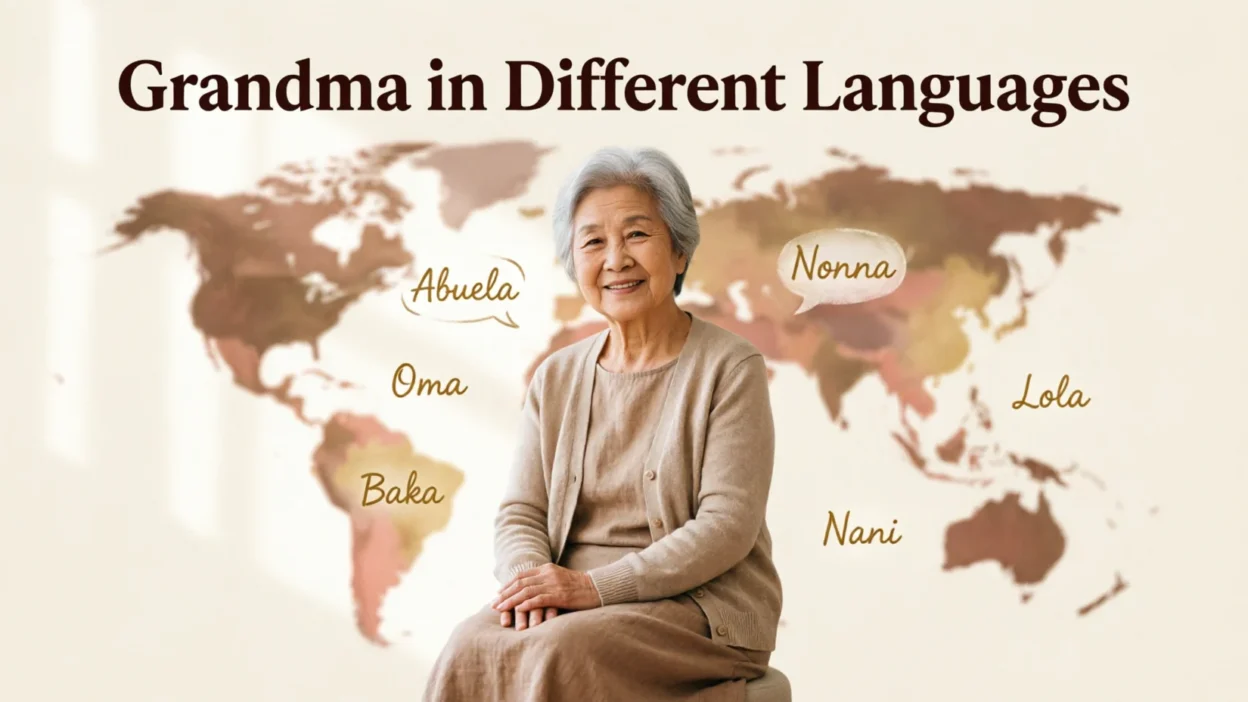
Grandmothers hold a special place in families and cultures around the world. The word “grandma” may sound different from one language to another, but it often carries the same feeling of love, wisdom, care, and family connection.
Learning how to say grandma in different languages is a simple way to explore how people describe one of the most important family relationships.
If you are researching grandma in all languages, looking for grandma translations, creating a family project, or simply wondering how to say grandma in different languages, this guide provides useful answers in one place.
The table below includes 70 languages, their native words for grandma, easy English pronunciations, and short examples. These grandma translations around the world also show how different cultures use special family terms in everyday conversation.
Grandma in Different Languages
| # | Language | Native Phrase | English Pronunciation | Example Sentence | English Meaning |
|---|---|---|---|---|---|
| 1 | Spanish | Abuela | ah-BWEH-lah | Mi abuela cocina muy bien. | My grandma cooks very well. |
| 2 | French | Grand-mère | grahn-MAIR | Ma grand-mère est gentille. | My grandma is kind. |
| 3 | German | Großmutter | GROHS-moot-er | Meine Großmutter lebt hier. | My grandma lives here. |
| 4 | Italian | Nonna | NON-nah | Mia nonna è dolce. | My grandma is sweet. |
| 5 | Portuguese | Avó | ah-VOH | Minha avó é carinhosa. | My grandma is loving. |
| 6 | Dutch | Oma | OH-mah | Mijn oma woont dichtbij. | My grandma lives nearby. |
| 7 | Swedish | Mormor / Farmor | MOR-moor / FAR-moor | Min mormor är snäll. | My grandma is kind. |
| 8 | Danish | Mormor / Farmor | MOR-mor / FAR-mor | Min mormor er sød. | My grandma is sweet. |
| 9 | Norwegian | Bestemor | BES-teh-moor | Min bestemor er snill. | My grandma is kind. |
| 10 | Finnish | Isoäiti | EE-soh-eye-tee | Isoäitini on mukava. | My grandma is nice. |
| 11 | Icelandic | Amma | AM-mah | Amma mín er góð. | My grandma is good. |
| 12 | Irish | Mamó | ma-MOH | Tá mo mhamó anseo. | My grandma is here. |
| 13 | Welsh | Mam-gu | mam-GEE | Mae Mam-gu yn hapus. | Grandma is happy. |
| 14 | Scottish Gaelic | Seanmhair | SHEN-var | Tha mo sheanmhair coibhneil. | My grandma is kind. |
| 15 | Polish | Babcia | BAP-chah | Moja babcia jest miła. | My grandma is nice. |
| 16 | Czech | Babička | BAH-bich-kah | Moje babička je hodná. | My grandma is kind. |
| 17 | Slovak | Stará mama | STAH-rah MAH-mah | Moja stará mama je milá. | My grandma is kind. |
| 18 | Slovenian | Babica | BAH-bee-tsah | Moja babica je prijazna. | My grandma is friendly. |
| 19 | Croatian | Baka | BAH-kah | Moja baka je kod kuće. | My grandma is at home. |
| 20 | Serbian | Baka | BAH-kah | Moja baka je divna. | My grandma is wonderful. |
| 21 | Bosnian | Nana | NAH-nah | Moja nana je kod kuće. | My grandma is at home. |
| 22 | Bulgarian | Баба | BAH-bah | Моята баба е добра. | My grandma is kind. |
| 23 | Macedonian | Баба | BAH-bah | Мојата баба е добра. | My grandma is kind. |
| 24 | Russian | Бабушка | BAH-boosh-kah | Моя бабушка добрая. | My grandma is kind. |
| 25 | Ukrainian | Бабуся | bah-BOO-syah | Моя бабуся добра. | My grandma is kind. |
| 26 | Belarusian | Бабуля | bah-BOO-lya | Мая бабуля добрая. | My grandma is kind. |
| 27 | Lithuanian | Močiutė | moh-CHOO-teh | Mano močiutė maloni. | My grandma is kind. |
| 28 | Latvian | Vecmāmiņa | vets-MAH-mee-nyah | Mana vecmāmiņa ir jauka. | My grandma is nice. |
| 29 | Estonian | Vanaema | VAH-nah-eh-mah | Minu vanaema on tore. | My grandma is nice. |
| 30 | Hungarian | Nagymama | NODJ-mah-mah | A nagymamám kedves. | My grandma is kind. |
| 31 | Romanian | Bunică | boo-NEE-kuh | Bunica mea este blândă. | My grandma is gentle. |
| 32 | Greek | Γιαγιά | yah-YAH | Η γιαγιά μου είναι καλή. | My grandma is kind. |
| 33 | Albanian | Gjyshe | JOO-shah | Gjyshja ime është e mirë. | My grandma is kind. |
| 34 | Armenian | Տատիկ | tah-TEEK | Տատիկս բարի է։ | My grandma is kind. |
| 35 | Georgian | ბებია | beh-BEE-ah | ბებია სახლშია. | Grandma is at home. |
| 36 | Turkish | Büyükanne | boo-YOOK-an-neh | Büyükannem çok nazik. | My grandma is very kind. |
| 37 | Azerbaijani | Nənə | neh-NEH | Mənim nənəm mehribandır. | My grandma is kind. |
| 38 | Persian | مادربزرگ | mah-dar-bozorg | مادربزرگ من مهربان است. | My grandma is kind. |
| 39 | Arabic | جدّة | JID-dah | جدتي لطيفة. | My grandma is kind. |
| 40 | Hebrew | סבתא | SAV-tah | סבתא שלי נחמדה. | My grandma is nice. |
| 41 | Hindi | दादी / नानी | DAA-dee / NAA-nee | मेरी दादी बहुत प्यारी हैं। | My grandma is very lovely. |
| 42 | Urdu | دادی / نانی | DAA-dee / NAA-nee | میری نانی بہت پیاری ہیں۔ | My grandma is very lovely. |
| 43 | Bengali | ঠাকুমা / দিদা | THA-koo-mah / DEE-dah | আমার দিদা খুব ভালো। | My grandma is very good. |
| 44 | Punjabi | ਦਾਦੀ / ਨਾਨੀ | DAA-dee / NAA-nee | ਮੇਰੀ ਦਾਦੀ ਬਹੁਤ ਪਿਆਰੀ ਹੈ। | My grandma is very lovely. |
| 45 | Gujarati | દાદી / નાની | DAA-dee / NAA-nee | મારી દાદી ખૂબ પ્રેમાળ છે. | My grandma is very loving. |
| 46 | Marathi | आजी | AA-jee | माझी आजी खूप प्रेमळ आहे. | My grandma is very loving. |
| 47 | Nepali | हजुरआमा | ha-JOOR-aa-mah | मेरी हजुरआमा मायालु हुनुहुन्छ। | My grandma is loving. |
| 48 | Sinhala | ආච්චි | AACH-chee | මගේ ආච්චි හොඳයි. | My grandma is good. |
| 49 | Tamil | பாட்டி | BAA-tee | என் பாட்டி அன்பானவர். | My grandma is loving. |
| 50 | Telugu | అమ్మమ్మ | am-MAM-mah | మా అమ్మమ్మ చాలా మంచిది. | My grandma is very kind. |
| 51 | Kannada | ಅಜ್ಜಿ | AJ-jee | ನನ್ನ ಅಜ್ಜಿ ತುಂಬಾ ಒಳ್ಳೆಯವರು. | My grandma is very kind. |
| 52 | Malayalam | മുത്തശ്ശി | moot-THA-shshee | എന്റെ മുത്തശ്ശി സ്നേഹമുള്ളവളാണ്. | My grandma is loving. |
| 53 | Thai | ยาย / ย่า | yaai / yah | คุณยายใจดีมาก | Grandma is very kind. |
| 54 | Vietnamese | Bà | bah | Bà tôi rất hiền. | My grandma is very gentle. |
| 55 | Indonesian | Nenek | NEH-nek | Nenek saya sangat baik. | My grandma is very kind. |
| 56 | Malay | Nenek | NEH-nek | Nenek saya penyayang. | My grandma is loving. |
| 57 | Filipino | Lola | LOH-lah | Ang lola ko ay mabait. | My grandma is kind. |
| 58 | Javanese | Mbah Putri | mbah POO-tree | Mbah Putri kula sae. | My grandma is good. |
| 59 | Chinese (Mandarin) | 奶奶 / 外婆 | nǎi-nai / wài-pó | 我的奶奶很慈祥。 | My grandma is kind and gentle. |
| 60 | Japanese | おばあちゃん | oh-bah-AH-chan | おばあちゃんは優しいです。 | My grandma is kind. |
| 61 | Korean | 할머니 | hal-MUH-nee | 우리 할머니는 친절하세요. | My grandma is kind. |
| 62 | Mongolian | Эмээ | eh-MEH | Миний эмээ сайхан сэтгэлтэй. | My grandma is kind-hearted. |
| 63 | Kazakh | Әже | ah-ZHEH | Менің әжем мейірімді. | My grandma is kind. |
| 64 | Uzbek | Buvi | boo-VEE | Mening buvim mehribon. | My grandma is kind. |
| 65 | Swahili | Bibi | BEE-bee | Bibi yangu ni mkarimu. | My grandma is generous. |
| 66 | Afrikaans | Ouma | OH-mah | My ouma is baie lief. | My grandma is very loving. |
| 67 | Zulu | Ugogo | oo-GOH-goh | Ugogo wami unomusa. | My grandma is kind. |
| 68 | Xhosa | Umakhulu | oo-mah-KHOO-loo | Umakhulu wam unobubele. | My grandma is kind. |
| 69 | Haitian Creole | Grann | grahn | Grann mwen renmen fanmi an. | My grandma loves the family. |
| 70 | Esperanto | Avino | ah-VEE-noh | Mia avino estas afabla. | My grandma is kind. |
How to Say Grandma in Different Languages
There is no single universal translation for “grandma.” Many languages have different words depending on family relationships, age, region, or whether the grandmother is from the mother’s or father’s side.
For example, Hindi and Urdu commonly distinguish between dadi, the father’s mother, and nani, the mother’s mother. Similarly, Chinese, Thai, Swedish, Danish, and several other languages can use different terms for maternal and paternal grandmothers.
In casual family conversations, people may also use affectionate forms that are different from the formal dictionary word.
Grandma in All Languages: Why the Words Are Different
The translations for grandma around the world reflect the importance of family relationships in language.
Some languages use a general word for grandmother, while others identify exactly which side of the family she belongs to. In many cultures, children also use affectionate versions of the formal term.
Words such as Nonna, Oma, Lola, Babcia, Baka, and Nana can sound very different, but they all represent a beloved grandmother in their respective cultures.
Grandma Translations Around the World
When searching for grandma translations, it is important to remember that pronunciation can vary between regions and families. A word may also have several accepted spellings when written in the Latin alphabet.
For language learners, the native spelling is usually the most useful form to learn first. The pronunciation column in this guide provides an easy approximation for English speakers.
Maternal and Paternal Grandma Terms
One of the most interesting features of grandma in different languages is the distinction between maternal and paternal grandmothers.
In Hindi, Urdu, Punjabi, Gujarati, and several related languages, different words identify the grandmother based on which parent she is related to. Mandarin Chinese also has separate terms for paternal and maternal grandmothers.
This distinction can make family relationships much clearer than simply using one word for “grandma.”
Why Learn the Word Grandma in Other Languages?
Learning how to say grandma in another language can be useful for travel, language learning, family research, cultural studies, and communication with relatives.
It can also help children understand how different cultures describe family members. Even a simple word such as “grandma” can reveal interesting differences in traditions and family structures.
Conclusion
The word grandma has dozens of beautiful forms around the world. From Abuela in Spanish and Nonna in Italian to Oma in Dutch, Lola in Filipino, and Avino in Esperanto, each language gives this special family relationship its own sound and character.
This list of grandma in different languages makes it easier to discover how people refer to grandmothers across cultures. If you are learning a new language, researching family terms, or simply curious about grandma in all languages, these translations provide a useful starting point.
FAQs:
“Grandma” has different names across languages, including Abuela in Spanish, Nonna in Italian, Oma in Dutch, Lola in Filipino, Babcia in Polish, and Baka in Croatian and Serbian.
2. How do you say grandma in Spanish?
Grandma in Spanish is abuela, pronounced approximately ah-BWEH-lah.
3. What is grandma called in Hindi and Urdu?
In Hindi and Urdu, dadi generally refers to the father’s mother, while nani refers to the mother’s mother.
4. What is the most common word for grandma?
There is no single most common word worldwide. Terms such as grandma, grandmother, nana, oma, abuela, nonna, and nani are widely used in different languages and cultures.
5. How do you say grandma in different languages?
You can use the 70-language table above to find the native phrase, pronunciation, and an example sentence for grandma in different languages.

Brandon Cody is the Administrator of LingoMean, a platform dedicated to helping people discover the right words for every situation. He oversees content quality, website management, and user experience, ensuring readers receive accurate, practical, and easy-to-understand communication guidance.