Fire is one of the most important and universal words in human language. It represents heat, light, energy, warmth, and sometimes danger. Learning how to say fire in different languages is useful for travelers, language learners, writers, students, and anyone interested in how cultures express everyday ideas.
In this guide, you will discover fire in all languages through 70 different translations. Each entry includes the native word or phrase, an easy English pronunciation, a short real-life example, and the English meaning of that example. This makes the list practical rather than simply providing direct translations.
If you are searching for how to say fire in different languages, comparing fire translations, or exploring the word fire around the world, this comprehensive list gives you an easy way to learn and compare them.
What Does “Fire” Mean?
The word “fire” generally refers to the visible process of combustion that produces heat, light, and flames. Depending on context, it can also describe a fireplace fire, a cooking fire, a wildfire, or a figurative idea such as passion and energy.
The translations below focus primarily on the common noun meaning of fire.
Fire in Different Languages: 70 Translations
| # | Language | Native Phrase | Easy English Pronunciation | Example Sentence | English Meaning |
|---|---|---|---|---|---|
| 1 | English | fire | fy-er | The fire is warm. | The fire is warm. |
| 2 | Spanish | fuego | FWEH-go | El fuego está caliente. | The fire is hot. |
| 3 | French | feu | fuh | Le feu est chaud. | The fire is hot. |
| 4 | German | Feuer | FOY-er | Das Feuer ist heiß. | The fire is hot. |
| 5 | Italian | fuoco | FWOH-koh | Il fuoco è caldo. | The fire is hot. |
| 6 | Portuguese | fogo | FOH-go | O fogo está quente. | The fire is hot. |
| 7 | Dutch | vuur | vyoor | Het vuur is heet. | The fire is hot. |
| 8 | Afrikaans | vuur | FEER | Die vuur is warm. | The fire is warm. |
| 9 | Swedish | eld | el-d | Elden brinner. | The fire is burning. |
| 10 | Norwegian | ild | ill | Ilden brenner. | The fire is burning. |
| 11 | Danish | ild | eel | Ilden brænder. | The fire is burning. |
| 12 | Icelandic | eldur | EL-dur | Eldurinn brennur. | The fire is burning. |
| 13 | Finnish | tuli | TOO-lee | Tuli palaa. | The fire is burning. |
| 14 | Estonian | tuli | TOO-lee | Tuli põleb. | The fire is burning. |
| 15 | Latvian | uguns | OO-goons | Uguns deg. | The fire is burning. |
| 16 | Lithuanian | ugnis | oog-NEES | Ugnis dega. | The fire is burning. |
| 17 | Polish | ogień | OH-gyen | Ogień płonie. | The fire is burning. |
| 18 | Czech | oheň | OH-hen | Oheň hoří. | The fire is burning. |
| 19 | Slovak | oheň | OH-hen | Oheň horí. | The fire is burning. |
| 20 | Slovenian | ogenj | OH-gen | Ogenj gori. | The fire is burning. |
| 21 | Croatian | vatra | VAH-trah | Vatra gori. | The fire is burning. |
| 22 | Serbian | ватра | VAHT-rah | Ватра гори. | The fire is burning. |
| 23 | Bosnian | vatra | VAHT-rah | Vatra gori. | The fire is burning. |
| 24 | Macedonian | оган | OH-gahn | Огнот гори. | The fire is burning. |
| 25 | Bulgarian | огън | OH-gun | Огънят гори. | The fire is burning. |
| 26 | Russian | огонь | ah-GON | Огонь горит. | The fire is burning. |
| 27 | Ukrainian | вогонь | voh-HON | Вогонь горить. | The fire is burning. |
| 28 | Belarusian | агонь | ah-HON | Агонь гарыць. | The fire is burning. |
| 29 | Greek | φωτιά | foh-TYAH | Η φωτιά καίει. | The fire is burning. |
| 30 | Albanian | zjarr | zyar | Zjarri po digjet. | The fire is burning. |
| 31 | Romanian | foc | fok | Focul arde. | The fire is burning. |
| 32 | Hungarian | tűz | tooz | A tűz ég. | The fire is burning. |
| 33 | Turkish | ateş | ah-TESH | Ateş yanıyor. | The fire is burning. |
| 34 | Azerbaijani | od | od | Od yanır. | The fire is burning. |
| 35 | Armenian | կրակ | KRAK | Կրակը վառվում է։ | The fire is burning. |
| 36 | Georgian | ცეცხლი | tsetskh-lee | ცეცხლი იწვის. | The fire is burning. |
| 37 | Arabic | نار | naar | النار مشتعلة. | The fire is burning. |
| 38 | Hebrew | אש | esh | האש בוערת. | The fire is burning. |
| 39 | Persian | آتش | aa-TESH | آتش میسوزد. | The fire is burning. |
| 40 | Urdu | آگ | aag | آگ جل رہی ہے۔ | The fire is burning. |
| 41 | Hindi | आग | aag | आग जल रही है। | The fire is burning. |
| 42 | Bengali | আগুন | AH-goon | আগুন জ্বলছে। | The fire is burning. |
| 43 | Punjabi | ਅੱਗ | agg | ਅੱਗ ਬਲ ਰਹੀ ਹੈ। | The fire is burning. |
| 44 | Gujarati | આગ | aag | આગ સળગી રહી છે. | The fire is burning. |
| 45 | Marathi | आग | aag | आग जळत आहे. | The fire is burning. |
| 46 | Nepali | आगो | AH-go | आगो बलिरहेको छ। | The fire is burning. |
| 47 | Sinhala | ගින්න | GIN-nah | ගින්න දැල්වෙයි. | The fire is burning. |
| 48 | Tamil | நெருப்பு | neh-ROOP-poo | நெருப்பு எரிகிறது. | The fire is burning. |
| 49 | Telugu | అగ్ని | AG-nee | అగ్ని మండుతోంది. | The fire is burning. |
| 50 | Kannada | ಬೆಂಕಿ | BEN-kee | ಬೆಂಕಿ ಉರಿಯುತ್ತಿದೆ. | The fire is burning. |
| 51 | Malayalam | തീ | tee | തീ കത്തുന്നു. | The fire is burning. |
| 52 | Odia | ନିଆଁ | nee-AAN | ନିଆଁ ଜଳୁଛି। | The fire is burning. |
| 53 | Assamese | জুই | ZOO-ee | জুই জ্বলি আছে। | The fire is burning. |
| 54 | Mandarin Chinese | 火 | hwaw | 火在燃烧。 | The fire is burning. |
| 55 | Japanese | 火 | hi | 火が燃えています。 | The fire is burning. |
| 56 | Korean | 불 | bool | 불이 타고 있어요. | The fire is burning. |
| 57 | Vietnamese | lửa | luh-uh | Lửa đang cháy. | The fire is burning. |
| 58 | Thai | ไฟ | fai | ไฟกำลังไหม้ | The fire is burning. |
| 59 | Lao | ໄຟ | fai | ໄຟກຳລັງໄໝ້. | The fire is burning. |
| 60 | Khmer | ភ្លើង | phleung | ភ្លើងកំពុងឆេះ។ | The fire is burning. |
| 61 | Burmese | မီး | mee | မီးလောင်နေတယ်။ | The fire is burning. |
| 62 | Indonesian | api | AH-pee | Api sedang menyala. | The fire is burning. |
| 63 | Malay | api | AH-pee | Api sedang menyala. | The fire is burning. |
| 64 | Filipino | apoy | ah-POY | Ang apoy ay nagliliyab. | The fire is blazing. |
| 65 | Javanese | geni | GEH-nee | Geni iku murub. | The fire is burning. |
| 66 | Swahili | moto | MOH-toh | Moto unawaka. | The fire is burning. |
| 67 | Zulu | umlilo | oom-LEE-loh | Umlilo uyavutha. | The fire is burning. |
| 68 | Xhosa | umlilo | oom-LEE-loh | Umlilo uyatsha. | The fire is burning. |
| 69 | Yoruba | ina | EE-nah | Ina n jó. | The fire is burning. |
| 70 | Māori | ahi | AH-hee | Kei te ka tonu te ahi. | The fire is still burning. |
How to Say Fire in Different Languages
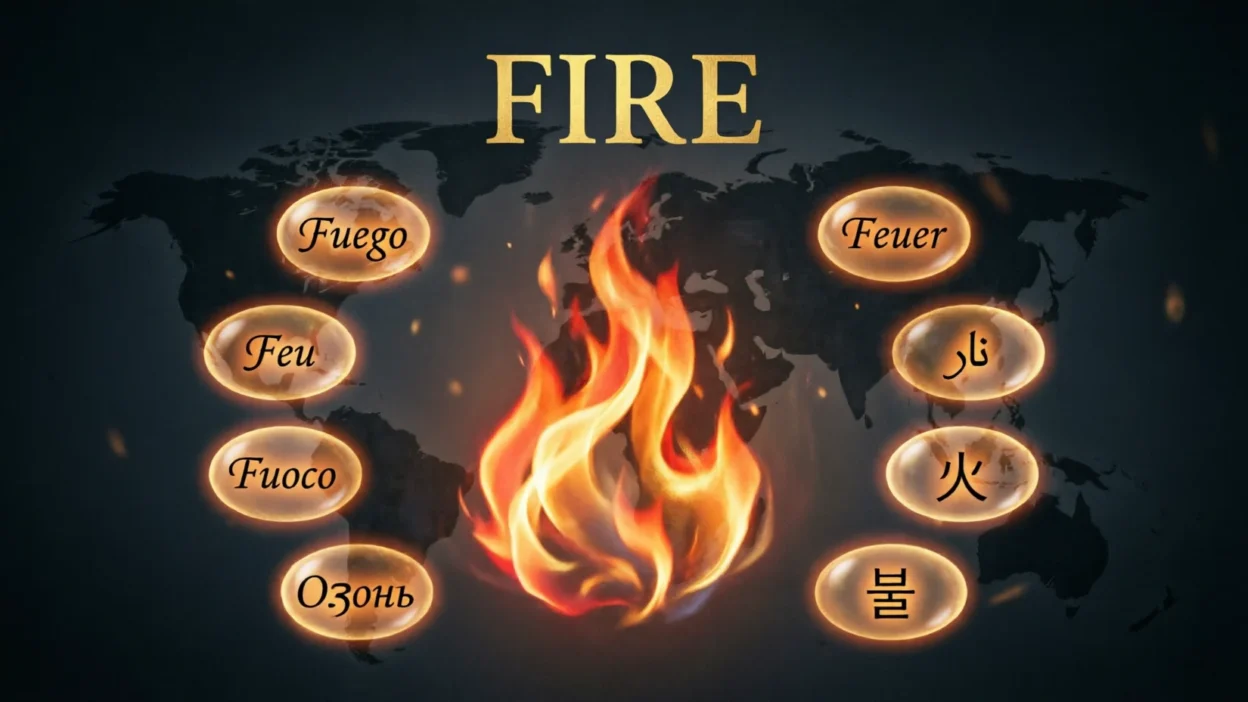
The word fire can sound completely different from one language to another. For example, Spanish uses “fuego,” French uses “feu,” German uses “Feuer,” and Italian uses “fuoco.” In several South Asian languages, including Hindi, Urdu, Punjabi, and Gujarati, closely related forms are used to express the idea of fire.
Asian languages also offer interesting differences. Mandarin Chinese uses “火,” Japanese uses “火,” and Korean uses “불.” These short words are common in everyday conversations and can also appear in compound words and expressions.
Fire Translations in European Languages
European languages have many distinct translations for fire. Romance languages such as Spanish, French, Italian, Portuguese, and Romanian use words that developed from historical Latin forms, while Germanic and Slavic languages have their own linguistic roots.
For language learners, comparing these translations is a useful way to understand vocabulary families and similarities between related languages.
Fire Around the World
Fire has a universal role in human life. People have used it for cooking, heating, lighting, manufacturing, ceremonies, and protection for thousands of years. Because of this importance, nearly every language has everyday vocabulary for describing fire and flames.
The translations in this guide show how the same basic idea can be expressed differently around the world. Learning these words can also make travel, cultural studies, creative writing, and language practice more interesting.
Common Uses of the Word “Fire”
The word “fire” can be used in several everyday situations. It may refer to a controlled flame used for cooking, a fireplace used for warmth, or an uncontrolled blaze that causes damage.
It can also have a figurative meaning. For example, English speakers may use “fire” to describe enthusiasm, determination, passion, or exceptional performance. The exact meaning depends on the sentence and cultural context.
Why Learn Fire in Different Languages?
Learning fire in different languages can help expand vocabulary and improve cultural awareness. It is especially useful for students who are studying foreign languages and writers who want accurate words for international settings.
It can also be useful for travelers. Knowing basic words such as fire, water, food, and help can make communication easier when visiting another country.
Tips for Learning Fire Translations
Start by memorizing a few languages rather than trying to learn all 70 words at once. Practice the pronunciation aloud and connect each word with a simple mental image.
You can also write each translation in a notebook and create short sentences with it. Repetition and real-life examples make unfamiliar vocabulary much easier to remember.
Conclusion
Learning fire in different languages is a simple but interesting way to explore vocabulary and cultures around the world. From “fuego” in Spanish and “feu” in French to “火” in Chinese and “آگ” in Urdu, each language gives this universal concept its own unique form.
FAQs:
1. How do you say fire in different languages?
Fire has many translations, including “fuego” in Spanish, “feu” in French, “Feuer” in German, “fuoco” in Italian, “آگ” in Urdu, “आग” in Hindi, “火” in Chinese, and “불” in Korean.
2. What is the word for fire in 70 languages?
There are many different words for fire across the world’s languages. This guide provides 70 examples, including their native forms, easy pronunciations, and practical example sentences.
3. How do you say fire in Spanish?
The Spanish word for fire is “fuego.” It is pronounced approximately “FWEH-go.”
4. How do you say fire in Japanese?
The common Japanese word for fire is “火,” pronounced “hi.” The word can be used in everyday contexts involving flames or fire.
5. What is fire called in Hindi and Urdu?
In Hindi, fire is “आग” (aag), while in Urdu it is “آگ” (aag). Both words are pronounced approximately like the English word “aag.”

Anthony Dylan is a language enthusiast and content writer at LingoMean, where he helps readers understand what to say in different situations. He creates clear, practical, and engaging guides that improve communication, confidence, and everyday conversations.