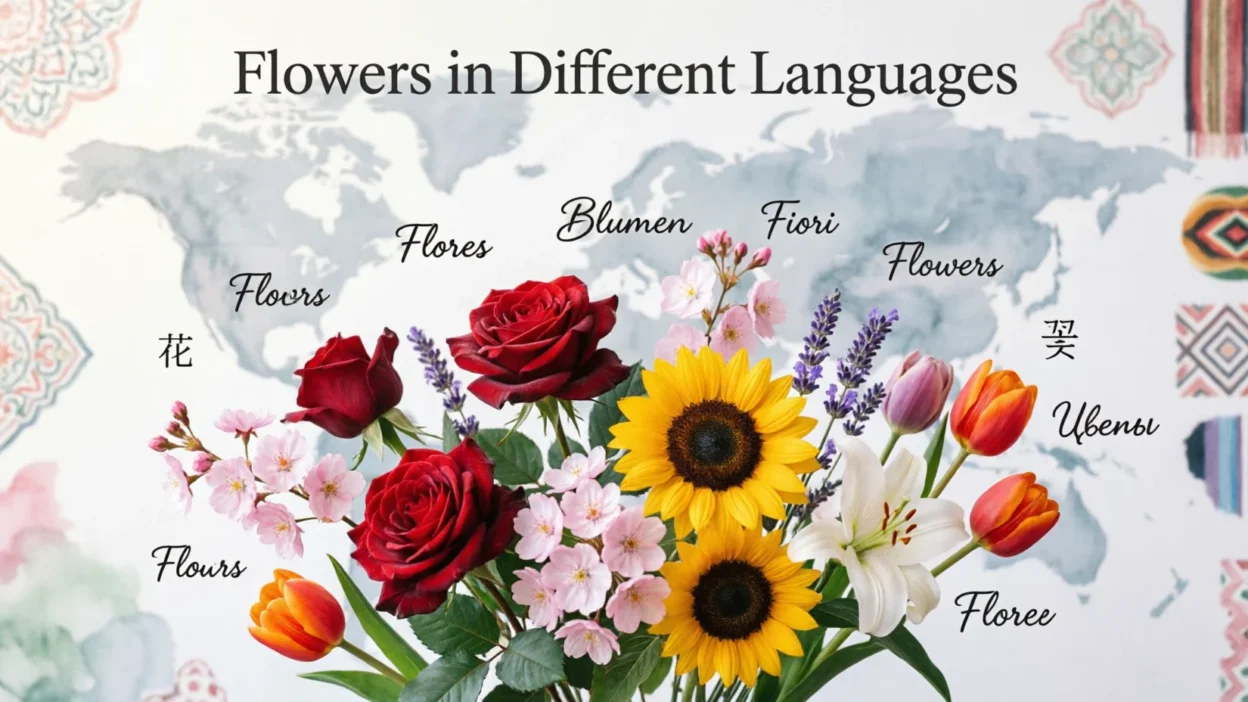
Flowers are loved in almost every culture, but the word used to describe them changes from one language to another.
Learning flowers in different languages is a simple and interesting way to explore vocabulary, culture, and the beauty of languages around the world.
If you want to know how to say flowers in different languages, are researching flowers in all languages, or simply want to discover common flowers translations, this guide gives you 70 useful examples in one place.
The table below includes the native word for “flowers,” an easy English pronunciation, and a short everyday sentence with its English meaning. These flowers around the world translations can be useful for students, travelers, writers, language learners, and anyone interested in multilingual vocabulary.
Flowers in Different Languages
| # | Language | Native Phrase | English Pronunciation | Example Sentence | English Meaning |
|---|---|---|---|---|---|
| 1 | Spanish | Flores | FLO-res | Las flores son hermosas. | The flowers are beautiful. |
| 2 | French | Fleurs | FLUR | Les fleurs sont magnifiques. | The flowers are beautiful. |
| 3 | German | Blumen | BLOO-men | Die Blumen sind schön. | The flowers are beautiful. |
| 4 | Italian | Fiori | FYOH-ree | I fiori sono belli. | The flowers are beautiful. |
| 5 | Portuguese | Flores | FLOH-res | As flores são lindas. | The flowers are beautiful. |
| 6 | Dutch | Bloemen | BLOO-men | De bloemen zijn mooi. | The flowers are beautiful. |
| 7 | Swedish | Blommor | BLOM-mor | Blommorna är vackra. | The flowers are beautiful. |
| 8 | Danish | Blomster | BLOM-stah | Blomsterne er smukke. | The flowers are beautiful. |
| 9 | Norwegian | Blomster | BLOM-ster | Blomstene er vakre. | The flowers are beautiful. |
| 10 | Finnish | Kukkia | KOOK-kee-ah | Kukat ovat kauniita. | The flowers are beautiful. |
| 11 | Icelandic | Blóm | BLOHM | Blómin eru falleg. | The flowers are beautiful. |
| 12 | Irish | Bláthanna | BLAW-hah-nah | Tá na bláthanna go hálainn. | The flowers are beautiful. |
| 13 | Welsh | Blodau | BLOH-dye | Mae’r blodau’n hardd. | The flowers are beautiful. |
| 14 | Scottish Gaelic | Flùraichean | FLOO-ree-akh-an | Tha na flùraichean àlainn. | The flowers are beautiful. |
| 15 | Polish | Kwiaty | KVYA-tih | Kwiaty są piękne. | The flowers are beautiful. |
| 16 | Czech | Květiny | KVYEH-tee-nih | Květiny jsou krásné. | The flowers are beautiful. |
| 17 | Slovak | Kvety | KVEH-tih | Kvety sú krásne. | The flowers are beautiful. |
| 18 | Slovenian | Rože | ROH-zheh | Rože so lepe. | The flowers are beautiful. |
| 19 | Croatian | Cvijeće | TSVEE-yeh-cheh | Cvijeće je lijepo. | The flowers are beautiful. |
| 20 | Serbian | Цвеће | TSVET-cheh | Цвеће је лепо. | The flowers are beautiful. |
| 21 | Bosnian | Cvijeće | TSVEE-yeh-cheh | Cvijeće je lijepo. | The flowers are beautiful. |
| 22 | Bulgarian | Цветя | TSVET-yah | Цветята са красиви. | The flowers are beautiful. |
| 23 | Macedonian | Цвеќиња | TSVET-kyeen-yah | Цвеќињата се убави. | The flowers are beautiful. |
| 24 | Russian | Цветы | TSVYEH-tih | Цветы очень красивые. | The flowers are very beautiful. |
| 25 | Ukrainian | Квіти | KVEE-tih | Квіти дуже красиві. | The flowers are very beautiful. |
| 26 | Belarusian | Кветкі | KVYET-kee | Кветкі вельмі прыгожыя. | The flowers are very beautiful. |
| 27 | Lithuanian | Gėlės | GAY-les | Gėlės yra gražios. | The flowers are beautiful. |
| 28 | Latvian | Ziedi | ZYEH-dee | Ziedi ir skaisti. | The flowers are beautiful. |
| 29 | Estonian | Lilled | LIL-led | Lilled on ilusad. | The flowers are beautiful. |
| 30 | Hungarian | Virágok | VEE-rah-gok | A virágok szépek. | The flowers are beautiful. |
| 31 | Romanian | Flori | FLOR-ee | Florile sunt frumoase. | The flowers are beautiful. |
| 32 | Greek | Λουλούδια | loo-LOO-dyah | Τα λουλούδια είναι όμορφα. | The flowers are beautiful. |
| 33 | Albanian | Lule | LOO-leh | Lulet janë të bukura. | The flowers are beautiful. |
| 34 | Armenian | Ծաղիկներ | tsah-GHEEK-ner | Ծաղիկները գեղեցիկ են։ | The flowers are beautiful. |
| 35 | Georgian | ყვავილები | qvah-vee-LEH-bee | ყვავილები ლამაზია. | The flowers are beautiful. |
| 36 | Turkish | Çiçekler | chee-CHEK-ler | Çiçekler çok güzel. | The flowers are very beautiful. |
| 37 | Azerbaijani | Çiçəklər | chee-CHAK-lar | Çiçəklər çox gözəldir. | The flowers are very beautiful. |
| 38 | Persian | گلها | gol-HA | گلها زیبا هستند. | The flowers are beautiful. |
| 39 | Arabic | زهور | zoo-HOOR | الزهور جميلة. | The flowers are beautiful. |
| 40 | Hebrew | פרחים | prah-HEEM | הפרחים יפים. | The flowers are beautiful. |
| 41 | Hindi | फूल | PHOOL | फूल बहुत सुंदर हैं। | The flowers are very beautiful. |
| 42 | Urdu | پھول | PHOOL | پھول بہت خوبصورت ہیں۔ | The flowers are very beautiful. |
| 43 | Bengali | ফুল | PHOOL | ফুলগুলো খুব সুন্দর। | The flowers are very beautiful. |
| 44 | Punjabi | ਫੁੱਲ | FOOL | ਫੁੱਲ ਬਹੁਤ ਸੋਹਣੇ ਹਨ। | The flowers are very beautiful. |
| 45 | Gujarati | ફૂલો | FOO-lo | ફૂલો ખૂબ સુંદર છે. | The flowers are very beautiful. |
| 46 | Marathi | फुले | FOO-leh | फुले खूप सुंदर आहेत. | The flowers are very beautiful. |
| 47 | Nepali | फूलहरू | PHOOL-ha-roo | फूलहरू धेरै राम्रा छन्। | The flowers are very beautiful. |
| 48 | Sinhala | මල් | MAL | මල් ලස්සනයි. | The flowers are beautiful. |
| 49 | Tamil | பூக்கள் | POOK-kal | பூக்கள் அழகாக உள்ளன. | The flowers are beautiful. |
| 50 | Telugu | పువ్వులు | POO-vvoo-loo | పువ్వులు చాలా అందంగా ఉన్నాయి. | The flowers are very beautiful. |
| 51 | Kannada | ಹೂವುಗಳು | HOO-voo-ga-loo | ಹೂವುಗಳು ಸುಂದರವಾಗಿವೆ. | The flowers are beautiful. |
| 52 | Malayalam | പൂക്കൾ | POO-kal | പൂക്കൾ മനോഹരമാണ്. | The flowers are beautiful. |
| 53 | Thai | ดอกไม้ | dok-MAI | ดอกไม้สวยมาก | The flowers are very beautiful. |
| 54 | Vietnamese | Hoa | HWA | Những bông hoa rất đẹp. | The flowers are very beautiful. |
| 55 | Indonesian | Bunga | BOONG-ah | Bunga-bunga itu indah. | The flowers are beautiful. |
| 56 | Malay | Bunga | BOONG-ah | Bunga-bunga itu cantik. | The flowers are beautiful. |
| 57 | Filipino | Mga bulaklak | muh-ngah boo-LAK-lak | Magaganda ang mga bulaklak. | The flowers are beautiful. |
| 58 | Javanese | Kembang | KEM-bang | Kembang iku ayu. | The flowers are beautiful. |
| 59 | Chinese (Mandarin) | 花 | HWA | 这些花很漂亮。 | These flowers are beautiful. |
| 60 | Japanese | 花 | HAH-nah | 花がきれいです。 | The flowers are beautiful. |
| 61 | Korean | 꽃 | KKOT | 꽃이 아름다워요. | The flowers are beautiful. |
| 62 | Mongolian | Цэцэг | TSEH-tseg | Цэцэг маш сайхан. | The flowers are very beautiful. |
| 63 | Kazakh | Гүлдер | GOOL-der | Гүлдер өте әдемі. | The flowers are very beautiful. |
| 64 | Uzbek | Gullar | GOOL-lar | Gullar juda chiroyli. | The flowers are very beautiful. |
| 65 | Swahili | Maua | MAH-oo-ah | Maua ni mazuri. | The flowers are beautiful. |
| 66 | Afrikaans | Blomme | BLOM-eh | Die blomme is mooi. | The flowers are beautiful. |
| 67 | Zulu | Izimbali | ee-ZAM-bee-lee | Izimbali zinhle. | The flowers are beautiful. |
| 68 | Xhosa | Iintyatyambo | een-tyah-TYAM-bo | Iintyatyambo zintle. | The flowers are beautiful. |
| 69 | Haitian Creole | Flè | FLEH | Flè yo bèl. | The flowers are beautiful. |
| 70 | Esperanto | Floroj | flo-ROY | La floroj estas belaj. | The flowers are beautiful. |
How to Say Flowers in Different Languages
The word for flowers varies considerably across languages. Some languages use a plural form that directly means “flowers,” while others use a collective or context-dependent form.
For example, flores is used in Spanish and Portuguese, while fiori is the Italian word. In German and Dutch, the words Blumen and bloemen are closely related in sound.
In many Asian languages, the word can be shorter. Mandarin Chinese uses 花 (huā), Japanese uses 花 (hana), and Korean uses 꽃 (kkot).
Flowers in All Languages: Cultural Differences
Flowers have important cultural meanings around the world. They can represent love, friendship, celebration, remembrance, beauty, and respect.
The vocabulary used for flowers can also reveal interesting features of each language. Some languages have very specific terms for individual flowers, while others commonly use a general word when talking about flowers.
Learning flowers in all languages can therefore be more than memorizing vocabulary. It can be a small introduction to how different communities describe nature.
Flowers Translations for Language Learners
If you are studying a new language, learning everyday nature words such as “flowers” can help expand your vocabulary quickly.
The native phrase is the most important part to remember, while the pronunciation guide can help English speakers say the word more comfortably. However, pronunciation guides are only approximations, so listening to native speakers is useful for mastering exact pronunciation.
These flowers translations are also useful for students, travelers, writers, and anyone interested in multilingual vocabulary.
Flowers Around the World
Flowers appear in gardens, homes, festivals, ceremonies, artwork, and everyday conversations across the globe.
From European languages such as French, German, and Italian to Asian languages such as Hindi, Japanese, Korean, and Mandarin, the word for flowers takes many forms.
Despite these linguistic differences, flowers have a remarkably universal connection with beauty and nature.
Why Learn the Word Flowers in Other Languages?
Learning how to say “flowers” in another language can be useful when traveling, studying languages, communicating with international friends, or exploring different cultures.
It can also be helpful when writing multilingual content or learning vocabulary based on familiar subjects. Because flowers are found in almost every part of the world, they provide an easy and memorable vocabulary topic.
Conclusion
Learning flowers in different languages is a simple way to discover how people around the world describe one of nature’s most beautiful creations. From flores in Spanish to fiori in Italian, Blumen in German, maua in Swahili, and 花 in Japanese and Mandarin, every language gives flowers its own unique sound.
This list of 70 languages makes it easy to explore flowers in all languages, understand common translations, and learn how to say flowers around the world. If you are studying a language or simply curious about international vocabulary, these words offer a beautiful starting point.
FAQs:
1. How do you say flowers in different languages?
“Flowers” is flores in Spanish, fleurs in French, Blumen in German, fiori in Italian, maua in Swahili, and hoa in Vietnamese.
2. What is the word for flowers in Spanish?
The Spanish word for flowers is flores, pronounced approximately FLO-res.
3. How do you say flowers in Japanese?
Flowers in Japanese is 花 (hana), pronounced approximately HAH-nah.
4. What is flowers in Hindi and Urdu?
The word for flowers is फूल (phool) in Hindi and پھول (phool) in Urdu.
5. What is the word for flowers in French?
Flowers in French is fleurs, pronounced approximately FLUR.

Brandon Cody is the Administrator of LingoMean, a platform dedicated to helping people discover the right words for every situation. He oversees content quality, website management, and user experience, ensuring readers receive accurate, practical, and easy-to-understand communication guidance.