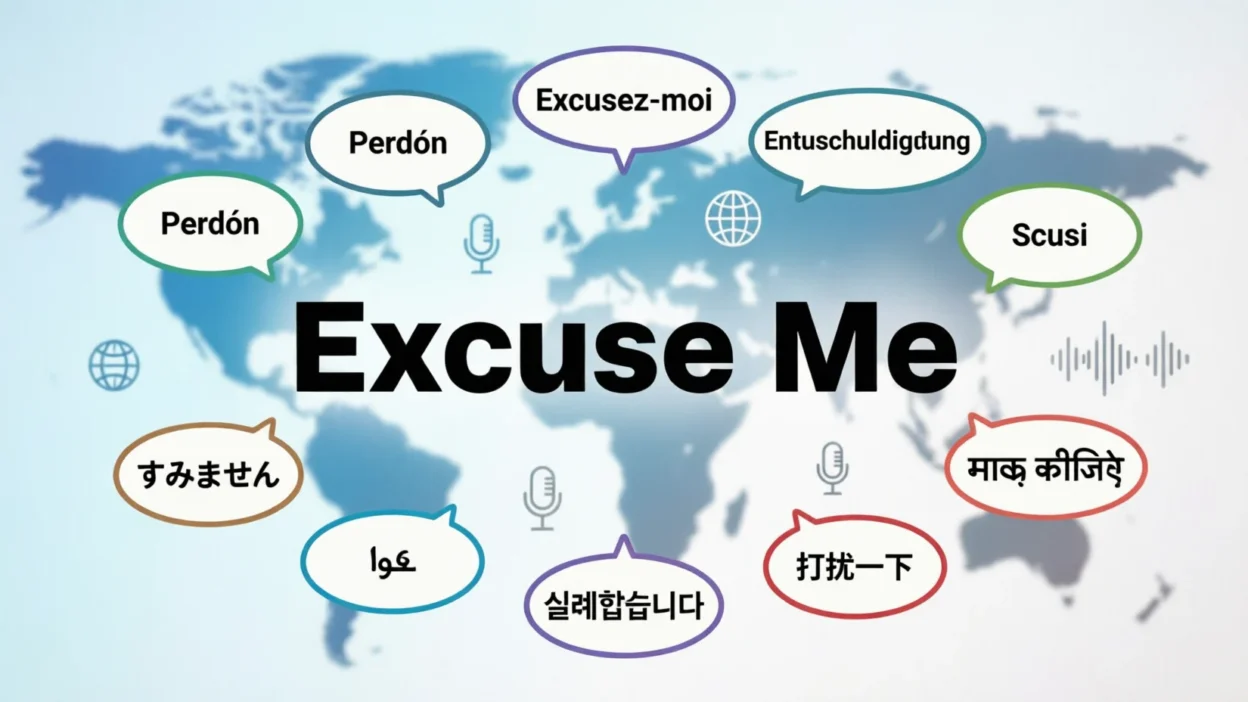
Knowing how to say excuse me in different languages is useful when traveling, learning a new language, or communicating with people from different cultures. “Excuse me” can be used for several purposes, such as politely getting someone’s attention, apologizing for a small interruption, asking someone to move, or requesting clarification.
Although the basic meaning is similar, languages around the world use different expressions depending on the situation and level of formality. Some languages have one common phrase, while others use different expressions for formal and informal situations.
If you are searching for excuse me in all languages, wondering how to say excuse me in different languages, or looking for accurate excuse me translations, this guide provides 70 useful examples. The table includes the native phrase, an easy English pronunciation, a short real-life example, and its English meaning.
| # | Language | Native Phrase | English Pronunciation | Example Sentence | English Meaning |
|---|---|---|---|---|---|
| 1 | Spanish | Perdón | pehr-DON | Perdón, ¿puedo pasar? | Excuse me, may I pass? |
| 2 | French | Excusez-moi | ex-koo-zay-MWAH | Excusez-moi, où est la gare ? | Excuse me, where is the station? |
| 3 | German | Entschuldigung | ent-SHOOL-dee-goong | Entschuldigung, können Sie mir helfen? | Excuse me, can you help me? |
| 4 | Italian | Scusi | SKOO-zee | Scusi, dov’è il bagno? | Excuse me, where is the bathroom? |
| 5 | Portuguese | Com licença | kohm lee-SEN-sah | Com licença, posso passar? | Excuse me, may I pass? |
| 6 | Dutch | Pardon | par-DON | Pardon, mag ik erlangs? | Excuse me, may I get past? |
| 7 | Swedish | Ursäkta | oor-SHEK-tah | Ursäkta, var ligger hotellet? | Excuse me, where is the hotel? |
| 8 | Danish | Undskyld | OON-skool | Undskyld, hvor er stationen? | Excuse me, where is the station? |
| 9 | Norwegian | Unnskyld | OON-shill | Unnskyld, hvor er toalettet? | Excuse me, where is the restroom? |
| 10 | Finnish | Anteeksi | AHN-tehk-see | Anteeksi, missä asema on? | Excuse me, where is the station? |
| 11 | Icelandic | Afsakið | AV-sah-kith | Afsakið, hvar er þetta? | Excuse me, where is this? |
| 12 | Irish | Gabh mo leithscéal | gov muh LEH-shkale | Gabh mo leithscéal, cá bhfuil an stáisiún? | Excuse me, where is the station? |
| 13 | Welsh | Esgusodwch fi | es-guh-SOD-oo-kh vee | Esgusodwch fi, ble mae’r orsaf? | Excuse me, where is the station? |
| 14 | Polish | Przepraszam | psheh-PRAH-sham | Przepraszam, gdzie jest hotel? | Excuse me, where is the hotel? |
| 15 | Czech | Promiňte | PROH-min-tyeh | Promiňte, kde je nádraží? | Excuse me, where is the station? |
| 16 | Slovak | Prepáčte | preh-PAACH-teh | Prepáčte, kde je stanica? | Excuse me, where is the station? |
| 17 | Slovenian | Oprostite | oh-proh-STEE-teh | Oprostite, kje je postaja? | Excuse me, where is the station? |
| 18 | Croatian | Oprostite | oh-PROH-stee-teh | Oprostite, gdje je hotel? | Excuse me, where is the hotel? |
| 19 | Serbian | Извините | iz-vee-NEE-teh | Извините, где је станица? | Excuse me, where is the station? |
| 20 | Bosnian | Izvinite | iz-vee-NEE-teh | Izvinite, gdje je banka? | Excuse me, where is the bank? |
| 21 | Bulgarian | Извинете | iz-vee-NEH-teh | Извинете, къде е хотелът? | Excuse me, where is the hotel? |
| 22 | Macedonian | Извинете | iz-vee-NEH-teh | Извинете, каде е станицата? | Excuse me, where is the station? |
| 23 | Russian | Извините | iz-vee-NEE-teh | Извините, где метро? | Excuse me, where is the metro? |
| 24 | Ukrainian | Вибачте | vih-BAHCH-teh | Вибачте, де вокзал? | Excuse me, where is the station? |
| 25 | Belarusian | Прабачце | prah-BAHCH-tseh | Прабачце, дзе гатэль? | Excuse me, where is the hotel? |
| 26 | Lithuanian | Atsiprašau | at-see-prah-SHOW | Atsiprašau, kur stotis? | Excuse me, where is the station? |
| 27 | Latvian | Atvainojiet | at-vai-NOH-yet | Atvainojiet, kur yra viesnīca? | Excuse me, where is the hotel? |
| 28 | Estonian | Vabandust | VAH-bahn-doost | Vabandust, kus on jaam? | Excuse me, where is the station? |
| 29 | Hungarian | Elnézést | el-NAY-zhasht | Elnézést, hol van a pályaudvar? | Excuse me, where is the station? |
| 30 | Romanian | Scuzați-mă | skoo-ZAHTS-muh | Scuzați-mă, unde este hotelul? | Excuse me, where is the hotel? |
| 31 | Greek | Συγγνώμη | see-GHNOH-mee | Συγγνώμη, πού είναι το ξενοδοχείο; | Excuse me, where is the hotel? |
| 32 | Albanian | Më falni | muh FAL-nee | Më falni, ku është stacioni? | Excuse me, where is the station? |
| 33 | Armenian | Ներեցեք | neh-reh-TSEK | Ներեցեք, որտե՞ղ է կայարանը։ | Excuse me, where is the station? |
| 34 | Georgian | უკაცრავად | oo-kats-RAH-vahd | უკაცრავად, სად არის სასტუმრო? | Excuse me, where is the hotel? |
| 35 | Turkish | Affedersiniz | af-feh-der-see-NEEZ | Affedersiniz, istasyon nerede? | Excuse me, where is the station? |
| 36 | Azerbaijani | Bağışlayın | bah-GHISH-lah-yin | Bağışlayın, stansiya haradadır? | Excuse me, where is the station? |
| 37 | Persian | ببخشید | beb-khe-SHEED | ببخشید، ایستگاه کجاست؟ | Excuse me, where is the station? |
| 38 | Arabic | عفوا | AF-wan | عفوا، أين المحطة؟ | Excuse me, where is the station? |
| 39 | Hebrew | סליחה | slee-KHAH | סליחה, איפה התחנה? | Excuse me, where is the station? |
| 40 | Hindi | माफ़ कीजिए | maaf KEE-jee-yeh | माफ़ कीजिए, स्टेशन कहाँ है? | Excuse me, where is the station? |
| 41 | Urdu | معاف کیجیے | maaf kee-JEE-yeh | معاف کیجیے، اسٹیشن کہاں ہے؟ | Excuse me, where is the station? |
| 42 | Bengali | মাফ করবেন | maf KOR-ben | মাফ করবেন, স্টেশন কোথায়? | Excuse me, where is the station? |
| 43 | Punjabi | ਮਾਫ਼ ਕਰਨਾ | maaf KAR-naa | ਮਾਫ਼ ਕਰਨਾ, ਸਟੇਸ਼ਨ ਕਿੱਥੇ ਹੈ? | Excuse me, where is the station? |
| 44 | Gujarati | માફ કરશો | maaf KAR-sho | માફ કરશો, સ્ટેશન ક્યાં છે? | Excuse me, where is the station? |
| 45 | Marathi | माफ करा | maaf KA-raa | माफ करा, स्टेशन कुठे आहे? | Excuse me, where is the station? |
| 46 | Nepali | माफ गर्नुहोस् | maaf gar-noos | माफ गर्नुहोस्, स्टेशन कहाँ छ? | Excuse me, where is the station? |
| 47 | Sinhala | සමාවෙන්න | sah-mah-WEN-nah | සමාවෙන්න, දුම්රිය ස්ථානය කොහෙද? | Excuse me, where is the station? |
| 48 | Tamil | மன்னிக்கவும் | man-nee-KAH-vum | மன்னிக்கவும், நிலையம் எங்கே? | Excuse me, where is the station? |
| 49 | Telugu | క్షమించండి | ksha-min-CHUN-dee | క్షమించండి, స్టేషన్ ఎక్కడ ఉంది? | Excuse me, where is the station? |
| 50 | Kannada | ಕ್ಷಮಿಸಿ | ksha-MEE-see | ಕ್ಷಮಿಸಿ, ನಿಲ್ದಾಣ ಎಲ್ಲಿದೆ? | Excuse me, where is the station? |
| 51 | Malayalam | ക്ഷമിക്കണം | ksha-MIK-kanam | ക്ഷമിക്കണം, സ്റ്റേഷൻ എവിടെയാണ്? | Excuse me, where is the station? |
| 52 | Thai | ขอโทษ | khaw-TOHT | ขอโทษ สถานีอยู่ที่ไหน? | Excuse me, where is the station? |
| 53 | Vietnamese | Xin lỗi | sin LOY | Xin lỗi, nhà ga ở đâu? | Excuse me, where is the station? |
| 54 | Indonesian | Permisi | per-MEE-see | Permisi, stasiun di mana? | Excuse me, where is the station? |
| 55 | Malay | Maafkan saya | ma-AF-kan SAH-yah | Maafkan saya, di mana stesen? | Excuse me, where is the station? |
| 56 | Filipino | Excuse me | eks-KYOOZ mee | Excuse me, nasaan ang istasyon? | Excuse me, where is the station? |
| 57 | Javanese | Nuwun sewu | NOO-woon SEH-woo | Nuwun sewu, stasiun wonten pundi? | Excuse me, where is the station? |
| 58 | Mandarin Chinese | 不好意思 | boo-HAOW ee-SUH | 不好意思,车站在哪里? | Excuse me, where is the station? |
| 59 | Japanese | すみません | soo-mee-mah-SEN | すみません、駅はどこですか? | Excuse me, where is the station? |
| 60 | Korean | 실례합니다 | shil-lyeh-HAM-nee-dah | 실례합니다, 역이 어디예요? | Excuse me, where is the station? |
| 61 | Mongolian | Уучлаарай | oo-CHLAH-rai | Уучлаарай, буудал хаана вэ? | Excuse me, where is the station? |
| 62 | Kazakh | Кешіріңіз | keh-SHEE-ree-NIZ | Кешіріңіз, станция қайда? | Excuse me, where is the station? |
| 63 | Uzbek | Kechirasiz | keh-chee-rah-SEEZ | Kechirasiz, bekat qayerda? | Excuse me, where is the station? |
| 64 | Swahili | Samahani | sah-mah-HAH-nee | Samahani, kituo kiko wapi? | Excuse me, where is the station? |
| 65 | Afrikaans | Verskoon my | fer-SKOON may | Verskoon my, waar is die stasie? | Excuse me, where is the station? |
| 66 | Zulu | Uxolo | oo-KHOH-loh | Uxolo, isiteshi sikuphi? | Excuse me, where is the station? |
| 67 | Xhosa | Uxolo | oo-KHOH-loh | Uxolo, siphi isikhululo? | Excuse me, where is the station? |
| 68 | Haitian Creole | Eskize m | es-kee-ZEH m | Eskize m, ki kote estasyon an ye? | Excuse me, where is the station? |
| 69 | Esperanto | Pardonu | par-DOH-noo | Pardonu, kie estas la stacidomo? | Excuse me, where is the station? |
| 70 | Latin | Excusa me | eks-KOO-sah meh | Excusa me, ubi est statio? | Excuse me, where is the station? |
What Does “Excuse Me” Mean?
“Excuse me” is a polite expression used in several everyday situations. You might say it when getting someone’s attention, asking a question, interrupting a conversation, apologizing for a minor mistake, or trying to move through a crowded place.
The exact translation depends on the language and context. A phrase that literally means “forgive me” or “pardon me” can serve the same purpose as “excuse me” in English.
How to Say ?
The best way to say excuse me in different languages depends on what you want to communicate.
For example, Spanish speakers commonly use perdón, while Italian uses scusi in formal situations. Japanese speakers often say sumimasen, which can be used to get attention, apologize, or politely acknowledge an inconvenience.
In Mandarin Chinese, bù hǎo yìsi is a common polite expression. In Indonesian, permisi is especially useful when asking to pass or getting someone’s attention.
Excuse Me in All Languages for Travel
Knowing a polite expression can make communication easier while traveling. If you need directions, want to pass through a crowd, or need someone’s attention, using the local phrase can make your request sound more respectful.
For travelers, it is useful to learn both the pronunciation and the situation in which the expression is normally used.
Excuse Me Translations and Cultural Differences
Not every translation of “excuse me” works in exactly the same situations.
Some languages have separate expressions for apologizing and asking someone to move. Others use one polite expression for several situations. Formality can also affect the correct word choice.
That is why learning the context along with the translation is helpful. A phrase that sounds natural among friends may not be the best choice when speaking with a stranger or someone older.
Why Learn ?
Learning polite expressions is one of the easiest ways to make your communication more respectful.
The phrase “excuse me” is particularly useful because it appears frequently in everyday conversations. Knowing it in another language can help you start conversations, ask questions, navigate public places, and handle small social situations more comfortably.
Excuse Me Around the World
The expressions in this guide show how widely the concept of politeness is represented in language. From perdón in Spanish to sumimasen in Japanese and samahani in Swahili, each language has its own way of expressing politeness and consideration.
These differences make excuse me around the world an interesting language-learning topic and a useful phrase for anyone interested in international communication.
Conclusion
Learning excuse me in different languages is a practical way to improve communication and understand cultural differences. While the exact words vary, the purpose is usually similar: showing politeness when getting attention, asking for help, interrupting, apologizing, or moving through a crowded area.
This guide provides 70 excuse me translations with native phrases, easy pronunciations, and real-life examples. If you are traveling, studying languages, or simply curious about excuse me in all languages, these expressions can help you communicate more confidently and respectfully.
FAQs:
1. How do you say “excuse me” in Spanish?
“Excuse me” in Spanish is commonly perdón, pronounced approximately pehr-DON. Disculpe is another polite option, especially in formal situations.
2. What is “excuse me” in French?
“Excuse me” in French is excusez-moi, pronounced approximately ex-koo-zay-MWAH. It is commonly used to politely get someone’s attention or ask a question.
3. How do you say “excuse me” in Japanese?
“Excuse me” in Japanese is commonly すみません (sumimasen), pronounced approximately soo-mee-mah-SEN. It can be used to get attention, apologize, or express polite acknowledgment.
4. What is the difference between “excuse me” and “sorry”?
“Excuse me” is often used before an interruption, question, request, or when getting someone’s attention. “Sorry” more directly expresses an apology. However, many languages use expressions that can cover both meanings depending on context.
5. What is the easiest way to learn “excuse me” in different languages?
Start by learning the native phrase and its pronunciation, then practice it in a simple real-life sentence. Understanding when the expression is appropriate is just as important as memorizing the translation.

Brandon Cody is the Administrator of LingoMean, a platform dedicated to helping people discover the right words for every situation. He oversees content quality, website management, and user experience, ensuring readers receive accurate, practical, and easy-to-understand communication guidance.