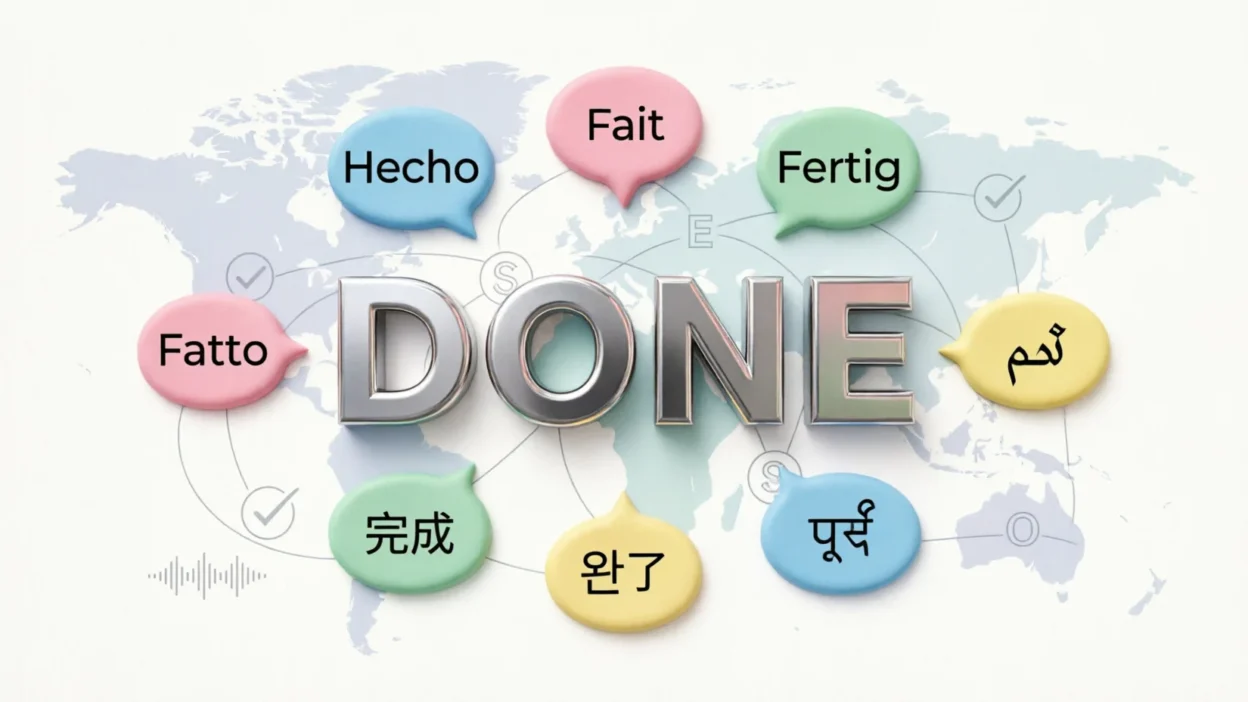
The word “done” is one of the most useful everyday expressions in any language. It can mean that a task has been completed, something is finished, or a person is ready to move on to the next step.
Learning done in different languages is useful for travelers, language learners, students, and anyone interested in how everyday words change across cultures.
If you are searching for done in all languages, wondering how to say done in different languages, or looking for accurate done translations, this guide gives you 70 examples in one place. Each entry includes the native phrase, an easy English pronunciation, and a practical example sentence.
The meaning of “done” can change slightly depending on context. For example, it may describe a completed task, finished food, or someone being ready. The translations below focus mainly on the common meaning of completed or finished.
Done in Different Languages
| # | Language | Native Phrase | English Pronunciation | Example Sentence | English Meaning |
|---|---|---|---|---|---|
| 1 | Spanish | Hecho | EH-cho | El trabajo está hecho. | The work is done. |
| 2 | French | Fait | feh | Le travail est fait. | The work is done. |
| 3 | German | Fertig | FAIR-tig | Die Arbeit ist fertig. | The work is done. |
| 4 | Italian | Fatto | FAHT-toh | Il lavoro è fatto. | The work is done. |
| 5 | Portuguese | Feito | FAY-too | O trabalho está feito. | The work is done. |
| 6 | Dutch | Klaar | klahr | Het werk is klaar. | The work is done. |
| 7 | Swedish | Klar | klahr | Arbetet är klart. | The work is done. |
| 8 | Danish | Færdig | FAIR-dee | Arbejdet er færdigt. | The work is done. |
| 9 | Norwegian | Ferdig | FAIR-dee | Arbeidet er ferdig. | The work is done. |
| 10 | Finnish | Valmis | VAHL-mis | Työ on valmis. | The work is done. |
| 11 | Icelandic | Búið | BOO-ith | Verkið er búið. | The work is done. |
| 12 | Irish | Déanta | JAYN-tah | Tá an obair déanta. | The work is done. |
| 13 | Welsh | Wedi gorffen | WEH-dee GOR-ven | Mae’r gwaith wedi gorffen. | The work is finished. |
| 14 | Polish | Gotowe | goh-TOH-veh | Praca jest gotowa. | The work is done. |
| 15 | Czech | Hotovo | HOH-toh-voh | Práce je hotová. | The work is done. |
| 16 | Slovak | Hotovo | HOH-toh-voh | Práca je hotová. | The work is done. |
| 17 | Slovenian | Končano | kon-CHAH-noh | Delo je končano. | The work is done. |
| 18 | Croatian | Gotovo | GOH-toh-voh | Posao je gotov. | The work is done. |
| 19 | Serbian | Готово | GOH-toh-voh | Посао је готов. | The work is done. |
| 20 | Bosnian | Gotovo | GOH-toh-voh | Posao je gotov. | The work is done. |
| 21 | Bulgarian | Готово | goh-TOH-voh | Работата е готова. | The work is done. |
| 22 | Macedonian | Готово | goh-TOH-voh | Работата е готова. | The work is done. |
| 23 | Russian | Готово | gah-TOH-vah | Работа готова. | The work is done. |
| 24 | Ukrainian | Готово | hoh-TOH-voh | Робота готова. | The work is done. |
| 25 | Belarusian | Гатова | gah-TOH-vah | Праца гатова. | The work is done. |
| 26 | Lithuanian | Padaryta | pah-dah-RIH-tah | Darbas padarytas. | The work is done. |
| 27 | Latvian | Gatavs | GAHT-vs | Darbs ir gatavs. | The work is ready. |
| 28 | Estonian | Valmis | VAHL-mis | Töö on valmis. | The work is done. |
| 29 | Hungarian | Kész | kase | A munka kész. | The work is done. |
| 30 | Romanian | Gata | GAH-tah | Treaba este gata. | The work is done. |
| 31 | Greek | Έτοιμο | EH-tee-moh | Η δουλειά είναι έτοιμη. | The work is done. |
| 32 | Albanian | E bërë | eh BUHR-eh | Puna është e bërë. | The work is done. |
| 33 | Armenian | Կատարված | kah-tah-VAHR-vats | Աշխատանքը կատարված է։ | The work is done. |
| 34 | Georgian | დასრულებული | dah-sroo-leh-BOO-lee | სამუშაო დასრულებულია. | The work is finished. |
| 35 | Turkish | Bitti | BIT-tee | İş bitti. | The work is done. |
| 36 | Azerbaijani | Hazırdır | hah-ZIR-dir | İş hazırdır. | The work is ready. |
| 37 | Persian | تمام شده | tah-MOM sho-DEH | کار تمام شده است. | The work is done. |
| 38 | Arabic | تمّ | tamm | تمّ العمل. | The work is done. |
| 39 | Hebrew | נגמר | nig-MAR | העבודה נגמרה. | The work is finished. |
| 40 | Hindi | हो गया | hoh GAH-yah | काम हो गया। | The work is done. |
| 41 | Urdu | ہو گیا | hoh GAH-yah | کام ہو گیا۔ | The work is done. |
| 42 | Bengali | হয়ে গেছে | HOY-eh ge-che | কাজ হয়ে গেছে। | The work is done. |
| 43 | Punjabi | ਹੋ ਗਿਆ | hoh GAH-ya | ਕੰਮ ਹੋ ਗਿਆ। | The work is done. |
| 44 | Gujarati | થઈ ગયું | thai GAH-yoo | કામ થઈ ગયું. | The work is done. |
| 45 | Marathi | झाले | JHAH-leh | काम झाले. | The work is done. |
| 46 | Nepali | भयो | BHAH-yo | काम भयो। | The work is done. |
| 47 | Sinhala | අවසන් | ah-vah-SAN | වැඩ අවසන්. | The work is finished. |
| 48 | Tamil | முடிந்தது | moo-dhin-DAH-too | வேலை முடிந்தது. | The work is done. |
| 49 | Telugu | పూర్తయింది | POOR-tah-yin-dee | పని పూర్తయింది. | The work is done. |
| 50 | Kannada | ಮುಗಿದಿದೆ | moo-GI-di-deh | ಕೆಲಸ ಮುಗಿದಿದೆ. | The work is done. |
| 51 | Malayalam | കഴിഞ്ഞു | kah-lin-YOO | ജോലി കഴിഞ്ഞു. | The work is done. |
| 52 | Thai | เสร็จแล้ว | set LAEW | งานเสร็จแล้ว | The work is done. |
| 53 | Vietnamese | Xong | song | Công việc xong rồi. | The work is done. |
| 54 | Indonesian | Selesai | seh-leh-SAI | Pekerjaan sudah selesai. | The work is done. |
| 55 | Malay | Siap | see-AHP | Kerja sudah siap. | The work is done. |
| 56 | Filipino | Tapos na | TAH-pos nah | Tapos na ang trabaho. | The work is done. |
| 57 | Javanese | Wis rampung | wees RAHM-poong | Pakaryane wis rampung. | The work is done. |
| 58 | Chinese (Mandarin) | 完成了 | wán-chéng le | 工作完成了。 | The work is done. |
| 59 | Japanese | 終わった | oh-WAH-tah | 仕事は終わった。 | The work is done. |
| 60 | Korean | 끝났어요 | kkeun-NAHT-suh-yo | 일이 끝났어요. | The work is done. |
| 61 | Mongolian | Дууссан | DOO-sahn | Ажил дууссан. | The work is done. |
| 62 | Kazakh | Бітті | BIT-tee | Жұмыс бітті. | The work is done. |
| 63 | Uzbek | Tugadi | too-GAH-dee | Ish tugadi. | The work is done. |
| 64 | Swahili | Imekwisha | ee-meh-KWEE-shah | Kazi imekwisha. | The work is done. |
| 65 | Afrikaans | Klaar | klahr | Die werk is klaar. | The work is done. |
| 66 | Zulu | Sekuphelile | seh-koo-peh-LEE-leh | Umsebenzi usuphelile. | The work is finished. |
| 67 | Xhosa | Kugqityiwe | koo-gqee-TYEE-weh | Umsebenzi ugqityiwe. | The work is done. |
| 68 | Haitian Creole | Fè | feh | Travay la fèt. | The work is done. |
| 69 | Esperanto | Farita | fah-REE-tah | La laboro estas farita. | The work is done. |
| 70 | Latin | Factum est | FAK-toom est | Opus factum est. | The work is done. |
What Does “Done” Mean?
“Done” commonly means that an activity, task, or piece of work has been completed. For example, if someone says, “The project is done,” they mean that the project has been completed.
The word can also describe food that has finished cooking. In this situation, the translation may be different from the word used for completing a task.
Because of these different meanings, the exact translation depends on context.
How to Say Done in Different Languages
The easiest way to learn how to say done in different languages is to understand the situation in which the word is being used.
For completed work, languages often use words equivalent to “finished,” “complete,” or “ready.” In everyday conversation, some languages use a short expression equivalent to “done!” rather than a direct dictionary translation.
For example, Spanish commonly uses hecho, while German uses fertig. Japanese uses 終わった (owatta) when something has finished, while Indonesian commonly uses selesai.
Done in All Languages: Common Uses
The English word “done” can appear in several contexts:
- A task is completed.
- A project has finished.
- Food has finished cooking.
- Someone has finished an activity.
- Someone is ready to leave or continue.
- An agreement or decision has been completed.
This is why done translations should always be understood in context rather than translated word-for-word.
Done Translations Around the World
The translations for “done” show interesting differences between languages. Some languages use a word meaning “finished,” while others use a form meaning “completed,” “ready,” or “it has happened.”
For language learners, the example sentence can be just as useful as the individual translation because it shows how the expression works naturally.
Why Learn “Done” in Different Languages?
Learning everyday words such as “done” can make basic conversations easier when traveling or communicating with people from different cultures.
It is also useful for students, translators, language enthusiasts, and anyone building vocabulary. Simple words are often among the most frequently used expressions in daily conversation.
Conclusion
Learning done in different languages is a simple way to expand your everyday vocabulary and understand how different cultures express completion. The word can be translated as “finished,” “complete,” “ready,” or a similar expression depending on the language and context.
This guide provides 70 done translations with native phrases, easy pronunciations, and practical examples. If you are searching for done in all languages, learning a new language, or exploring done around the world, these examples give you a useful starting point.
FAQs:
1. How do you say “done” in Spanish?
“Done” can be translated as hecho in Spanish. For example, El trabajo está hecho means “The work is done.”
2. What is “done” in French?
In French, “done” can be fait, depending on the context. Le travail est fait means “The work is done.”
3. How do you say “done” in Hindi and Urdu?
In Hindi and Urdu, हो गया (ho gaya) and ہو گیا (ho gaya) are commonly used to express that something has been completed or is done.
4. What is the word for “done” in Japanese?
Japanese commonly uses 終わった (owatta) to say that something has finished or is done.
5. How can I learn “done” in different languages?
Start with the native phrase and pronunciation, then practice it in a short everyday sentence. This helps you understand how the translation is naturally used.

Carter Connor is a language enthusiast and content writer at LingoMean, helping readers discover what to say in everyday conversations with clear explanations, practical examples, and easy-to-understand communication tips.