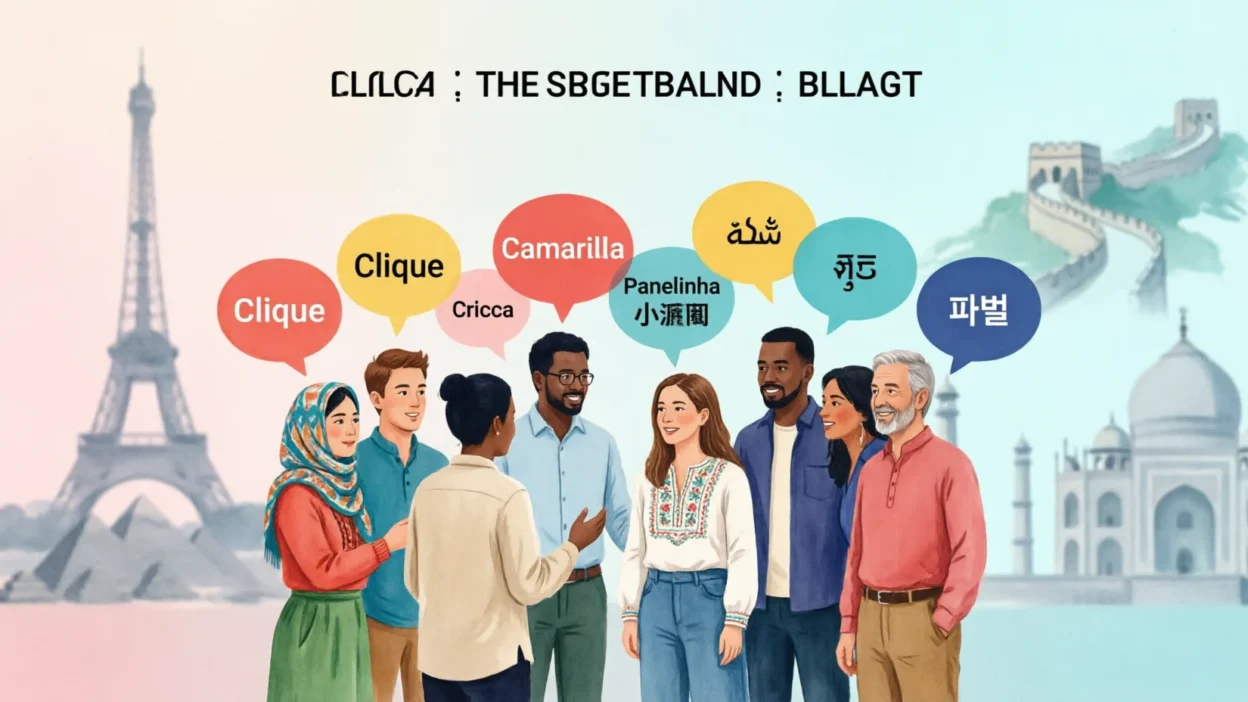
Learning clique in different languages is a useful way to expand your vocabulary and understand how different cultures describe a close-knit social group.
A clique is a small group of people who spend time together and may not easily include others.
The word is commonly used in schools, workplaces, social settings, literature, and psychology.
Many people search for clique in all languages to compare translations and improve their language skills.
Learning how to say clique in different languages is helpful for students, travelers, teachers, writers, and translators.
These clique translations are commonly found in books, news articles, social discussions, and educational materials.
While some languages have a direct equivalent of clique, others use words that mean group, circle, or exclusive group.
The table below features clique around the world in 45 popular languages, along with the native translation and an easy English pronunciation.
| Language | Native Word | English Pronunciation |
|---|---|---|
| English | Clique | Kleek |
| Spanish | Camarilla | Ka-ma-REE-ya |
| French | Clique | Kleek |
| German | Clique | Klee-kuh |
| Italian | Cricca | KREEK-ka |
| Portuguese | Panelinha | Pa-ne-LEE-nya |
| Dutch | Kliek | Kleek |
| Swedish | Klick | Klik |
| Norwegian | Klikk | Klik |
| Danish | Klik | Klik |
| Finnish | Klikki | KLIK-kee |
| Polish | Klika | KLEE-ka |
| Czech | Klika | KLEE-ka |
| Slovak | Klika | KLEE-ka |
| Hungarian | Klikk | Klik |
| Romanian | Clică | KLEE-kuh |
| Greek | Κλίκα | KLEE-ka |
| Russian | Клика | KLEE-ka |
| Ukrainian | Кліка | KLEE-ka |
| Turkish | Klik | Klik |
| Arabic | شلة | Shil-la |
| Hebrew | קליקה | Klee-ka |
| Persian | دار و دسته | Daar-o Das-teh |
| Hindi | गुट | Goot |
| Urdu | ٹولہ | To-la |
| Bengali | গোষ্ঠী | Gosh-thee |
| Punjabi | ਟੋਲੀ | To-lee |
| Gujarati | ટોળકી | To-la-kee |
| Marathi | टोळी | To-lee |
| Tamil | சிறு குழு | Si-ru Ku-zhu |
| Telugu | చిన్న వర్గం | Chin-na Var-gam |
| Kannada | ಗುಂಪು | Goom-poo |
| Malayalam | കൂട്ടം | Koo-ttam |
| Chinese (Mandarin) | 小圈子 | Shyao Chyuan Dz |
| Japanese | 派閥 | Ha-batsu |
| Korean | 파벌 | Pa-beol |
| Thai | กลุ่มพวกพ้อง | Gloom Poo-ak Pong |
| Vietnamese | Phe nhóm | Fe Nyom |
| Indonesian | Kelompok kecil | Ke-lom-pok Ke-chil |
| Malay | Kelompok kecil | Ke-lom-pok Ke-chil |
| Filipino | Maliit na grupo | Ma-li-it Na Gro-po |
| Swahili | Kikundi | Kee-KOON-dee |
| Zulu | Iqembu elincane | Ee-KEM-bo Eh-lin-KAA-neh |
| Afrikaans | Kliek | Kleek |
| Icelandic | Klíka | KLEE-ka |
What does “clique” mean?
A clique is a small, close group of people who regularly spend time together and may not easily allow others to join.
Why should I learn “clique” in different languages?
Learning this word helps you understand books, movies, social discussions, and conversations about friendships, school life, and workplace relationships.
Is “clique” always a negative word?
Not always. It can simply describe a close group of friends, but it often has a negative meaning when the group excludes others.
Can I use these translations while traveling?
Yes. These translations are useful for understanding conversations, literature, educational content, and social topics in different countries.
What is the easiest way to remember “clique” in different languages?
Many European languages use words similar to Clique or Klika, making them easy to recognize. Practice the unique translations by using them in simple sentences.
Conclusion
Learning clique in different languages is an easy way to improve your vocabulary and better understand social relationships across cultures.
If you’re studying a new language, reading international literature, or discussing group dynamics, these translations will help you communicate more effectively.
Bookmark this guide whenever you want to learn clique in all languages, explore clique translations, or discover how to say clique in different languages.

Anthony Dylan is a language enthusiast and content writer at LingoMean, where he helps readers understand what to say in different situations. He creates clear, practical, and engaging guides that improve communication, confidence, and everyday conversations.