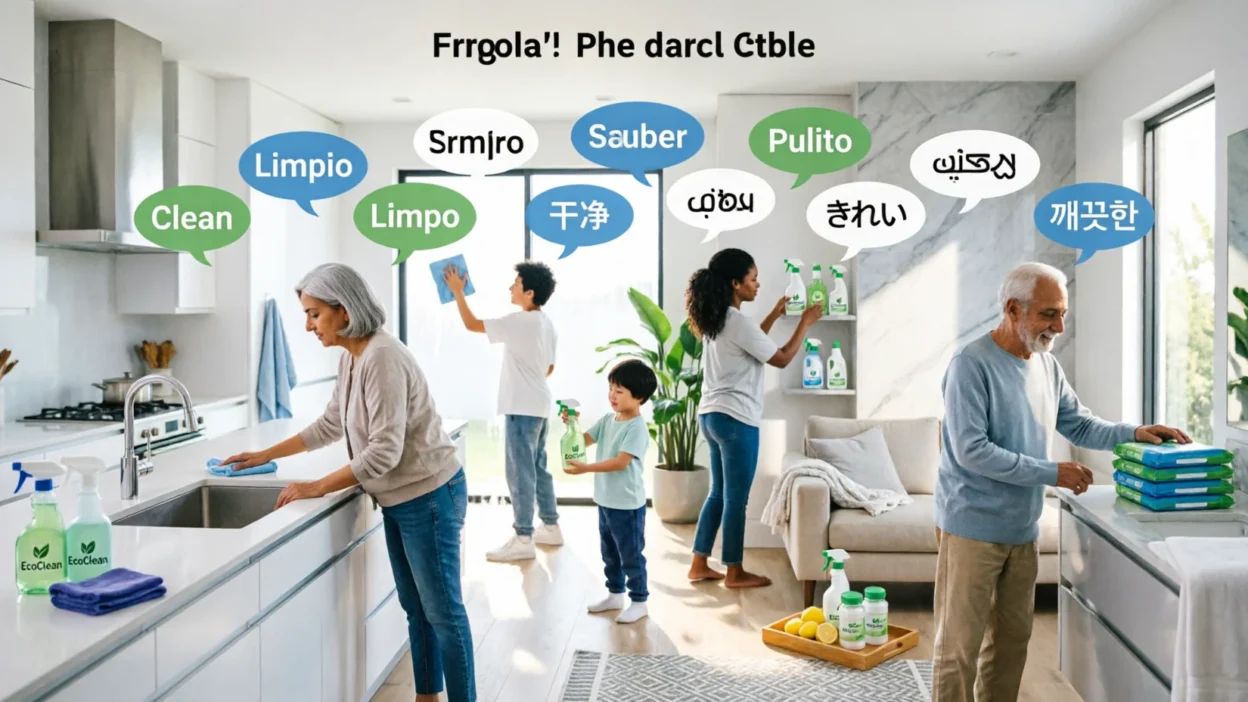
Learning clean in different languages is a practical way to expand your everyday vocabulary and communicate more effectively around the world.
The word clean is commonly used to describe something that is free from dirt, germs, stains, or clutter.
It can also refer to being neat, hygienic, pure, or well-maintained. If you’re traveling, learning a new language, shopping, or discussing household chores, knowing how to say clean in different languages can be very useful.
Many people search for clean in all languages to compare translations and improve their language skills.
Learning how to say clean in different languages is valuable for students, travelers, teachers, translators, and anyone interested in multilingual communication.
These clean translations are frequently used in homes, schools, hotels, workplaces, and public places.
Although the meaning of clean is universal, each language has its own unique word and pronunciation.
The table below features clean around the world in 45 popular languages, along with the native translation and an easy English pronunciation.
| Language | Native Phrase | English Pronunciation |
|---|---|---|
| English | Clean | Kleen |
| Spanish | Limpio | LEEM-pee-oh |
| French | Propre | PRO-pruh |
| German | Sauber | ZOW-ber |
| Italian | Pulito | Poo-LEE-to |
| Portuguese | Limpo | LEEM-poo |
| Dutch | Schoon | Skhohn |
| Swedish | Ren | Ren |
| Norwegian | Ren | Ren |
| Danish | Ren | Ren |
| Finnish | Puhdas | POOH-das |
| Polish | Czysty | CHIS-tee |
| Czech | Čistý | CHIS-tee |
| Slovak | Čistý | CHIS-tee |
| Hungarian | Tiszta | TEES-ta |
| Romanian | Curat | Koo-RAT |
| Greek | Καθαρός | Ka-tha-ROS |
| Russian | Чистый | CHEES-tee |
| Ukrainian | Чистий | CHIS-tee |
| Turkish | Temiz | Teh-MEEZ |
| Arabic | نظيف | Na-ZEEF |
| Hebrew | נקי | Na-KEE |
| Persian | تمیز | Ta-MEEZ |
| Hindi | साफ़ | Saaf |
| Urdu | صاف | Saaf |
| Bengali | পরিষ্কার | Po-ri-shkar |
| Punjabi | ਸਾਫ਼ | Saaf |
| Gujarati | સ્વચ્છ | Swachh |
| Marathi | स्वच्छ | Swachh |
| Tamil | சுத்தமான | Sut-tha-maan |
| Telugu | శుభ్రమైన | Shu-bhra-maina |
| Kannada | ಸ್ವಚ್ಛ | Swa-cha |
| Malayalam | വൃത്തിയുള്ള | Vrit-thi-yul-la |
| Chinese (Mandarin) | 干净 | Gan Jing |
| Japanese | きれい | Ki-rei |
| Korean | 깨끗한 | Kkae-kkeut-han |
| Thai | สะอาด | Sa-aat |
| Vietnamese | Sạch | Sak |
| Indonesian | Bersih | Ber-seeh |
| Malay | Bersih | Ber-seeh |
| Filipino | Malinis | Ma-li-nees |
| Swahili | Safi | SA-fee |
| Zulu | Hlanzekile | Hlan-za-KEH-lee |
| Afrikaans | Skoon | Skoon |
| Icelandic | Hreinn | Hraytn |
What does “clean” mean?
Clean means free from dirt, dust, stains, germs, or unwanted substances. It can also describe something that is neat, pure, or hygienic.
Why should I learn “clean” in different languages?
Learning this word helps you communicate in hotels, restaurants, homes, schools, workplaces, and while traveling in different countries.
Is “clean” the same in every language?
No. Every language has its own word for clean, although many express the same idea of being neat, hygienic, or free from dirt.
Can I use these translations while traveling?
Yes. These translations are useful when asking for clean rooms, clean water, clean clothes, or discussing cleanliness with native speakers.
What is the easiest way to remember “clean” in different languages?
Practice a few translations each day, repeat the pronunciations aloud, and use the words in simple everyday sentences to build your vocabulary.
Conclusion
Learning clean in different languages is an easy way to improve your everyday vocabulary and communicate confidently across cultures.
If you’re studying a foreign language, traveling, or simply expanding your knowledge, these translations will help you express one of the most common and useful words in daily life.
Bookmark this guide whenever you want to learn clean in all languages, discover clean translations, or explore how to say clean in different languages.

Carter Connor is a language enthusiast and content writer at LingoMean, helping readers discover what to say in everyday conversations with clear explanations, practical examples, and easy-to-understand communication tips.