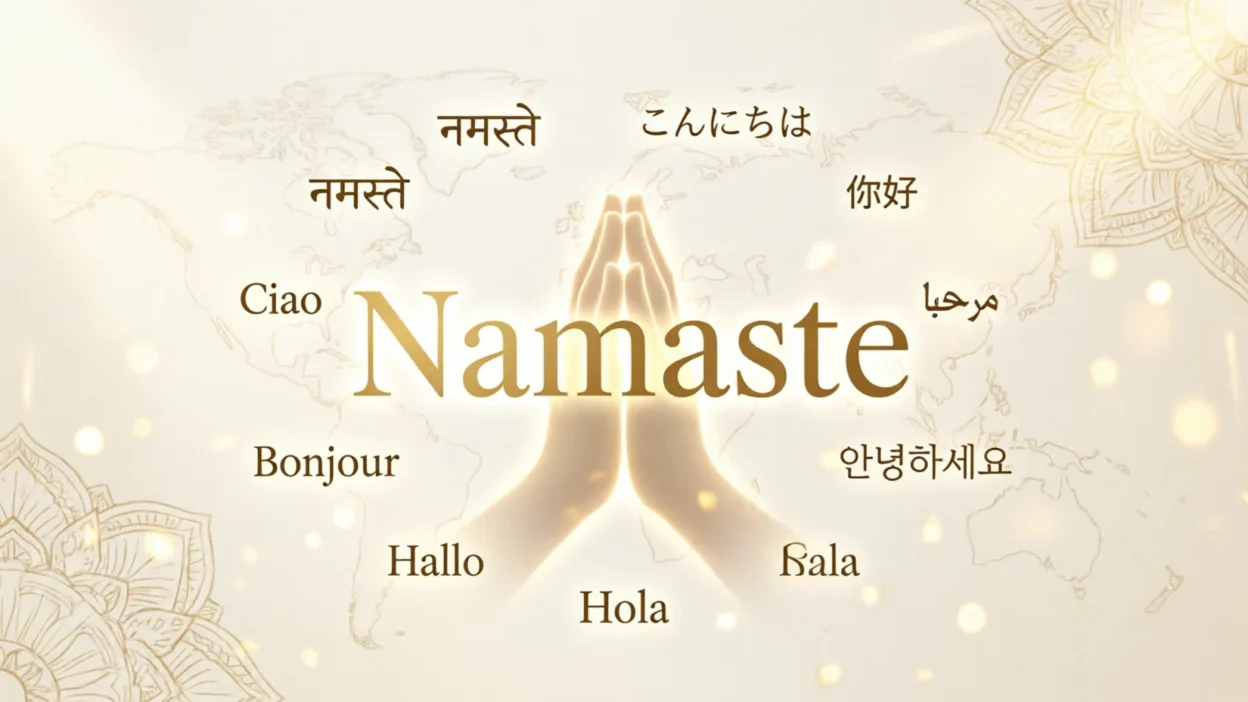
Namaste is one of the most recognizable greetings associated with India and South Asian culture. It is commonly used to greet someone politely and respectfully, often with the palms pressed together in front of the chest. The word is especially familiar in yoga, travel, spirituality, and international conversations.
If you want to learn namaste in different languages, this guide gives you 70 ways to express the same welcoming idea around the world. Because some languages have a direct equivalent of “Namaste” while others use their own traditional greeting, the phrases below focus on natural greetings that communicate a similar meaning.
If you are searching for namaste in all languages, wondering how to say namaste in different languages, or looking for namaste translations, this list makes it easy to compare greetings from different cultures.
Namaste in Different Languages: 70 Translations
| # | Language | Native Phrase | Easy English Pronunciation | Real-Life Example | English Meaning |
|---|---|---|---|---|---|
| 1 | Hindi | नमस्ते | Nuh-muh-stay | नमस्ते, आप कैसे हैं? | Namaste, how are you? |
| 2 | Sanskrit | नमस्ते | Nuh-muh-stay | नमस्ते मित्र। | Namaste, friend. |
| 3 | Marathi | नमस्कार | Nuh-muh-skaar | नमस्कार, कसे आहात? | Namaskar, how are you? |
| 4 | Gujarati | નમસ્તે | Nuh-muh-stay | નમસ્તે, તમે કેમ છો? | Namaste, how are you? |
| 5 | Bengali | নমস্কার | Nuh-mosh-kaar | নমস্কার, কেমন আছেন? | Namaskar, how are you? |
| 6 | Punjabi | ਸਤ ਸ੍ਰੀ ਅਕਾਲ | Sut Sri Akaal | ਸਤ ਸ੍ਰੀ ਅਕਾਲ ਜੀ। | Greetings to you. |
| 7 | Nepali | नमस्ते | Nuh-muh-stay | नमस्ते, तपाईंलाई कस्तो छ? | Namaste, how are you? |
| 8 | Sinhala | ආයුබෝවන් | Aa-yu-bo-wan | ආයුබෝවන්, ඔබට කොහොමද? | Ayubowan, how are you? |
| 9 | Tamil | வணக்கம் | Vuh-nuh-kum | வணக்கம், எப்படி இருக்கிறீர்கள்? | Vanakkam, how are you? |
| 10 | Telugu | నమస్కారం | Nuh-muh-skaa-rum | నమస్కారం, ఎలా ఉన్నారు? | Namaskaram, how are you? |
| 11 | Kannada | ನಮಸ್ಕಾರ | Nuh-muh-skaa-ra | ನಮಸ್ಕಾರ, ಹೇಗಿದ್ದೀರಿ? | Namaskara, how are you? |
| 12 | Malayalam | നമസ്കാരം | Nuh-muh-skaa-rum | നമസ്കാരം, സുഖമാണോ? | Namaskaram, are you well? |
| 13 | Odia | ନମସ୍କାର | Nuh-muh-skaar | ନମସ୍କାର, ଆପଣ କେମିତି ଅଛନ୍ତି? | Namaskar, how are you? |
| 14 | Assamese | নমস্কাৰ | Nuh-moh-skaar | নমস্কাৰ, আপুনি কেনে আছে? | Namaskar, how are you? |
| 15 | Maithili | नमस्कार | Nuh-muh-skaar | नमस्कार, अहाँ कोना छी? | Namaskar, how are you? |
| 16 | Bhojpuri | प्रणाम | Pruh-naam | प्रणाम, रउआ कइसन बानी? | Pranam, how are you? |
| 17 | Urdu | آداب | Aa-daab | آداب، آپ کیسے ہیں؟ | Adab, how are you? |
| 18 | Kashmiri | आदाब | Aa-daab | आदाब, توہہ چھُو کیٛاہ حال؟ | Adab, how are you? |
| 19 | Sindhi | نمستي | Nuh-muh-stay | نمستي، توهان ڪيئن آهيو؟ | Namaste, how are you? |
| 20 | Konkani | नमस्कार | Nuh-muh-skaar | नमस्कार, कसो आसा? | Namaskar, how are you? |
| 21 | Dogri | नमस्कार | Nuh-muh-skaar | नमस्कार, तुस कैसे ओ? | Namaskar, how are you? |
| 22 | Manipuri | ꯅꯃꯁ꯭ꯀꯥꯔ | Nuh-muh-skaar | ꯅꯃꯁ꯭ꯀꯥꯔ, ꯅꯇꯝ ꯀꯩꯗꯣꯏ? | Namaskar, how are you? |
| 23 | Bodo | नमस्कार | Nuh-muh-skaar | नमस्कार, नों माबोरै? | Namaskar, how are you? |
| 24 | Santali | ᱡᱚᱦᱟᱨ | Jo-haar | ᱡᱚᱦᱟᱨ ᱢᱤᱫ ᱥᱮᱞᱮᱫ | Johar, good day. |
| 25 | Nepali Bhasa | नमस्ते | Nuh-muh-stay | नमस्ते, ज्वजलपा। | Namaste, greetings. |
| 26 | Dzongkha | ཀུ་ཟུ་ཟང་པོ། | Ku-zoo-zang-po | ཀུ་ཟུ་ཟང་པོ། | Hello. |
| 27 | Tibetan | བཀྲ་ཤིས་བདེ་ལེགས། | Tashi delek | བཀྲ་ཤིས་བདེ་ལེགས། | Greetings and good wishes. |
| 28 | Thai | สวัสดี | Sa-wat-dee | สวัสดีครับ | Hello. |
| 29 | Lao | ສະບາຍດີ | Sa-bai-dee | ສະບາຍດີ | Hello. |
| 30 | Khmer | សួស្តី | Suos-dei | សួស្តី! | Hello! |
| 31 | Vietnamese | Xin chào | Sin chow | Xin chào bạn! | Hello, friend! |
| 32 | Indonesian | Halo | Ha-lo | Halo, apa kabar? | Hello, how are you? |
| 33 | Malay | Salam sejahtera | Sa-lam suh-jah-te-rah | Salam sejahtera kepada semua. | Greetings to everyone. |
| 34 | Filipino | Kumusta | Ku-mus-ta | Kumusta ka? | How are you? |
| 35 | Burmese | မင်္ဂလာပါ | Ming-ga-la-ba | မင်္ဂလာပါ။ | Hello. |
| 36 | Chinese | 你好 | Nee-how | 你好,很高兴见到你。 | Hello, nice to meet you. |
| 37 | Japanese | こんにちは | Kon-nee-chee-wah | こんにちは、お元気ですか。 | Hello, how are you? |
| 38 | Korean | 안녕하세요 | An-nyeong-ha-se-yo | 안녕하세요! | Hello! |
| 39 | Mongolian | Сайн байна уу | Sain bai-na uu | Сайн байна уу? | Hello, how are you? |
| 40 | Arabic | مرحبًا | Mar-ha-ban | مرحبًا، كيف حالك؟ | Hello, how are you? |
| 41 | Persian | سلام | Sa-laam | سلام، حال شما چطور است؟ | Hello, how are you? |
| 42 | Hebrew | שלום | Sha-lom | שלום, מה שלומך? | Hello, how are you? |
| 43 | Turkish | Merhaba | Mehr-ha-ba | Merhaba, nasılsın? | Hello, how are you? |
| 44 | Kurdish | Silav | See-lav | Silav, tu çawa yî? | Hello, how are you? |
| 45 | Armenian | Բարև | Ba-rev | Բարև, ինչպե՞ս ես։ | Hello, how are you? |
| 46 | Georgian | გამარჯობა | Ga-mar-jo-ba | გამარჯობა, როგორ ხარ? | Hello, how are you? |
| 47 | Greek | Γεια σου | Ya soo | Γεια σου, τι κάνεις; | Hello, how are you? |
| 48 | Russian | Здравствуйте | Zdrav-stvooy-te | Здравствуйте! | Hello! |
| 49 | Ukrainian | Вітаю | Vee-ta-yu | Вітаю вас! | Greetings to you! |
| 50 | Polish | Dzień dobry | Jen doh-bri | Dzień dobry! | Good day! |
| 51 | Czech | Dobrý den | Doh-bree den | Dobrý den! | Good day! |
| 52 | Slovak | Dobrý deň | Doh-bree den | Dobrý deň! | Good day! |
| 53 | Slovenian | Pozdravljeni | Poh-zdrav-lyeh-nee | Pozdravljeni! | Greetings! |
| 54 | Croatian | Pozdrav | Poh-zdrav | Pozdrav! | Greetings! |
| 55 | Serbian | Здраво | Zdra-vo | Здраво! | Hello! |
| 56 | Bulgarian | Здравейте | Zdra-vey-te | Здравейте! | Hello! |
| 57 | Romanian | Bună ziua | Boo-nuh zee-wa | Bună ziua! | Good day! |
| 58 | Hungarian | Jó napot kívánok | Yo na-pot kee-va-nok | Jó napot kívánok! | I wish you a good day! |
| 59 | German | Guten Tag | Goo-ten tahk | Guten Tag! | Good day! |
| 60 | Dutch | Goedendag | Khoo-den-dakh | Goedendag! | Good day! |
| 61 | French | Bonjour | Bon-zhoor | Bonjour, comment allez-vous? | Hello, how are you? |
| 62 | Spanish | Hola | Oh-la | Hola, ¿cómo estás? | Hello, how are you? |
| 63 | Portuguese | Olá | Oh-la | Olá, como você está? | Hello, how are you? |
| 64 | Italian | Buongiorno | Bwon-jor-no | Buongiorno, come sta? | Good morning/day, how are you? |
| 65 | Swedish | Hej | Hay | Hej, hur mår du? | Hello, how are you? |
| 66 | Norwegian | Hei | Hi | Hei, hvordan har du det? | Hello, how are you? |
| 67 | Danish | Hej | Hi | Hej, hvordan har du det? | Hello, how are you? |
| 68 | Finnish | Hei | Hay | Hei, mitä kuuluu? | Hello, how are you? |
| 69 | Icelandic | Halló | Ha-loh | Halló, hvernig hefur þú það? | Hello, how are you? |
| 70 | Swahili | Jambo | Jahm-bo | Jambo, habari yako? | Hello, how are you? |
What Does Namaste Mean?
The word Namaste comes from Sanskrit and is traditionally associated with a respectful greeting. It is commonly explained as expressing respect or acknowledging the person being greeted.
The greeting is often accompanied by a gesture called Anjali Mudra, in which the palms are brought together in front of the chest. The gesture is widely recognized in India and has also become familiar internationally through yoga and wellness practices.
Although “Namaste” has a specific cultural and linguistic origin, many languages have their own respectful greetings. That is why namaste around the world can be understood not only as a direct translation but also as a comparison of culturally appropriate ways to greet someone.
How to Say Namaste in Different Languages
There is not always a perfect one-word translation for Namaste. In languages such as Hindi, Nepali, Gujarati, and Sindhi, forms of Namaste or closely related traditional greetings are commonly used.
In other languages, a natural equivalent may simply mean “hello,” “greetings,” or “good day.” For example, French uses “Bonjour,” Spanish uses “Hola,” German uses “Guten Tag,” and Japanese uses “こんにちは.”
When learning how to say Namaste in different languages, it is therefore useful to understand both the literal phrase and the cultural context in which people normally greet one another.
Namaste Translations and Cultural Meaning
Namaste translations can vary depending on the language and culture. Some languages preserve a form of the original greeting, while others use a traditional local greeting instead.
The difference is important because greetings are more than vocabulary. They can communicate respect, friendliness, formality, warmth, or familiarity.
For this reason, learning the appropriate greeting for each language can make communication more natural and respectful.
Namaste in All Languages: What Can You Learn?
Looking at Namaste in all languages shows how diverse human communication can be. A simple greeting can have many forms, pronunciations, and cultural traditions.
The table above includes greetings from South Asia, East Asia, Southeast Asia, the Middle East, Europe, and Africa. Some are direct or closely related forms of Namaste, while others are natural local equivalents.
This makes the list useful for language learners, travelers, students, writers, teachers, and anyone interested in greetings around the world.
Why Is Namaste Popular Around the World?
Namaste became particularly familiar internationally through Indian culture, yoga, meditation, wellness, travel, and popular media.
Its simple pronunciation and recognizable hand gesture have helped make it an internationally known greeting. At the same time, learning local greetings is important when communicating with people from different cultures.
Using a greeting in someone’s own language can be a simple way to show interest and respect.
Conclusion
Learning Namaste in different languages is a simple way to explore greetings, cultures, and languages from around the world. While some languages use Namaste or a closely related traditional expression, others have their own natural ways to say hello or offer respectful greetings.
From Hindi and Sanskrit to Japanese, Arabic, French, Spanish, and Swahili, each expression reflects the culture and communication style of its speakers.
If you are traveling, studying languages, practicing yoga, or simply curious about global greetings, these 70 phrases provide an easy starting point for discovering how people greet one another around the world.
FAQs:
1. What does Namaste mean?
Namaste is a traditional greeting associated with India and Sanskrit. It is commonly used to express respect when greeting or acknowledging another person.
2. How do you say Namaste in Hindi?
In Hindi, Namaste is written as नमस्ते and is pronounced approximately “nuh-muh-stay.”
3. Is Namaste used in other languages?
Yes. Forms of Namaste or related traditional greetings are used in several South Asian languages. Other languages generally use their own culturally appropriate greeting equivalents.
4. What is Namaste in Sanskrit?
In Sanskrit, Namaste is written नमस्ते and pronounced approximately “nuh-muh-stay.” The word has Sanskrit roots and is traditionally associated with respectful greeting.
5. What is the most common English equivalent of Namaste?
The closest everyday English equivalent is usually “hello” or “greetings.” Depending on the context, it can also communicate respect or a warm acknowledgment of another person.

Brandon Cody is the Administrator of LingoMean, a platform dedicated to helping people discover the right words for every situation. He oversees content quality, website management, and user experience, ensuring readers receive accurate, practical, and easy-to-understand communication guidance.