The number 1 is one of the most basic and universally recognized numbers, yet the word used to express it changes dramatically from one language to another.
If you are learning a new language, creating multilingual content, traveling, studying vocabulary, or simply curious about how people around the world say “one,” exploring these translations can be both useful and fascinating.
In this guide, you will discover number 1 in different languages with the native word, an easy English pronunciation, and a short example sentence. The examples make it easier to understand how each translation works naturally in everyday communication.
If you have ever searched for how to say number 1 in different languages, this list provides 70 useful translations from languages spoken across Europe, Asia, Africa, the Middle East, and beyond.
Number 1 in Different Languages
The following table shows 70 ways to say “one” around the world. Pronunciations are written in an easy English-friendly style to help beginners read the words aloud.
| # | Language | Native Phrase | Easy English Pronunciation | Example Sentence | English Meaning |
|---|---|---|---|---|---|
| 1 | English | one | wun | I have one book. | I have a single book. |
| 2 | Spanish | uno | OO-noh | Tengo uno. | I have one. |
| 3 | French | un | uhn | J’en ai un. | I have one. |
| 4 | German | eins | ayns | Ich habe eins. | I have one. |
| 5 | Italian | uno | OO-noh | Ne voglio uno. | I want one. |
| 6 | Portuguese | um | oom | Eu tenho um. | I have one. |
| 7 | Dutch | één | ayn | Ik heb er één. | I have one. |
| 8 | Swedish | ett | eht | Jag har ett. | I have one. |
| 9 | Norwegian | én | ayn | Jeg har én. | I have one. |
| 10 | Danish | én | ayn | Jeg har én. | I have one. |
| 11 | Finnish | yksi | OOK-see | Minulla on yksi. | I have one. |
| 12 | Icelandic | einn | ayn | Ég á einn. | I have one. |
| 13 | Irish | aon | ayn | Tá aon cheann agam. | I have one. |
| 14 | Welsh | un | een | Mae gen i un. | I have one. |
| 15 | Polish | jeden | YEH-den | Mam jeden. | I have one. |
| 16 | Czech | jeden | YEH-den | Mám jeden. | I have one. |
| 17 | Slovak | jeden | YEH-den | Mám jeden. | I have one. |
| 18 | Slovenian | ena | EH-nah | Imam eno. | I have one. |
| 19 | Croatian | jedan | YEH-dan | Imam jedan. | I have one. |
| 20 | Serbian | jedan | YEH-dan | Imam jedan. | I have one. |
| 21 | Bulgarian | едно | ed-NOH | Имам едно. | I have one. |
| 22 | Macedonian | еден | EH-den | Имам еден. | I have one. |
| 23 | Russian | один | ah-DEEN | У меня один. | I have one. |
| 24 | Ukrainian | один | oh-DEEN | У мене один. | I have one. |
| 25 | Belarusian | адзін | ah-DEEN | У мяне адзін. | I have one. |
| 26 | Lithuanian | vienas | VYEH-nas | Turiu vieną. | I have one. |
| 27 | Latvian | viens | VYEHNS | Man ir viens. | I have one. |
| 28 | Estonian | üks | ueks | Mul on üks. | I have one. |
| 29 | Hungarian | egy | EDJ | Van egy. | There is one. |
| 30 | Romanian | unu | OO-noo | Am unul. | I have one. |
| 31 | Greek | ένα | EH-na | Έχω ένα. | I have one. |
| 32 | Albanian | një | NYEH | Kam një. | I have one. |
| 33 | Armenian | մեկ | mek | Ես ունեմ մեկ։ | I have one. |
| 34 | Georgian | ერთი | ER-tih | მე მაქვს ერთი. | I have one. |
| 35 | Turkish | bir | beer | Bir tane istiyorum. | I want one. |
| 36 | Azerbaijani | bir | beer | Mənim birim var. | I have one. |
| 37 | Persian | یک | yek | من یکی دارم. | I have one. |
| 38 | Arabic | واحد | WAA-hid | لدي واحد. | I have one. |
| 39 | Hebrew | אחד | eh-KHAD | יש לי אחד. | I have one. |
| 40 | Urdu | ایک | aik | میرے پاس ایک ہے۔ | I have one. |
| 41 | Hindi | एक | ek | मेरे पास एक है। | I have one. |
| 42 | Bengali | এক | ek | আমার একটি আছে। | I have one. |
| 43 | Punjabi | ਇੱਕ | ikk | ਮੇਰੇ ਕੋਲ ਇੱਕ ਹੈ। | I have one. |
| 44 | Gujarati | એક | ek | મારી પાસે એક છે. | I have one. |
| 45 | Marathi | एक | ek | माझ्याकडे एक आहे. | I have one. |
| 46 | Nepali | एक | ek | मसँग एउटा छ। | I have one. |
| 47 | Sanskrit | एकम् | EH-kum | एकम् अस्ति। | There is one. |
| 48 | Tamil | ஒன்று | ON-roo | என்னிடம் ஒன்று உள்ளது. | I have one. |
| 49 | Telugu | ఒకటి | oh-KAH-tee | నా దగ్గర ఒకటి ఉంది. | I have one. |
| 50 | Kannada | ಒಂದು | ON-doo | ನನ್ನ ಬಳಿ ಒಂದು ಇದೆ. | I have one. |
| 51 | Malayalam | ഒന്ന് | ON-noo | എനിക്ക് ഒന്ന് ഉണ്ട്. | I have one. |
| 52 | Sinhala | එක | EH-kah | මට එකක් තියෙනවා. | I have one. |
| 53 | Thai | หนึ่ง | neung | ฉันมีหนึ่งอัน | I have one. |
| 54 | Lao | ຫນຶ່ງ | neung | ຂ້ອຍມີຫນຶ່ງ. | I have one. |
| 55 | Khmer | មួយ | muoy | ខ្ញុំមានមួយ។ | I have one. |
| 56 | Vietnamese | một | moht | Tôi có một cái. | I have one. |
| 57 | Indonesian | satu | SAH-too | Saya punya satu. | I have one. |
| 58 | Malay | satu | SAH-too | Saya ada satu. | I have one. |
| 59 | Filipino | isa | EE-sah | Mayroon akong isa. | I have one. |
| 60 | Chinese (Mandarin) | 一 | yī | 我有一个。 | I have one. |
| 61 | Japanese | 一 | ichi | 一つあります。 | There is one. |
| 62 | Korean | 하나 | hana | 하나 있어요. | There is one. |
| 63 | Mongolian | нэг | neg | Надад нэг байна. | I have one. |
| 64 | Swahili | moja | MOH-jah | Nina moja. | I have one. |
| 65 | Zulu | kunye | KOON-yeh | Nginokunye. | I have one. |
| 66 | Xhosa | nye | NYEH | Ndinanye. | I have one. |
| 67 | Afrikaans | een | ayn | Ek het een. | I have one. |
| 68 | Amharic | አንድ | ahnd | አንድ አለኝ። | I have one. |
| 69 | Somali | kow | kohw | Waxaan haystaa kow. | I have one. |
| 70 | Hausa | ɗaya | DAH-yah | Ina da ɗaya. | I have one. |
How to Say Number 1 in Different Languages
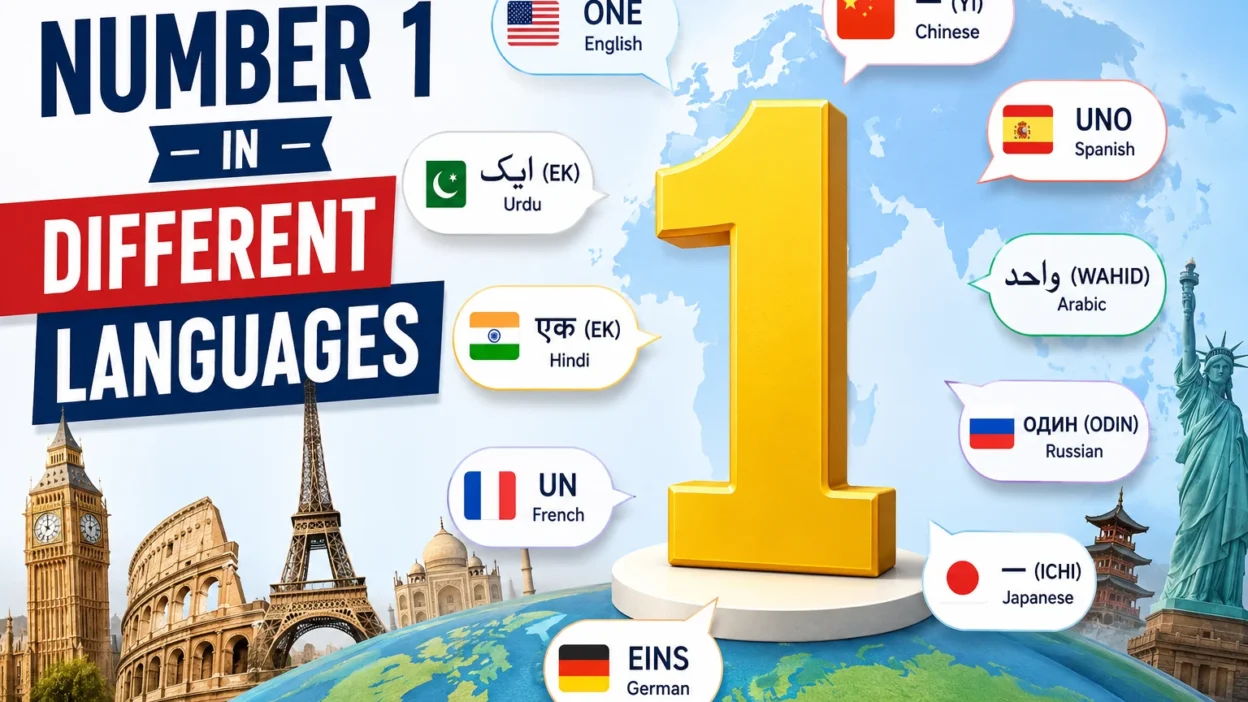
The most common English equivalent of the number 1 is “one,” but other languages use completely different words. For example, Spanish and Italian use uno, German uses eins, French uses un, and Japanese uses ichi when counting.
In many languages, the exact word for one can change depending on gender, noun type, grammatical case, or counting system. Therefore, the word shown in a basic vocabulary list may not always be the only form you encounter.
Number 1 in European Languages
European languages offer a fascinating variety of words for one. Several languages have related forms because they belong to the same language families.
For example, Spanish uno and Italian uno look and sound almost identical. Meanwhile, Polish jeden, Czech jeden, and Slovak jeden share a close resemblance.
Other examples include German eins, Dutch één, Swedish ett, and Finnish yksi. These differences show how the same basic number can develop into very different words across languages.
Number 1 in Asian Languages
Asian languages provide some especially interesting translations. In Mandarin Chinese, the word is 一, pronounced yī. Japanese also uses the character 一, although the common pronunciation for one is ichi.
Korean commonly uses 하나 (hana) when counting things in a general context. Hindi, Urdu, Bengali, Punjabi, Gujarati, Marathi, and Nepali all have closely related number systems because of their linguistic history and geographical connections.
For travelers and language learners, learning the word for one can be a useful first step because it appears frequently when discussing prices, quantities, dates, addresses, and everyday objects.
Number 1 in Middle Eastern Languages
The concept of one is also expressed differently across Middle Eastern languages.
In Arabic, واحد (wāḥid) is a common form of “one.” Persian uses یک (yek), while Hebrew uses אחד (eḥad) in the masculine form. Turkish, which is spoken across Turkey and surrounding regions, uses bir.
Because grammatical gender and noun agreement can affect number words, learners should remember that the basic dictionary form may change in a complete sentence.
Number 1 in African Languages
Africa is home to hundreds of languages, and this list includes several examples.
Swahili uses moja, while Zulu uses kunye in the example provided. Xhosa uses nye, and Afrikaans uses een. Amharic uses አንድ, while Somali uses kow.
These translations demonstrate why exploring number 1 around the world can be an excellent way to discover linguistic diversity.
Number 1 in South Asian Languages
South Asia has many major languages with their own words and grammatical systems for expressing one.
Hindi uses एक (ek), Urdu uses ایک (aik), Punjabi uses ਇੱਕ (ikk), Bengali uses এক (ek), Gujarati uses એક (ek), and Marathi uses एक (ek).
Nepali also uses एक (ek). Although these languages have different scripts and pronunciation patterns, several of them share related vocabulary.
Number 1 Translations for Travel and Conversation
Knowing the word for one can be surprisingly useful when traveling. You might need it when ordering a single item, counting objects, buying tickets, or answering a simple question about quantity.
For instance, learning uno before visiting a Spanish-speaking country can help with basic counting. Similarly, knowing bir in Turkish, satu in Indonesian, or un in French gives travelers a small but practical piece of local vocabulary.
However, remember that pronunciation matters. A word that looks simple on paper may sound quite different when spoken naturally by native speakers.
Why Learn Number 1 in Different Languages?
Learning the word for one in multiple languages has several benefits.
First, it is an easy way to begin exploring a new language. Since numbers are used frequently, even beginners can quickly find practical opportunities to use them.
Second, multilingual number words can be useful for students, travelers, writers, teachers, designers, and content creators.
Finally, comparing translations reveals relationships between languages. Similar-looking words can sometimes point to shared linguistic roots, while completely different words show how languages have developed independently over time.
Tips for Remembering Number 1 Translations
Start with a small group instead of trying to memorize all 70 words at once.
You can group the words by region, language family, or similarity. For example, Spanish uno and Italian uno are easy to connect, while Hindi ek, Bengali ek, and Gujarati ek provide another memorable group.
Writing each word down, saying it aloud, and using it in a short sentence can also make memorization easier.
Another useful technique is to learn the number together with numbers two and three. This creates a small counting pattern that is often easier to remember than a single isolated word.
Common Uses of the Word One
The number one can express more than simple counting. In English, “one” can refer to quantity, position, identity, or a single person or object.
For example:
- Quantity: I bought one apple.
- Position: She finished number one.
- Selection: Choose one.
- Identity: One person called me.
- Emphasis: You are the one I need.
Other languages can have similarly broad uses, although grammar and sentence structure may differ.
Number 1 Around the World
From uno in Spanish and Italian to ichi in Japanese and moja in Swahili, the idea of one appears in many fascinating linguistic forms.
Some words are closely related across neighboring languages, while others have completely different sounds and writing systems. Nevertheless, they all communicate the same fundamental concept: a quantity of one.
This makes number 1 in all languages a useful topic for anyone interested in vocabulary, translation, travel, or world languages.
Conclusion
Learning number 1 in different languages is a simple way to explore global vocabulary and discover how languages express the same basic idea in different ways.
From European languages such as Spanish, French, and German to Asian, African, and Middle Eastern languages, each translation offers a small glimpse into another linguistic tradition.
If you are studying languages, preparing for travel, or simply curious about number 1 translations, these 70 examples provide a useful starting point for learning how to say “one” around the world.
FAQs:
What is number 1 called in different languages?
Number 1 has many different names, including one in English, uno in Spanish and Italian, eins in German, un in French, ichi in Japanese, hana in Korean, and ek in Hindi.
How do you say number 1 in Spanish?
Number 1 in Spanish is uno, pronounced approximately “OO-noh.” It is commonly used when referring to the number one or a masculine noun.
How do you say number 1 in French?
Number 1 in French is un, pronounced approximately “uhn.” The form can vary depending on grammatical context.
How do you say number 1 in Japanese?
Number 1 in Japanese is commonly 一, pronounced ichi when used as the number one. Japanese also has different readings and counting forms depending on context.
What is the easiest way to learn number 1 in many languages?
A useful method is to group translations by region or similarity, practice their pronunciation, and create short sentences with each word. Learning a few at a time makes memorization easier.

Evelyn Grace is a language enthusiast and content writer at LingoMean, where she explains the meaning of words, phrases, and expressions. She creates clear, practical, and engaging content that helps readers confidently understand what to say in everyday conversations.