
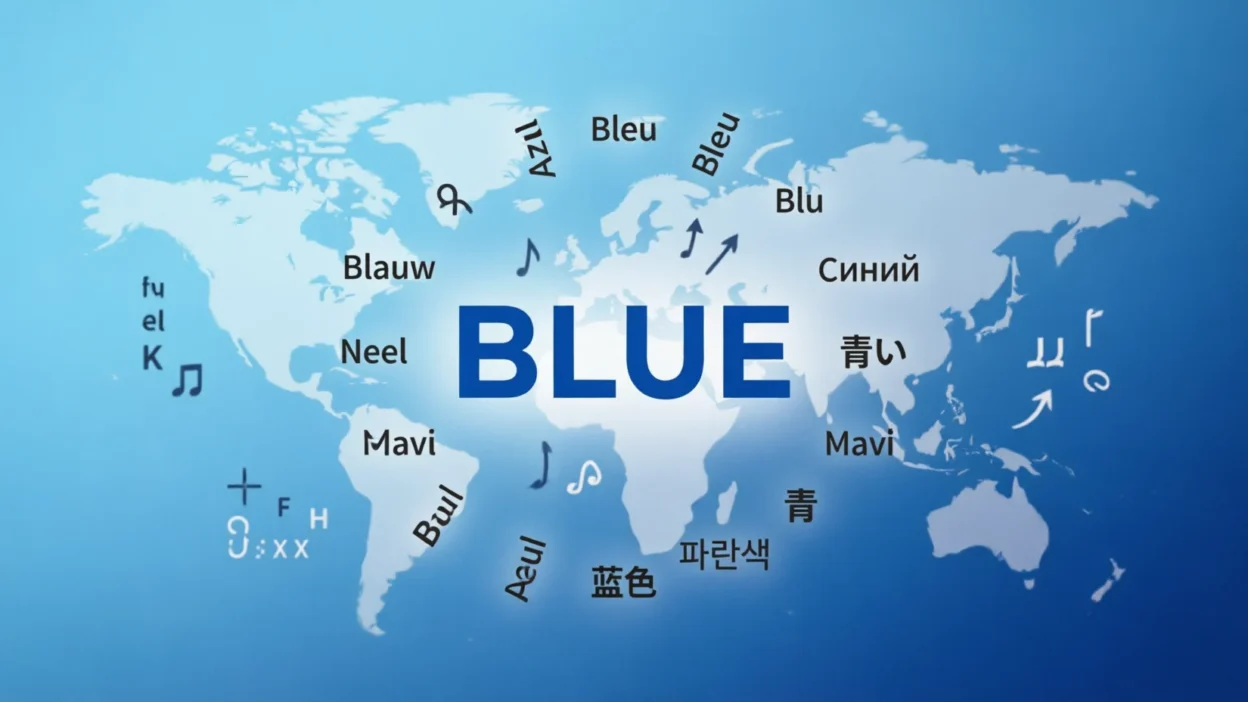
The color blue is one of the most recognizable colors in the world. It is commonly associated with the sky, ocean, calmness, trust, freshness, and peace. But how do people say “blue” in different languages?
If you are searching for blue in different languages, this guide gives you 70 translations in a simple, easy-to-read format. Each translation includes the native word, an easy English pronunciation, a short real-life example, and the English meaning of that example.
If you are learning a new language, working on a writing project, studying vocabulary, or simply curious about blue translations around the world, this list makes it easy to discover how this beautiful color is expressed across different cultures.
How to Say Blue in Different Languages
The word “blue” can change considerably from one language to another. Some languages also change the word depending on grammatical gender, number, or the object being described.
Below, you can explore blue in all languages included in this guide, along with practical examples that show how the word can be used naturally.
Blue in Different Languages: 70 Translations
| # | Language | Native Phrase | Easy English Pronunciation | Example Sentence | English Meaning |
|---|---|---|---|---|---|
| 1 | English | Blue | B loo | The sky is blue today. | The sky has a blue color today. |
| 2 | Spanish | Azul | Ah-SOOL | El cielo es azul. | The sky is blue. |
| 3 | French | Bleu | Bluh | Le ciel est bleu. | The sky is blue. |
| 4 | German | Blau | Blau | Der Himmel ist blau. | The sky is blue. |
| 5 | Italian | Blu | B loo | Il cielo è blu. | The sky is blue. |
| 6 | Portuguese | Azul | Ah-ZOOL | O céu é azul. | The sky is blue. |
| 7 | Dutch | Blauw | Blau | De lucht is blauw. | The sky is blue. |
| 8 | Russian | Синий | SEE-nee | Небо синее. | The sky is blue. |
| 9 | Ukrainian | Синій | SEE-nee | Небо синє. | The sky is blue. |
| 10 | Polish | Niebieski | Nyeh-BYES-kee | Niebo jest niebieskie. | The sky is blue. |
| 11 | Czech | Modrý | MOHD-ree | Obloha je modrá. | The sky is blue. |
| 12 | Slovak | Modrý | MOHD-ree | Obloha je modrá. | The sky is blue. |
| 13 | Slovenian | Moder | MOH-der | Nebo je modro. | The sky is blue. |
| 14 | Croatian | Plav | Plahv | Nebo je plavo. | The sky is blue. |
| 15 | Serbian | Плав | Plahv | Небо је плаво. | The sky is blue. |
| 16 | Bulgarian | Син | Seen | Небето е синьо. | The sky is blue. |
| 17 | Macedonian | Син | Seen | Небото е сино. | The sky is blue. |
| 18 | Romanian | Albastru | Al-BAHS-troo | Cerul este albastru. | The sky is blue. |
| 19 | Hungarian | Kék | Kake | Az ég kék. | The sky is blue. |
| 20 | Greek | Μπλε | Bleh | Ο ουρανός είναι μπλε. | The sky is blue. |
| 21 | Albanian | Blu | B loo | Qielli është blu. | The sky is blue. |
| 22 | Swedish | Blå | Bloh | Himlen är blå. | The sky is blue. |
| 23 | Norwegian | Blå | Bloh | Himmelen er blå. | The sky is blue. |
| 24 | Danish | Blå | Bloh | Himlen er blå. | The sky is blue. |
| 25 | Icelandic | Blár | Blour | Himinninn er blár. | The sky is blue. |
| 26 | Finnish | Sininen | SEE-nee-nen | Taivas on sininen. | The sky is blue. |
| 27 | Estonian | Sinine | SEE-nee-neh | Taevas on sinine. | The sky is blue. |
| 28 | Latvian | Zils | Zils | Debesis ir zilas. | The sky is blue. |
| 29 | Lithuanian | Mėlynas | MAY-lee-nahs | Dangus yra mėlynas. | The sky is blue. |
| 30 | Irish | Gorm | Gorum | Tá an spéir gorm. | The sky is blue. |
| 31 | Welsh | Glas | Glaas | Mae’r awyr yn las. | The sky is blue. |
| 32 | Scottish Gaelic | Gorm | Gorm | Tha an speur gorm. | The sky is blue. |
| 33 | Basque | Urdin | OOR-deen | Zerua urdina da. | The sky is blue. |
| 34 | Catalan | Blau | Blau | El cel és blau. | The sky is blue. |
| 35 | Galician | Azul | Ah-SOOL | O ceo é azul. | The sky is blue. |
| 36 | Maltese | Blu | B loo | Is-sema hija blu. | The sky is blue. |
| 37 | Turkish | Mavi | MAH-vee | Gökyüzü mavi. | The sky is blue. |
| 38 | Azerbaijani | Mavi | Mah-VEE | Göy mavidir. | The sky is blue. |
| 39 | Persian | آبی | Aa-bee | آسمان آبی است. | The sky is blue. |
| 40 | Arabic | أزرق | AZ-rak | السماء زرقاء. | The sky is blue. |
| 41 | Hebrew | כחול | Ka-KHOL | השמיים כחולים. | The sky is blue. |
| 42 | Hindi | नीला | NEE-laa | आसमान नीला है। | The sky is blue. |
| 43 | Urdu | نیلا | NEE-la | آسمان نیلا ہے۔ | The sky is blue. |
| 44 | Bengali | নীল | Neel | আকাশ নীল। | The sky is blue. |
| 45 | Punjabi | ਨੀਲਾ | NEE-laa | ਅਸਮਾਨ ਨੀਲਾ ਹੈ। | The sky is blue. |
| 46 | Gujarati | વાદળી | Vaa-dlee | આકાશ વાદળી છે. | The sky is blue. |
| 47 | Marathi | निळा | NEE-laa | आकाश निळे आहे. | The sky is blue. |
| 48 | Nepali | नीलो | NEE-lo | आकाश नीलो छ। | The sky is blue. |
| 49 | Sinhala | නිල් | Nil | අහස නිල් පාටයි. | The sky is blue. |
| 50 | Tamil | நீலம் | NEE-lam | வானம் நீலமாக உள்ளது. | The sky is blue. |
| 51 | Telugu | నీలం | NEE-lam | ఆకాశం నీలంగా ఉంది. | The sky is blue. |
| 52 | Kannada | ನೀಲಿ | NEE-lee | ಆಕಾಶ ನೀಲಿಯಾಗಿದೆ. | The sky is blue. |
| 53 | Malayalam | നീല | NEE-la | ആകാശം നീലയാണ്. | The sky is blue. |
| 54 | Thai | สีน้ำเงิน | See-NAM-ngern | ท้องฟ้าเป็นสีน้ำเงิน | The sky is blue. |
| 55 | Vietnamese | Xanh dương | Sahng Zyoong | Bầu trời màu xanh dương. | The sky is blue. |
| 56 | Indonesian | Biru | BEE-roo | Langit berwarna biru. | The sky is blue. |
| 57 | Malay | Biru | BEE-roo | Langit berwarna biru. | The sky is blue. |
| 58 | Filipino | Asul | Ah-SOOL | Asul ang langit. | The sky is blue. |
| 59 | Javanese | Biru | BEE-roo | Langite biru. | The sky is blue. |
| 60 | Chinese | 蓝色 | Lahng-suh | 天空是蓝色的。 | The sky is blue. |
| 61 | Japanese | 青い | Ah-OY | 空は青いです。 | The sky is blue. |
| 62 | Korean | 파란색 | Pah-ran-saek | 하늘은 파란색이에요. | The sky is blue. |
| 63 | Mongolian | Цэнхэр | Tsen-kher | Тэнгэр цэнхэр байна. | The sky is blue. |
| 64 | Kazakh | Көк | Kök | Аспан көк. | The sky is blue. |
| 65 | Uzbek | Ko‘k | Koke | Osmon ko‘k. | The sky is blue. |
| 66 | Swahili | Bluu | B loo | Anga ni ya bluu. | The sky is blue. |
| 67 | Afrikaans | Blou | Blau | Die lug is blou. | The sky is blue. |
| 68 | Amharic | ሰማያዊ | Se-ma-ya-wee | ሰማዩ ሰማያዊ ነው። | The sky is blue. |
| 69 | Zulu | Luhlaza okwesibhakabhaka | Loo-hla-za oh-kweh-see-bha-ka-bha-ka | Isibhakabhaka siluhlaza okwesibhakabhaka. | The sky is blue. |
| 70 | Xhosa | Luhlaza okwesibhakabhaka | Loo-hla-za oh-kweh-see-bha-ka-bha-ka | Isibhakabhaka siluhlaza okwesibhakabhaka. | The sky is blue. |
What Does Blue Mean?
Blue is a color commonly associated with the sky and water. It can represent calmness, stability, trust, freedom, depth, and tranquility.
The meaning of blue can also change depending on culture and context. In fashion, blue may suggest confidence and elegance. In nature, it is strongly connected with oceans and clear skies. In branding, blue is often used to communicate reliability and professionalism.
Blue in Different Languages and Cultures
The word for blue is not always used in exactly the same way across languages. Some languages have grammatical forms that change according to gender or the noun being described.
For example, Romance and Slavic languages may change the form of a color adjective depending on grammatical gender or number. Asian languages can also use different structures when describing colors.
These differences make blue around the world an interesting example of how languages organize colors and descriptions.
Why Learn Blue Translations?
Learning the word blue in another language can be useful for language students, travelers, writers, teachers, and anyone interested in world languages.
Simple color words are also excellent vocabulary-building tools. They are easy to remember and appear frequently in everyday conversations, descriptions, stories, signs, clothing terms, and art.
Knowing basic color vocabulary can also help learners create simple sentences while practicing grammar and pronunciation.
Blue in All Languages: Common Uses
The word blue can describe many different things in everyday speech. Here are some common examples:
- A blue sky
- Blue eyes
- A blue shirt
- A blue car
- Blue water
- Blue flowers
- A blue ocean
- Blue jeans
- A blue pen
- A blue house
Learning these combinations can help you understand how blue translations work naturally rather than memorizing the word by itself.
How to Pronounce Blue in Different Languages
Pronunciation varies widely between languages. In some languages, the word may sound similar to English, while in others it can be completely different.
For example, Spanish uses “azul,” Turkish uses “mavi,” Indonesian uses “biru,” and Arabic uses “azraq.” Japanese commonly uses “aoi,” while Korean uses “paransaek.”
The pronunciation column above provides a simple English-friendly guide to help beginners approximate the sound.
Is Blue the Same in Every Language?
No. The concept of the color blue exists across cultures, but languages may categorize and describe blue differently.
Some languages have multiple words or expressions for shades that English speakers might simply call blue. Other languages use a broader color category that can overlap with colors such as green.
Grammar also affects the way blue is written. In some languages, adjectives change based on the gender, number, or grammatical form of the noun.
Blue Color Vocabulary for Language Learners
If you are learning a new language, colors are among the easiest vocabulary categories to practice.
Start with the basic word for blue, then combine it with familiar nouns. For example, you can practice phrases equivalent to “blue sky,” “blue shirt,” “blue car,” and “blue eyes.”
This method helps you learn both vocabulary and sentence structure at the same time.
FAQs:
1. How do you say blue in different languages?
The word for blue changes from language to language. Some common translations include “azul” in Spanish and Portuguese, “bleu” in French, “blau” in German and Dutch, “mavi” in Turkish, “biru” in Indonesian and Malay, and “blue” in English.
2. What is blue in the most popular languages?
In widely spoken languages, blue is “azul” in Spanish, “bleu” in French, “blau” in German, “blu” in Italian, “mavi” in Turkish, “नीला” in Hindi, “蓝色” in Chinese, “青い” in Japanese, and “파란색” in Korean.
3. How do you say blue in Spanish?
In Spanish, blue is “azul.” A common sentence is “El cielo es azul,” which means “The sky is blue.”
4. What is the word for blue in Japanese?
The commonly used Japanese word is “青い” (aoi). It is often used to describe something that is blue, although Japanese color terminology can differ depending on context.
5. Why are blue translations different across languages?
Languages developed independently in different cultures and have their own vocabulary and grammatical systems. As a result, the word for blue can differ in spelling, pronunciation, grammatical form, and sometimes even in how color categories are organized.
Conclusion
Learning blue in different languages is a simple and useful way to explore vocabulary, pronunciation, grammar, and cultural differences. From “azul” in Spanish to “mavi” in Turkish and “biru” in Indonesian, the same familiar color has many fascinating names around the world.
This list of 70 translations makes it easier to understand how to say blue in different languages, practice new vocabulary, and discover how languages describe one of the world’s most recognizable colors.

Evelyn Grace is a language enthusiast and content writer at LingoMean, where she explains the meaning of words, phrases, and expressions. She creates clear, practical, and engaging content that helps readers confidently understand what to say in everyday conversations.