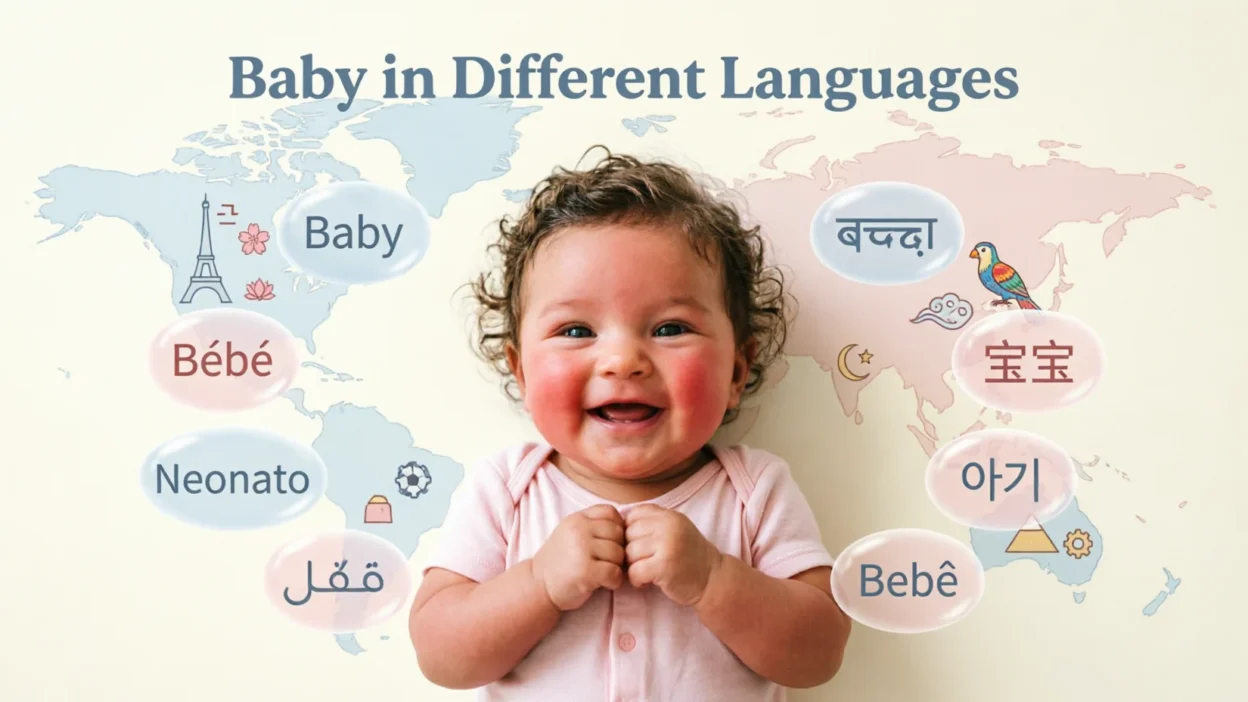
The word “baby” is one of the most familiar and affectionate words in everyday communication. If you are learning a new language, traveling, writing a multilingual message, or simply curious about world languages, knowing how to say baby in different languages can be both useful and interesting.
The translation of “baby” can vary depending on the language and context. Some languages use a direct word for an infant, while others have different forms for a newborn, small child, or affectionate term. Below, you will find baby in all languages with native translations, easy English pronunciations, and simple example sentences.
If you have been searching for how to say baby in different languages, this table provides 70 useful translations from languages spoken around the world.
Baby in Different Languages: 70 Translations
| # | Language | Native Phrase | Easy English Pronunciation | Example Sentence | English Meaning |
|---|---|---|---|---|---|
| 1 | English | Baby | BAY-bee | The baby is sleeping. | The baby is sleeping. |
| 2 | Spanish | Bebé | beh-BEH | El bebé está durmiendo. | The baby is sleeping. |
| 3 | French | Bébé | bay-BAY | Le bébé dort. | The baby is sleeping. |
| 4 | German | Baby | BAY-bee | Das Baby schläft. | The baby is sleeping. |
| 5 | Italian | Bambino | bam-BEE-noh | Il bambino dorme. | The baby is sleeping. |
| 6 | Portuguese | Bebê | beh-BEH | O bebê está dormindo. | The baby is sleeping. |
| 7 | Dutch | Baby | BAY-bee | De baby slaapt. | The baby is sleeping. |
| 8 | Swedish | Bebis | BEH-bis | Bebisen sover. | The baby is sleeping. |
| 9 | Norwegian | Baby | BAY-bee | Babyen sover. | The baby is sleeping. |
| 10 | Danish | Baby | BAY-bee | Babyen sover. | The baby is sleeping. |
| 11 | Finnish | Vauva | VOW-vah | Vauva nukkuu. | The baby is sleeping. |
| 12 | Icelandic | Barn | BARTN | Barnið sefur. | The baby is sleeping. |
| 13 | Irish | Leanbh | LAN-iv | Tá an leanbh ina chodladh. | The baby is sleeping. |
| 14 | Welsh | Babi | BAH-bee | Mae’r babi’n cysgu. | The baby is sleeping. |
| 15 | Scottish Gaelic | Pàisde | PAHSH-cheh | Tha am pàisde na chadal. | The baby is sleeping. |
| 16 | Polish | Niemowlę | nyeh-MOV-lyeh | Niemowlę śpi. | The baby is sleeping. |
| 17 | Czech | Miminko | MEE-meen-koh | Miminko spí. | The baby is sleeping. |
| 18 | Slovak | Bábätko | BAH-byat-koh | Bábätko spí. | The baby is sleeping. |
| 19 | Slovenian | Dojenček | doh-YEN-chek | Dojenček spi. | The baby is sleeping. |
| 20 | Croatian | Beba | BEH-bah | Beba spava. | The baby is sleeping. |
| 21 | Serbian | Беба | BEH-bah | Беба спава. | The baby is sleeping. |
| 22 | Bosnian | Beba | BEH-bah | Beba spava. | The baby is sleeping. |
| 23 | Bulgarian | Бебе | BEH-beh | Бебето спи. | The baby is sleeping. |
| 24 | Macedonian | Бебе | BEH-beh | Бебето спие. | The baby is sleeping. |
| 25 | Romanian | Bebeluș | beh-beh-LOOSH | Bebelușul doarme. | The baby is sleeping. |
| 26 | Hungarian | Baba | BAH-bah | A baba alszik. | The baby is sleeping. |
| 27 | Greek | Μωρό | moh-ROH | Το μωρό κοιμάται. | The baby is sleeping. |
| 28 | Russian | Малыш | mah-LYSH | Малыш спит. | The baby is sleeping. |
| 29 | Ukrainian | Немовля | neh-mov-LYAH | Немовля спить. | The baby is sleeping. |
| 30 | Belarusian | Немаўля | neh-MOW-lyah | Немаўля спіць. | The baby is sleeping. |
| 31 | Lithuanian | Kūdikis | KOO-dee-kis | Kūdikis miega. | The baby is sleeping. |
| 32 | Latvian | Mazulis | MAH-zoo-lis | Mazulis guļ. | The baby is sleeping. |
| 33 | Estonian | Beebi | BAY-bee | Beebi magab. | The baby is sleeping. |
| 34 | Albanian | Bebë | BEH-buh | Bebja po fle. | The baby is sleeping. |
| 35 | Turkish | Bebek | beh-BEK | Bebek uyuyor. | The baby is sleeping. |
| 36 | Azerbaijani | Körpə | KUR-pah | Körpə yatır. | The baby is sleeping. |
| 37 | Armenian | Երեխա | yeh-reh-KHA | Երեխան քնած է։ | The baby is sleeping. |
| 38 | Georgian | ჩვილი | CHVI-lee | ჩვილი სძინავს. | The baby is sleeping. |
| 39 | Arabic | طفل رضيع | TIFL ra-DEE | الطفل الرضيع نائم. | The infant is sleeping. |
| 40 | Hebrew | תינוק | tee-NOOK | התינוק ישן. | The baby is sleeping. |
| 41 | Persian | نوزاد | noo-ZAAD | نوزاد خواب است. | The baby is sleeping. |
| 42 | Urdu | بچہ | bach-CHA | بچہ سو رہا ہے۔ | The baby is sleeping. |
| 43 | Hindi | बच्चा | BACH-cha | बच्चा सो रहा है। | The baby is sleeping. |
| 44 | Bengali | শিশু | SHEE-shoo | শিশুটি ঘুমাচ্ছে। | The baby is sleeping. |
| 45 | Punjabi | ਬੱਚਾ | BACH-cha | ਬੱਚਾ ਸੌਂ ਰਿਹਾ ਹੈ। | The baby is sleeping. |
| 46 | Gujarati | બાળક | BAA-lak | બાળક સૂઈ રહ્યું છે. | The baby is sleeping. |
| 47 | Marathi | बाळ | BAAL | बाळ झोपले आहे. | The baby is sleeping. |
| 48 | Nepali | बच्चा | BACH-cha | बच्चा सुतिरहेको छ। | The baby is sleeping. |
| 49 | Sinhala | බබා | BAH-bah | බබා නිදි. | The baby is sleeping. |
| 50 | Tamil | குழந்தை | koo-lan-THAI | குழந்தை தூங்குகிறது. | The baby is sleeping. |
| 51 | Telugu | శిశువు | shi-shu-voo | శిశువు నిద్రపోతోంది. | The baby is sleeping. |
| 52 | Kannada | ಮಗು | MAH-goo | ಮಗು ಮಲಗಿದೆ. | The baby is sleeping. |
| 53 | Malayalam | കുഞ്ഞ് | KOONJ | കുഞ്ഞ് ഉറങ്ങുന്നു. | The baby is sleeping. |
| 54 | Odia | ଶିଶୁ | SHEE-shoo | ଶିଶୁଟି ଶୋଇଛି। | The baby is sleeping. |
| 55 | Assamese | কেঁচুৱা | KEN-choo-ah | কেঁচুৱাটো শুই আছে। | The baby is sleeping. |
| 56 | Chinese | 婴儿 | YING-er | 婴儿正在睡觉。 | The baby is sleeping. |
| 57 | Japanese | 赤ちゃん | ah-KAH-chan | 赤ちゃんが寝ています。 | The baby is sleeping. |
| 58 | Korean | 아기 | AH-gee | 아기가 자고 있어요. | The baby is sleeping. |
| 59 | Vietnamese | Em bé | em BAY | Em bé đang ngủ. | The baby is sleeping. |
| 60 | Thai | ทารก | TAA-rok | ทารกกำลังนอนหลับ | The baby is sleeping. |
| 61 | Indonesian | Bayi | BAH-yee | Bayi sedang tidur. | The baby is sleeping. |
| 62 | Malay | Bayi | BAH-yee | Bayi sedang tidur. | The baby is sleeping. |
| 63 | Filipino | Sanggol | SANG-gol | Natutulog ang sanggol. | The baby is sleeping. |
| 64 | Khmer | ទារក | TEE-ah-rohk | ទារកកំពុងដេក។ | The baby is sleeping. |
| 65 | Lao | ເດັກນ້ອຍ | DEK noy | ເດັກນ້ອຍກຳລັງນອນ. | The baby is sleeping. |
| 66 | Burmese | ကလေး | ka-LAY | ကလေးအိပ်နေတယ်။ | The baby is sleeping. |
| 67 | Mongolian | Нярай | NYA-rye | Нярай унтаж байна. | The newborn is sleeping. |
| 68 | Swahili | Mtoto | m-TOH-toh | Mtoto amelala. | The child is sleeping. |
| 69 | Zulu | Ingane | in-GAH-neh | Ingane ilele. | The baby is sleeping. |
| 70 | Afrikaans | Baba | BAH-bah | Die baba slaap. | The baby is sleeping. |
What Does Baby Mean?
“Baby” generally refers to a very young child, especially an infant who has not yet reached the toddler stage. The word can also be used affectionately for someone a person loves or cares about.
In different languages, the most natural translation may depend on age and context. For example, a language may distinguish between a newborn, infant, baby, and young child.
How to Say Baby in Different Languages
Learning how to say “baby” in different languages is a simple way to expand your vocabulary. Common translations include bebé in Spanish and Portuguese, bébé in French, bebek in Turkish, vauva in Finnish, bayi in Indonesian and Malay, and 아기 in Korean.
Some translations are direct equivalents, while others may have a slightly different meaning depending on the age of the child.
Baby in All Languages: Common Translations
The word “baby” has many familiar forms around the world. Several European languages use words that sound similar to English, such as German “Baby,” Dutch “baby,” Norwegian “baby,” and Danish “baby.”
Other languages have completely different words. Finnish uses “vauva,” Turkish uses “bebek,” Japanese uses “赤ちゃん,” and Chinese commonly uses “婴儿” for an infant.
Baby Translations Around the World
Baby translations around the world show how languages describe young children in different ways. Some words focus specifically on infancy, while others can refer more generally to a child.
Context is especially important when translating this word. A formal translation may differ from the affectionate term parents commonly use at home.
Why Learn the Word Baby in Different Languages?
Knowing simple everyday words can make language learning more enjoyable and practical. “Baby” is especially useful because it appears frequently in conversations about families, children, parenting, travel, and everyday life.
Learning these translations can also help students recognize similarities between languages and understand how different cultures describe young children.
Baby in Different Languages for Travel and Language Learning
If you are traveling or communicating with people from another country, basic family and child-related vocabulary can be useful. Learning the local word for baby can help you understand conversations, signs, books, and simple sentences.
For language learners, practicing the word in a short sentence is often more effective than memorizing the translation alone.
Tips for Pronouncing Baby in Different Languages
Pronunciation can vary considerably between languages. The English pronunciation column above is designed as a simple guide rather than a precise phonetic transcription.
For the best pronunciation, listen to native speakers and pay attention to vowel sounds, stress, and regional accents. Repeating the word several times in a short sentence can also improve confidence.
Conclusion
Learning how to say baby in different languages is a simple and useful way to explore global vocabulary. The 70 translations above include words from European, Asian, Middle Eastern, and African languages, along with easy pronunciations and practical examples.
If you are studying languages, researching baby-related vocabulary, or simply curious about baby around the world, these translations provide a helpful starting point.
FAQs:
1. How do you say baby in different languages?
“Baby” has different translations depending on the language. Examples include bebé in Spanish, bébé in French, bebek in Turkish, vauva in Finnish, bayi in Indonesian, and 아기 in Korean.
2. What is baby in Spanish?
Baby in Spanish is bebé. It is pronounced approximately “beh-BEH” and is commonly used to refer to an infant or very young child.
3. What is baby in French?
Baby in French is bébé, pronounced approximately “bay-BAY.” It is a common word for a baby or infant.
4. What is baby in Japanese?
Baby in Japanese is commonly 赤ちゃん, pronounced approximately “ah-KAH-chan.” It is a familiar and affectionate way to refer to a baby.
5. What is baby in Hindi and Urdu?
In Hindi, a common word is बच्चा (bachcha), while Urdu commonly uses بچہ (bachcha). Both can refer to a child, and the exact meaning depends on context and age.

Brandon Cody is the Administrator of LingoMean, a platform dedicated to helping people discover the right words for every situation. He oversees content quality, website management, and user experience, ensuring readers receive accurate, practical, and easy-to-understand communication guidance.