The word “bear” refers to a large mammal belonging to the family Ursidae. Bears are found across many parts of the world and appear frequently in wildlife discussions, books, mythology, stories, logos, and everyday language.
If you are searching for bear in different languages, this guide gives you 70 translations from around the world. Each entry includes the native word or phrase, an easy English pronunciation, a short example sentence, and the English meaning.
If you are learning vocabulary, exploring animal names, writing multilingual content, or simply wondering how to say bear in different languages, the table below makes the translations easy to compare.
Bear in Different Languages
The following table provides bear in all languages covered in this guide. Pronunciations are simplified for English speakers and are intended as an easy reading aid.
| # | Language | Native Word for Bear | Easy English Pronunciation | Example Sentence | English Meaning |
|---|---|---|---|---|---|
| 1 | English | bear | bair | I saw a bear in the forest. | I saw a bear in the forest. |
| 2 | Spanish | oso | OH-soh | Vi un oso en el bosque. | I saw a bear in the forest. |
| 3 | French | ours | oors | J’ai vu un ours dans la forêt. | I saw a bear in the forest. |
| 4 | German | Bär | bair | Ich sah einen Bären im Wald. | I saw a bear in the forest. |
| 5 | Italian | orso | OR-soh | Ho visto un orso nel bosco. | I saw a bear in the woods. |
| 6 | Portuguese | urso | OOR-soo | Eu vi um urso na floresta. | I saw a bear in the forest. |
| 7 | Dutch | beer | bair | Ik zag een beer in het bos. | I saw a bear in the forest. |
| 8 | Swedish | björn | byurn | Jag såg en björn i skogen. | I saw a bear in the forest. |
| 9 | Norwegian | bjørn | byurn | Jeg så en bjørn i skogen. | I saw a bear in the forest. |
| 10 | Danish | bjørn | byurn | Jeg så en bjørn i skoven. | I saw a bear in the forest. |
| 11 | Finnish | karhu | KAR-hoo | Näin karhun metsässä. | I saw a bear in the forest. |
| 12 | Icelandic | björn | byurt-n | Ég sá björn í skóginum. | I saw a bear in the forest. |
| 13 | Irish | béar | bair | Chonaic mé béar san fhoraois. | I saw a bear in the forest. |
| 14 | Welsh | arth | arth | Gwelais arth yn y goedwig. | I saw a bear in the forest. |
| 15 | Scottish Gaelic | mathan | MAH-an | Chunnaic mi mathan sa choille. | I saw a bear in the forest. |
| 16 | Polish | niedźwiedź | NYEDZH-vyetch | Widziałem niedźwiedzia w lesie. | I saw a bear in the forest. |
| 17 | Czech | medvěd | MED-vyet | Viděl jsem medvěda v lese. | I saw a bear in the forest. |
| 18 | Slovak | medveď | MED-ved | Videl som medveďa v lese. | I saw a bear in the forest. |
| 19 | Slovenian | medved | MED-ved | Videl sem medveda v gozdu. | I saw a bear in the forest. |
| 20 | Croatian | medvjed | MED-vyed | Vidio sam medvjeda u šumi. | I saw a bear in the forest. |
| 21 | Serbian | медвед | MED-ved | Видео сам медведа у шуми. | I saw a bear in the forest. |
| 22 | Bulgarian | мечка | MECH-kah | Видях мечка в гората. | I saw a bear in the forest. |
| 23 | Macedonian | мечка | MECH-kah | Видов мечка во шумата. | I saw a bear in the forest. |
| 24 | Russian | медведь | med-VYED | Я увидел медведя в лесу. | I saw a bear in the forest. |
| 25 | Ukrainian | ведмідь | ved-MEED | Я побачив ведмедя в лісі. | I saw a bear in the forest. |
| 26 | Belarusian | мядзведзь | myad-ZVYEDZ | Я ўбачыў мядзведзя ў лесе. | I saw a bear in the forest. |
| 27 | Lithuanian | lokys | LOH-kis | Aš mačiau lokį miške. | I saw a bear in the forest. |
| 28 | Latvian | lācis | LAH-tsis | Es redzēju lāci mežā. | I saw a bear in the forest. |
| 29 | Estonian | karu | KAH-roo | Ma nägin metsas karu. | I saw a bear in the forest. |
| 30 | Hungarian | medve | MED-veh | Láttam egy medvét az erdőben. | I saw a bear in the forest. |
| 31 | Romanian | urs | oorz | Am văzut un urs în pădure. | I saw a bear in the forest. |
| 32 | Albanian | ari | AH-ree | Pashë një ari në pyll. | I saw a bear in the forest. |
| 33 | Greek | αρκούδα | ar-KOO-tha | Είδα μια αρκούδα στο δάσος. | I saw a bear in the forest. |
| 34 | Turkish | ayı | AH-yuh | Ormanda bir ayı gördüm. | I saw a bear in the forest. |
| 35 | Azerbaijani | ayı | AH-yuh | Meşədə ayı gördüm. | I saw a bear in the forest. |
| 36 | Armenian | արջ | arj | Ես անտառում արջ տեսա։ | I saw a bear in the forest. |
| 37 | Georgian | დათვი | DAT-vee | ტყეში დათვი დავინახე. | I saw a bear in the forest. |
| 38 | Persian | خرس | khers | من یک خرس در جنگل دیدم. | I saw a bear in the forest. |
| 39 | Arabic | دب | dubb | رأيت دبًا في الغابة. | I saw a bear in the forest. |
| 40 | Hebrew | דוב | dov | ראיתי דוב ביער. | I saw a bear in the forest. |
| 41 | Hindi | भालू | BHAH-loo | मैंने जंगल में भालू देखा। | I saw a bear in the forest. |
| 42 | Urdu | ریچھ | reechh | میں نے جنگل میں ریچھ دیکھا۔ | I saw a bear in the forest. |
| 43 | Bengali | ভালুক | BHA-loo-k | আমি বনে একটি ভালুক দেখেছি। | I saw a bear in the forest. |
| 44 | Punjabi | ਰਿੱਛ | ritchh | ਮੈਂ ਜੰਗਲ ਵਿੱਚ ਰਿੱਛ ਦੇਖਿਆ। | I saw a bear in the forest. |
| 45 | Gujarati | રીંછ | reenchh | મેં જંગલમાં રીંછ જોયું. | I saw a bear in the forest. |
| 46 | Marathi | अस्वल | AS-vul | मी जंगलात अस्वल पाहिले. | I saw a bear in the forest. |
| 47 | Nepali | भालु | BHAH-loo | मैले जंगलमा भालु देखें। | I saw a bear in the forest. |
| 48 | Sinhala | වලහා | va-la-HA | මම වනාන්තරයේ වලහෙක් දුටුවෙමි. | I saw a bear in the forest. |
| 49 | Tamil | கரடி | ka-RA-di | நான் காட்டில் ஒரு கரடியைப் பார்த்தேன். | I saw a bear in the forest. |
| 50 | Telugu | ఎలుగుబంటి | eh-loo-goo-BUN-tee | నేను అడవిలో ఎలుగుబంటిని చూశాను. | I saw a bear in the forest. |
| 51 | Kannada | ಕರಡಿ | ka-ra-DEE | ನಾನು ಕಾಡಿನಲ್ಲಿ ಕರಡಿಯನ್ನು ನೋಡಿದೆ. | I saw a bear in the forest. |
| 52 | Malayalam | കരടി | ka-ra-DEE | ഞാൻ കാട്ടിൽ ഒരു കരടിയെ കണ്ടു. | I saw a bear in the forest. |
| 53 | Odia | ଭାଲୁ | BHAH-loo | ମୁଁ ଜଙ୍ଗଲରେ ଭାଲୁ ଦେଖିଲି। | I saw a bear in the forest. |
| 54 | Assamese | ভালুক | BHA-look | মই হাবিত এটা ভালুক দেখিলোঁ। | I saw a bear in the forest. |
| 55 | Chinese | 熊 | shyong | 我在森林里看到一只熊。 | I saw a bear in the forest. |
| 56 | Japanese | 熊 | koo-ma | 森で熊を見ました。 | I saw a bear in the forest. |
| 57 | Korean | 곰 | gom | 나는 숲에서 곰을 봤어요. | I saw a bear in the forest. |
| 58 | Vietnamese | gấu | gow | Tôi thấy một con gấu trong rừng. | I saw a bear in the forest. |
| 59 | Thai | หมี | mee | ฉันเห็นหมีในป่า | I saw a bear in the forest. |
| 60 | Indonesian | beruang | beh-roo-ahng | Saya melihat beruang di hutan. | I saw a bear in the forest. |
| 61 | Malay | beruang | beh-roo-ahng | Saya nampak beruang di hutan. | I saw a bear in the forest. |
| 62 | Filipino | oso | OH-soh | Nakakita ako ng oso sa gubat. | I saw a bear in the forest. |
| 63 | Swahili | dubu | DOO-boo | Niliona dubu msituni. | I saw a bear in the forest. |
| 64 | Afrikaans | beer | bair | Ek het ’n beer in die bos gesien. | I saw a bear in the forest. |
| 65 | Zulu | ibhele | ee-BEH-leh | Ngabona ibhele ehlathini. | I saw a bear in the forest. |
| 66 | Xhosa | ibhere | ee-BEH-reh | Ndabona ibhere ehlathini. | I saw a bear in the forest. |
| 67 | Somali | orso | OR-soh | Waxaan kaynta ku arkay orso. | I saw a bear in the forest. |
| 68 | Amharic | ድብ | dib | በጫካ ውስጥ ድብ አየሁ። | I saw a bear in the forest. |
| 69 | Malagasy | bera | BEH-rah | Nahita bera tany anaty ala aho. | I saw a bear in the forest. |
| 70 | Māori | pea | PEH-ah | I kite au i te pea i te ngahere. | I saw a bear in the forest. |
What Does “Bear” Mean?
A bear is a large mammal belonging to the family Ursidae. Bears are generally characterized by powerful bodies, strong limbs, thick fur, and large paws.
The English word “bear” can refer to the animal generally, while specific types include the polar bear, brown bear, black bear, and giant panda. The exact vocabulary used for bears differs considerably across languages.
How to Say Bear in Different Languages
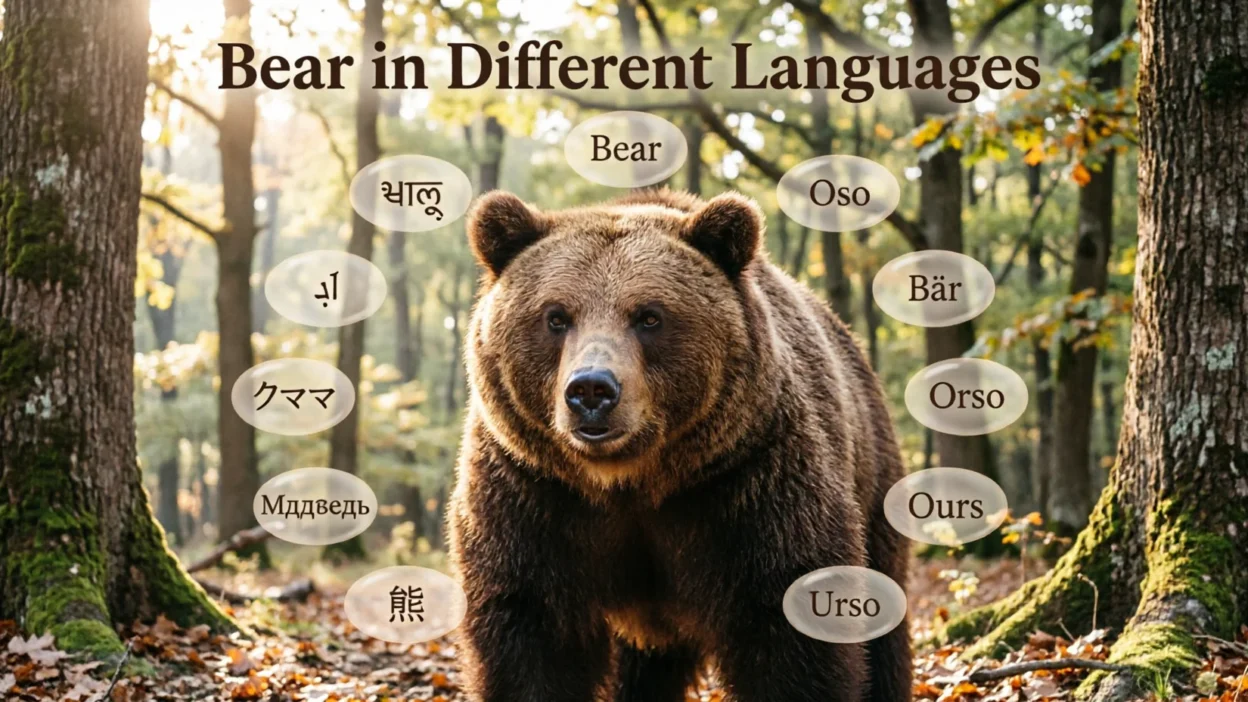
The word for bear varies widely from one language to another. For example, Spanish uses “oso,” French uses “ours,” German uses “Bär,” Italian uses “orso,” and Russian uses “медведь.”
In several South Asian languages, the word is also quite different. Hindi uses “भालू,” Urdu uses “ریچھ,” Punjabi uses “ਰਿੱਛ,” and Bengali uses “ভালুক.”
These differences make animal vocabulary an interesting way to explore how languages develop and how cultures describe the natural world.
Bear Translations in European Languages
European languages offer a wide range of words for bear. Romance languages include forms such as “oso” in Spanish, “ours” in French, “orso” in Italian, and “urso” in Portuguese.
Germanic languages also have distinctive terms. German uses “Bär,” Dutch uses “beer,” while Swedish, Norwegian, Danish, and Icelandic use closely related forms based around “björn” or “bjørn.”
Slavic languages commonly use forms derived from older Slavic vocabulary, including “medvěd,” “medved,” and “медведь.”
Bear in Asian Languages
Asian languages show some of the most interesting variations in bear translations. Hindi uses “भालू,” Urdu uses “ریچھ,” and Nepali uses “भालु.”
Chinese uses “熊,” Japanese uses “熊,” and Korean uses “곰.” Vietnamese uses “gấu,” while Indonesian and Malay use “beruang.”
The examples demonstrate that there is no single universal pattern for translating the name of an animal.
Bear in African Languages
African languages also have their own words for bear. Swahili uses “dubu,” while Zulu uses “ibhele” and Xhosa uses “ibhere.”
Afrikaans, which developed from Dutch, uses “beer,” showing a connection with vocabulary found in another Germanic language.
Amharic uses “ድብ,” while Malagasy uses “bera.”
Bear in Middle Eastern Languages
Several Middle Eastern languages have distinct terms for the animal. Arabic commonly uses “دب,” Hebrew uses “דוב,” Persian uses “خرس,” and Turkish uses “ayı.”
Learning these translations can be especially useful for travelers, language learners, students, and anyone interested in comparing vocabulary across language families.
Bear in South Asian Languages
South Asia contains a remarkable variety of languages, and the translations for bear reflect that diversity.
Hindi uses “भालू,” Urdu uses “ریچھ,” Punjabi uses “ਰਿੱਛ,” Bengali uses “ভালুক,” Gujarati uses “રીંછ,” and Marathi uses “अस्वल.”
Dravidian languages also have different terms. Tamil uses “கரடி,” Telugu uses “ఎలుగుబంటి,” Kannada uses “ಕರಡಿ,” and Malayalam uses “കരടി.”
Why Learn Bear in Different Languages?
Learning the word “bear” in multiple languages can be useful for vocabulary building and cultural exploration. Animal names are simple, memorable words that can help beginners compare pronunciation, writing systems, and sentence structure.
It can also be useful when creating educational material, multilingual projects, language-learning exercises, travel content, or creative writing.
Bear Around the World
Bears have an important place in wildlife, folklore, literature, and popular culture. Different bear species live in different regions, including parts of North America, Europe, Asia, and other northern areas.
Because languages have developed independently across these regions, the word for bear can sound and look very different from one language to another.
Exploring bear around the world therefore offers more than a simple vocabulary lesson. It provides a small glimpse into the diversity of human languages.
Common Types of Bears
There are several well-known bear species and bear groups. Some of the most familiar include:
- Brown bear
- American black bear
- Polar bear
- Asian black bear
- Sloth bear
- Sun bear
- Spectacled bear
- Giant panda
Different languages may have additional words for individual bear species, so the general word for “bear” should not always be confused with the name of a particular species.
Bear Translations for Language Learners
For language learners, the easiest way to remember a new animal word is to connect it with a simple sentence.
For example, Spanish learners can remember “oso” through “Vi un oso,” meaning “I saw a bear.” French learners can practice “ours” with “J’ai vu un ours.” German learners can use “Bär” in a simple sentence about seeing a bear.
Using the word in context makes vocabulary more memorable than learning isolated translations.
FAQs:
1. How do you say bear in different languages?
“Bear” has many translations. Some common examples are “oso” in Spanish, “ours” in French, “Bär” in German, “orso” in Italian, “medved” in Slovenian, “деб” in Arabic script as “دب,” “भालू” in Hindi, “熊” in Chinese, and “곰” in Korean.
2. What is bear in Spanish?
The Spanish word for bear is “oso.” For example, “Vi un oso en el bosque” means “I saw a bear in the forest.”
3. What is bear in Hindi and Urdu?
In Hindi, bear is “भालू” (bhaalu). In Urdu, it is “ریچھ” (reechh). Both words refer to the animal commonly known as a bear in English.
4. What is bear in Japanese and Chinese?
In Japanese, bear is “熊,” commonly pronounced “kuma.” In Chinese, “熊” is pronounced “xióng.” Both characters represent the word for bear in their respective languages.
5. Why are bear translations different in every language?
Languages developed independently over long periods and often borrowed or changed words through contact with neighboring cultures. As a result, the same animal can have completely different names in different languages.
Conclusion
Learning bear in different languages is a simple and interesting way to explore global vocabulary. From “oso” in Spanish and “ours” in French to “भालू” in Hindi, “ریچھ” in Urdu, and “熊” in Chinese, the word changes significantly across languages.
These 70 bear translations provide a useful reference for students, language learners, writers, travelers, and anyone curious about how people describe animals around the world.

Anthony Dylan is a language enthusiast and content writer at LingoMean, where he helps readers understand what to say in different situations. He creates clear, practical, and engaging guides that improve communication, confidence, and everyday conversations.