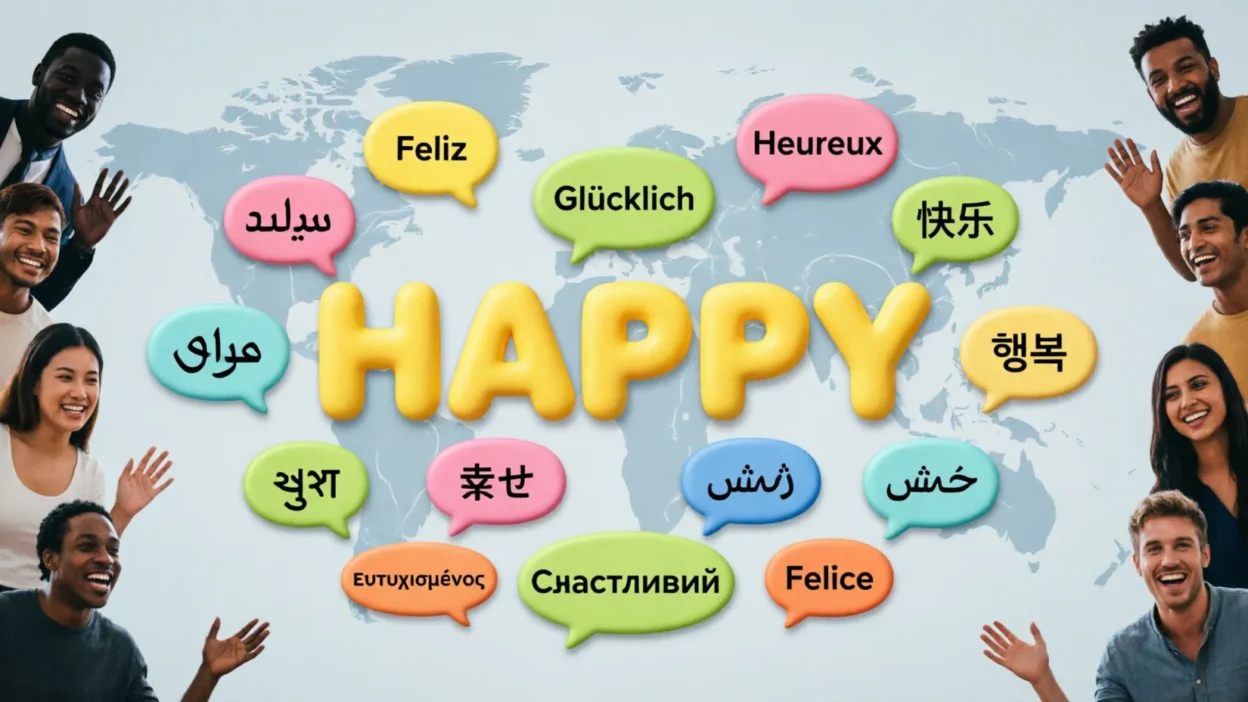
The word happy is one of the most positive and universal words in any language. If you are learning a new language, writing a message, traveling, or simply curious about world languages, knowing how to say “happy” in different languages can help you express positive feelings naturally.
Although the exact translation can change depending on context, most languages have a common word or expression for describing someone who feels joyful, pleased, or content. In this guide, you will discover happy in different languages, including the native phrase, an easy English pronunciation, and a simple real-life example.
Below is a complete list of 70 happy translations around the world. It is useful for language learners, writers, students, travelers, and anyone searching for how to say happy in all languages.
Happy in Different Languages: 70 Translations
| # | Language | Native Phrase | Easy English Pronunciation | Example Sentence | English Meaning |
|---|---|---|---|---|---|
| 1 | English | Happy | HAP-ee | I am happy today. | I am happy today. |
| 2 | Spanish | Feliz | feh-LEES | Estoy feliz hoy. | I am happy today. |
| 3 | French | Heureux / Heureuse | uh-RUH / uh-RUHZ | Je suis heureux aujourd’hui. | I am happy today. |
| 4 | German | Glücklich | GLOOK-likh | Ich bin glücklich heute. | I am happy today. |
| 5 | Italian | Felice | feh-LEE-cheh | Sono felice oggi. | I am happy today. |
| 6 | Portuguese | Feliz | feh-LEEZ | Estou feliz hoje. | I am happy today. |
| 7 | Dutch | Gelukkig | guh-LOO-khikh | Ik ben gelukkig vandaag. | I am happy today. |
| 8 | Russian | Счастливый | SHAS-lee-vihy | Я счастлив сегодня. | I am happy today. |
| 9 | Ukrainian | Щасливий | shchas-LY-vyi | Я щасливий сьогодні. | I am happy today. |
| 10 | Polish | Szczęśliwy | shchen-SHLEE-vih | Jestem szczęśliwy. | I am happy. |
| 11 | Czech | Šťastný | SHTYAST-nee | Jsem šťastný. | I am happy. |
| 12 | Slovak | Šťastný | SHTYAST-nee | Som šťastný. | I am happy. |
| 13 | Slovenian | Srečen | SREH-chen | Sem srečen. | I am happy. |
| 14 | Croatian | Sretan | SREH-tan | Sretan sam danas. | I am happy today. |
| 15 | Serbian | Срећан | SREH-chan | Срећан сам данас. | I am happy today. |
| 16 | Bosnian | Sretan | SREH-tan | Ja sam sretan. | I am happy. |
| 17 | Bulgarian | Щастлив | SHTAS-tleev | Аз съм щастлив. | I am happy. |
| 18 | Macedonian | Среќен | SREH-kyen | Јас сум среќен. | I am happy. |
| 19 | Romanian | Fericit | feh-ree-CHEET | Sunt fericit. | I am happy. |
| 20 | Hungarian | Boldog | BOL-dog | Boldog vagyok. | I am happy. |
| 21 | Greek | Ευτυχισμένος | ef-tee-khee-SME-nos | Είμαι ευτυχισμένος. | I am happy. |
| 22 | Albanian | I lumtur | ee LOOM-toor | Jam i lumtur. | I am happy. |
| 23 | Turkish | Mutlu | MOOT-loo | Bugün mutluyum. | I am happy today. |
| 24 | Azerbaijani | Xoşbəxt | khosh-BEKHT | Mən xoşbəxtəm. | I am happy. |
| 25 | Armenian | Երջանիկ | yer-jah-NEEK | Ես երջանիկ եմ. | I am happy. |
| 26 | Georgian | ბედნიერი | bed-nee-EH-ree | მე ბედნიერი ვარ. | I am happy. |
| 27 | Persian | خوشحال | khosh-HAL | من خوشحالم. | I am happy. |
| 28 | Arabic | سعيد | sa-EED | أنا سعيد اليوم. | I am happy today. |
| 29 | Hebrew | שמח | sa-ME-ach | אני שמח היום. | I am happy today. |
| 30 | Hindi | खुश | khush | मैं आज खुश हूँ। | I am happy today. |
| 31 | Urdu | خوش | khush | میں آج خوش ہوں۔ | I am happy today. |
| 32 | Bengali | খুশি | KHU-shee | আমি আজ খুশি। | I am happy today. |
| 33 | Punjabi | ਖੁਸ਼ | khush | ਮੈਂ ਅੱਜ ਖੁਸ਼ ਹਾਂ। | I am happy today. |
| 34 | Gujarati | ખુશ | khush | હું આજે ખુશ છું. | I am happy today. |
| 35 | Marathi | आनंदी | aa-NAN-dee | मी आज आनंदी आहे. | I am happy today. |
| 36 | Nepali | खुसी | KHU-see | म आज खुसी छु। | I am happy today. |
| 37 | Sinhala | සතුටු | sa-TOO-too | මම අද සතුටුයි. | I am happy today. |
| 38 | Tamil | மகிழ்ச்சியாக | ma-gizh-CHYAA-ga | நான் மகிழ்ச்சியாக இருக்கிறேன். | I am happy. |
| 39 | Telugu | సంతోషంగా | san-TO-shan-ga | నేను సంతోషంగా ఉన్నాను. | I am happy. |
| 40 | Kannada | ಸಂತೋಷ | san-TO-sha | ನಾನು ಸಂತೋಷವಾಗಿದ್ದೇನೆ. | I am happy. |
| 41 | Malayalam | സന്തോഷം | san-TO-sham | ഞാൻ സന്തോഷവാനാണ്. | I am happy. |
| 42 | Odia | ଖୁସି | KHU-shee | ମୁଁ ଆଜି ଖୁସି ଅଛି। | I am happy today. |
| 43 | Assamese | সুখী | soo-KHEE | মই সুখী। | I am happy. |
| 44 | Chinese (Mandarin) | 快乐 | KUAHY-luh | 我今天很快乐。 | I am very happy today. |
| 45 | Japanese | 幸せ | shee-AH-wah-seh | 私は幸せです。 | I am happy. |
| 46 | Korean | 행복한 | haeng-BOK-han | 나는 행복해요. | I am happy. |
| 47 | Vietnamese | Hạnh phúc | han FOOK | Tôi hạnh phúc. | I am happy. |
| 48 | Thai | มีความสุข | mee khwaam SOOK | ฉันมีความสุข | I am happy. |
| 49 | Indonesian | Bahagia | ba-ha-GEE-a | Saya bahagia hari ini. | I am happy today. |
| 50 | Malay | Gembira | gem-BEE-ra | Saya gembira hari ini. | I am happy today. |
| 51 | Filipino | Masaya | ma-SA-ya | Masaya ako ngayon. | I am happy now. |
| 52 | Javanese | Bungah | BOO-ngah | Aku bungah dina iki. | I am happy today. |
| 53 | Sundanese | Bagja | BAG-ja | Abdi bagja ayeuna. | I am happy now. |
| 54 | Burmese | ပျော်ရွှင် | pyaw-SHWIN | ကျွန်တော် ပျော်ရွှင်ပါတယ်။ | I am happy. |
| 55 | Khmer | សប្បាយ | sa-BYE | ខ្ញុំសប្បាយចិត្ត។ | I am happy. |
| 56 | Lao | ມີຄວາມສຸກ | mee khwam sook | ຂ້ອຍມີຄວາມສຸກ. | I am happy. |
| 57 | Mongolian | Аз жаргалтай | az jar-GAL-tai | Би аз жаргалтай байна. | I am happy. |
| 58 | Kazakh | Бақытты | ba-KUT-ty | Мен бақыттымын. | I am happy. |
| 59 | Uzbek | Baxtli | bakh-TLEE | Men baxtliman. | I am happy. |
| 60 | Kyrgyz | Бактылуу | bak-tuh-LOO | Мен бактылуумун. | I am happy. |
| 61 | Tajik | Хушбахт | khush-BAKHT | Ман хушбахтам. | I am happy. |
| 62 | Turkmen | Bagtly | bagt-LUH | Men bagtly. | I am happy. |
| 63 | Estonian | Õnnelik | UN-neh-lik | Ma olen õnnelik. | I am happy. |
| 64 | Finnish | Onnellinen | ON-neh-lee-nen | Olen onnellinen. | I am happy. |
| 65 | Swedish | Lycklig | LOOK-lig | Jag är lycklig. | I am happy. |
| 66 | Norwegian | Lykkelig | LOOK-eh-lee | Jeg er lykkelig. | I am happy. |
| 67 | Danish | Lykkelig | LOOK-eh-lee | Jeg er lykkelig. | I am happy. |
| 68 | Icelandic | Hamingjusamur | HA-ming-yoo-sa-mur | Ég er hamingjusamur. | I am happy. |
| 69 | Irish | Sásta | SAW-sta | Tá mé sásta. | I am happy. |
| 70 | Welsh | Hapus | HAP-is | Rwy’n hapus heddiw. | I am happy today. |
How to Say Happy in Different Languages
The most common way to say happy in different languages is to use an adjective describing a person’s emotional state. However, languages do not always translate the English word “happy” in exactly the same way.
For example, Spanish uses feliz, French commonly uses heureux or heureuse, German uses glücklich, and Italian uses felice. In several Asian languages, expressions meaning “to have happiness” or “to be in a state of happiness” are also common.
This is why understanding the context is important when learning happy translations.
Happy in All Languages: What Does It Mean?
In English, “happy” generally describes a positive emotional state. It can mean feeling joyful, pleased, satisfied, fortunate, or emotionally content.
The appropriate translation can depend on the sentence. Someone can be happy about an event, happy with a result, or simply feel happy in life. Some languages use different grammatical forms depending on gender, number, or sentence structure.
Happy Around the World
The idea of happiness exists in every culture, but languages express it in different ways. European languages often use words that directly correspond to “happy,” while some Asian and Middle Eastern languages may use expressions associated with happiness, joy, satisfaction, or good fortune.
Learning these expressions is a useful way to understand how different cultures communicate emotions. It can also make conversations more natural when speaking with people from other countries.
Why Learn the Word Happy in Different Languages?
Learning how to say “happy” in another language can be useful for several reasons:
- It can improve your everyday vocabulary.
- It helps when traveling internationally.
- It is useful for language-learning practice.
- It can make greetings and personal messages more meaningful.
- It helps you understand cultural differences in expressing emotions.
- It provides useful vocabulary for writing and translation.
Happy Translations for Language Learners
If you are studying a foreign language, start by learning the simplest form of “happy.” Then practice it in a short sentence.
For example:
- Spanish: Estoy feliz.
- French: Je suis heureux.
- German: Ich bin glücklich.
- Italian: Sono felice.
- Turkish: Mutluyum.
- Hindi: मैं खुश हूँ।
- Japanese: 私は幸せです。
Practicing the word in a complete sentence is often more effective than memorizing a translation by itself.
Common Questions About Happy in Different Languages
What is happy in Spanish?
“Happy” in Spanish is feliz. For example, “Estoy feliz” means “I am happy.”
What is happy in French?
“Happy” in French can be heureux for a masculine speaker or heureuse for a feminine speaker. The phrase “Je suis heureux” means “I am happy.”
What is happy in German?
“Happy” in German is commonly translated as glücklich. “Ich bin glücklich” means “I am happy.”
What is happy in Japanese?
“Happy” can be expressed as 幸せ (shiawase) in Japanese. “私は幸せです” means “I am happy.”
What is happy in Hindi?
“Happy” in Hindi is commonly खुश (khush). “मैं खुश हूँ” means “I am happy.”
Conclusion
Knowing how to say happy in different languages is a simple and enjoyable way to expand your vocabulary and learn how people around the world express positive emotions.
From Spanish feliz and French heureux to Japanese 幸せ and Hindi खुश, each language provides its own way to communicate happiness. Use the 70 translations above to practice new languages, improve your vocabulary, and discover how happiness is expressed around the world.
FAQs:
1. How do you say happy in different languages?
“Happy” has different translations around the world, including feliz in Spanish, heureux in French, glücklich in German, felice in Italian, mutlu in Turkish, and 幸せ in Japanese.
2. What is the most common translation of happy?
There is no single universal translation. Many languages have a direct equivalent of “happy,” while others commonly express the idea through words or phrases related to joy, satisfaction, or happiness.
3. How do you say happy in 70 languages?
The table in this article provides 70 ways to express “happy,” along with native spellings, easy pronunciations, example sentences, and English meanings.
4. Why does happy have different translations?
Languages have different grammatical systems and cultural ways of describing emotions. A direct translation may therefore change according to gender, context, sentence structure, or the intended meaning.
5. What is happy in all languages?
There is no single word shared by all languages. Each language has its own translation or expression for the idea of being happy, and the 70-language table above provides examples from languages around the world.

Evelyn Grace is a language enthusiast and content writer at LingoMean, where she explains the meaning of words, phrases, and expressions. She creates clear, practical, and engaging content that helps readers confidently understand what to say in everyday conversations.