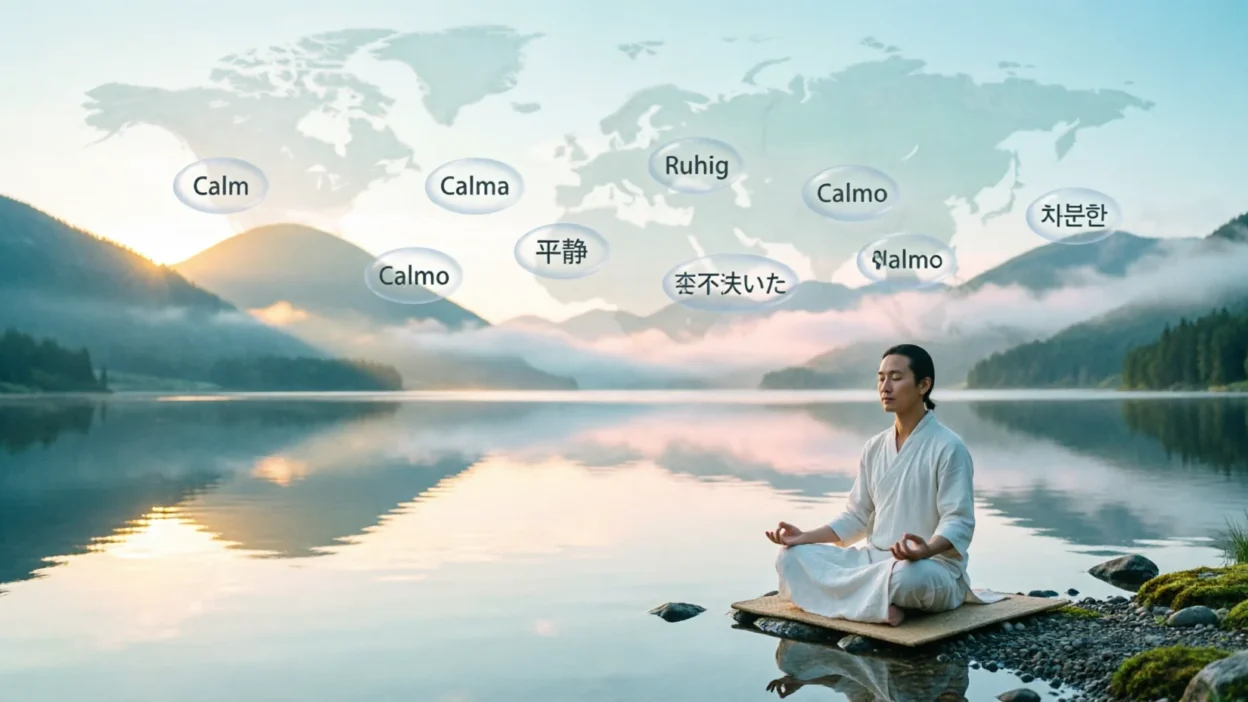
Learning calm in different languages is a wonderful way to expand your everyday vocabulary while expressing peace, relaxation, and emotional balance across cultures.
The word calm describes a state of quietness, stillness, or freedom from stress, anger, or excitement. It can refer to a person’s emotions, peaceful weather, a quiet place, or a relaxed atmosphere.
If you’re learning a new language, traveling, or simply exploring world cultures, knowing how to say calm in different languages can be very useful.
Many people search for calm in all languages to compare translations and improve their multilingual vocabulary. Learning calm translations is helpful for students, travelers, teachers, translators, mindfulness practitioners, and language enthusiasts.
These translations frequently appear in books, meditation guides, wellness content, motivational quotes, and everyday conversations.
Although the feeling of calm is universal, each language has its own word and pronunciation. The table below features calm around the world in 45 popular languages, along with the native translation and an easy English pronunciation.
| Language | Native Phrase | English Pronunciation |
|---|---|---|
| English | Calm | Kahm |
| Spanish | Calma | KAL-ma |
| French | Calme | Kalm |
| German | Ruhig | ROO-ig |
| Italian | Calmo | KAL-mo |
| Portuguese | Calmo | KAL-mo |
| Dutch | Rustig | RUS-tikh |
| Swedish | Lugn | Loong |
| Norwegian | Rolig | ROO-lig |
| Danish | Rolig | ROH-lig |
| Finnish | Rauhallinen | Row-HAH-lee-nen |
| Polish | Spokojny | Spo-KOY-nee |
| Czech | Klidný | KLID-nee |
| Slovak | Pokojný | Po-KOY-nee |
| Hungarian | Nyugodt | NYOO-got |
| Romanian | Calm | Kalm |
| Greek | Ήρεμος | EE-re-mos |
| Russian | Спокойный | Spa-KOY-ny |
| Ukrainian | Спокійний | Spo-KIY-nee |
| Turkish | Sakin | Sa-KEEN |
| Arabic | هادئ | HAA-dee |
| Hebrew | רגוע | Ra-GOO-a |
| Persian | آرام | Aa-RAAM |
| Hindi | शांत | Shaant |
| Urdu | پرسکون | Pur-Sukoon |
| Bengali | শান্ত | Shan-to |
| Punjabi | ਸ਼ਾਂਤ | Shaant |
| Gujarati | શાંત | Shaant |
| Marathi | शांत | Shaant |
| Tamil | அமைதி | A-mai-thi |
| Telugu | ప్రశాంతం | Pra-shaan-tam |
| Kannada | ಶಾಂತ | Shaan-ta |
| Malayalam | ശാന്തം | Shaan-tham |
| Chinese (Mandarin) | 平静 | Ping Jing |
| Japanese | 落ち着いた | Ochi-tsui-ta |
| Korean | 차분한 | Cha-boon-han |
| Thai | สงบ | Sa-ngop |
| Vietnamese | Bình tĩnh | Binh Tinh |
| Indonesian | Tenang | Te-nang |
| Malay | Tenang | Te-nang |
| Filipino | Kalmado | Kal-MA-do |
| Swahili | Tulivu | Too-LEE-voo |
| Zulu | Zolile | Zo-LEE-le |
| Afrikaans | Kalm | Kalm |
| Icelandic | Rólegur | RO-le-gur |
What does “calm” mean?
Calm means being peaceful, quiet, relaxed, and free from stress, anger, or strong emotions. It can describe both people and environments.
Why should I learn “calm” in different languages?
Learning this word helps you communicate feelings, understand wellness content, read books, and interact naturally with people from different cultures.
Is “calm” always used to describe emotions?
No. Calm can describe emotions, weather, water, places, situations, or any environment that is peaceful and quiet.
Can I use these translations while traveling?
Yes. These translations are useful in conversations, meditation classes, wellness retreats, and everyday situations where you want to express peace or relaxation.
What is the easiest way to remember “calm” in different languages?
Start with similar words like Calm, Calma, Calme, and Calmo, then gradually practice unique translations such as Sakin, Tenang, and 平静.
Conclusion
Learning calm in different languages is a meaningful way to improve your vocabulary while expressing one of the world’s most universal emotions.
If you’re studying a new language, traveling, practicing mindfulness, or simply expanding your knowledge, these translations will help you communicate with confidence.
Bookmark this guide whenever you want to learn calm in all languages, discover calm translations, or explore how to say calm in different languages.
Evelyn Grace is a language enthusiast and content writer at LingoMean, where she explains the meaning of words, phrases, and expressions. She creates clear, practical, and engaging content that helps readers confidently understand what to say in everyday conversations.