
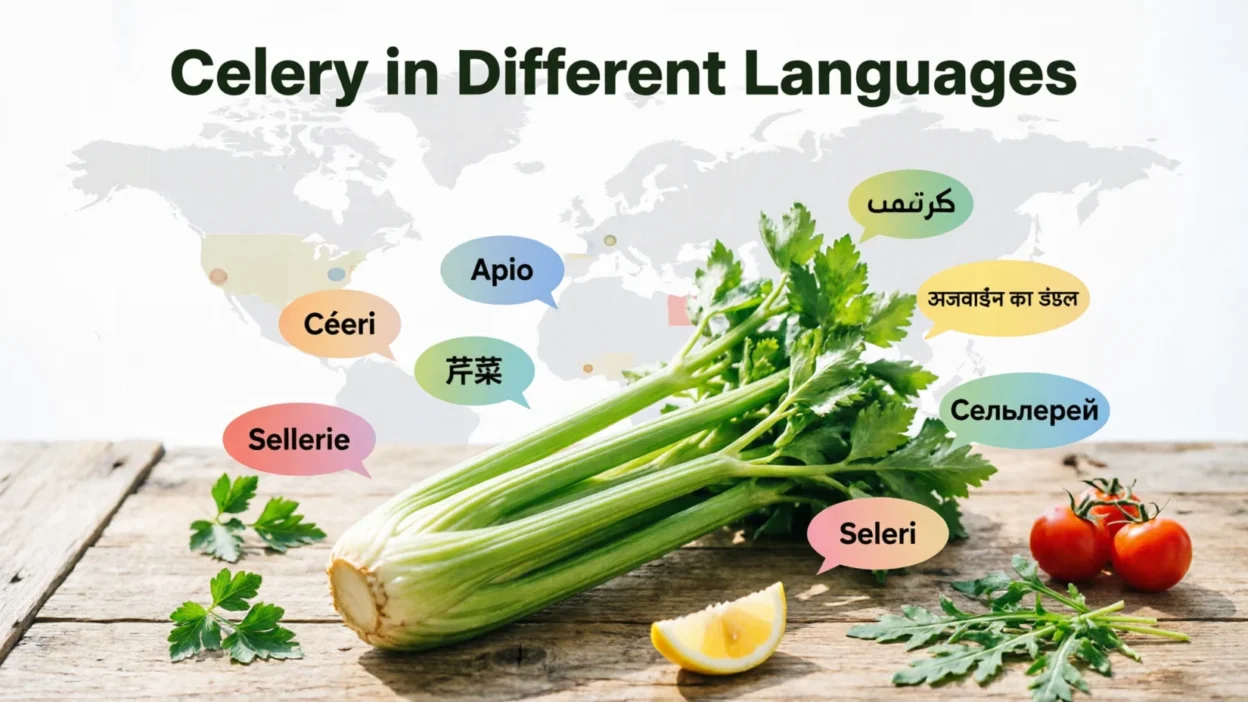
Celery is a crunchy, nutritious vegetable enjoyed in salads, soups, juices, and healthy snacks around the world.
If you’re traveling, learning a new language, studying international recipes, or expanding your vocabulary, knowing how to say celery in different languages can be incredibly useful.
In this guide, you’ll discover 70 accurate celery translations, along with easy English pronunciations, real-life example sentences, and their English meanings.
This resource is designed for students, travelers, chefs, language enthusiasts, and anyone curious about celery in all languages.
If you’re searching for how to say celery in different languages, celery translations, or celery around the world, this comprehensive table provides quick and easy answers in one place.
| # | Language | Native Translation | Pronunciation | Example Sentence | English Meaning |
|---|---|---|---|---|---|
| 1 | English | Celery | SEL-uh-ree | I added celery to the soup. | I added celery to the soup. |
| 2 | Spanish | Apio | AH-pee-oh | Añadí apio a la ensalada. | I added celery to the salad. |
| 3 | French | Céleri | Say-luh-REE | J’ai acheté du céleri. | I bought celery. |
| 4 | German | Sellerie | Zel-ler-EE | Ich esse Sellerie jeden Tag. | I eat celery every day. |
| 5 | Italian | Sedano | Seh-DAH-no | Il sedano è fresco. | The celery is fresh. |
| 6 | Portuguese | Aipo | EYE-po | O aipo está fresco. | The celery is fresh. |
| 7 | Dutch | Selderij | SEL-duh-ry | Ik koop selderij. | I buy celery. |
| 8 | Russian | Сельдерей | Sel-duh-RAY | Я люблю сельдерей. | I like celery. |
| 9 | Ukrainian | Селера | Se-LE-ra | Я купив селеру. | I bought celery. |
| 10 | Polish | Seler | SEH-ler | Dodaj seler do zupy. | Add celery to the soup. |
| 11 | Czech | Celer | TSE-ler | Celer je zdravý. | Celery is healthy. |
| 12 | Slovak | Zeler | ZEH-ler | Zeler chutí dobre. | Celery tastes good. |
| 13 | Slovenian | Zelena | Zeh-LEH-na | Dodaj zeleno v juho. | Add celery to the soup. |
| 14 | Croatian | Celer | TSE-ler | Kupio sam celer. | I bought celery. |
| 15 | Serbian | Целер | TSE-ler | Целер је свеж. | The celery is fresh. |
| 16 | Bosnian | Celer | TSE-ler | Volim celer u supi. | I like celery in soup. |
| 17 | Romanian | Țelină | Tseh-LEE-nuh | Țelina este proaspătă. | The celery is fresh. |
| 18 | Bulgarian | Целина | Tseh-LEE-na | Добави целина към супата. | Add celery to the soup. |
| 19 | Greek | Σέλινο | SEH-lee-no | Το σέλινο είναι φρέσκο. | The celery is fresh. |
| 20 | Turkish | Kereviz | Keh-reh-VEEZ | Kereviz çorbada var. | There is celery in the soup. |
| 21 | Arabic | كرفس | Kar-fas | أضفت الكرفس إلى الحساء. | I added celery to the soup. |
| 22 | Hebrew | סלרי | SEL-eh-ree | אני אוהב סלרי. | I like celery. |
| 23 | Persian | کرفس | Kar-fas | کرفس سالم است. | Celery is healthy. |
| 24 | Hindi | अजवाइन का डंठल | A-ja-vine ka DUN-thal | मैंने सूप में अजवाइन का डंठल डाला। | I added celery to the soup. |
| 25 | Urdu | اجوائن کا ڈنٹھل | Ajwain ka DUN-thal | میں نے سوپ میں اجوائن کا ڈنٹھل ڈالا۔ | I added celery to the soup. |
| 26 | Punjabi | ਅਜਵਾਇਨ ਦਾ ਡੰਠਲ | Ajwain da DUN-thal | ਮੈਂ ਸੂਪ ਵਿੱਚ ਅਜਵਾਇਨ ਪਾਈ। | I added celery to the soup. |
| 27 | Bengali | সেলারি | SEL-ah-ree | আমি সেলারি কিনেছি। | I bought celery. |
| 28 | Gujarati | સેલરી | SEL-ah-ree | મેં સેલરી ખરીદી. | I bought celery. |
| 29 | Marathi | सेलरी | SEL-ah-ree | मी सेलरी सूपमध्ये घातली. | I added celery to the soup. |
| 30 | Tamil | செலரி | SEL-ah-ree | நான் செலரியை வாங்கினேன். | I bought celery. |
| 31 | Telugu | సెలరీ | SEL-ah-ree | నేను సెలరీ కొన్నాను. | I bought celery. |
| 32 | Kannada | ಸೆಲರಿ | SEL-ah-ree | ನಾನು ಸೆಲರಿ ತಂದೆ. | I bought celery. |
| 33 | Malayalam | സെലറി | SEL-ah-ree | ഞാൻ സെലറി വാങ്ങി. | I bought celery. |
| 34 | Sinhala | සැලරි | SEL-ah-ree | මම සැලරි මිලදී ගත්තා. | I bought celery. |
| 35 | Nepali | सेलरी | SEL-ah-ree | मैले सेलरी किनेँ। | I bought celery. |
| 36 | Chinese (Simplified) | 芹菜 | Chin-tsai | 我买了芹菜。 | I bought celery. |
| 37 | Chinese (Traditional) | 芹菜 | Chin-tsai | 我買了芹菜。 | I bought celery. |
| 38 | Japanese | セロリ | Seh-ro-ree | セロリを買いました。 | I bought celery. |
| 39 | Korean | 셀러리 | Sel-leo-ri | 셀러리를 샀어요. | I bought celery. |
| 40 | Vietnamese | Cần tây | Guhn-TIE | Tôi mua cần tây. | I bought celery. |
| 41 | Thai | ขึ้นฉ่าย | Kheun-Chai | ฉันซื้อขึ้นฉ่าย | I bought celery. |
| 42 | Indonesian | Seledri | Seh-LEH-dree | Saya membeli seledri. | I bought celery. |
| 43 | Malay | Saderi | Sah-DEH-ree | Saya membeli saderi. | I bought celery. |
| 44 | Filipino | Kintsay | Kint-SAI | Bumili ako ng kintsay. | I bought celery. |
| 45 | Swahili | Seleri | Seh-LEH-ree | Nimenunua seleri. | I bought celery. |
| 46 | Afrikaans | Seldery | SEL-duh-ree | Ek het seldery gekoop. | I bought celery. |
| 47 | Zulu | Isilimo se-celery | Ee-see-LEE-mo | Ngithenge isilimo se-celery. | I bought celery. |
| 48 | Xhosa | Iseleri | Ee-sel-LEH-ree | Ndithenge iseleri. | I bought celery. |
| 49 | Yoruba | Seleri | Seh-LEH-ree | Mo ra seleri. | I bought celery. |
| 50 | Hausa | Seleri | Seh-LEH-ree | Na sayi seleri. | I bought celery. |
| 51 | Amharic | ሴሌሪ | Seh-LEH-ree | ሴሌሪ ገዛሁ። | I bought celery. |
| 52 | Somali | Seleri | Seh-LEH-ree | Waxaan iibsaday seleri. | I bought celery. |
| 53 | Finnish | Selleri | SEL-le-ri | Ostin selleriä. | I bought celery. |
| 54 | Swedish | Selleri | SEL-le-ri | Jag köpte selleri. | I bought celery. |
| 55 | Norwegian | Selleri | SEL-le-ri | Jeg kjøpte selleri. | I bought celery. |
| 56 | Danish | Selleri | SEL-le-ri | Jeg købte selleri. | I bought celery. |
| 57 | Icelandic | Sellerí | SEL-le-ree | Ég keypti sellerí. | I bought celery. |
| 58 | Estonian | Seller | SEL-ler | Ostsin sellerit. | I bought celery. |
| 59 | Latvian | Selerija | Seh-le-REE-ya | Es nopirku seleriju. | I bought celery. |
| 60 | Lithuanian | Salieras | Sah-LYE-ras | Nusipirkau salierų. | I bought celery. |
| 61 | Irish | Soilire | SUL-i-ra | Cheannaigh mé soilire. | I bought celery. |
| 62 | Welsh | Seleri | Seh-LEH-ree | Prynais seleri. | I bought celery. |
| 63 | Basque | Apioa | Ah-pee-O-ah | Apioa erosi dut. | I bought celery. |
| 64 | Catalan | Api | AH-pee | He comprat api. | I bought celery. |
| 65 | Galician | Apio | AH-pee-oh | Merquei apio. | I bought celery. |
| 66 | Maltese | Karfus | KAR-fus | Xtrajt karfus. | I bought celery. |
| 67 | Albanian | Selino | Seh-LEE-no | Bleva selino. | I bought celery. |
| 68 | Mongolian | Сельдерей | Sel-de-REY | Би сельдерей авсан. | I bought celery. |
| 69 | Kazakh | Балдыркөк | Bal-dur-KOK | Мен балдыркөк сатып алдым. | I bought celery. |
| 70 | Uzbek | Selderey | Sel-de-REY | Men selderey sotib oldim. | I bought celery. |
What Is Celery?
Celery is a green, crunchy vegetable known for its long stalks and fresh flavor. It belongs to the parsley family and is widely used in salads, soups, stir-fries, juices, and healthy snacks. Celery is low in calories and rich in vitamins, minerals, antioxidants, and dietary fiber, making it a popular choice for healthy eating.
How to Say Celery in Different Languages
The word celery varies across languages and cultures. While some languages have unique native terms, others use transliterations of the English word. Learning these translations is useful for traveling, reading international recipes, shopping in foreign markets, or expanding your language skills.
Celery Translations Around the World
Celery is cultivated and enjoyed in many countries. If you’re visiting Europe, Asia, Africa, or the Americas, knowing the local name for celery can help you communicate more confidently. These celery translations around the world make it easier to recognize the vegetable in recipes, grocery stores, and conversations.
Benefits of Learning Food Names in Different Languages
Learning food vocabulary like celery in different languages offers several benefits:
- Makes traveling easier.
- Helps you understand international recipes.
- Improves communication in foreign countries.
- Expands your language vocabulary.
- Makes grocery shopping abroad more convenient.
Common Uses of Celery
Celery is commonly used for:
- Fresh salads
- Vegetable soups
- Healthy smoothies and juices
- Stir-fries
- Sandwiches and wraps
- Stuffing recipes
- Low-calorie snacks
- Vegetable platters
Conclusion
Learning celery in different languages is a practical way to improve your vocabulary and communicate more effectively while traveling or exploring international cuisine.
If you’re a language learner, chef, student, or traveler, these celery translations in all languages provide a quick and reliable reference for one of the world’s most popular vegetables.
FAQs:
1. How do you say celery in different languages?
Celery has different names around the world, such as Apio in Spanish, Céleri in French, Sellerie in German, Sedano in Italian, and 芹菜 in Chinese.
2. Why should I learn celery translations?
Learning celery translations helps you read recipes, shop for groceries abroad, communicate while traveling, and expand your language skills.
3. Is celery called the same thing in every language?
No. Some languages have unique native words, while others use a pronunciation or spelling similar to the English word.
4. Is celery popular worldwide?
Yes. Celery is widely grown and consumed in North America, Europe, Asia, Australia, and many other regions because of its nutritional value and versatility.
5. What are the health benefits of celery?
Celery is low in calories, high in fiber, and contains vitamins A, C, and K, along with antioxidants that support a healthy diet.

Evelyn Grace is a language enthusiast and content writer at LingoMean, where she explains the meaning of words, phrases, and expressions. She creates clear, practical, and engaging content that helps readers confidently understand what to say in everyday conversations.