Cement is one of the most important building materials used around the world. It plays a key role in constructing homes, bridges, roads, skyscrapers, and countless other structures.
If you are a traveler, student, engineer, contractor, or language enthusiast, learning cement in different languages can help you communicate more effectively across cultures.
Many people search for cement in all languages to expand their vocabulary, prepare for international projects, or simply satisfy their curiosity.
Knowing how to say cement in different languages is especially useful when working in the construction industry, studying foreign languages, or traveling to countries where English is not widely spoken.
Every language has its own unique word and pronunciation, making language learning both practical and fascinating.
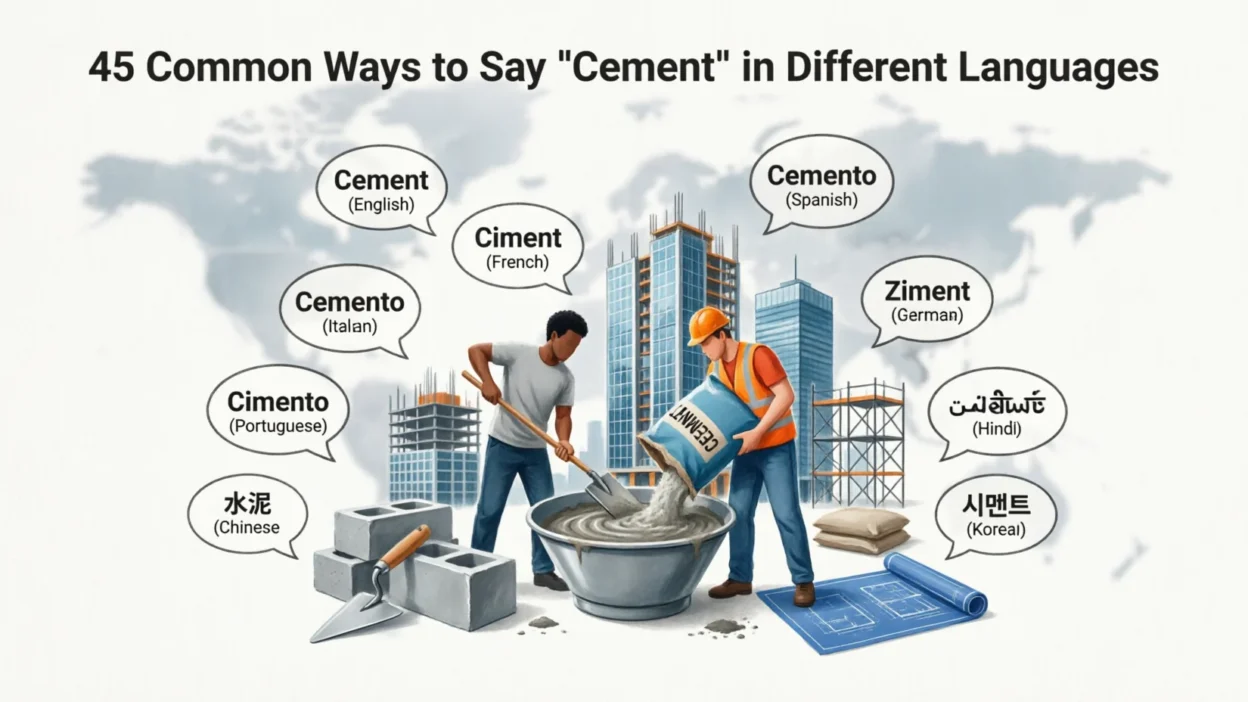
This guide provides accurate cement translations from 45 widely spoken languages. The easy-to-read table includes the language name, the native word for cement, and a simple English pronunciation to help you speak each term confidently.
If you need the translation for work, education, or personal interest, this resource is designed to be quick, reliable, and mobile-friendly.
If you’ve ever wondered how people refer to cement around the world, this article has the answers. Explore the translations below and discover how this essential construction material is spoken in different countries and cultures.
Cement in Different Languages
| Language | Native Phrase | English Pronunciation |
|---|---|---|
| English | Cement | suh-MENT |
| Spanish | Cemento | seh-MEN-toh |
| French | Ciment | see-MON |
| German | Zement | tseh-MENT |
| Italian | Cemento | cheh-MEN-toh |
| Portuguese | Cimento | see-MEN-too |
| Dutch | Cement | seh-MENT |
| Russian | Цемент | Tse-MYENT |
| Ukrainian | Цемент | Tse-MENT |
| Polish | Cement | TSEH-ment |
| Czech | Cement | TSEH-ment |
| Slovak | Cement | TSEH-ment |
| Hungarian | Cement | TSEH-ment |
| Romanian | Ciment | chee-MENT |
| Greek | Τσιμέντο | Tsee-MEN-do |
| Turkish | Çimento | Chee-MEN-to |
| Arabic | إسمنت | Is-MENT |
| Hebrew | מלט | Meh-LET |
| Persian | سیمان | See-MAAN |
| Hindi | सीमेंट | SEE-ment |
| Urdu | سیمنٹ | SEE-ment |
| Punjabi | ਸੀਮੈਂਟ | SEE-ment |
| Bengali | সিমেন্ট | Shi-MENT |
| Gujarati | સિમેન્ટ | See-MENT |
| Marathi | सिमेंट | See-MENT |
| Tamil | சிமெண்டு | Si-MEN-du |
| Telugu | సిమెంట్ | Si-MENT |
| Kannada | ಸಿಮೆಂಟ್ | Si-MENT |
| Malayalam | സിമന്റ് | Si-MENT |
| Chinese (Simplified) | 水泥 | Shway Nee |
| Japanese | セメント | Seh-men-to |
| Korean | 시멘트 | Shee-men-teu |
| Thai | ซีเมนต์ | See-Men |
| Vietnamese | Xi măng | See Mang |
| Indonesian | Semen | Seh-men |
| Malay | Simen | See-men |
| Filipino | Semento | Se-men-to |
| Swahili | Saruji | Sah-ROO-jee |
| Afrikaans | Sement | Seh-MENT |
| Finnish | Sementti | Seh-MENT-tee |
| Swedish | Cement | Seh-MENT |
| Norwegian | Sement | Seh-MENT |
| Danish | Cement | Seh-MENT |
| Croatian | Cement | TSEH-ment |
| Serbian | Цемент | Tse-MENT |
What is cement in different languages?
The word “cement” has different translations depending on the language. While many European languages use similar words, Asian and Middle Eastern languages often have unique native terms.
Why should I learn cement translations?
Learning cement translations helps travelers, engineers, builders, students, and language learners communicate effectively in construction-related conversations across different countries.
Is the word for cement similar in many languages?
Yes. Many languages, especially in Europe, use words derived from the Latin root, making them sound very similar to the English word “cement.”
How do you pronounce cement in other languages?
The pronunciation varies by language. The table above includes a simple English pronunciation guide to help you say each word correctly.
Which languages have completely different words for cement?
Languages such as Chinese (水泥), Hebrew (מלט), Swahili (Saruji), and Persian (سیمان) use native words that differ significantly from the English term.
Conclusion
Learning cement in different languages is a practical way to improve your vocabulary while gaining a better understanding of global communication.
If you work in construction, study languages, travel internationally, or simply enjoy discovering new words, knowing how to say cement in multiple languages can be valuable in many situations.
This guide covered cement translations in exactly 45 languages, making it easy to compare words and pronunciations from around the world.
Many languages share similar spellings because of their historical roots, while others use completely unique native terms that reflect their linguistic traditions.
By bookmarking this resource, you can quickly find cement in all languages whenever you need it. Continue exploring vocabulary from different cultures to expand your language skills and communicate with greater confidence wherever your journey takes you.

Evelyn Grace is a language enthusiast and content writer at LingoMean, where she explains the meaning of words, phrases, and expressions. She creates clear, practical, and engaging content that helps readers confidently understand what to say in everyday conversations.